The Barrys
The Barrys gave this family its English forenames, its farm at Manor Owen, its politics — and its single most contradictory record. Everything from 1819 forward is solid. Everything before it falls apart.
John Augustus Barry I, 1819–1903
The most documented person in the Booyzen ancestry, and the least certain.
| Born | 8 June 1819 — recorded in the tree, literally, as "?Sunderland, Durham, England? Ireland? High Seas?" |
| Trades | Carpenter and Builder · timmerman en bouwvakker · Grocer · Labourer — five occupation records, all working trades |
| Married | c. 23 February 1846, Dutch Reformed Church, Colesberg — Margaretha Wilhelmina Elizabeth Mary Kolbe |
| Died | 3 August 1903 on the farm Manorowen, Barkly East — the tree gives 25 August; his 1915 death notice gives the 3rd. His son James Henry died there too, in 1939, aged 92 |
The 1915 death notice is now in hand
The tree carried a long research note describing three conflicting documents. One of the three — the 1915 death notice, typewritten and therefore unarguable — turned out to be sitting in the tree's own photo store, unread. It can now be quoted rather than paraphrased.
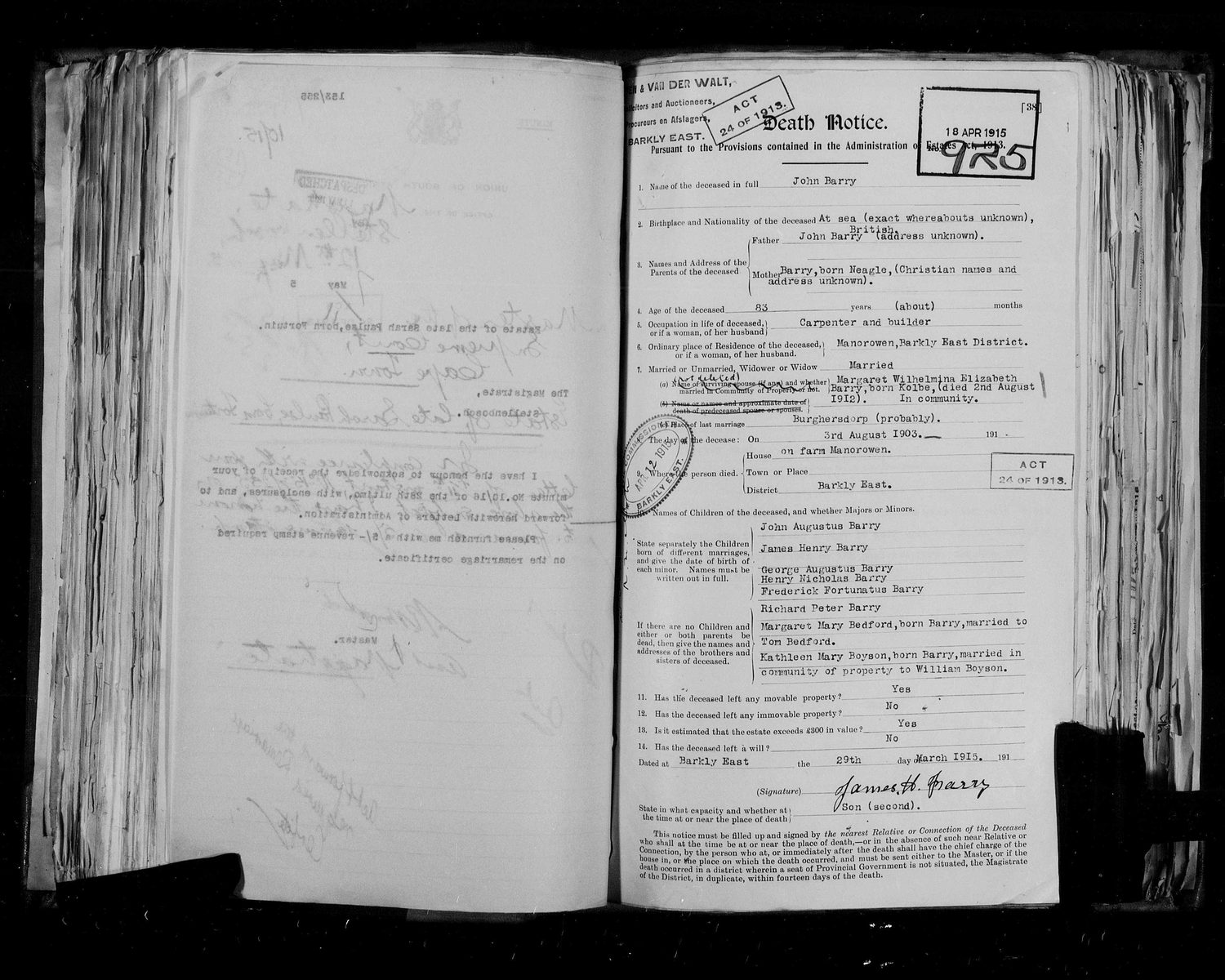
| Birthplace and nationality | "At sea (exact whereabouts unknown), British." |
| Father | John Barry (address unknown) |
| Mother | Barry, born Neagle — Christian names and address unknown |
| Occupation | Carpenter and builder |
| Residence | Manorowen, Barkly East District — and he owned no immovable property |
| Place of last marriage | "Burghersdorp (probably)" — the informant was not sure |
Three answers to one question
An extended research note carried in the tree — written by an earlier researcher, not by this archive — sets out why nobody knows where he was born. The 1915 document above is the second of the three.
"An Irishman born in Ireland"
Recorded by the Cape Mounted Rifles, then the authority in the district, stationed at Johnson's Leap — and dated two months after his death.
"At sea, exact whereabouts unknown. British."
Signed by his second son James Henry Barry. It also names his father as John Barry and his mother's maiden name as "Neagle" — almost certainly Nagle, of County Cork.
Sunderland, Durham
Offered with a question mark and no source. The note's own conclusion is a question: if he was born on the high seas with the 1820 Settlers, who were his parents?
Not the Swellendam Barrys — and the tree that proves it arrived in 2008
The obvious guess about a South African Barry family is the famous one. This archive wrote the guess down as “unknown and must not be assumed” and left it there. It is answered now, by a letter that had been sitting in the house for eighteen years.
On 11 June 2008 a researcher named Wendy wrote to David with the whole of her work on the English Barrys — 1,604 numbered people across eleven generations, 1659 to 1999, twelve years of archives, libraries and letters to “most of the Barry names in all the South African telephone books”. It is the family of Joseph Barry (1796–1865) of Hitchin, Hertfordshire, who built the trading house at Swellendam.
It contains nobody from this family. No Kolbe, no Mountjoy, no Booyzen, no Downing, no Daschner; no Burgersdorp, no Barkly East, no Indwe, no Grahamstown. And it is not simply an English tree that never crossed the water — it names South Africa two hundred times, the Cape two hundred and thirty-six and Swellendam a hundred and twenty-nine. It is in the right country, in the right century, and this family is not in it. What was searched →
She sorted the South African Barrys into three, and we are the third. The Irish, who came out in the early 1800s and are her own; the English, whom she traced because the two intermarry so often “that the trees overlap”; and — her words — “the other Barry family that came to South Africa in the late 1700 from London”, which she was only then about to begin. That fits what little is known here: a John Barry who died at de Bruins Poort in 1853 with no birth, no arrival and no burial found, and a son born “at sea” in 1819. It is a working researcher's sorting and not a census, and nothing is adopted from it — but it is the first time anyone has told this archive where not to look.
And she sent one tree of the two she had finished. Ireland does not appear once in four hundred thousand characters. The Irish tree is the one this family’s own story points at — the note quoted in the next section begins “As an Irishman, John Barry…” The one tree that would test the family’s oldest claim about itself is the one not attached, and it existed before 2008. That is a question for a person, and it is on the work list.
The line that makes the rebel story make sense
"As an Irishman, John Barry was reputed to be anti English, and as his son and grandson were married to Dutch girls their activity during the Boer War would be interesting."
From the same research note in the tree. Written by someone else, about their own family, long before this archive existed.
It lands exactly on the Booyzen name-change testimony. His daughter Kathleen Barry married Willem Hermanus Booyzen — the man recorded as changing Booysen to Booyzen so as not to be taken for a British-siding joiner. An anti-English Irish grandfather at Barkly East, whose children married almost entirely into Cape Dutch families, is precisely the household in which rebel sympathies would be unremarkable.
Inferred This is the most testable inference in the archive, and it is still an inference. Nobody has yet found a Barry or a Booysen on a rebel roll. The rebels →
He married into Afrikanerdom, not the other way round
An English-speaking carpenter of Irish reputation married a Cape-born woman in the Dutch Reformed Church at Colesberg, and within one generation his children had married Louw, van Ellinckhuyzen, Schoemann, Dry, Bedford — and Booyzen.
| Child | Dates | Born | Married |
|---|---|---|---|
| John Augustus II | 1847–1935 | Burgersdorp | m. Alida Jacoba van Ellinckhuyzen, 1870, DRC Colesberg |
| James Henry | 1848–1939 | Burgersdorp | m. Maria Margaretha Hester Catherina Louw, 1867, Dordrecht; died at Manor Owen aged 92 |
| George Augustus | 1850–1933 | Burgersdorp | — |
| Margaretha Louisa Maria (Bedford) | 1851–1915 | Burgersdorp | m. Thomas Bedford, 1875, Colesberg |
| Catherina Maria Sophia | 1855–1859 | Burgersdorp | died aged four, 30 July 1859 |
| Hendrik Nicholaas | 1857–1931 | Dordrecht | m. Anna Johanna Maria Schoemann, 1877, Barkly East |
| Catherine Maria Sophia “Kathleen” | 1859–1940 | Barkly East | m. Willem Hermanus Booyzen, 1879 — the line to David |
| Willem Frederick Thomas “Tom” | 1861–1890 | Barkly East | m. Hendrina Petronella Jacomina Dry, 1886; died at 29 |
| Frederick Fortunatus | 1863–1952 | Burgersdorp | the forename reappears as Frederik Fortsenatus Booÿsen, 1899 |
| Richard Peter | 1866–1946 | Lady Grey | — |
| — (a duplicate) | — | — | the tree also lists a “Kathleen Mary Barry (Booysen)”. The 1915 death notice shows she is the same woman as Kathleen above. Withdrawn. |
One sister fewer than the tree thinks
The tree lists Catherine Maria Sophia "Kathleen" Barry (1859–1940), married Booyzen and, separately, a sister Kathleen Mary Barry (Booysen) with no dates — implying two Barry sisters married two Booysens.
The 1915 death notice lists only one Barry daughter married to a Boyson: "Kathleen Mary Boyson, born Barry, married in community of property to William Boyson." And the arithmetic closes exactly — the tree's 11 children equal the notice's 8 surviving, plus the 2 who predeceased him (Catherina Maria Sophia, d. 1859; Willem Frederick Thomas, d. 1890), plus 1 duplicate.
Resolved They are the same woman. This archive's earlier claim of "two Barry sisters married Booysens" is withdrawn.
The third Barry–Booyzen tie stands: Dorothea Regina Barry married Henry James Booyzen at Elliot in 1912. The cousin marriage →
Kathleen Barry, 1859–1940
Born at Barkly East, christened at Dordrecht in September 1859. Her occupation is recorded — rarely, and valuably — as "Needle Woman". She married Willem Hermanus Booyzen on 22 December 1879 and bore thirteen children, of whom nine are dated.
She outlived her husband by thirty-five years and died on 5 September 1940 at No. 1, Fifteenth Avenue, Mayfair, Johannesburg, of carcinoma of the uterus after thirteen months' illness. She was buried at Brixton Cemetery. She made the journey the testimony describes, and lived four decades on the Rand at the end of it.
Her death certificate records her occupation as Home Duties — and, on the line below, "Military Pensioner." Her husband had been dead thirty-five years and died of an ulcer, so the pension is not his.
Searched The archive guessed a son killed in the First World War. The war-dead registers say otherwise: no Booyzen among the 1914–18 dead, no Booysen matching a son's forename, and all her identifiable sons survived — dying in 1932, 1952, 1956, 1966 and 1980. The pension belongs to a man who served and came home. Where it goes next →
Nine years after her death, her granddaughter and namesake Catherine Mary Sophia Booyzen married at St Joseph's Catholic Church, Mayfair. Johannesburg →
Barkly East, off the index
Ranking a whole-surname search by place brings the right Barrys to the top. These are index entries and not documents, and the person pages say so — but they name three farms, date a man this archive had dateless, and produce one name that does a great deal of work.
| Who | Dates | What the index says |
|---|---|---|
| Richard Pieter Kolbe Barry | b. 1899 | Both names at once. Richard Pieter for the Barry of Manorowen, Kolbe for the 1820 Settler family his great-grandmother married out of. Married Maria Magdalena Siebert. |
| James Henry Barry | c. 1847 – 23 Jun 1939 | He swore his father's 1915 death notice. Now dated: dead at Barkly East, having outlived his father by thirty-six years. |
| Harriet Louisa Barry | 1894 – 7 Sep 1912 | Of Manorowen, Barkly East district — R. P. Barry's farm. Dead at eighteen. |
| Cornelia Herculena Petronella Barry | d. 21 Dec 1909 | Of Cherryville, Barkly East — a third named Barry farm, after Manorowen and Jerpoint. |
| John Gerson Eliazer Barry | 1893 – 8 Mar 1941 | Married Elizabeth Johanna Magdalena Botha; died at Barkly East. |
| Theunis Christoffel Barry | 1895 – 11 Jul 1963 | Born Barkly East, died East London. |
Richard Pieter Kolbe Barry is the one that matters. A Barry born in 1899 carrying both the forename of the man on the Cape Rebel roll and the surname of the 1820 Settler family this archive has spent weeks documenting. It does not prove the rebel is Kathleen's brother. It does show that whoever named this child was standing inside the same family this archive is describing. The namesakes →
How far the Barry names travel
There is no Barry surname left in this family after 1859. There is a great deal of Barry name.
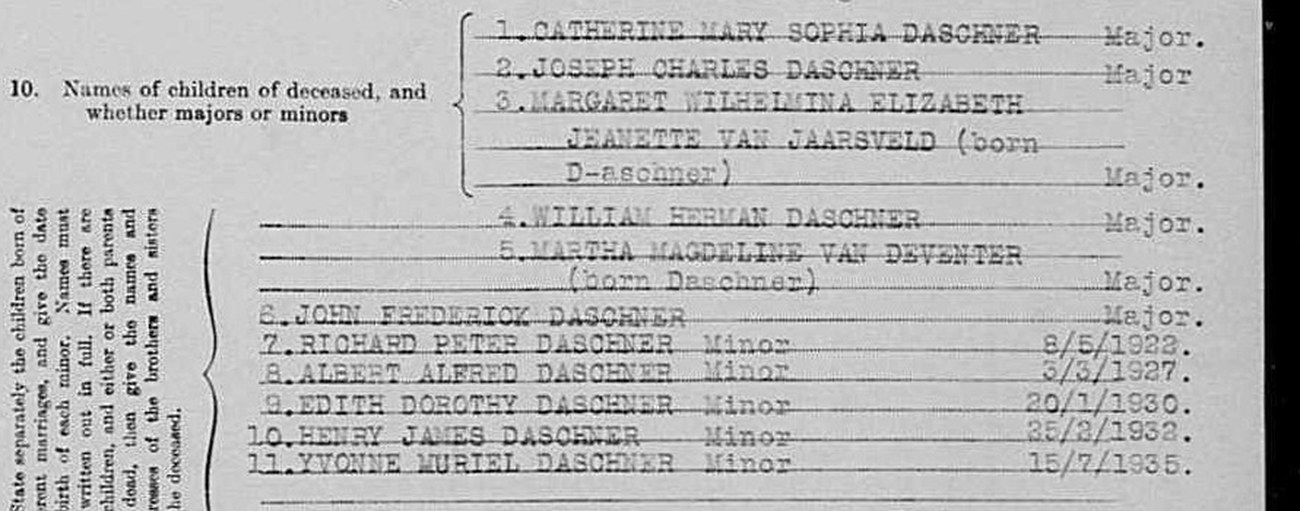
Kathleen Barry married a Booyzen in the 1880s, so the surname stops with her. Her daughter married a Daschner, so it is two surnames gone in two generations. Then look at what those eleven grandchildren are called:
- Catherine Mary Sophia Daschner — Kathleen's own name, third generation running
- Margaret Wilhelmina Elizabeth Jeanette Daschner — the Barry name that also runs down the Pretorius side of this family and reaches Maggie Booyzen in 1926
- Richard Peter Daschner — for Kathleen's brother Richard Peter Barry of Manorowen
- Henry James Daschner — for her brother Henry James Booyzen
- William Herman Daschner — for her father Willem Hermanus
Five of eleven. The Barrys stop being a surname in this archive in 1859 and go on being a set of first names for another eighty years.
And a sixth, off the 1942 list The Johannesburg cemetery index carries a George Downing Daschner, buried at Brixton on 20 June 1925, the year he was born. He is not on his father's death notice because he was dead seventeen years before it was written — a twelfth child. George Downing is the name of Kathleen Barry's own grandson, born in 1901, and here it is on an infant in another family in the same decade. A second of the name died in 1998.
This comes from an index and not from an image, and the page says so. But it moves the reading: six names, not five, and a pattern that cannot comfortably be called coincidence. The namesakes →
This matters to the rebel question in a small, real way. When the Cape Rebel roll produces a Fred J. Barry of Ivanhoe and a Richard Peter Barry of Jerpoint, the second name is not a coincidence to be waved at — it is a name this family demonstrably used and kept using. It still does not prove the man on the roll is Kathleen's brother, and this archive still marks that unproven. But it does mean the name is evidence of a family, not of an individual. The 1942 notice →
Not one of them is in the Master's index
Film 007844477 is the Cape Master's own Index of Estates 1834–1912 — every estate reported in the Colony for seventy-eight years, alphabetically, with the death-notice number beside each name. Barry runs across three pages and this family is on none of them.
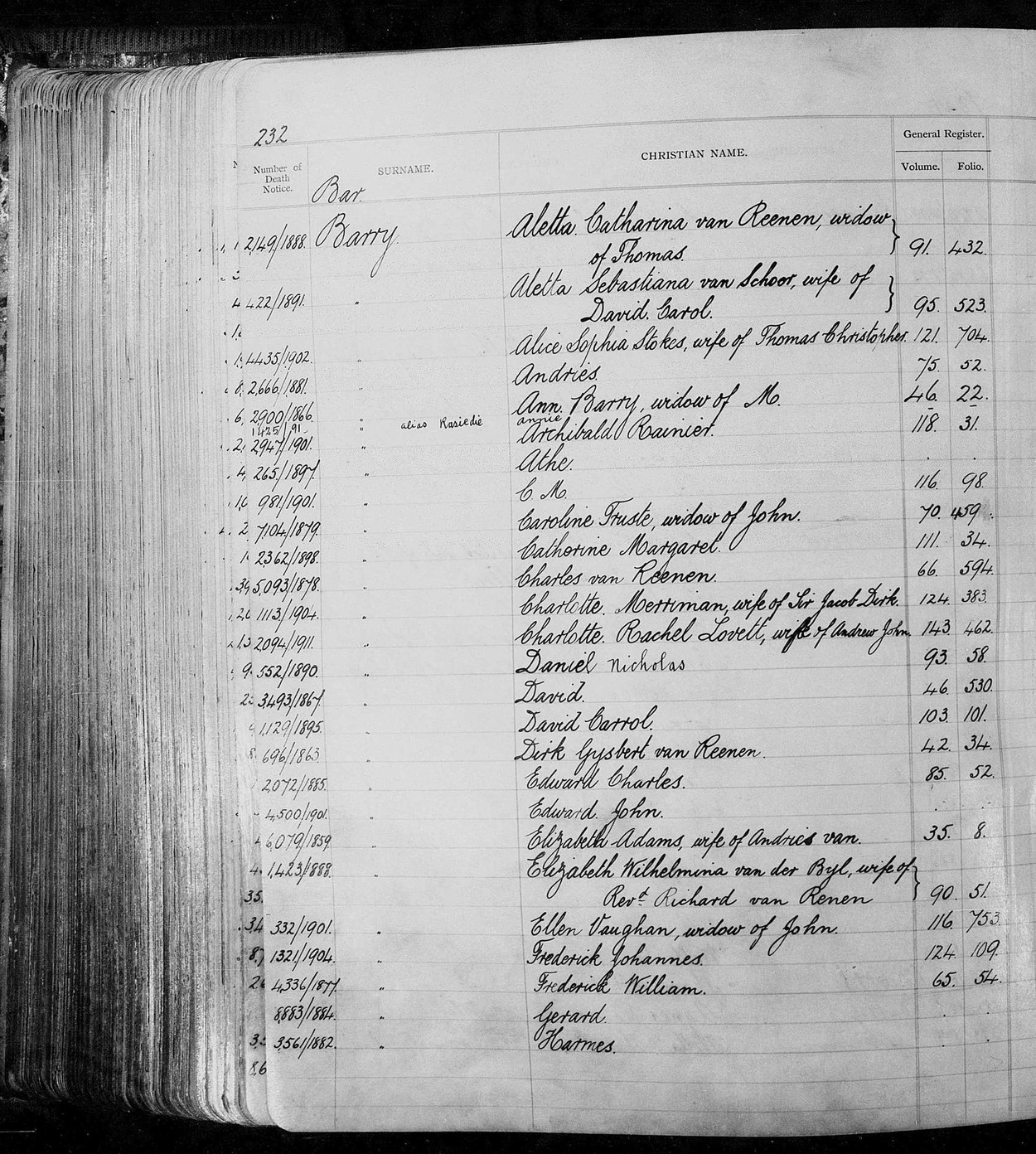
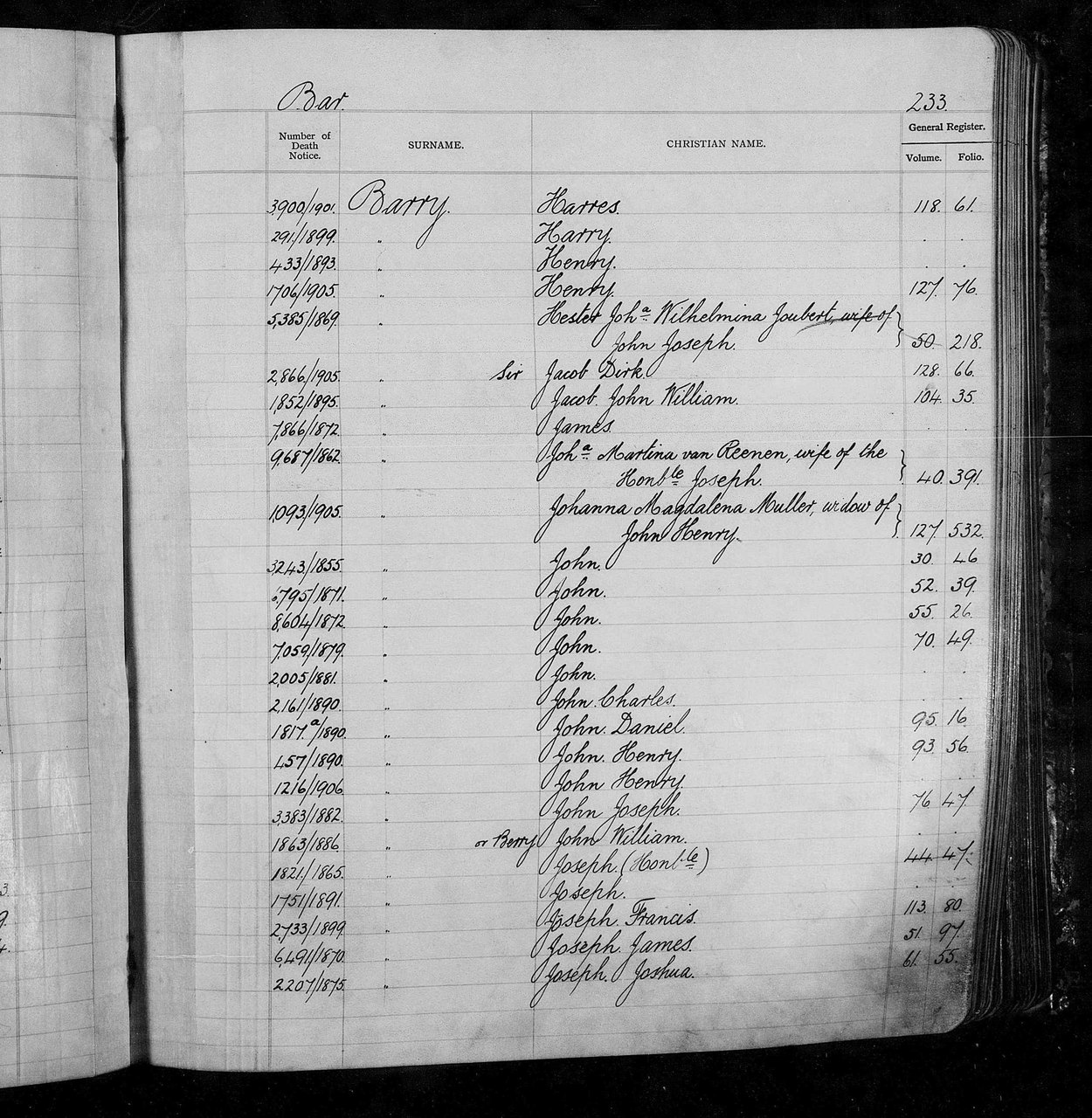
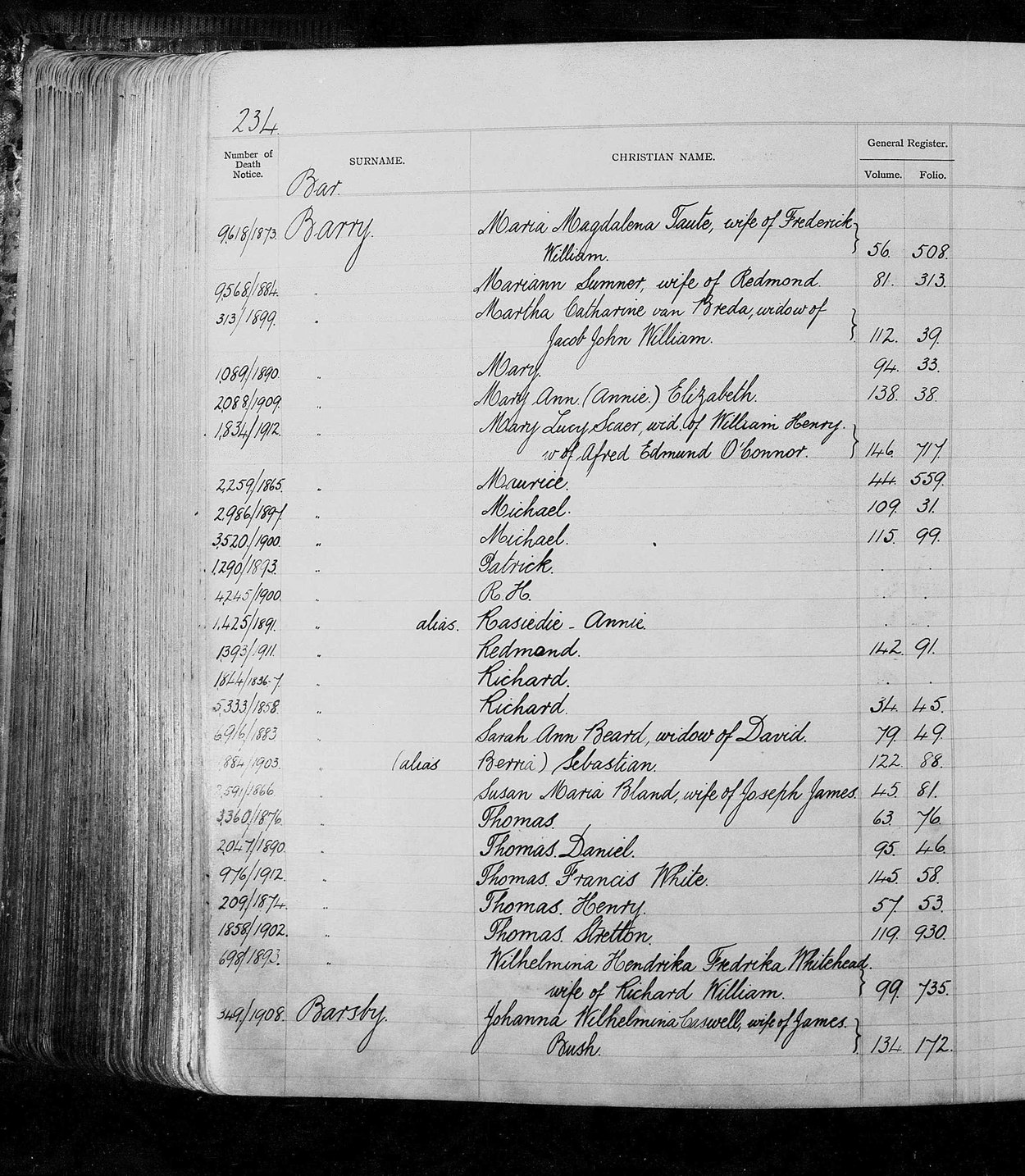
The archive went to this index for one thing: to settle whether the Cape Rebel Richard Peter Barry of Jerpoint is Kathleen's brother, by finding his estate. He is not there. Neither is Frederick Fortunatus, nor Dorothea Regina, nor Hendrik Nicholaas, nor Catherine Maria Sophia, nor Kathleen Mary.
And neither, more startlingly, is John Augustus Barry, who died in August 1903 in the middle of the index's range, or his widow Margaretha Kolbe, who died in 1912, the year it closes.
Then the reason arrives, and it is not an absence at all. This archive has already read their death notices. Both are dated 29 March 1915, sworn by their sons. The index stops in 1912. They filed in 1915.
And there is a second reason, found the same afternoon. The FamilySearch index of Cape probate enters John Barry's estate not at Cape Town but at GRAHAMSTOWN — the Master's office of the Eastern Districts. So this volume would not have held him even if he had died in 1911. Two independent reasons for one absence, and the archive had neither of them an hour ago.
John Augustus Barry died in August 1903 and nobody reported his estate for twelve years. That is not carelessness with a form. It is the third instance of the same thing in this archive:
| Who | Died | Reported | Gap | Who filed |
|---|---|---|---|---|
| John Augustus Barry and Margaretha Kolbe | 1903 · 1912 | 29 Mar 1915 | 12 years | two sons, together |
| Isabella Fredrika Booyzen, born Coetzee | 31 Mar 1930 | 1 Apr 1943 | 13 years | her husband |
| Maria Louisa Bertha Mountjoy, born Kumm | 3 Jul 1934 | 19 Feb 1938 | 3½ years | her son — "death not reported" |
Three families, three decades, one habit. Twice a husband's estate and a wife's were filed on the same day, years after the fact, by a son. The Master's office was something this family went to when it had to, not when somebody died — and any search that assumes an estate was reported in the year of the death will miss them all. Two of this archive's own corrections are exactly that mistake →
Eleven, nine, eight — and a candidate that dissolved
Three documents count this family and no two agree. The 1903 death registration says eleven children. John Augustus Barry's own death notice names eight. His wife's, estate 1291, names nine — the ninth being William, who appears on nothing else at all. Two children have never been identified.
Every previous attempt on this asked the index for a person: a name, a date, a district. All of them failed, because you cannot search for somebody whose name you do not know. So the question was turned around and put to the index as a class — every Barry child anywhere in South Africa whose mother's surname was Kolbe, with no forename given at all.
It returned the known children, and two names on neither parent's death notice — one of which this archive had already recorded and forgotten.
HENRY JAONAS BARRY IS JAMES HENRY BARRY. The same baptism is indexed twice. One entry reads Henry Jaonas Barry, baptism 13 Nov 1868; the other reads Hennery James Berry, baptism 13 Nov 1848. Both give the birth as 13 July 1848, both name John Barry and Margret Willemina Kolbe, both sit in the Cape Town Archives DRC collection, and FamilySearch attaches both to one tree person — James Henry Barry, 1848–1939, which is this archive's man, dead at Barkly East on 23 June 1939.
The volume settles the year without the image being read. The register is titled "Graaff-Reinet. Baptism Records 1846–1851". A baptism of 1868 cannot sit in a book that closes in 1851. So he was baptised at four months old, not at twenty — and at GRAAFF-REINET, not at Cape Town or Tulbagh, which is what both index entries give for the place. The image has now been read — film 008119684, image 930 of 1,117, the page headed Het Jaar 1848:
603 · Het Kind is N. HENRY JAMES · Get. 13 July 1848 · Gedoopt 13 Novr 1848 · V. JOHN BARRY · M. MARGRET WILLEMINA KOLBER · Gt: PETRUS JACOBUS JOUBERT, CATHARINE SOPHIA MARIA KOLBER
Three things come off that line. The register writes HENRY JAMES, so the archive's "James Henry" is the inversion, not the record's. The year is 1848 in the clerk's own hand. And the godmother's name, written out in full, turned out to be the origin of this family's most persistent female name — which this archive had been attributing to the wrong surname for the whole of the project.
Both arguments below were right. The birth-spacing one predicted a next child around the turn of 1848 and he was born on 13 July 1848, sixteen months after his brother. And the register search that found Jonas nowhere among the Barrys or Kolbes was pointing at the truth: it was never a family name, it was a clerk's James. The withdrawal →
| The name as indexed | Dates | What it might be |
|---|---|---|
| Henry Jaonas Barry | born 13 Jul 1848 baptised 13 Nov 1868 | Baptised at twenty years old, which is itself unusual enough to be worth the image. Indexed twice, once to Cape Town and once to Tulbagh — both a long way from this family's Cape midlands. It may not be a new child: this archive holds a James Henry Barry, born about 1847, who died at Barkly East on 23 June 1939. Jaonas is what a clerk writes when he is not sure, and James Henry and Henry Jonas are not the same man on paper. |
| William Frederick Thomas Barry not new | baptised 29 Sep 1861 | This archive already had him, and the first version of this section said otherwise. He has been sitting on William Barry's page since the day the Burgersdorp register was read — "a SECOND William Frederick Thomas was baptised in 1861 and this archive cannot say whether the first died or a clerk erred". The query re-surfaced him; it did not find him. He remains exactly what he was: an unresolved second William, indexed twice over to Graaff-Reinet and Dordrecht, eight years after the Burgersdorp baptism. |
On Henry Jaonas there is an argument, and it comes entirely out of figures this archive already held. John Augustus Barry II was born 13 March 1847 and baptised four weeks later — a documented date, off a register. James Henry Barry is carried in this archive as born "about 1847", and that figure is not a register at all: it is an age worked back from his death at Barkly East on 23 June 1939. Two brothers cannot both be born in 1847, and the approximate date is the one that has to give way. The earliest a next child could arrive is roughly the turn of 1848.
Henry Jaonas Barry is dated 13 July 1848 — sixteen months after his brother, which is exactly where a next child belongs. That is not proof. It is a soft date being replaced by a hard one that fits better, and the two names still differ on paper.
One thing cuts the other way, and it belongs here too. This family reuses forenames relentlessly — that is the whole argument of the namesakes page. So the archive's own register, 7,543 rows and 3,653 distinct names gathered out of this family's records, was searched for Jonas. It appears four times and every one of them is an unrelated Cape Booyzen household — a Jonas Booyzen who married a Leah Olifant, and an estate at Grahamstown in 1920. Not once among the Barrys or the Kolbes. A family that names children after uncles does not usually produce a Jonas out of nowhere, which is a point for the clerk and against a tenth child. The scope of that is exactly one archive's harvest, and it is not a census of the name.
Neither has been added to this family, and neither will be until the register is read. The archive asked FamilySearch for the record identifiers that would reach the two baptism images and was answered with HTTP 403 — the block that comes down after a handful of calls. So this section is marked lead and is deliberately written at the length of a finding while containing none — a name off a search screen, an honest reading of what it could be, and the next step named.
The method is the part worth keeping. Ask the index for a person and it can only confirm what you already suspected. Ask it for a relationship — any child, of this mother — and it can hand you a name nobody in the family wrote down. The method → · The queries, written out →
And then it breaks
Above John Augustus Barry I the record becomes impossible. His recorded father, John Barry (1796–1853), is buried in Yorkshire five days before he dies in the Eastern Cape. His parents are entered as "Unknown Barry" and "Unknown Barry"; a brother as "Other Barry's - South Africa Barry".
The Barry line is documented from 1819 forward and is a knot before it. The archive draws it as a break, not a chain. See the full contradiction →
His 1915 death notice and his son's marriage register. The estate files below it are located and unread, and the Irish end of this family rests on none of them.
The full bibliography, with what each source gave and where it is weak →