The documents
The family tree carried these scans for years with nobody transcribing them. They are not snapshots — they are death registrations, a death notice and a marriage register. Reading them corrected three dates, killed one family legend, and caught the surname changing on a single sheet of paper.
What is on this page
124 documents, in the order the events happened rather than the order they were read. Every one of them has been read from the image unless the entry says otherwise.
124 documents · 1780–2026
in the order the events happened rather than the order they were read
- 1780 Anna Catharina Slier gets parents, and this archive had two men under one name
- 1781 The people this family owned, and the fact that this archive had never looked
- 1792 Five of the eight sons, named at last
- 1800 Not Brunswick Square: a tailor rated in Soho for thirty-one years
- 1803 The London end of the line, closed
- 1806 Anna Maria van der Merwe stops being a rumour
- 1806 The regiment James Mountjoy left, tracked through the London papers
- 1807 Seven Kolbe burials in a German Lutheran register, and two wives called Mary
- 1817 The marriage register — where the blank actually begins
- 1819 A sworn falsehood in Shoreditch
- 1819 The marriage entry — and a bride who could not sign her name
- 1819 What the voyage was like, from a man on the same deck
- 1819 A brother of the Settler says where his father lives
- 1822 A man who lodged in James Mountjoy’s house says where he came from
- 1824 The Olivier line, and the marriage that puts this family north of the Vaal in 1850
- 1824 Four more things the London press says about this family
- 1824 Five notices in the London Gazette, and a house coming apart in one year
- 1830 “Your affectionate father, J G Kolbe“
- 1831 “Extracts from the Journal of Mr. George Augustus Kolbe“
- 1834 Kolbe and Fletcher, Conduit-street, in a list of three hundred master tailors
- 1840 The oldest document in this archive — and it answers by refusing
- 1841 The whole English Kolbe family, counted — and a gap that is the record failing, not the family ending
- 1841 The Yorkshire John Barry is real, and he is a shipowner at Whitby
- 1842 The will of a Bond Street tailor
- 1843 The oldest Booyzen death notice in the Cape — and a warning
- 1844 The estate the archive had a reference for but had never read
- 1844 The Grahamstown Journal buries the Settler — and names a London square and eight sons
- 1845 Two documents correct the tree twice over
- 1847 The Barry children at the font — and William, found
- 1847 The two missing Barry children, found — and an API that lies by wrapping
- 1851 The baptism that settles an age, and names a godfather
- 1852 Eight of the thirteen Mountjoy children, and the Keys question answered
- 1853 The Burgersdorp register swept image by image — and why no search could have found this
- 1862 The Rustenburg register, where an index has to stand in for the page
- 1863 The death notice that adds a generation
- 1866 The widow remarried, and the farm was two hours from Bloemfontein
- 1867 Margaret's death notice solves a problem this archive had raised
- 1868 Leeuwberg, a commando, and a farmers’ president — the Free State Kolbes in the British press
- 1868 “Death of Commandant Kolbe“ — the Settler’s eldest son, at length
- 1870 The second wife, named at last
- 1874 The Werdmullers — a nameless baptism, four newspaper notices, and a Victoria Cross
- 1876 The oldest man in this archive, and the two names above him
- 1879 The marriage register — and one ambiguous letter
- 1884 A farmer who died owning his clothes — and a third "not known"
- 1885 The estate this archive gave to the wrong man
- 1889 Two grandparents at a font, and a name on the facing page
- 1891 The same font, two years on — and the name that runs three generations
- 1891 Two deaths at Brakfontein in five days, and a woman this archive had thrown away
- 1892 The marriage the 1908 notice named, found — and it takes four children off one mother
- 1893 Volumes two and three of the Cape genealogies — where the name David Schalk comes from
- 1897 A farm school in Marico, and the man who countersigned it
- 1900 A zinc building in Market Street, Pretoria — and the direct line’s own brother
- 1900 Six Kolbes and three David Schalk Booysens, each with a farm against his name
- 1901 A wedding in a rebel's house, under martial law
- 1901 Three Booyzens on the City of Cambridge — the war, at last with a document behind it
- 1901 Tolosberg, 25 April — the register that names the commando
- 1901 The Wakkerstroom stones — two men of one name, and a child returned to the right cemetery
- 1902 A wrong name in the index, and a right family behind it
- 1902 Charlotta’s own death notice — three husbands, six children, and none of them his
- 1903 "Irishman born in Ireland"
- 1905 The death registration that settles the biggest question
- 1905 David Schalk marries again — and the register cites the estate number
- 1905 Estate 7081 — the other number, and the same address
- 1906 A one-digit slip, caught by two documents
- 1907 An eighth child, and the word MIJNWERKER
- 1907 Piet Retief and Wakkerstroom — a date for the twin, and a third stone that names children by nickname
- 1908 The son who signed the 1876 notice, found — and a mother nobody had
- 1908 The second Willem Hermanus — married at sixteen and twenty-two, dead in Booysens
- 1909 Anna Pretorius, aged about four
- 1910 Indwe and Barkly East past 1910 — and most of what came back was already here
- 1912 "Father: Kolbe, thinks James was christian name"
- 1912 "Dutch, born in the District of Barkly East"
- 1914 The Johannesburg burial registers, swept
- 1914 The last six graves — and three things this archive had wrong
- 1915 John Barry's death notice — typewritten, and therefore unarguable
- 1915 Estate 1291 — Margaretha Kolbe’s own notice, and a ninth Barry child
- 1915 The death notice, read entire at last
- 1918 Richard Peter Booyzen at Turffontein — and a good idea that does not survive the document
- 1923 The Schoemans get a name
- 1923 Two estate files at Pietermaritzburg name nine children, and the daughters by their married names
- 1924 A tree nurseryman marries at Vereeniging
- 1930 A death notice thirteen years late
- 1930 Four Booyzen stones in one Cape cemetery, read
- 1935 Looking for Ockert’s estate and finding his son’s
- 1937 A whole estate, from the death to the last shilling
- 1937 BARRY, MOUNTJOY and DASCHNER on NAAIRS — the first time they have been asked
- 1940 Kathleen Barry's death certificate, and one unexpected word
- 1940 A fourth time the form asks for the parents, and a fourth time it fails
- 1940 Grave 9760 — where Kathleen Barry actually is
- 1940 The pillar at Silverton — twelve household names, matched to eleven legal ones
- 1942 A daughter married at Indwe, and eleven cousins
- 1942 West Park — graves 2171, 50 and 51
- 1944 The parents line, filled in
- 1946 The two Gertrudes — a contradiction resolved
- 1947 George's death notice corrects his own death date
- 1947 The death registration, and a garbled memory vindicated
- 1956 Phthisis was not what killed him. It was what he was paid for.
- 1961 Margarietha Barry, and a pension that is only ordinary
- 2026 The Savoy register is filmed, digitised, and padlocked
- 2026 Four things FindMyPast does not have, and the controls that prove it
- — The name changing, on one sheet of paper
- — The photographs
- — The grave at Burgersdorp
- — The portraits — and one that cannot be who it says
- — Two corrections to this archive's own work
- — The portrait is a painting — as it had to be
- — The second attachment — a historian’s draft, and the two things in it that are wrong
- — The story the tailor asked his son to check — found, and it is a novel
- — The tailor’s own marriage — searched properly, and it is not there
- — Looking for a Downing–Pooley marriage — and finding that two trees cannot agree what she was called
- — A collaborative tree names the Commandant’s twelve — and two of its claims are already on this site
- — Four journals in his own hand — and the catalogue names every one
- — Owen’s party on the Nautilus — and the lie was still running
- — The Society’s own register — and it had been free all along
- — The rest of the Burgersdorp register — 214 images, 2,046 baptisms, and three of the five were already here
- — The gravestone collection swept, and what a memoir is worth
- — The Natal depot, opened — and a connection this archive nearly invented
- — The Free State depot, swept at last — and the Settler was a missionary
- — Three questions put to the same search engine, and what each one cost
- — A search engine this project had never opened, and a negative it took back in ten minutes
- — Question 0, answered by two people who own the book this archive does not
- — What was searched today and not found
- — Two questions worked hard and not closed
- — What is still in there
1905 · The death registration that settles the biggest question
Cape Colony, Form of Information of a Death, Act No. 7 of 1894. Entry 299, sub-district Indwe, district Wodehouse. Registered 14 September 1905.
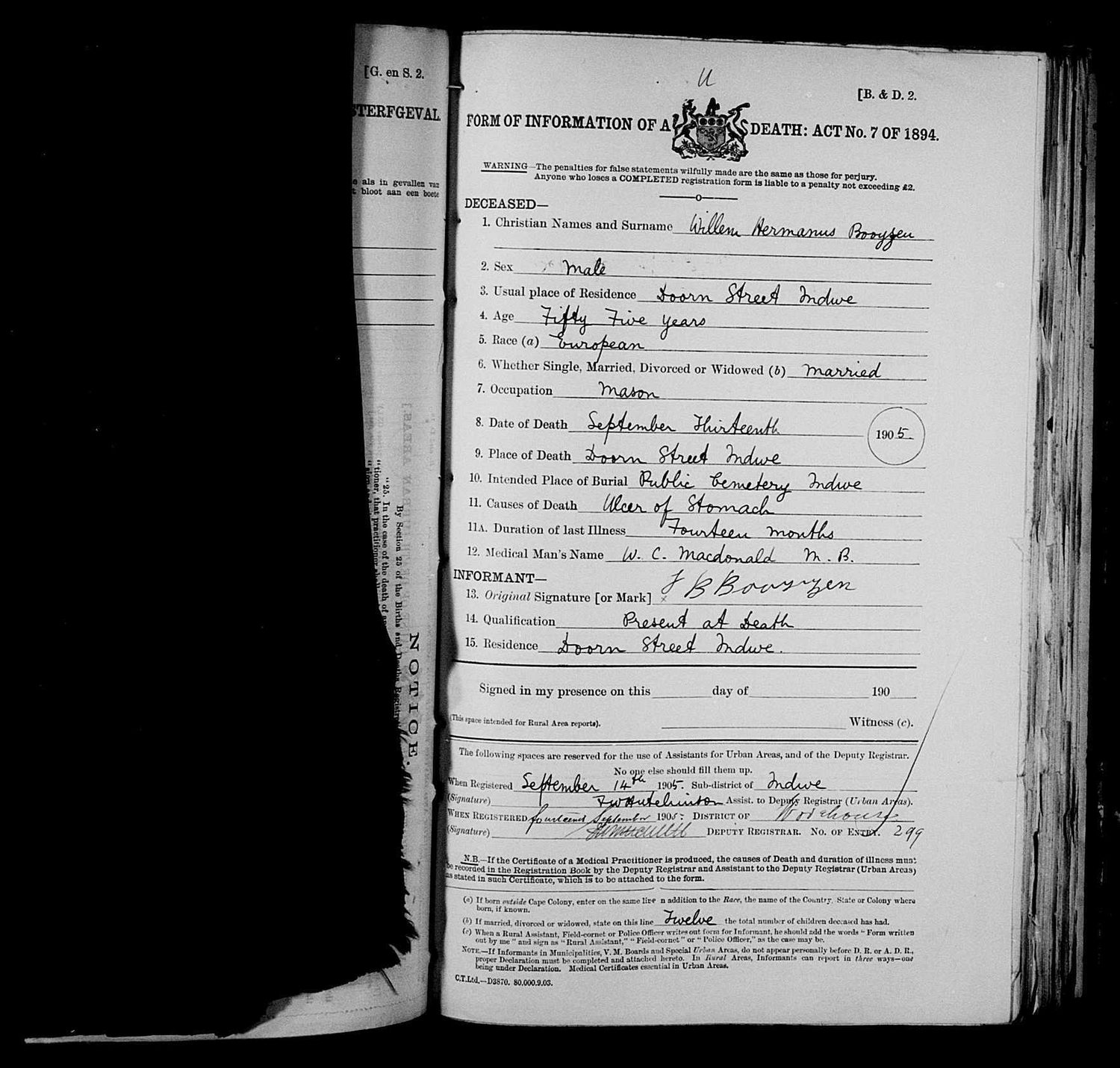
| Usual place of residence | Doorn Street, Indwe |
| Age | Fifty Five years |
| Occupation | Mason |
| Date of death | September Thirteenth 1905 |
| Intended place of burial | Public Cemetery, Indwe |
| Cause of death | Ulcer of Stomach |
| Duration of last illness | Fourteen months |
| Medical man | W. C. Macdonald, M.B. |
| Informant | J. B. Booyzen — qualification: Present at Death |
| Total children | Twelve |
What it proves
Documented The death date the tree flagged "To be confirmed, not sure" is correct. He died at Indwe on 13 September 1905.
Documented He was not shot by the British. He died of a stomach ulcer after fourteen months of illness, under a doctor's care, in his own house, three years after the war ended. What that does to the testimony →
A farmer who became a mason
At his marriage in 1879 his occupation is Boer — farmer. At his death in 1905 it is Mason.
A man who works land and then works stone has, in between, very often lost the land. The war sits in that interval. Inferred Suggestive, not probative — but it is exactly the trajectory the burned-farm testimony describes.
The name changing, on one sheet of paper
The registering clerk writes the deceased's surname. Four lines below, his son signs his own. They are not the same word.


The father is registered under the old spelling. The son signs the new one. Both are on the same page, in September 1905 — three years after the Anglo-Boer War ended.
The informant is John Barry Booyzen (b. 1884), the eldest son, then twenty-one, recorded as present at the death. This is as close to a photograph of the surname changing as the archive is ever likely to find. The name →
1879 · The marriage register — and one ambiguous letter
Duplicaat Origineel Register, in Dutch. Entry 15, 22 December 1879. Married in the Nederduits Gereformeerde Kerk at Barkly, after banns, by David Ross, consulent.
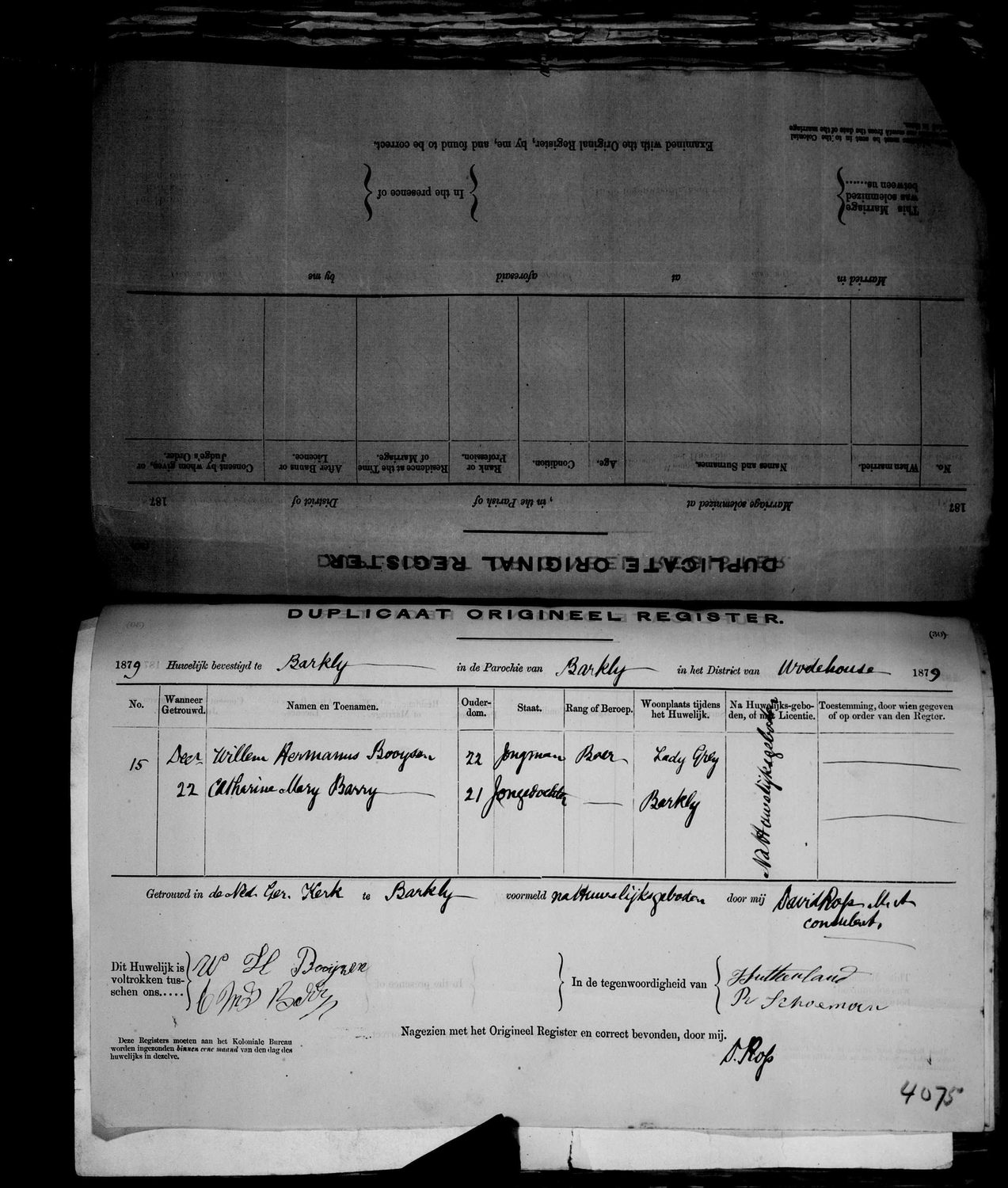
| Groom | Bride | |
|---|---|---|
| Name as entered | Willem Hermanus Booysen | Catharine Mary Barry |
| Age | 22 | 21 |
| Status | Jongman | Jongedochter |
| Rank or occupation | Boer (farmer) | — |
| Residence | Lady Grey | Barkly |
Witnesses: J. Sutherland and P. Schoeman. Set that beside Anna Johanna Maria Schoemann marrying Hendrik Nicholaas Barry in 1877, the 1901 Pretorius–Barry wedding held at the home of D. Schoeman, "Caerlaverock", Barkly East, and a Commandant D. Schoeman leading Cape Rebels at Labuschagne's Nek in 1900. The Schoemans are braided through this family across three generations. The rebels →
The most consequential letter in the archive
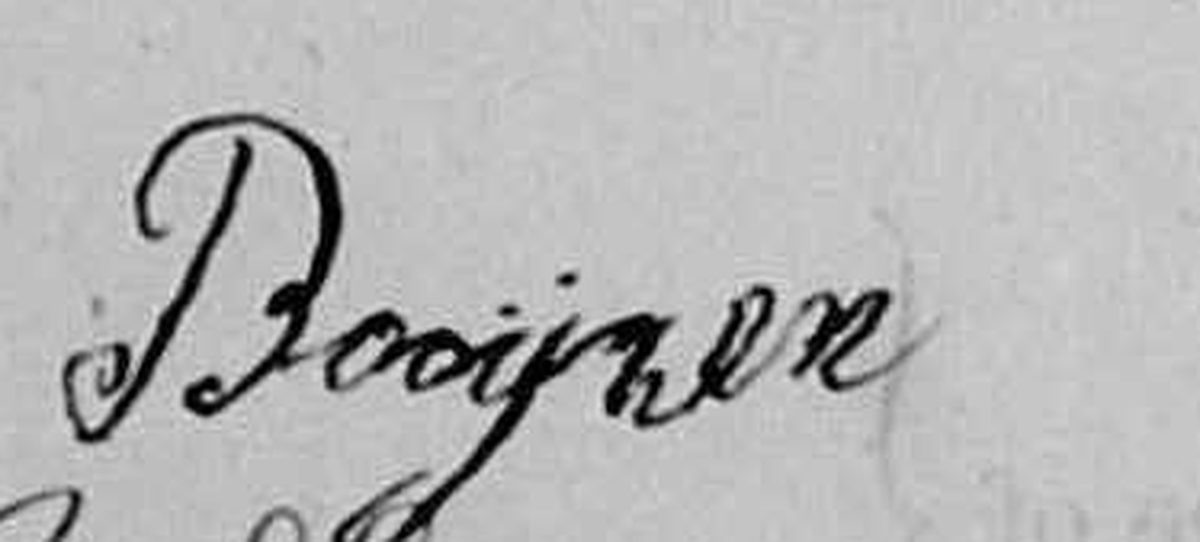
The clerk wrote Booysen. The groom signed what reads as "Booij_en" — using the older Dutch ij digraph, with a medial letter whose descending loop is more consistent with z than s.
If that reading is right, he was already signing with a z in 1879 — twenty years before the Anglo-Boer War — and the testimony's explanation of why the spelling changed is a later rationalisation of something that had already happened.
Not established The reading is not certain. Cursive Dutch s and z are genuinely confusable, and this is a photograph of a duplicate register, not the original. The archive states both readings and prefers neither.
This single letter is now the most consequential unresolved question here. It wants an eye trained on nineteenth-century Cape Dutch hands, and the original register at the Cape Archives. Open questions →
1915 · John Barry's death notice — typewritten, and therefore unarguable
Prepared by solicitors at Barkly East, stamped 18 April 1915, No. 925. Signed by James H. Barry, "Son (second)". This is the very document the family's earlier research note describes — it can now be quoted rather than paraphrased.
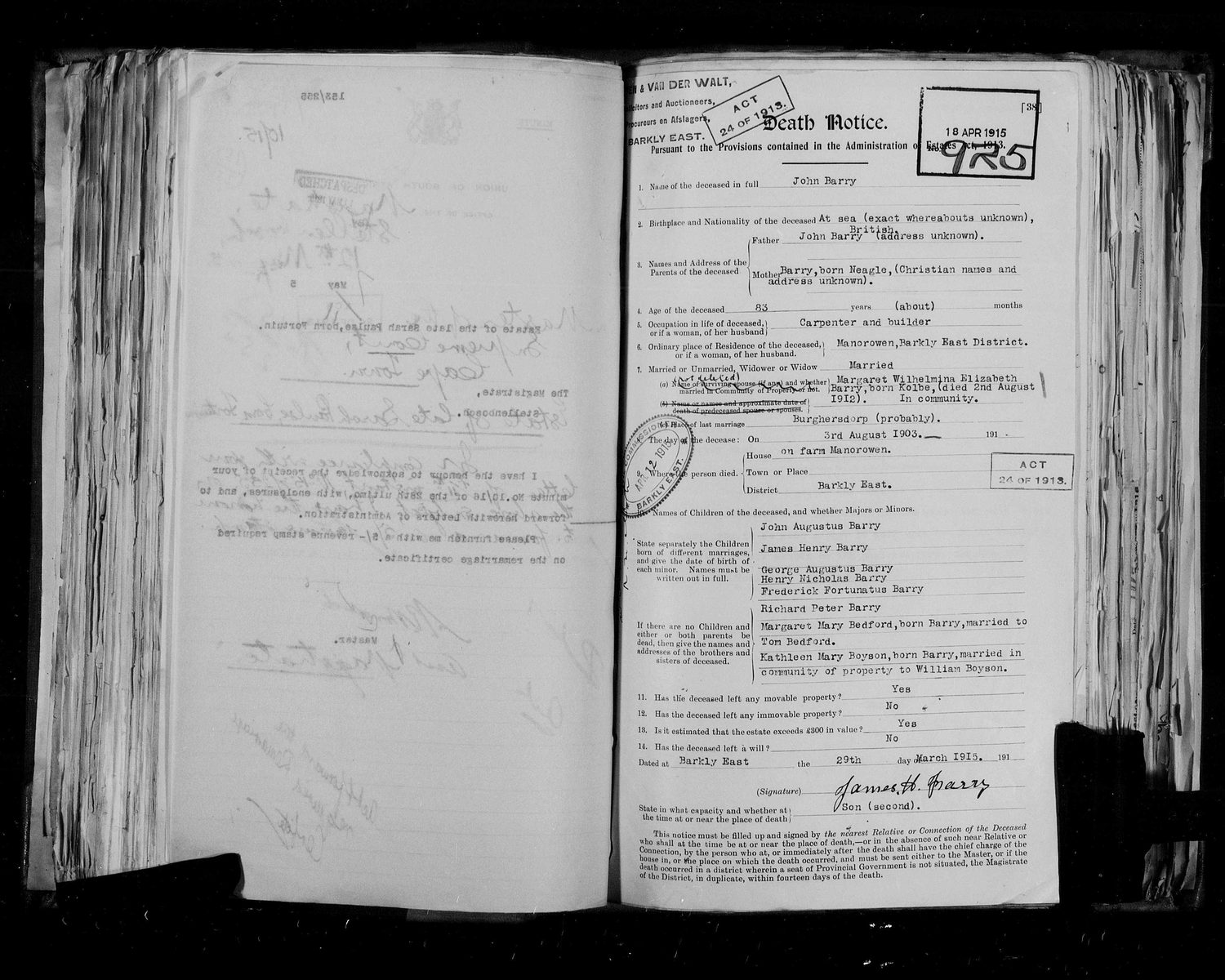
| Birthplace and nationality | "At sea (exact whereabouts unknown), British." |
| Father | John Barry (address unknown) |
| Mother | Barry, born Neagle (Christian names and address unknown) |
| Age | 83 years (about) |
| Occupation | Carpenter and builder |
| Residence | Manorowen, Barkly East District |
| Spouse | Margaret Wilhelmina Elizabeth Barry, born Kolbe (died 2 August 1912). In community. |
| Place of last marriage | "Burghersdorp (probably)" |
| Day of decease | 3rd August 1903 |
| Where died | on farm Manorowen, district Barkly East |
| Estate | movable Yes · immovable No · exceeds £300 Yes · will No |
"At sea" is official, not folklore
The Irish/High-Seas ambiguity is contemporaneous and legal, sworn by his own son. The mother's maiden name Neagle — almost certainly Nagle, of County Cork — is on a state document, not a family memory. The Barrys →
Manorowen is Welsh
The tree renders the farm "Manor Owen", which hides it. The notice types it as one word: Manorowen — a village in Pembrokeshire, Wales. He also owned no immovable property: he lived on Manorowen but did not own it. Both are new and entirely unexplored.
1. The death date is 3 August 1903, not the 25 August the tree carries — a 22-day discrepancy.
2. A duplicate person is resolved. The tree lists both Catherine Maria Sophia "Kathleen" Barry (1859–1940), married Booyzen and a separate sister Kathleen Mary Barry (Booysen) with no dates. This notice lists only one Barry daughter married to a Boyson. The arithmetic closes exactly: the tree's 11 children = the notice's 8 surviving + 2 who predeceased him + 1 duplicate. They are the same woman, and the archive's earlier claim of "two Barry sisters marrying Booysens" is withdrawn.
1947 · George's death notice corrects his own death date
Signed by G. Booyzen at Johannesburg on 21 February 1948 under the Administration of Estates Act 1913.
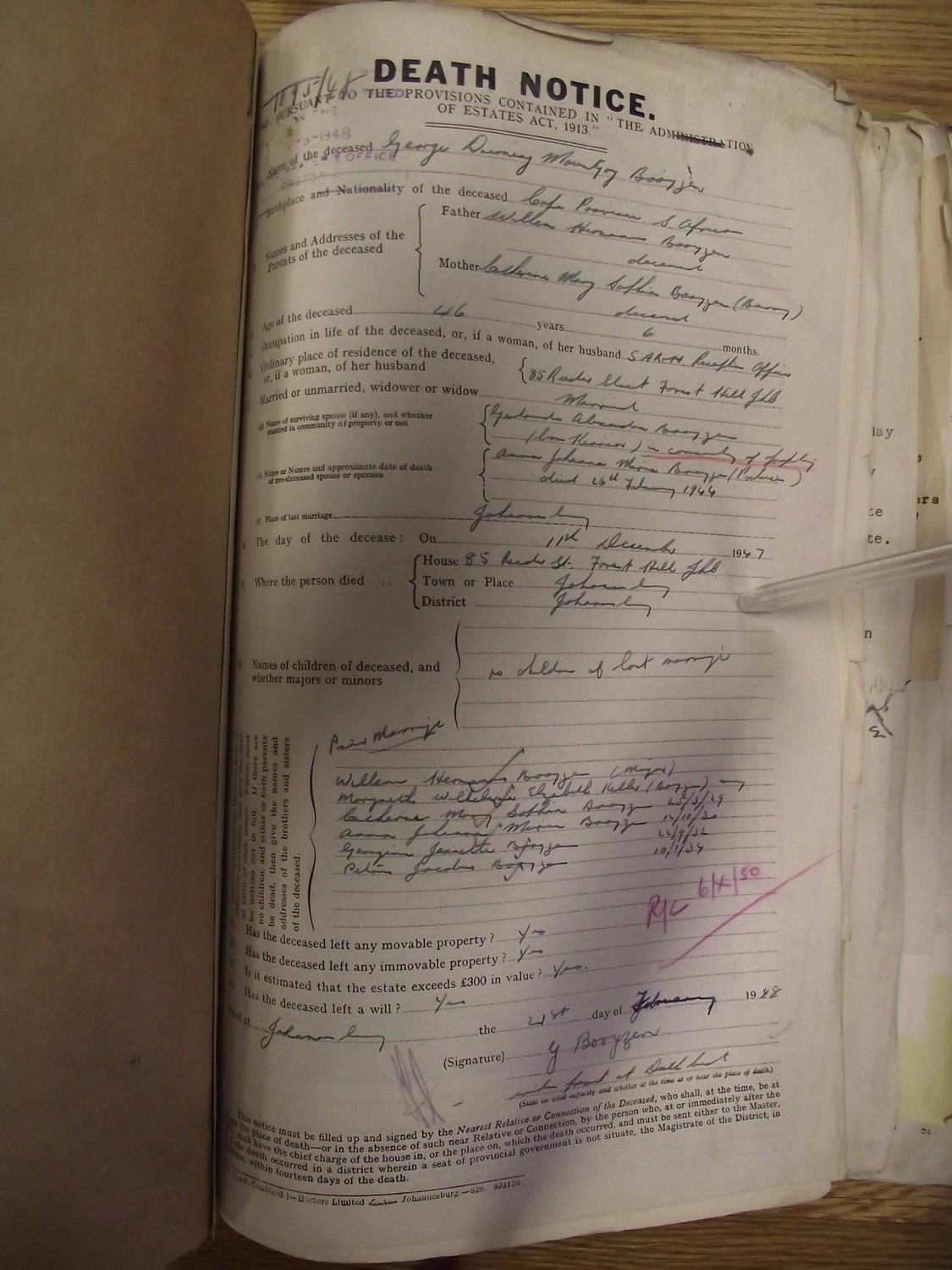
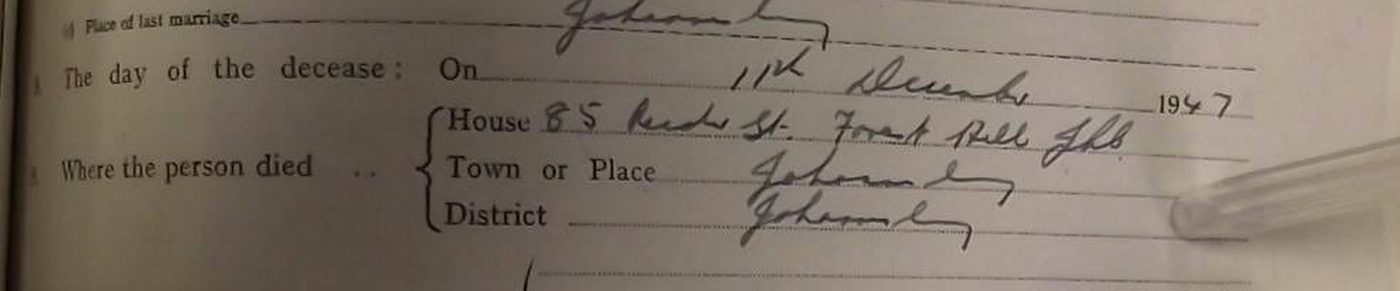
He died on 11 December 1947 — not 21 February 1947.
21 February is the date the notice was signed, and it was signed in 1948. A transcriber conflated the two and lost ten months.
This also dissolves an anomaly this archive had itself flagged: a burial at West Park recorded on 14 December 1947 looked like a ten-month delay. It was not. He died on the 11th and was buried on the 14th — three days later, exactly as one would expect.
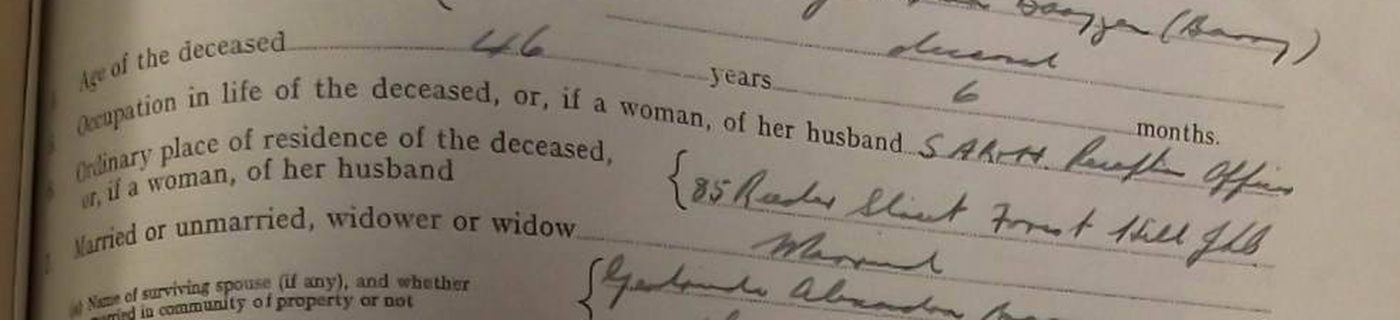
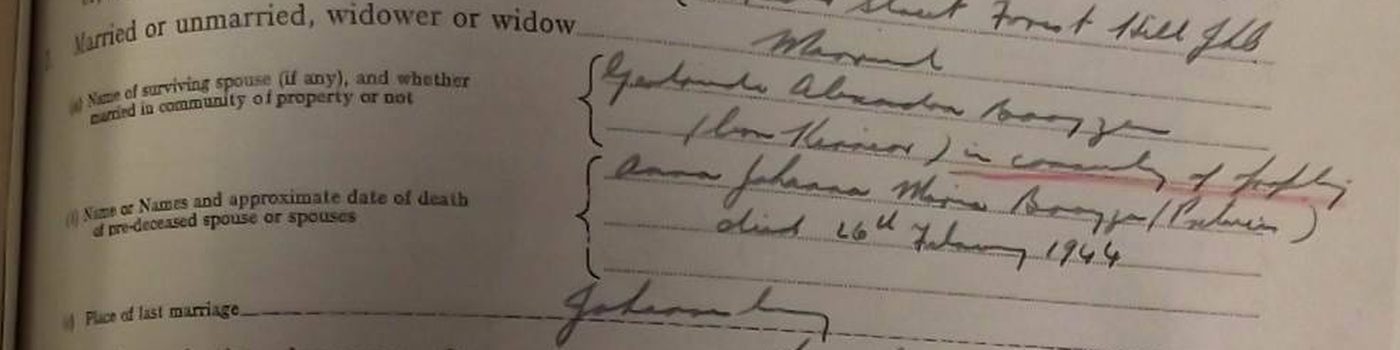
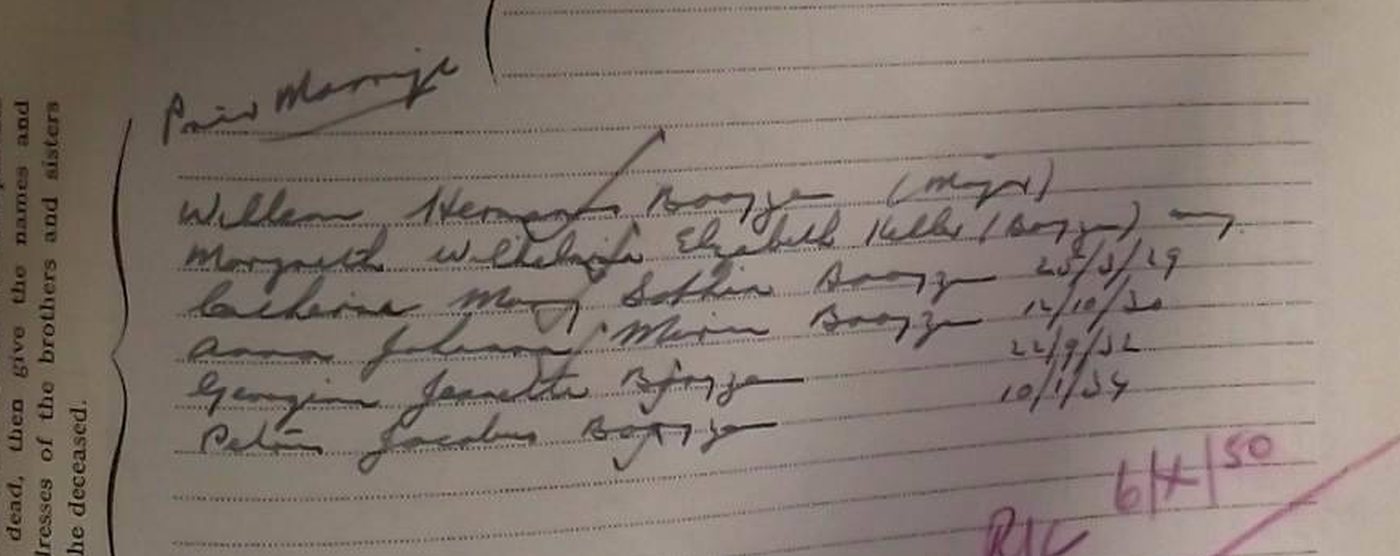
The notice also records "no children of last marriage" — consistent with both infant Gertrude Elizabeths having died before him.
The photographs
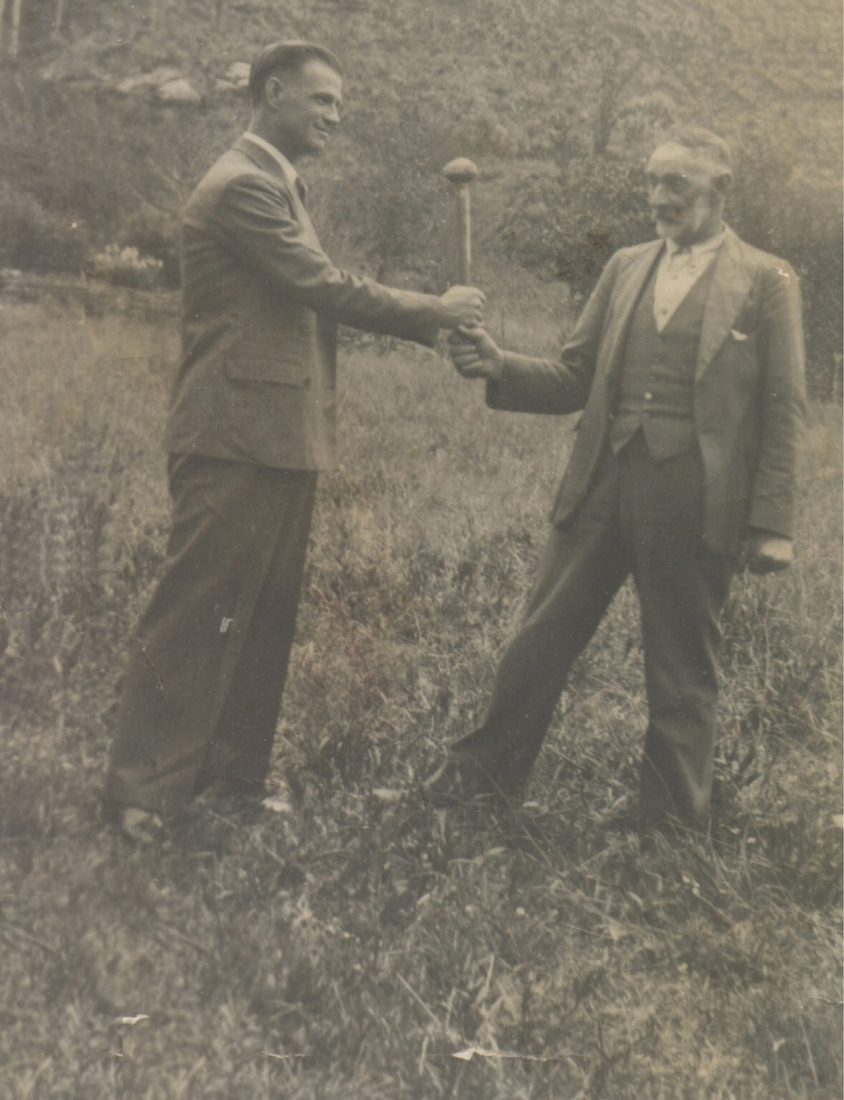
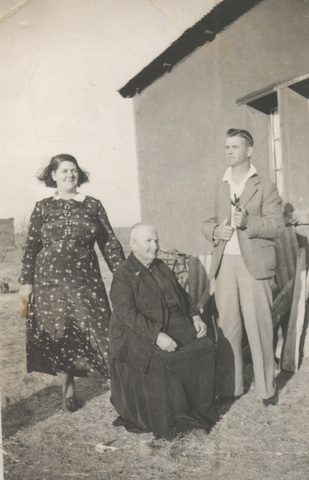
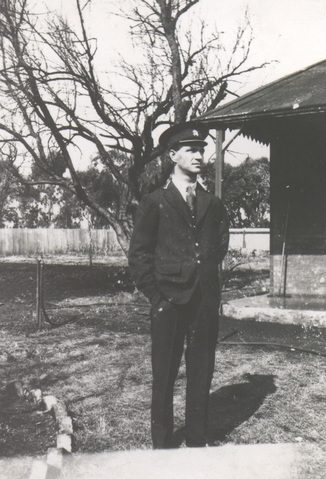
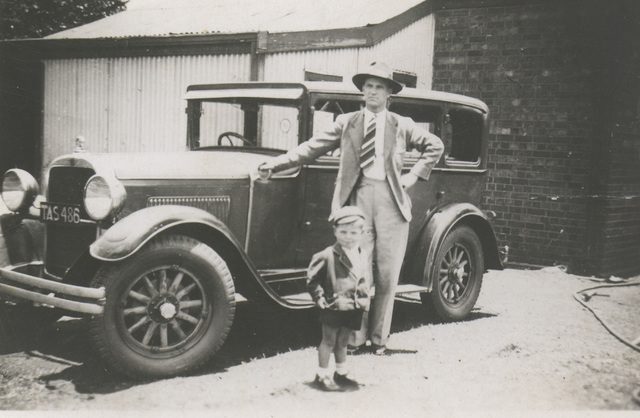
Three uncaptioned photographs
Attached to George's profile with no caption, no date and no tagging. The identifications below are Inferred — reasoning is given so it can be overturned.
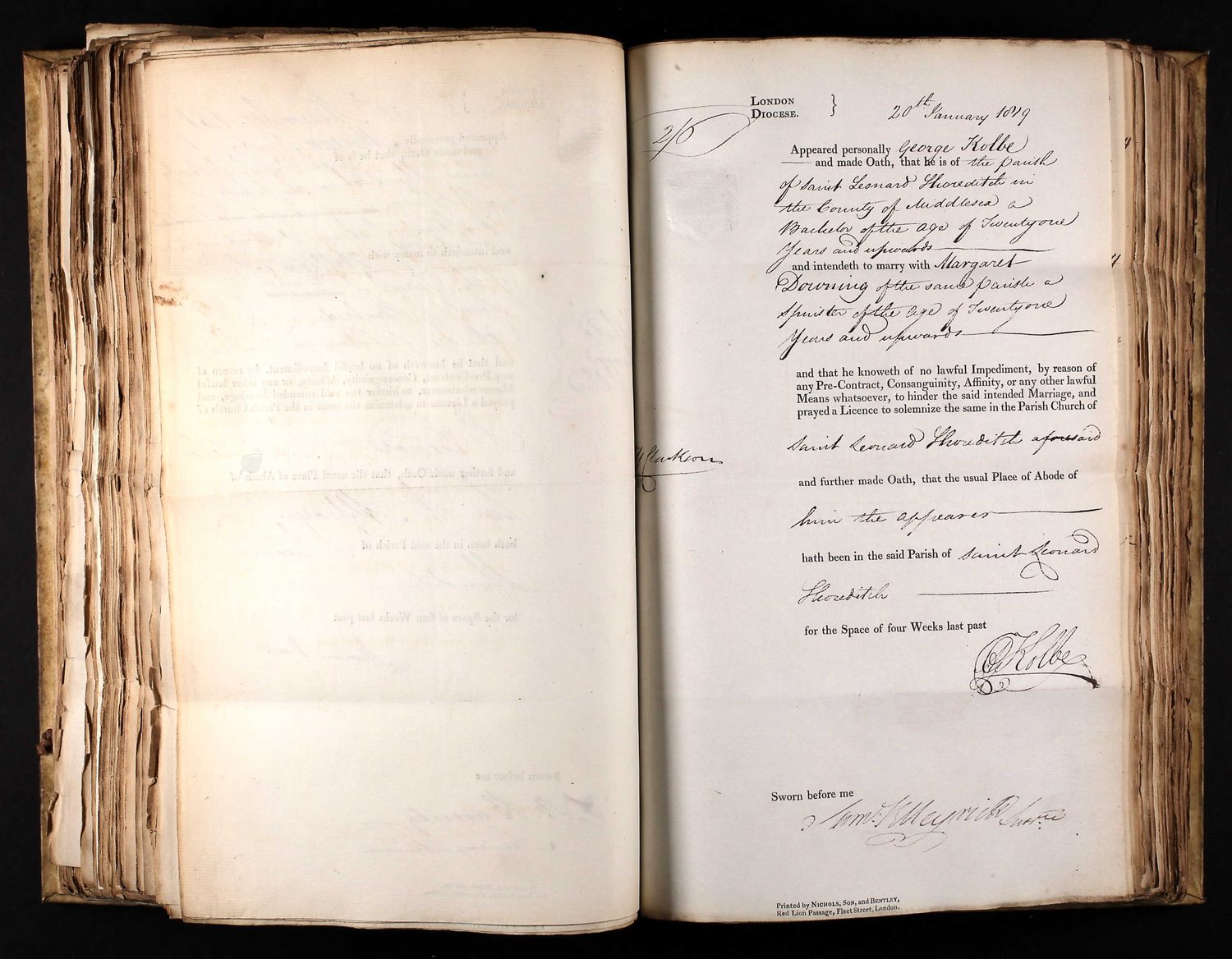
1819 · A sworn falsehood in Shoreditch
A marriage allegation of the London Diocese, 20 January 1819 — the sworn statement required before a marriage licence could be issued. Fee, 2/6.
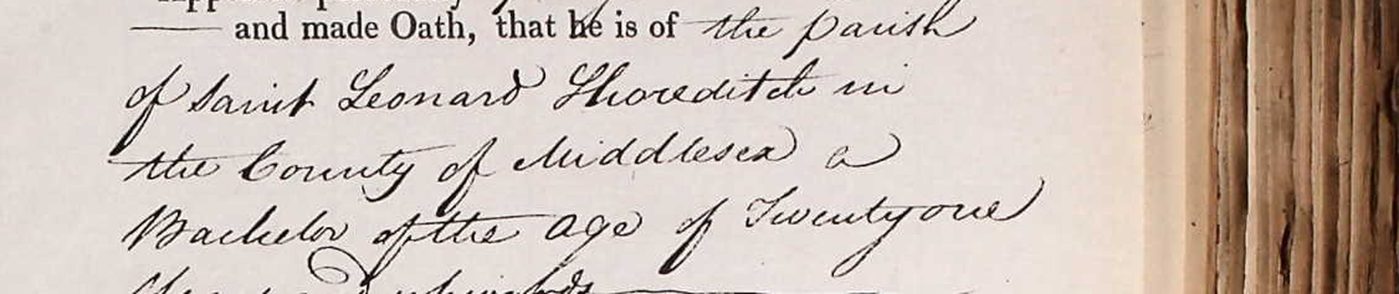
"Appeared personally George Kolbe and made Oath, that he is of the Parish of Saint Leonard Shoreditch in the County of Middlesex, a Bachelor of the age of Twenty-one Years and upwards, and intendeth to marry with Margaret Downing of the same Parish, a Spinster of the age of Twenty-one Years and upwards…"
George Augustus Kolbe was born 7 December 1802. On 20 January 1819 he was sixteen years and six weeks old. Margaret Downing was born 23 February 1803; she was fifteen years and eleven months.
Under Hardwicke's Marriage Act of 1753 a minor under twenty-one could not marry by licence without a parent's consent. Swearing to be "of the age of twenty-one years and upwards" was the ordinary way round it — and it was perjury. The four weeks' residence in the parish was very often nominal too.
This archive's 1820 Settler married at sixteen, by lying under oath about his age, and sailed for Africa eleven months later. The Kolbes →
1844 · The estate the archive had a reference for but had never read
The Cape Archives reference KAB MOOC 6/9/35: 7698 (1845) was already noted here as "not yet ordered". It was in the family tree all along — the estate number 7698 is written at the head of the page.
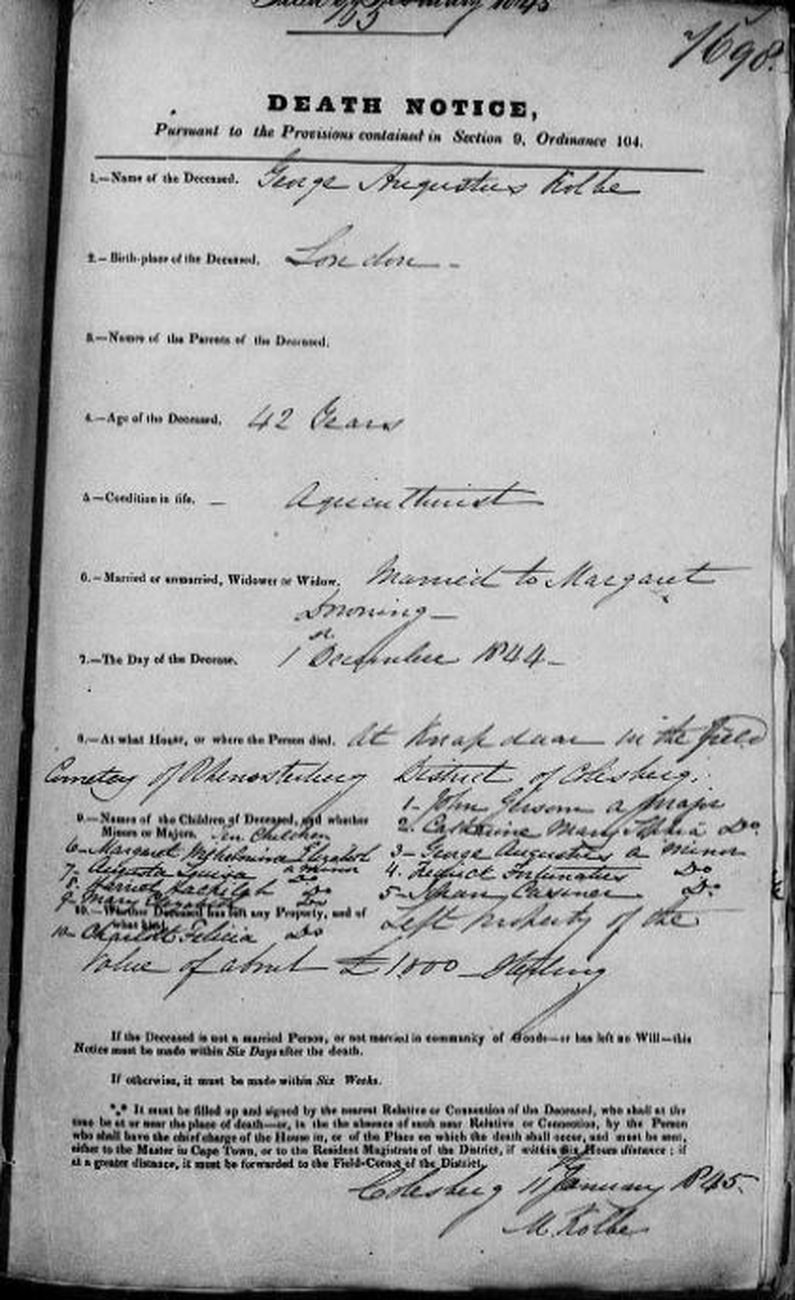
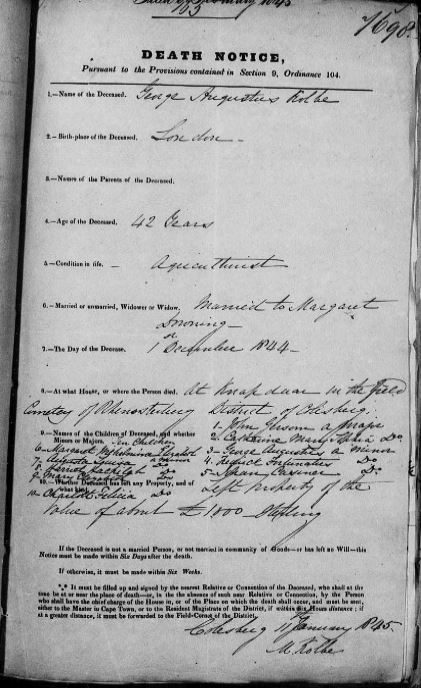
| Birth-place | London |
| Names of the parents | left blank |
| Age | 42 years |
| Condition in life | Agriculturist |
| Day of the decease | 1 December 1844 |
| Where died | At Knapdaar, in the field cornetcy of Rhenosterberg, District of Colesberg |
| Property | "about £1000 Sterling" |
He died a farmer
The tree gives his occupations as Reverend Missionary of the London Missionary Society, Chemist and Tailor. The official record at the end of his life calls him simply an agriculturist, and he died on his own farm. Those are not contradictions — they are a life in sequence — but the archive should stop leading with "missionary".
Ten children, and one who is missing
The notice names ten. Keetor Peter Benjamin Kolbe, whom the tree gives a birth in 1840, is not among them — nor among the ten in his mother's 1867 notice. He died young, or he does not belong in this family. Julia Kolbe, whom MyHeritage flags as born two years after her father's death, is likewise absent, as she must be.
21 September 2026 — and “Keetor” is not a name. A compiled register report of 2012 gives the same man as Peter Rector Kolbe, which is a name, so the tree has been carrying a misreading. It matters because this archive holds Anton Rector Kolbe Barry (1882) and has never been able to say where his Rector came from. A great-uncle of the name would say it. Nothing is adopted — he is still in no document, and the same report splits him into two children, which is how it inflates its count. Johan Casimir, the fifth name on this notice, was in the same position until today: named here and again in 1867, and missing from this archive’s own people list. He now has a record.
1867 · Margaret's death notice solves a problem this archive had raised
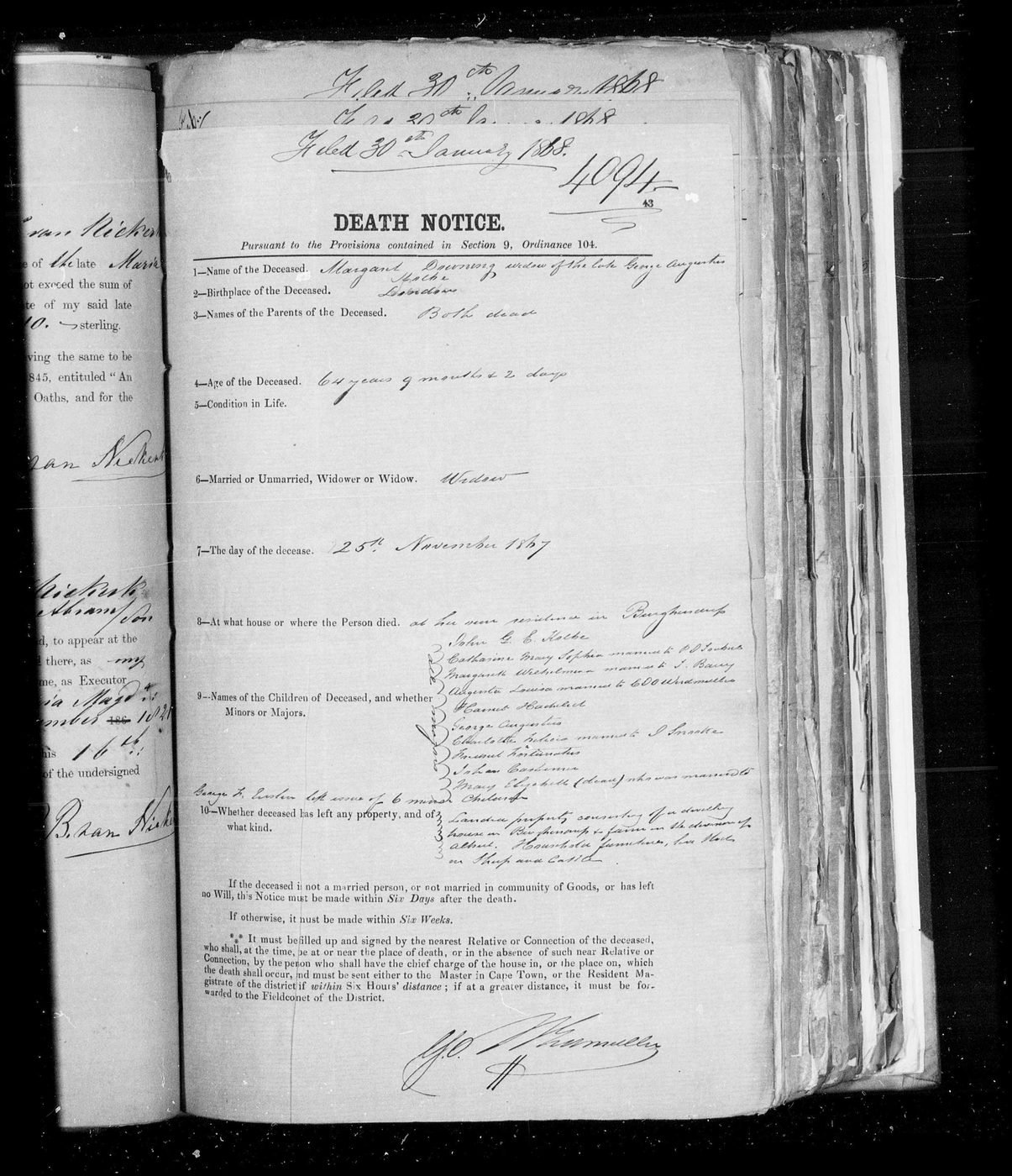
| Birthplace | London |
| Names of the parents | "Both dead" — no names given |
| Age | 64 years 9 months & 2 days |
| Day of the decease | 25 November 1867 |
| Where died | at her own residence in Burghersdorp |
| Property | a dwelling house in Burghersdorp and a farm in the division of Albert; household furniture, live stock, sheep and cattle |
"64 years 9 months & 2 days" on 25 November 1867 computes to a birth of 23 February 1803 — exactly what the tree says and exactly what the gravestone says. A three-way agreement, which in this archive is rare enough to be worth stating.
The notice lists, among Margaret Downing's children: "Mary Elizabeth (dead) who was married to George F. Enslin — left issue of 6 minor children." Resolved The Enslin marriage and its children are Mary Elizabeth's, not Margaretha's. The tree has attached one sister's family to the other. Disputed →
One thing it does not give: her parents, entered only as "Both dead". The tree's John Paul Downing and Mary P King are therefore not corroborated here.
The grave at Burgersdorp
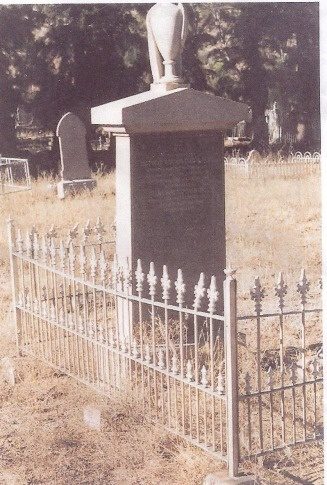
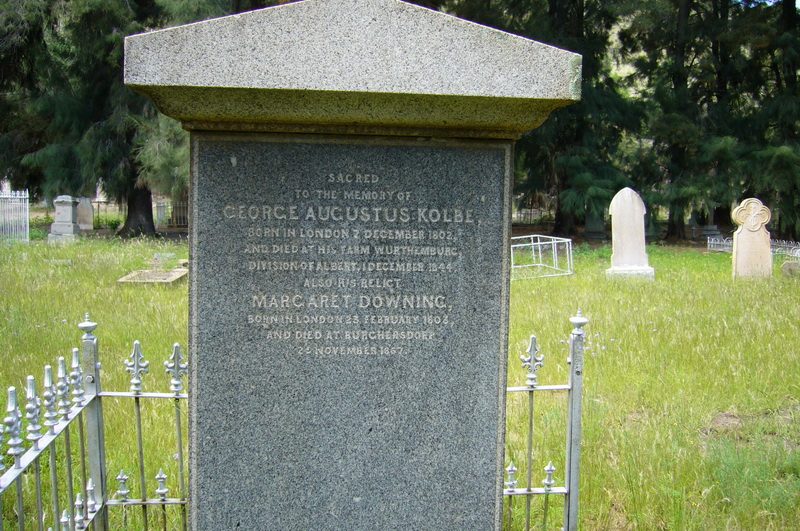
SACRED / TO THE MEMORY OF / GEORGE AUGUSTUS KOLBE, / BORN IN LONDON 7 DECEMBER 1802, / AND DIED AT HIS FARM WURTHEMBURG, / DIVISION OF ALBERT, 1 DECEMBER 1844. / ALSO HIS RELICT / MARGARET DOWNING, / BORN IN LONDON 23 FEBRUARY 1803, / AND DIED AT BURGHERSDORP / 25 NOVEMBER 1867.
The farm is spelled WURTHEMBURG in cut stone, with a th — closer to Württemberg than the tree's "Wurtemburg". And the stone says "HIS FARM": he owned it, which Margaret's 1867 notice confirms with "a farm in the division of Albert".
She is commemorated under her maiden name, as his relict — the old word for widow. She outlived him by twenty-three years and was buried in his grave, as the Dutch note on the MyHeritage record says: "Zijn vrouw is later bijgezet in het graf."
The 1845 notice says district of Colesberg; the stone says division of Albert. Both are right — Albert, with its seat at Burgersdorp, was carved out of the older district afterwards. The stone is the later text.
The portraits — and one that cannot be who it says
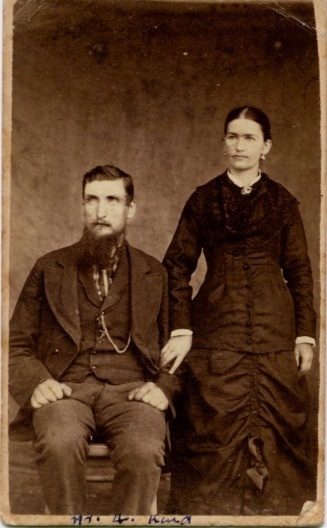
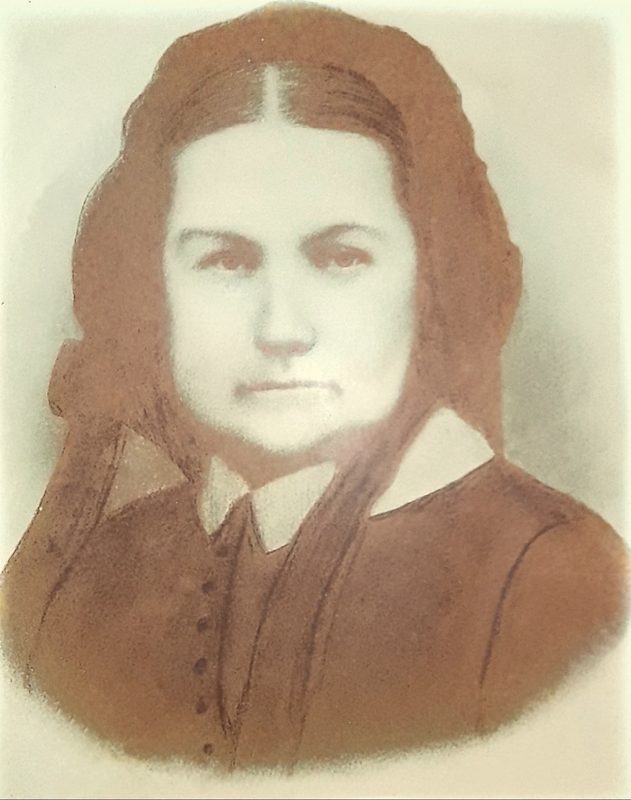
George Augustus Kolbe died in 1844. Margaret Downing died in 1867. Neither can appear in a photograph taken in the late 1870s. A pencilled inscription on the mount does not appear to read "Kolbe".
Hypothesis It is their son George Augustus Kolbe (b. 1836) — who would be about forty in 1876, matching the sitter — with his wife. The repeated forename is the obvious route by which a caption goes astray. Unproved.
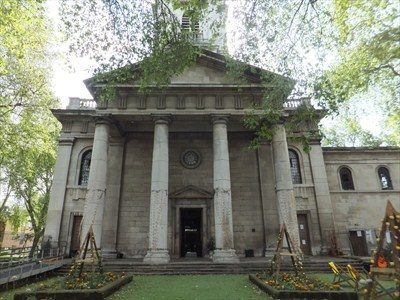
1842 · The will of a Bond Street tailor
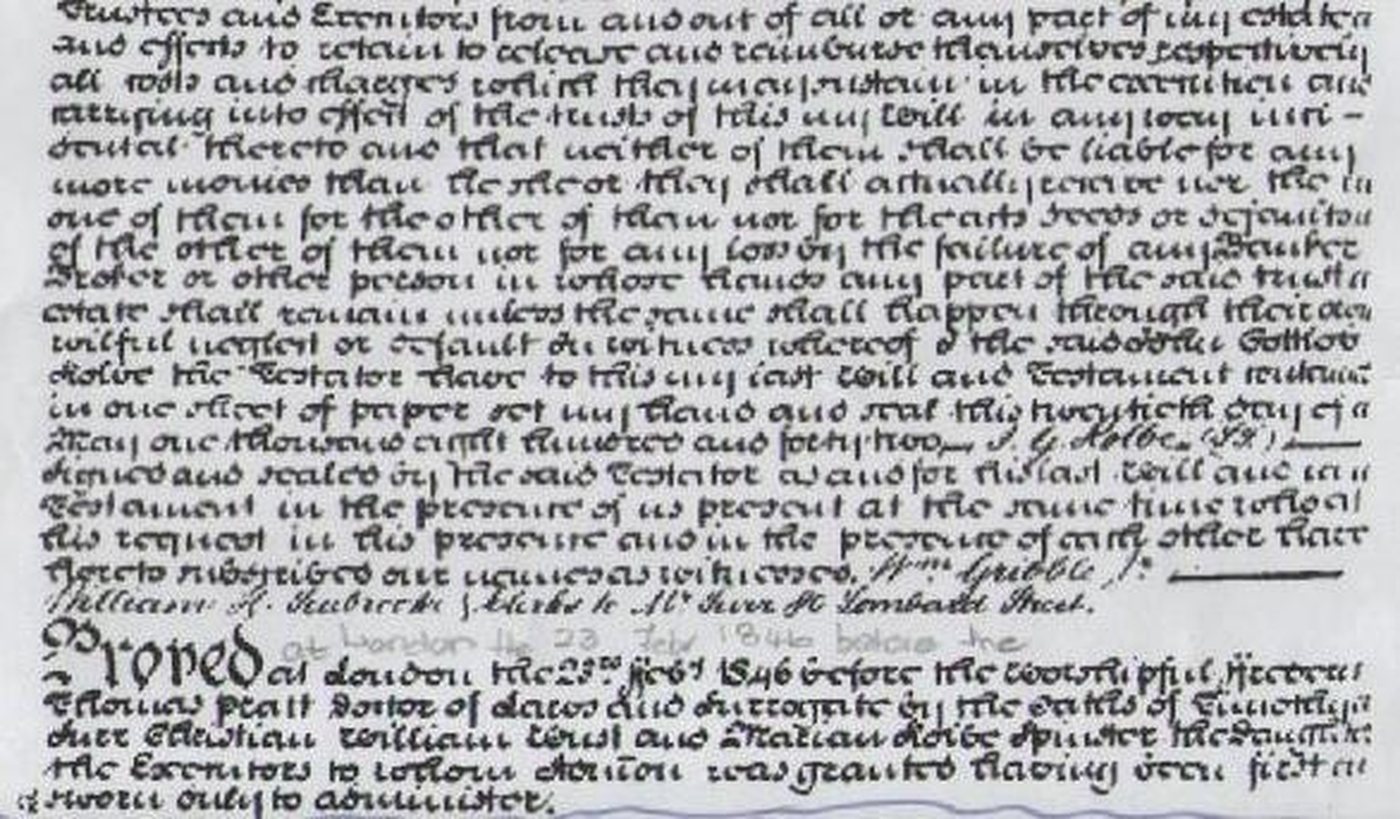
A Prerogative Court of Canterbury register copy, from the Public Record Office. Signed 25 May 1842; proved at London 23 February 1846.
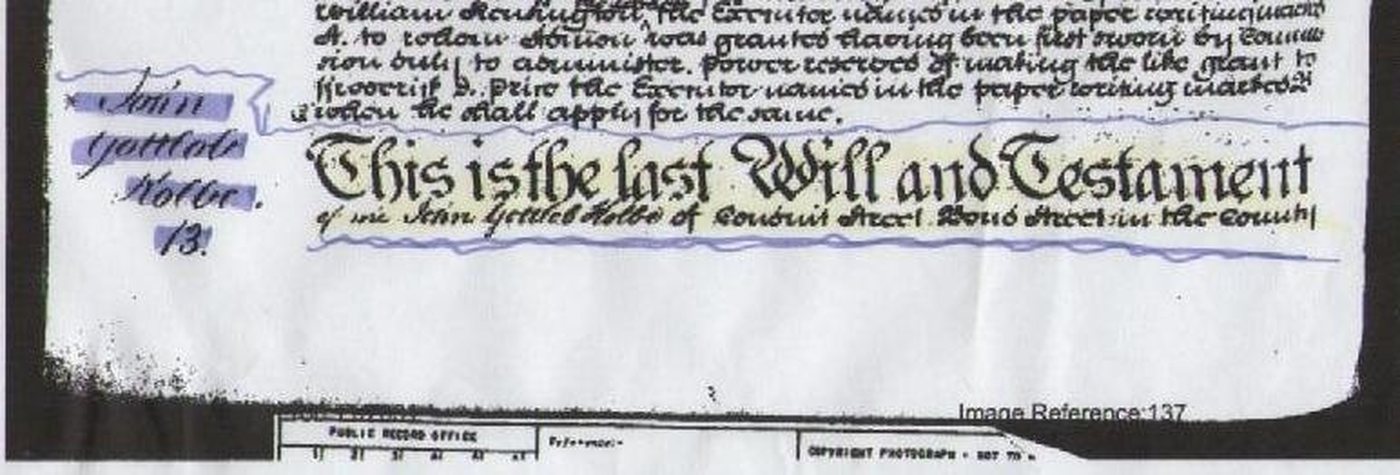
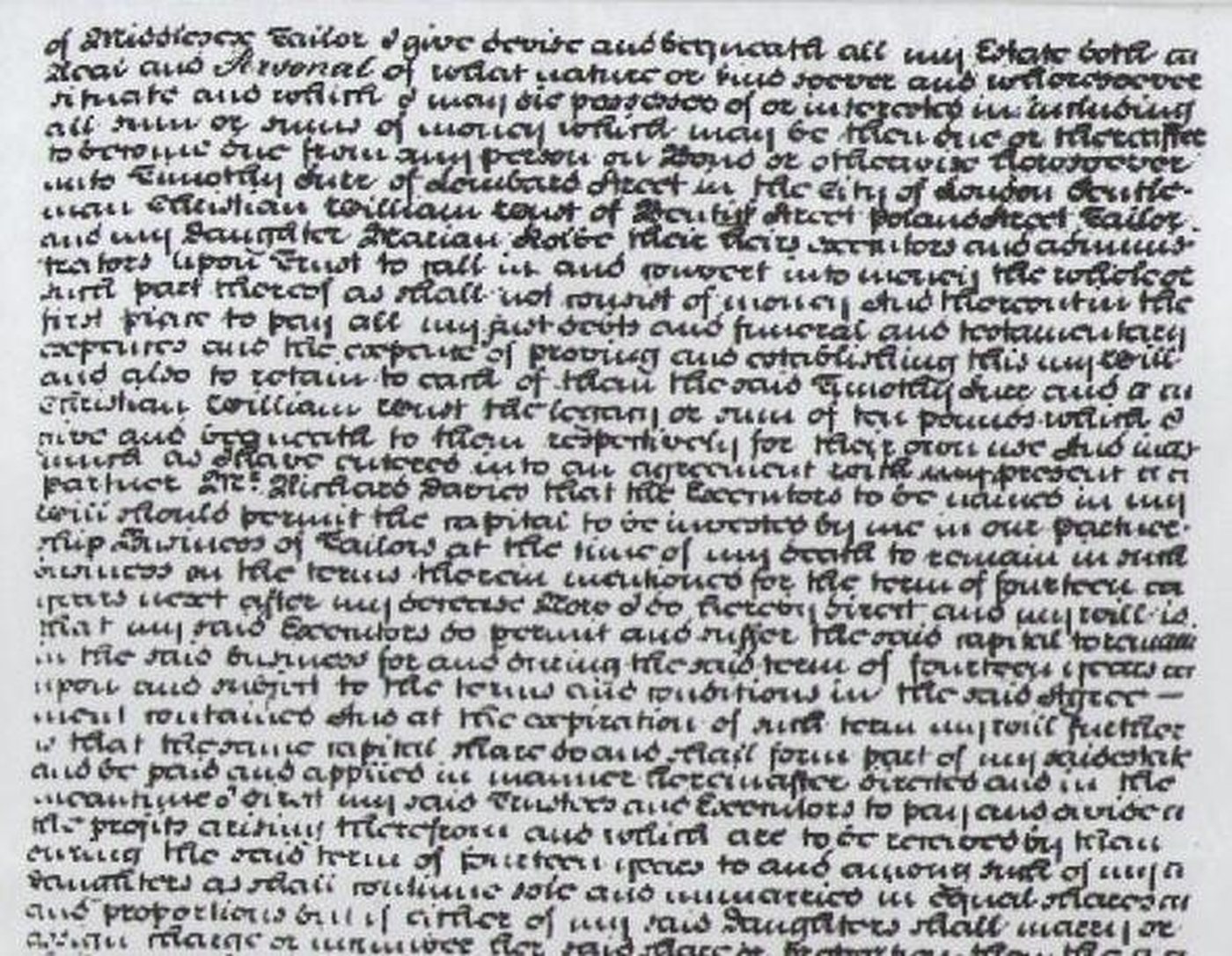
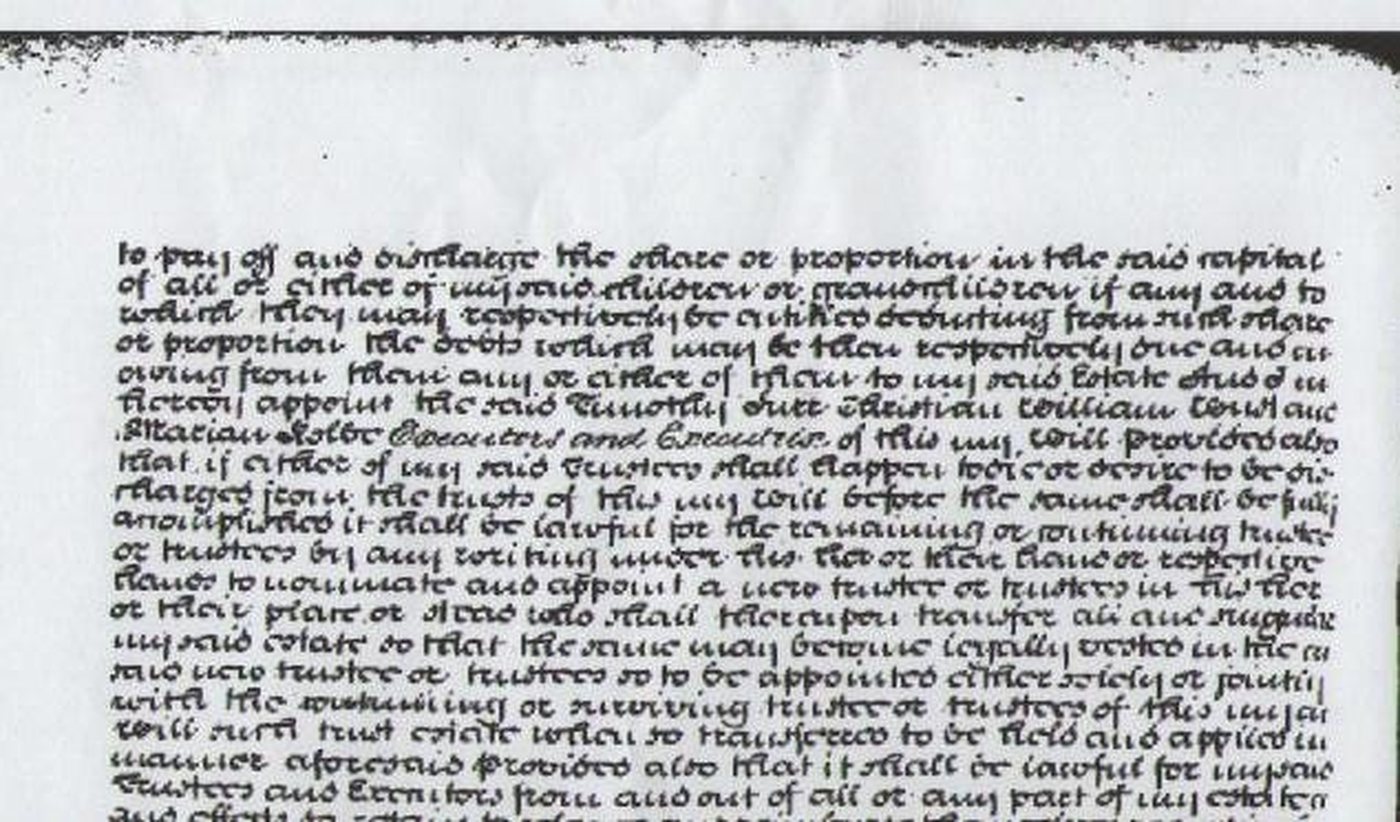
He had a partner and a going concern
"…an agreement with my present partner Mr Richard Davies that the Executors … should permit the capital to be invested by me in our partnership business of Tailors at the time of my death to remain in such business…" — for a term of fourteen years after he died.
This is not a jobbing tailor. It is a firm with capital, a partner, and a fourteen-year plan.
His daughter was an executrix
He appointed Timothy Duke, Christian William Kent and Marian Kolbe — his own daughter — "Executors and Executrix". At probate she is sworn as "Marian Kolbe Spinster the daughter."
A woman administering a substantial estate in her own right in 1846 is worth pausing on.
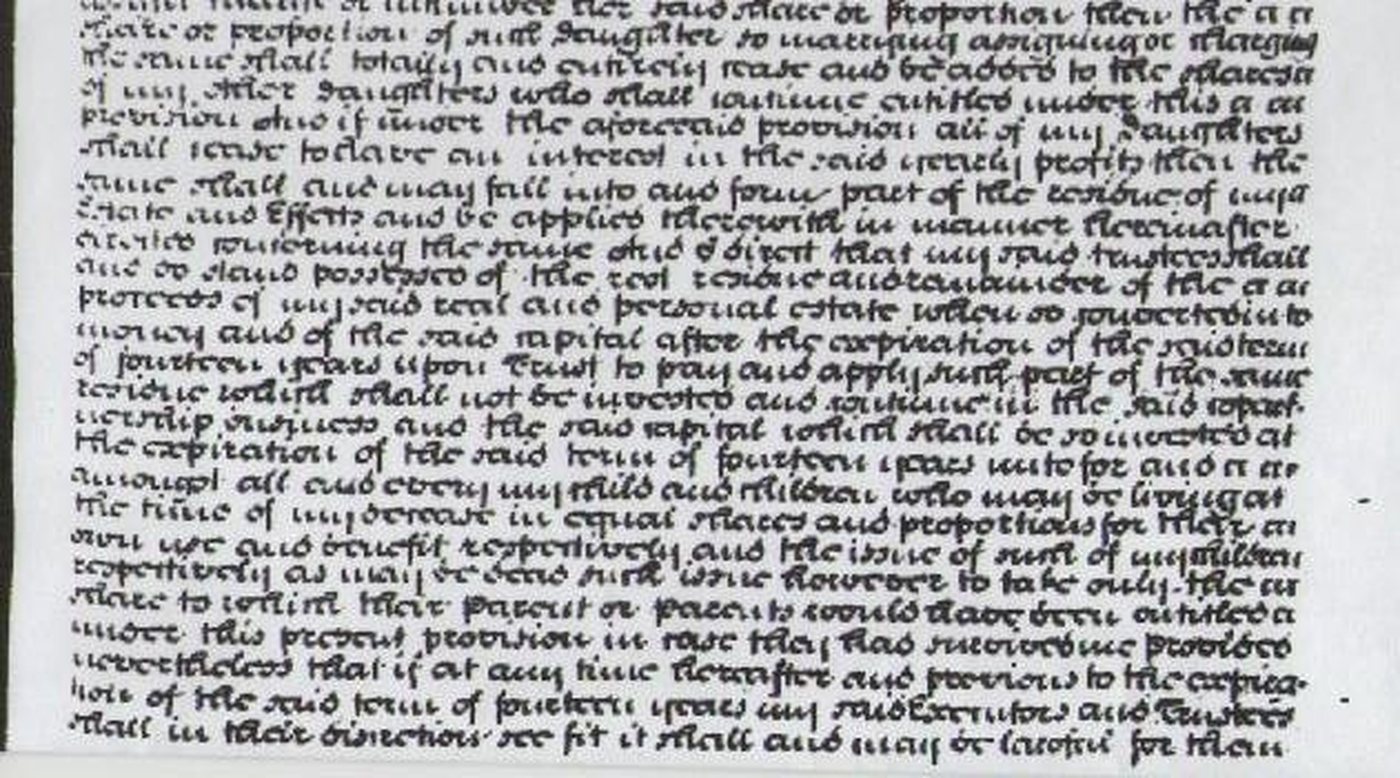
George Augustus Kolbe died on 1 December 1844. His father died on 18 November 1845 — a year later. Under that clause, George's share passed to his own children — to Margaret Downing's family at Burgersdorp, and so to Margaretha Kolbe, who married John Augustus Barry.
Inferred There is, on paper, a line of money from a Bond Street tailor's estate to the Barkly East family. A later clause names "my said children or grandchildren" explicitly. Whether a shilling of it ever reached the Cape is unknown and untested — it would show in the PCC estate papers and in the Cape estate files. Open questions →
1845 · Two documents correct the tree twice over
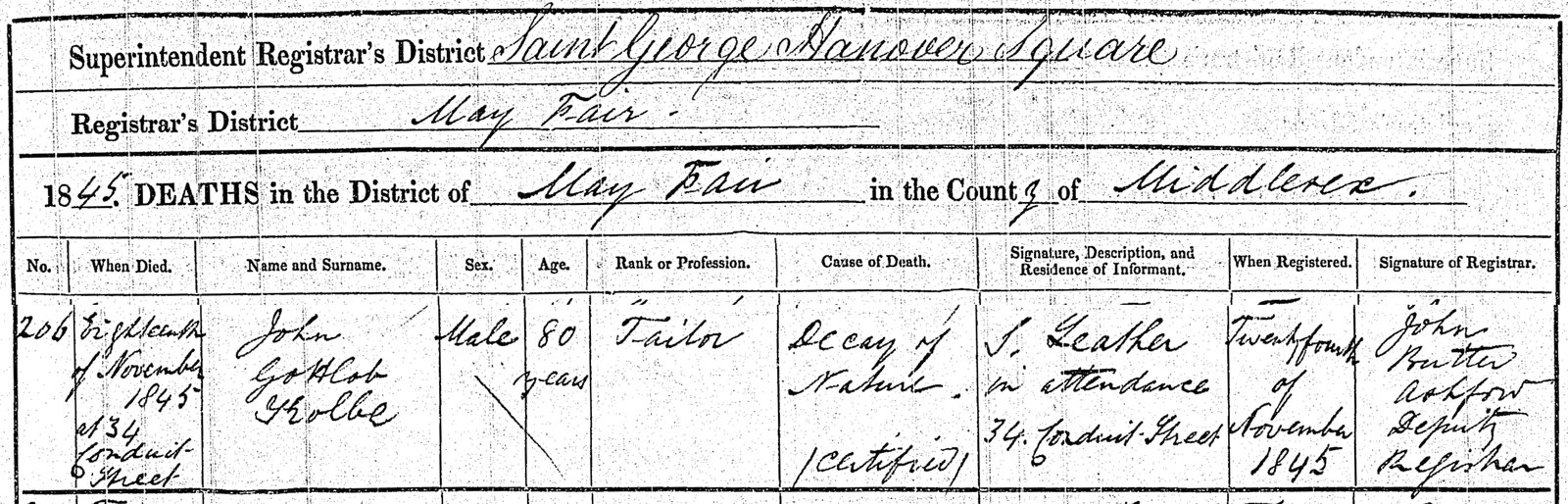
| When died | Eighteenth of November 1845, at 34 Conduit Street |
| Age | 80 years |
| Rank or profession | Tailor |
| Cause of death | "Decay of Nature" (certified) — the Victorian phrase for old age |
| Informant | S. Leather, in attendance, 34 Conduit Street — an attendant, not family |
Correction 1 — he did not die in Lamb's Conduit Street
The tree records "34 Lamb's Conduit Street". Three independent documents say otherwise.
| Document | Address as given |
|---|---|
| Death certificate, 1845 | 34 Conduit Street, registered at May Fair |
| Burial register, 1845 | "Conduit Street, Regent Street" |
| His own will, 1842 | "of Conduit Street, Bond Street, in the County of Middlesex, Tailor" |
Conduit Street runs between Regent Street and New Bond Street, in Mayfair. Lamb's Conduit Street is in Bloomsbury, over a mile away and in the Holborn registration district — a death there could not have been registered at May Fair.
The consequence
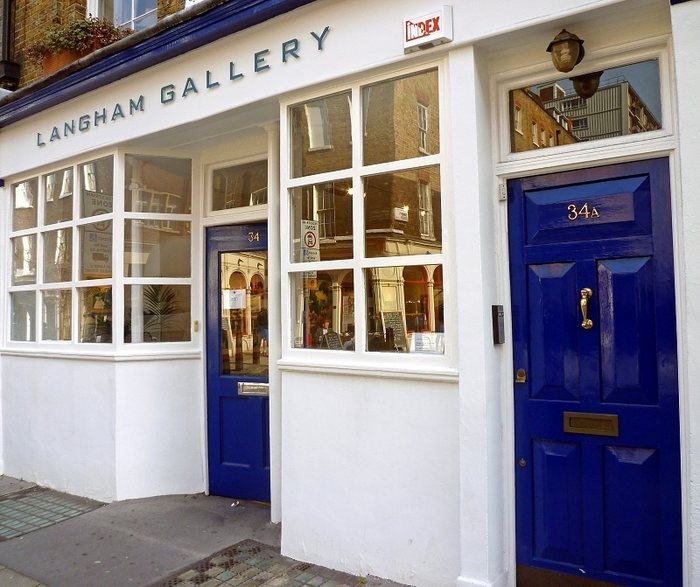
The photograph in the tree captioned "34 Lamb's Conduit Street" is a picture of the wrong building, in the wrong part of London. Someone went and photographed a real 34 — just not his.
He lived and died above his own shop, in Mayfair.
Correction 2 — he was not buried in Warwickshire
The tree records "St John the Baptist, Leamington, Warwickshire."


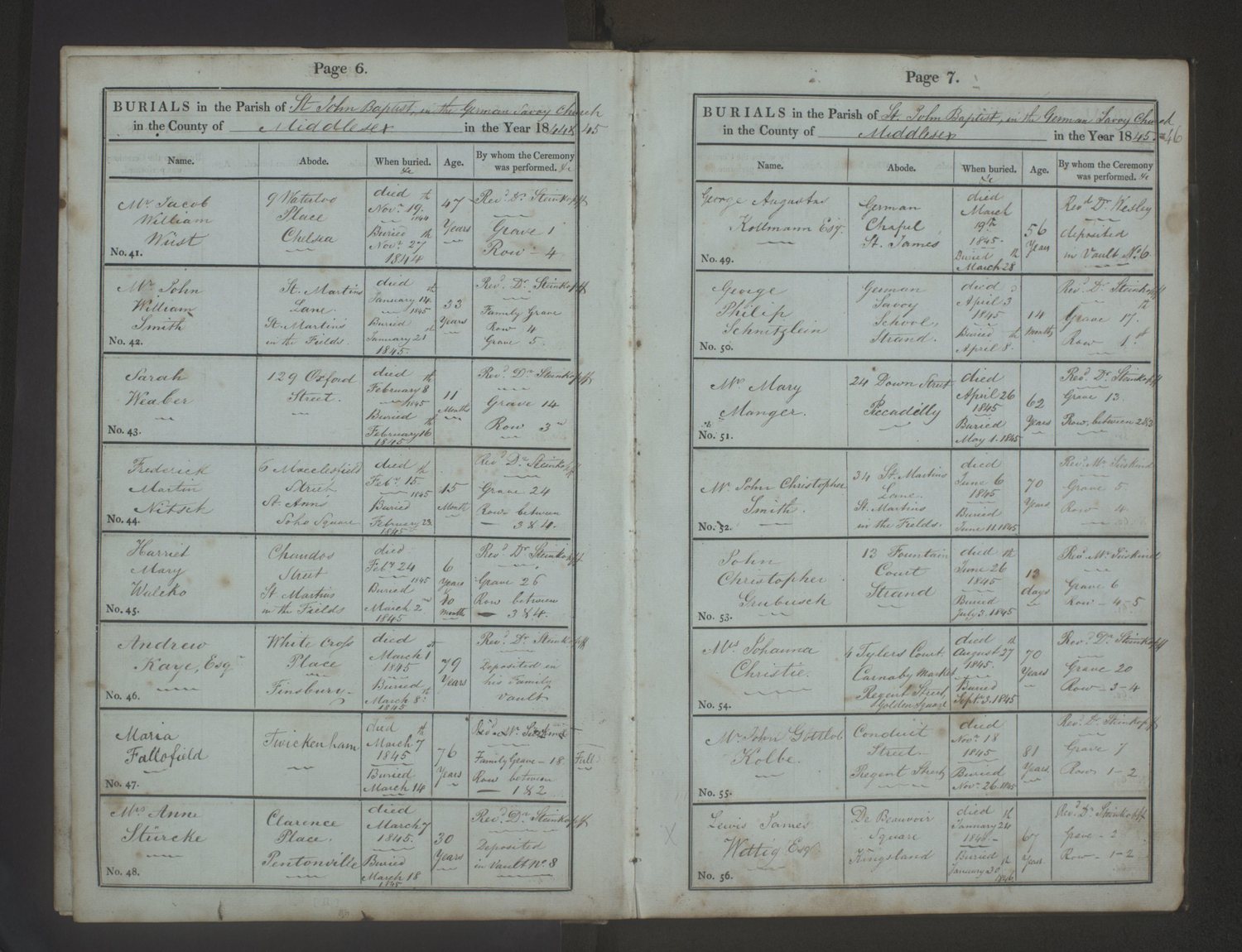
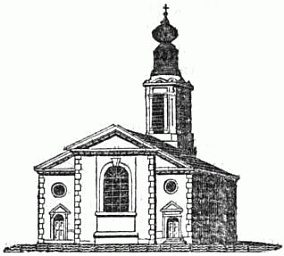
The correction makes the family more coherent, not less. They are German Lutherans of the Savoy from first to last. The officiant, Revd Dr Steinkopff, is Karl Friedrich Adolf Steinkopf (1773–1859), minister of the German Savoy Church and a founder of the British and Foreign Bible Society. The Kolbes →
The neighbouring entries in the register are almost all German — Wüst, Nitsch, Wuleko, Stürcke, Kollmann, Schnitzlein, Grubusch, Wettig. A German congregation in London, burying its own.
1901 · A wedding in a rebel's house, under martial law
The archive knew from a note in the tree that this marriage was held "at the home of D Schoeman". The original register gives the man a signature.
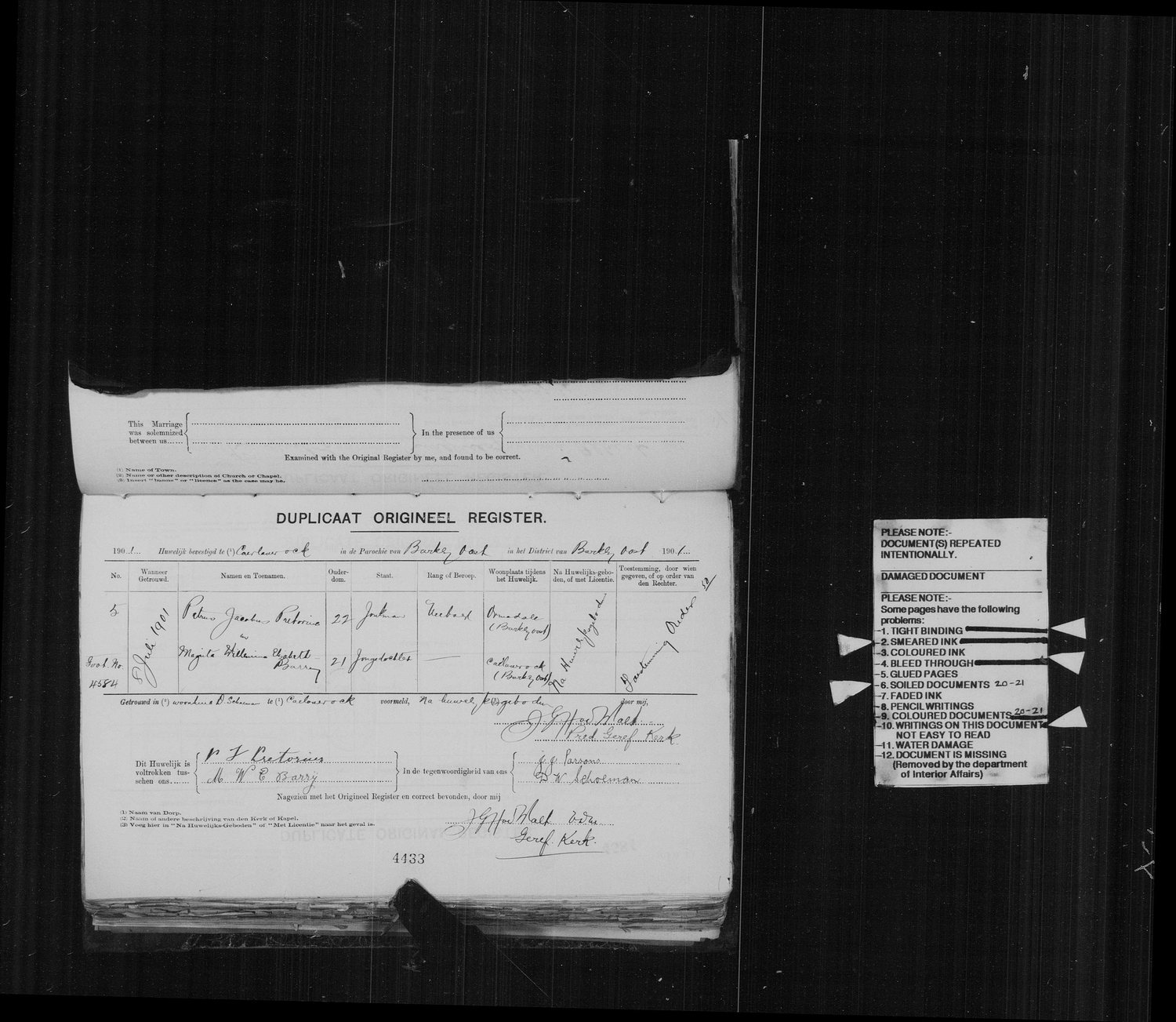
| Groom | Bride | |
|---|---|---|
| Age | 22 | 21 |
| Occupation | Veeboer — stock farmer | — |
| Residence | “Arundale” (reading uncertain), Barkly Oost | Caerlaverock, Barkly Oost |
"Getrouwd in woonhuis D. Schoeman te Caerlaverock voormeld, na huwelijksgeboden, door mij: J. G. van der Walt, Pred. Geref. Kerk."
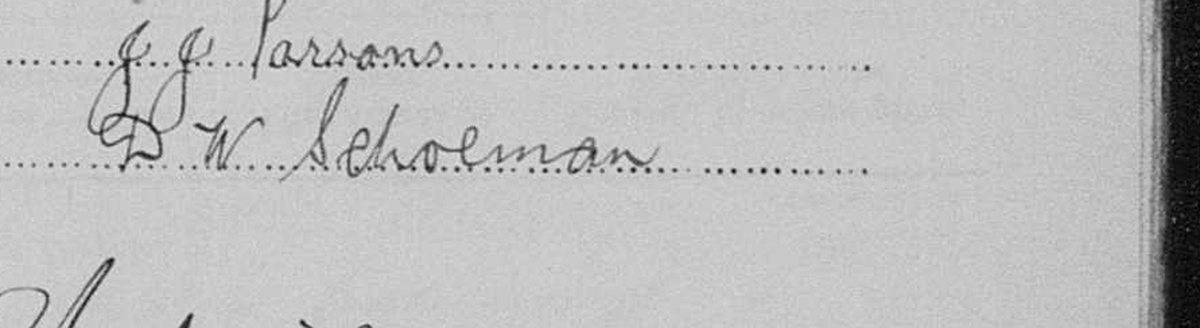
Hypothesis That is now a specific, searchable identity to set against the rebel commandant lists — not the bare initial the archive had before. It is still not proof. The rebels →
Married in a house, not a church
In the middle of the war, in a private dwelling. And in the Gereformeerde Kerk — the "Dopper" church — not the Nederduitse Gereformeerde Kerk in which Willem Hermanus Booysen had married in 1879. A different, more conservative denomination.
And two more British farm names
He was of a farm whose name reads as “Arundale” — the word is genuinely ambiguous at full magnification — and she of Caerlaverock. Set beside John Barry's Manorowen, the farms of this district carry Scottish and Welsh place-names — Dumfriesshire, Scotland, Pembrokeshire.
Inferred These are British settlers' farms, and the families on them were siding with the republics. That complicates the picture in a way worth keeping.
c. 1909 · Anna Pretorius, aged about four
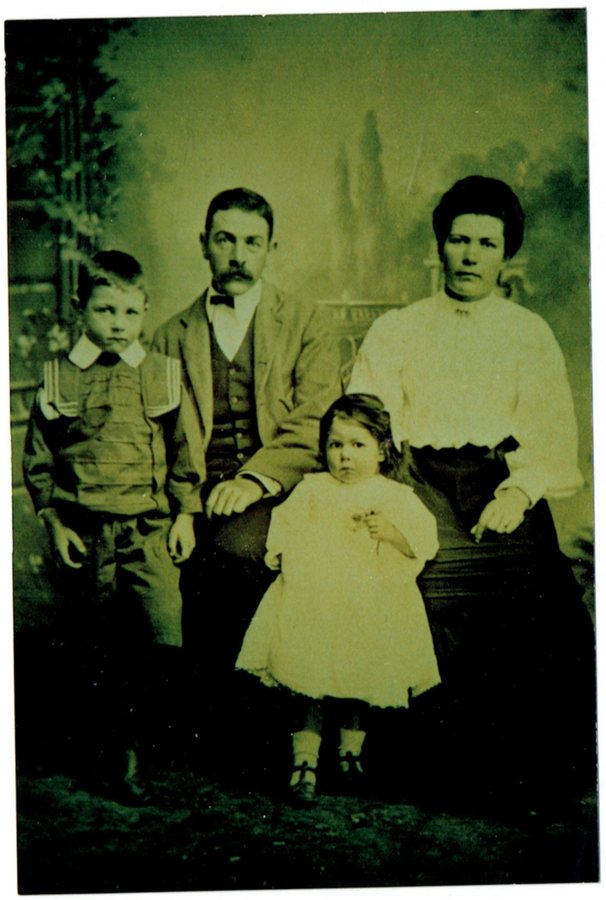
Left: a boy of about seven in a pleated tunic and wide collar — Dirk Jacobus
Pretorius (b. 8 June 1902).
Centre: Petrus Jacobus Pretorius (1878–1941), the stock farmer.
Right: Margarietha Wilhelmina Elizabeth Barry (1880–1961), in a high-necked blouse
with her hair dressed in a pompadour.
Front: a small girl of about four — Anna Johanna Maria Pretorius (b. 3 Oct 1905).
Inferred The hairstyle and blouse date the picture to about 1908–1912; the children's ages narrow it to roughly 1909.
This is David Defranceski's great-grandmother as a small child — the woman who would die at thirty-eight of an ectopic pregnancy at Forest Hill, leaving Catherine orphaned at eighteen. It appears to be the only photograph of her parents together, eight years after they married in D. W. Schoeman's house.
1940 · Kathleen Barry's death certificate, and one unexpected word
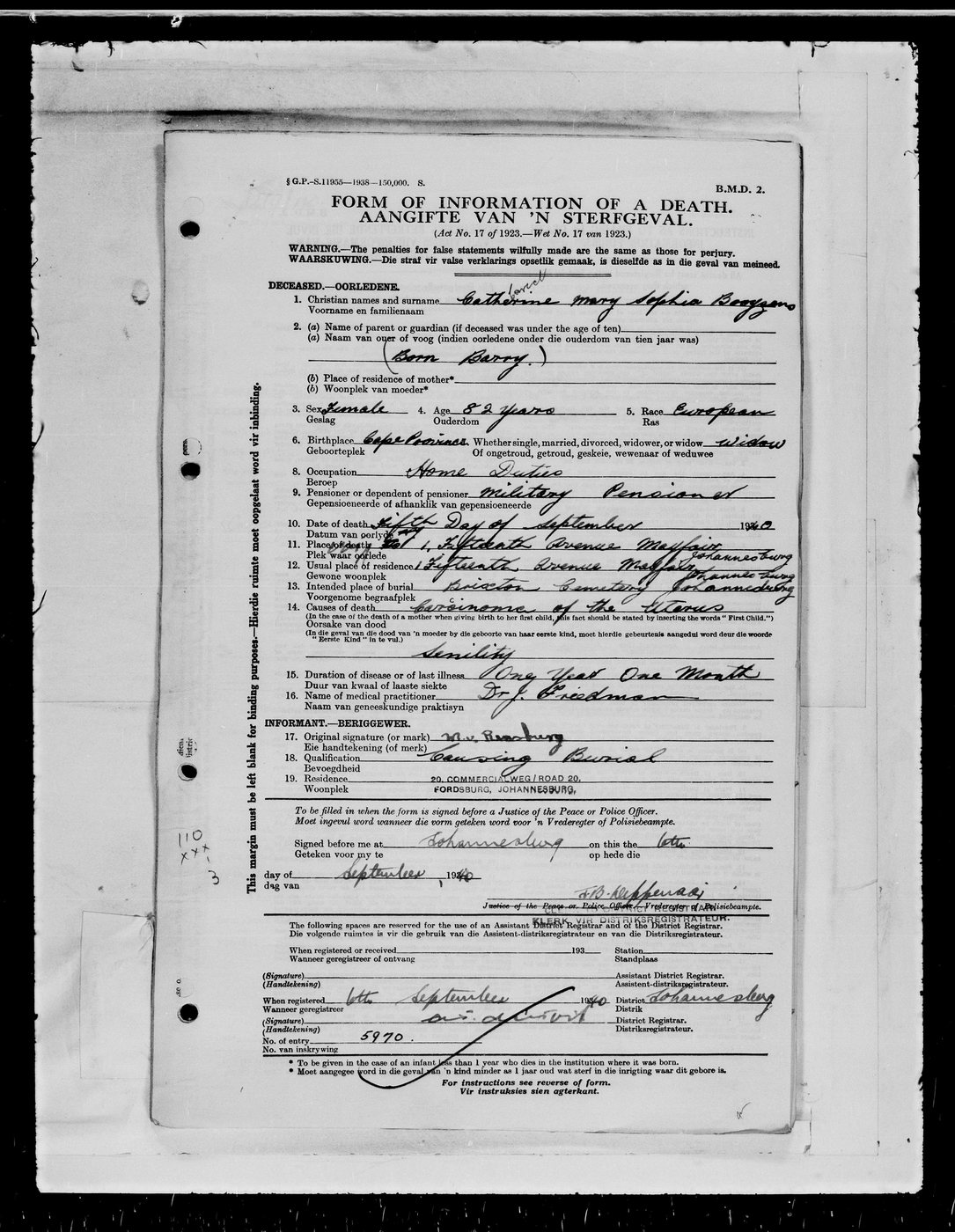
| Name | Catherine Mary Sophia Booyzen — "(Born Barry.)" |
| Age · birthplace · condition | 82 · Cape Province · Widow |
| Occupation | Home Duties |
| Pensioner | MILITARY PENSIONER |
| Place of death | No. 1, Fifteenth Avenue, Mayfair, Johannesburg |
| Intended place of burial | Brixton Cemetery, Johannesburg |
| Causes of death | Carcinoma of the Uterus; Senility — one year one month |
| Informant | M. v. Rensburg, "Causing Burial", of 20 Commercial Road, Fordsburg |


Untested The likeliest route is a son's First World War service — several of her sons were of age — with a dependant's pension attaching to her. It is a hard, searchable fact and an entirely new thread in this archive.
It also carries an irony worth leaving in rather than smoothing away: a family that remembers fighting the British ends with its matriarch on a military pension in a British dominion.
Two smaller gains. The archive had only "Mayfair" for her death; it now has No. 1, Fifteenth Avenue. And the tree records no burial place for her at all — she is at Brixton Cemetery. Johannesburg →
1912–1915 · "Father: Kolbe, thinks James was christian name"
Of everything read in these four days, this is the line that most justifies the archive existing.
She died on 2 August 1912; her son completed the notice on 13 May 1915, nearly three years later. That gap matters — and it is the same gap as the 1840 Montjoy notice, written thirteen years after that death, which answers the same question with "Not Known." In both cases the delay is part of the reason the answer is empty.
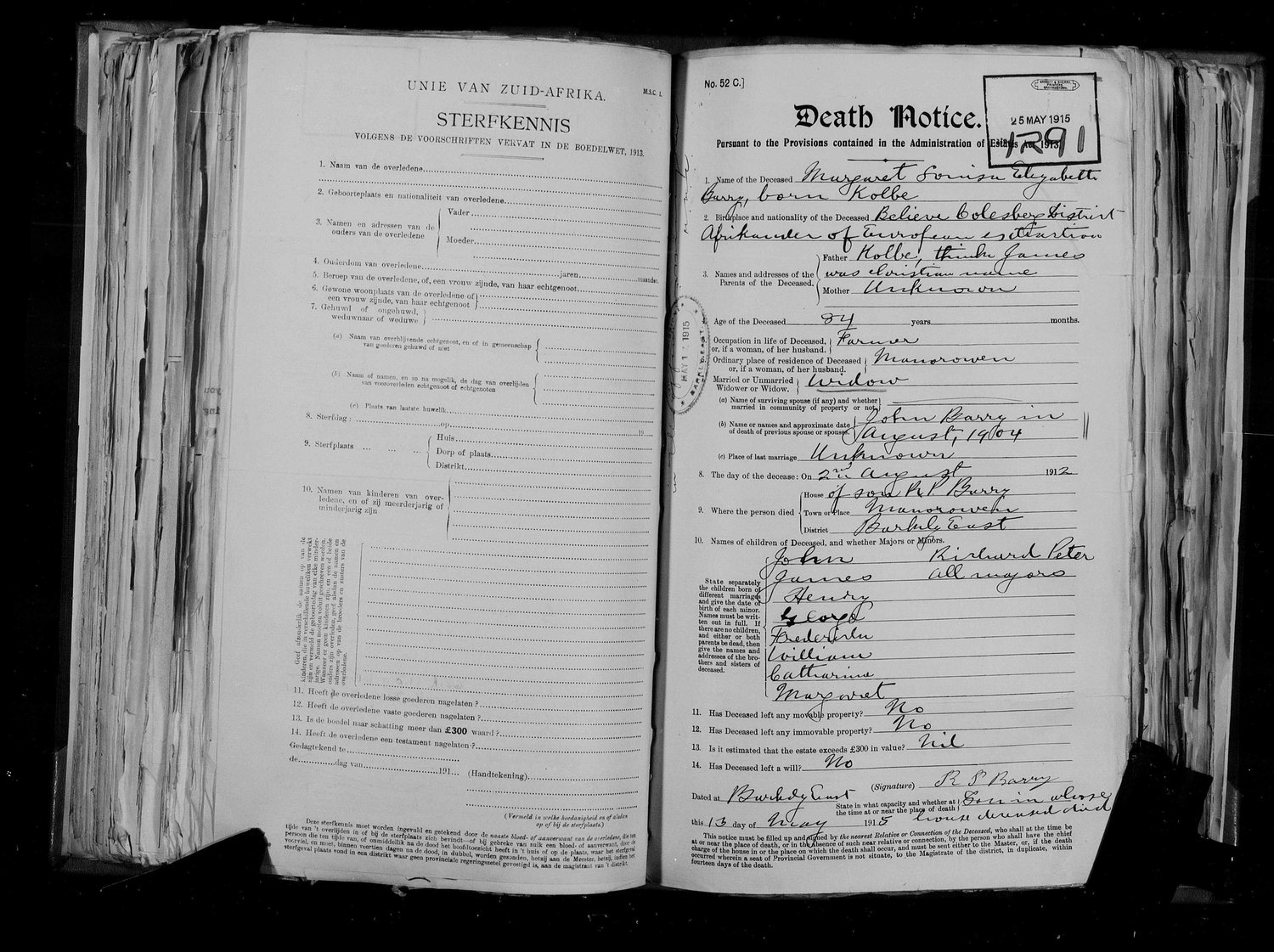

Her son, filling in his own mother's death notice, did not know his grandfather's name. He guessed James. Of his grandmother he knew nothing at all.
His grandfather was George Augustus Kolbe — who married at sixteen on a sworn lie in Shoreditch, sailed on the Nautilus in 1819, preached across the Orange River, named a Karoo farm after his father's Württemberg, and lies under a cut-stone monument at Burgersdorp with his name, his London birth and his farm carved into it. His grandmother was Margaret Downing of London, buried in the same grave.
The family forgot them inside seventy years, while the headstone stood forty miles up the road.
Two generations after the Nautilus, the notice describes her as "Afrikander of European extraction" and guesses her birthplace: "Believe Colesberg District." The Kolbes →
Set that beside her mother Margaret Downing, who in 1867 left a house in Burgersdorp and a farm in the division of Albert; beside her grandfather Johan Gottlieb Kolbe, whose 1842 will disposed of a partnership in a Bond Street tailoring firm; and beside her husband John Barry, whose estate in 1903 exceeded £300. The Kolbe money did not last three generations.
This notice also supplies a third date for John Barry's death — "August 1904" — against the 3 August 1903 of his own 1915 death notice and the 25 August 1903 in the tree. Both notices were made in 1915, by two different sons, and they contradict each other. Disputed →
1923 · The Schoemans get a name
The archive has been chasing a "D. Schoeman" of Caerlaverock since the beginning. This document does not name him — but it plants his family.
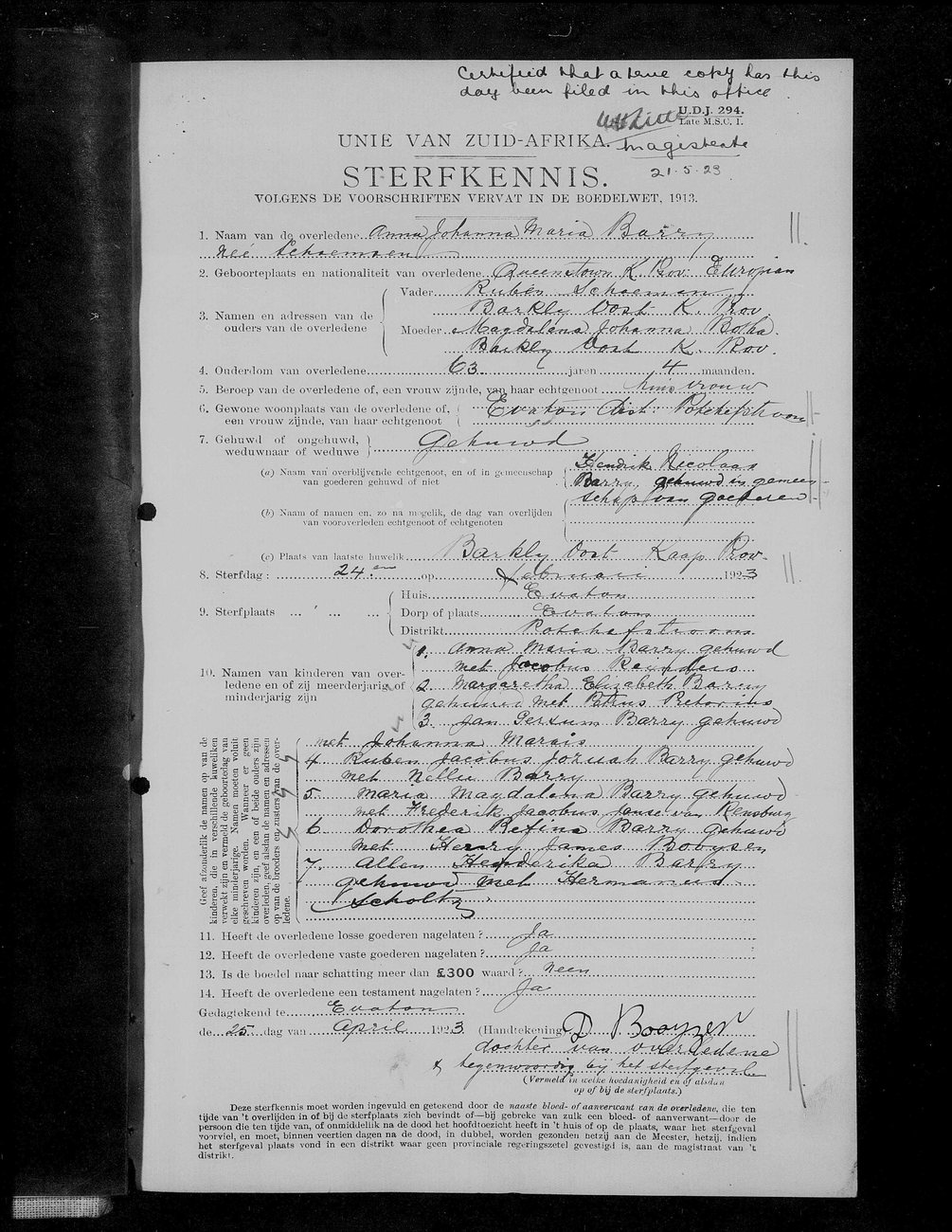
| Geboorteplaats | Queenstown, Cape Province |
| Vader | Ruben Schoeman, Barkly Oost, K. Prov. |
| Moeder | Magdalena Johanna Botha, Barkly Oost, K. Prov. |
| Echtgenoot | Hendrik Nicolaas Barry, in community of property |
| Plaats van laatste huwelik | Barkly Oost |
| Signed | D. Booyzen, "dochter van overledene", present at the death |
Ruben Schoeman of Barkly Oost
Anna Johanna Maria Schoemann — who married Hendrik Nicholaas Barry in 1877, and whose grandchild Anna married George Booyzen in 1924 — was the daughter of Ruben Schoeman and Magdalena Johanna Botha, both of Barkly Oost.
The naming confirms it: her fourth son is Ruben Jacobus Josuah Barry, after his maternal grandfather.
Inferred This does not identify D. W. Schoeman of Caerlaverock — but it places a named Schoeman family in exactly the right district and generation to hold him. The rebels →
And a Booyzen signs it
The informant is "D. Booyzen" — Dorothea Regina Barry, who married Henry James Booyzen at Elliot in 1912. She signs as a Booyzen, daughter of the deceased, present at the death.
A third document, independent of the other two, confirming the third Barry–Booyzen marriage. The cousin marriage →
1803 · The London end of the line, closed
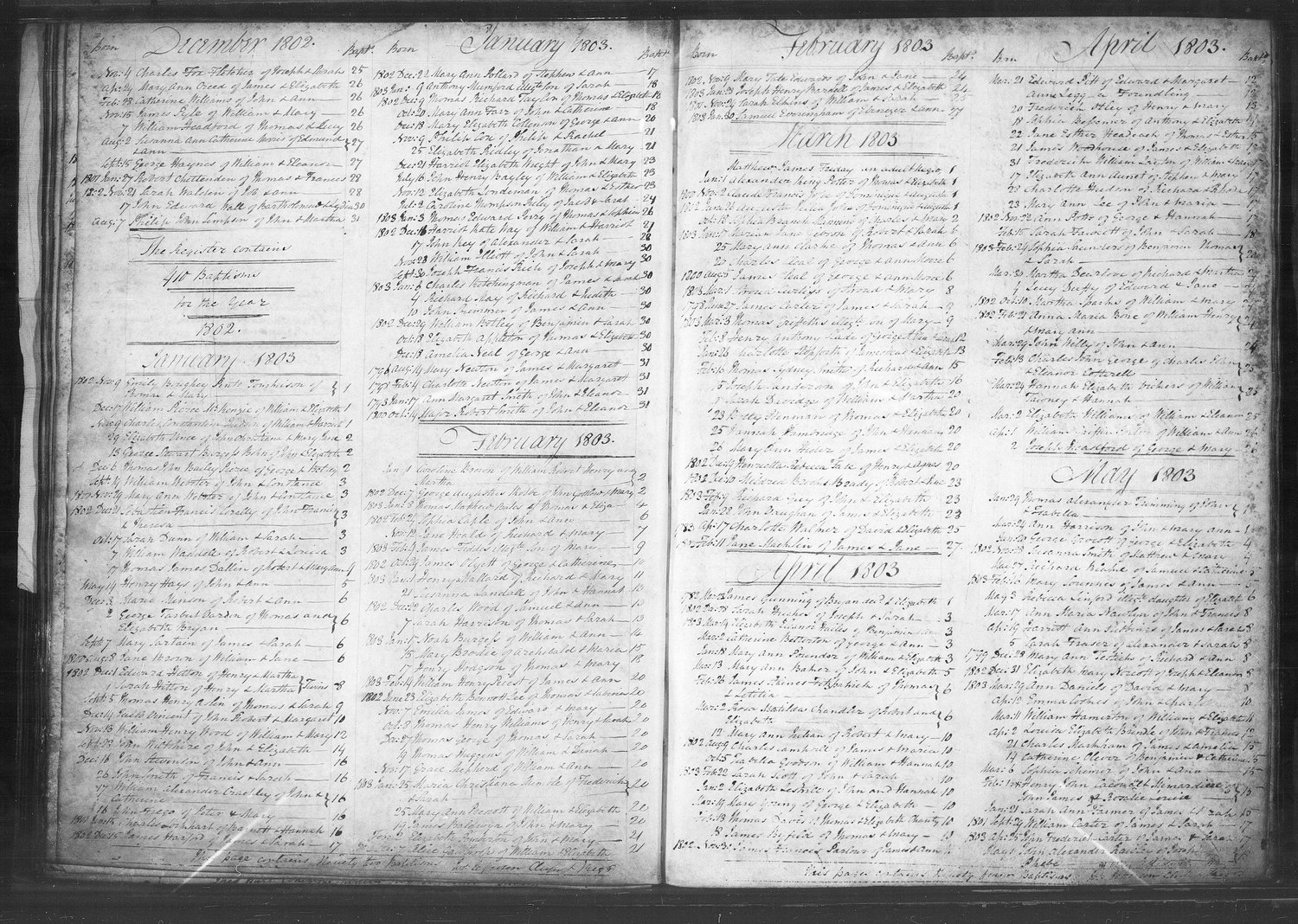
A baptism register index from St Anne's, Soho — birth date at the left, day of baptism at the right. A note on the same page records that the register holds "410 Baptisms for the Year 1802."
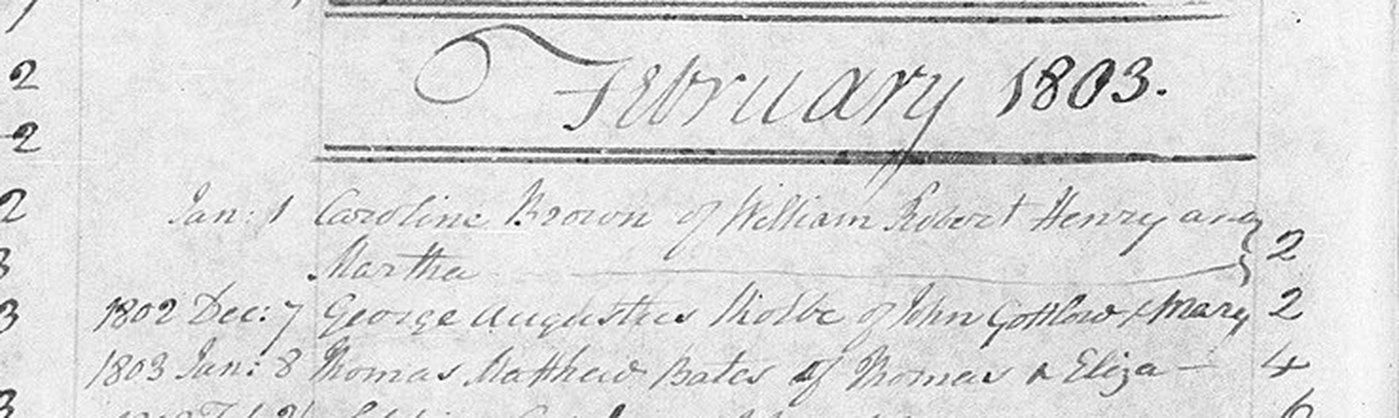
Born 7 December 1802. Baptised 2 February 1803. Son of John Gottlob and Mary.
An English parish register and a Karoo gravestone, written ninety years and six thousand miles apart, give the same birth date to the day: 7 December 1802.
Documented And the parentage is no longer taken on the tree's word. The link from George Augustus Kolbe, the 1820 Settler, to John Gottlob Kolbe, tailor of Conduit Street, is on the parish register. The London end of this line is closed. His mother is not. The register names her “Mary” and nothing more — as it does at eight other baptisms — and the burial register that gives her death and her age gives no maiden name either. “Larman” comes from the family tree and from nowhere else this archive has read, and for an afternoon this page said it was on the register. It is not. Corrections →
Four independent documents, and not one of them says "Johan Gottlieb." That is the German original the family tree leads with. "John Gottlob" is the name he actually used, and was buried under, in England — and this archive now follows the documents. The Kolbes →
1906 · A one-digit slip, caught by two documents
A Gereformeerde Kerk baptism register. Entry 29, under Gedoopt 11 Nov. 1906:
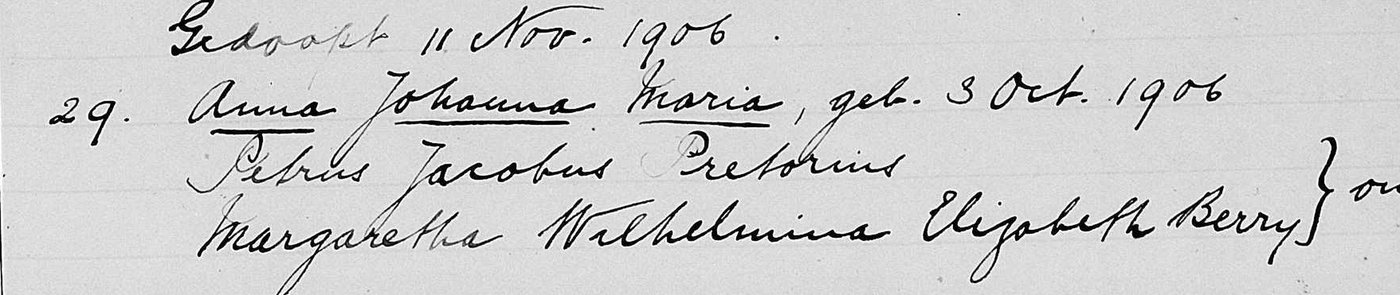
The tree gives her birth as 3 October 1905 and her christening as 11 November 1906 — a thirteen-month gap. The register shows the two are five weeks apart, both in 1906. It is the same register the christening date came from; the birth year was mistranscribed by one digit.
And her own death form settles it independently: "Age — 37 years" at 26 February 1944. A birth in October 1905 would make her 38.
Documented Anna Johanna Maria Pretorius was born 3 October 1906. A contemporary baptism register and a death registration agree, against the tree.
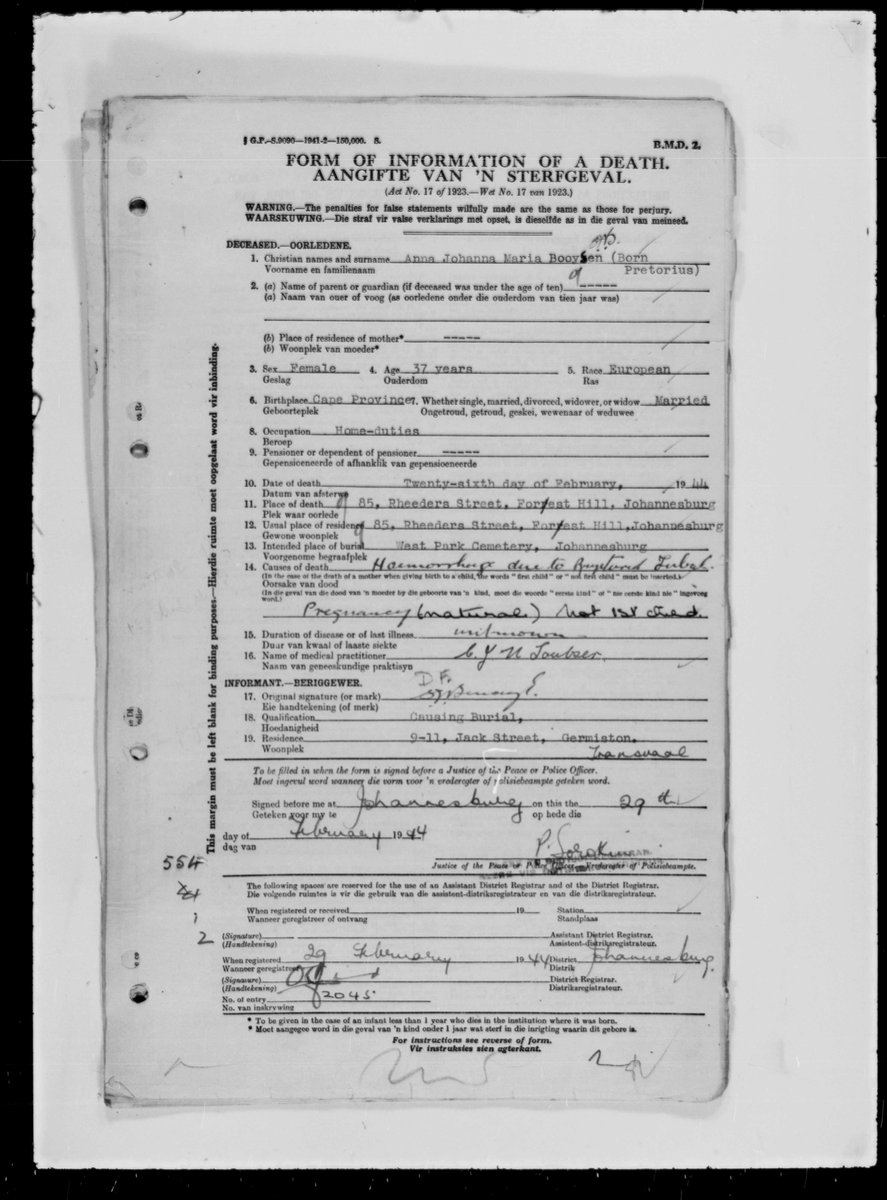
| Age | 37 years |
| Place of death | 85, Rheeders Street, Forrest Hill, Johannesburg |
| Intended place of burial | West Park Cemetery — the same ground as her husband; the tree gives only "Johannesburg" |
| Causes of death | "Haemorrhage due to Ruptured Tubal Pregnancy (extra-uterine). Not 1st child." |
| Informant | "Causing Burial", of 9–11 Jack Street, Germiston |
1961 · Margarietha Barry, and a pension that is only ordinary
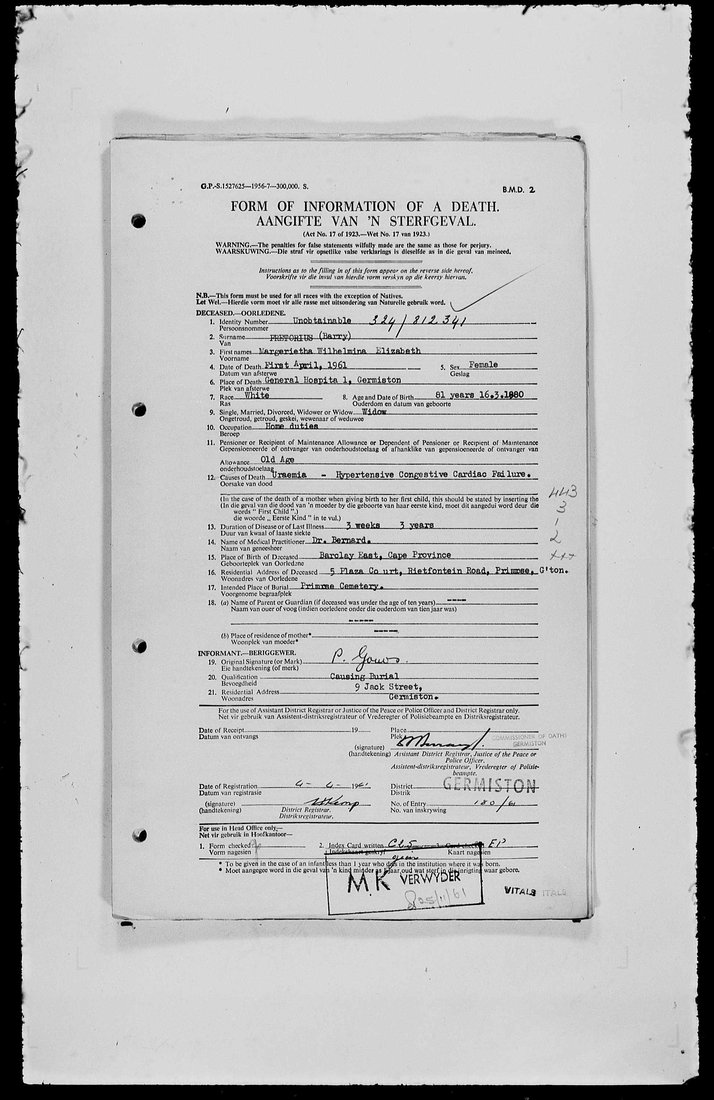
| Age and date of birth | 81 years, 16.3.1880 — confirming the tree exactly |
| Place of birth | Barclay East, Cape Province |
| Died | First April 1961, General Hospital, Germiston |
| Causes of death | Uraemia — Hypertensive Congestive Cardiac Failure |
| Residence | 5 Plaza Court, Rietfontein Road, Primrose, Germiston |
| Burial | Primrose Cemetery |
| Allowance | Old Age |
| Identity number | "Unobtainable" |
One small human detail. The informant here, P. Gouws of 9 Jack Street, Germiston, gives the same address as the informant on Anna's 1944 form seventeen years earlier. Almost certainly an undertaker's premises rather than a relative — a reminder that "informant" on these forms often means the funeral director, not family.
Two corrections to this archive's own work
Both were found by reading the last four documents. Both were mine, not the tree's.
The farm was not "Armadale"
This archive read the groom's 1901 residence as Armadale and built a small argument on it — that the Barkly East farms carried Scottish names. At full magnification on the original register the word is genuinely ambiguous: it reads as "Arundale", possibly Armsdale or Ormsdale.
"Armadale" was an over-reading and is withdrawn. The wider point survives on the two names that are certain — Caerlaverock (Dumfriesshire) and Manorowen (Pembrokeshire) — but the archive should not have leant on a word it could not read.
Catherine was orphaned at eighteen
This archive said in four places that Catherine Mary Sophia Booyzen was "seventeen years old and had no parents." That was calculated from the wrong death date for her father — the tree's 21 February 1947, which this archive itself later corrected to 11 December 1947 without carrying the correction through to her age.
Born 25 March 1929, she was eighteen when her father died, and fourteen when her mother did. Corrected throughout.
1851 · The baptism that settles an age, and names a godfather
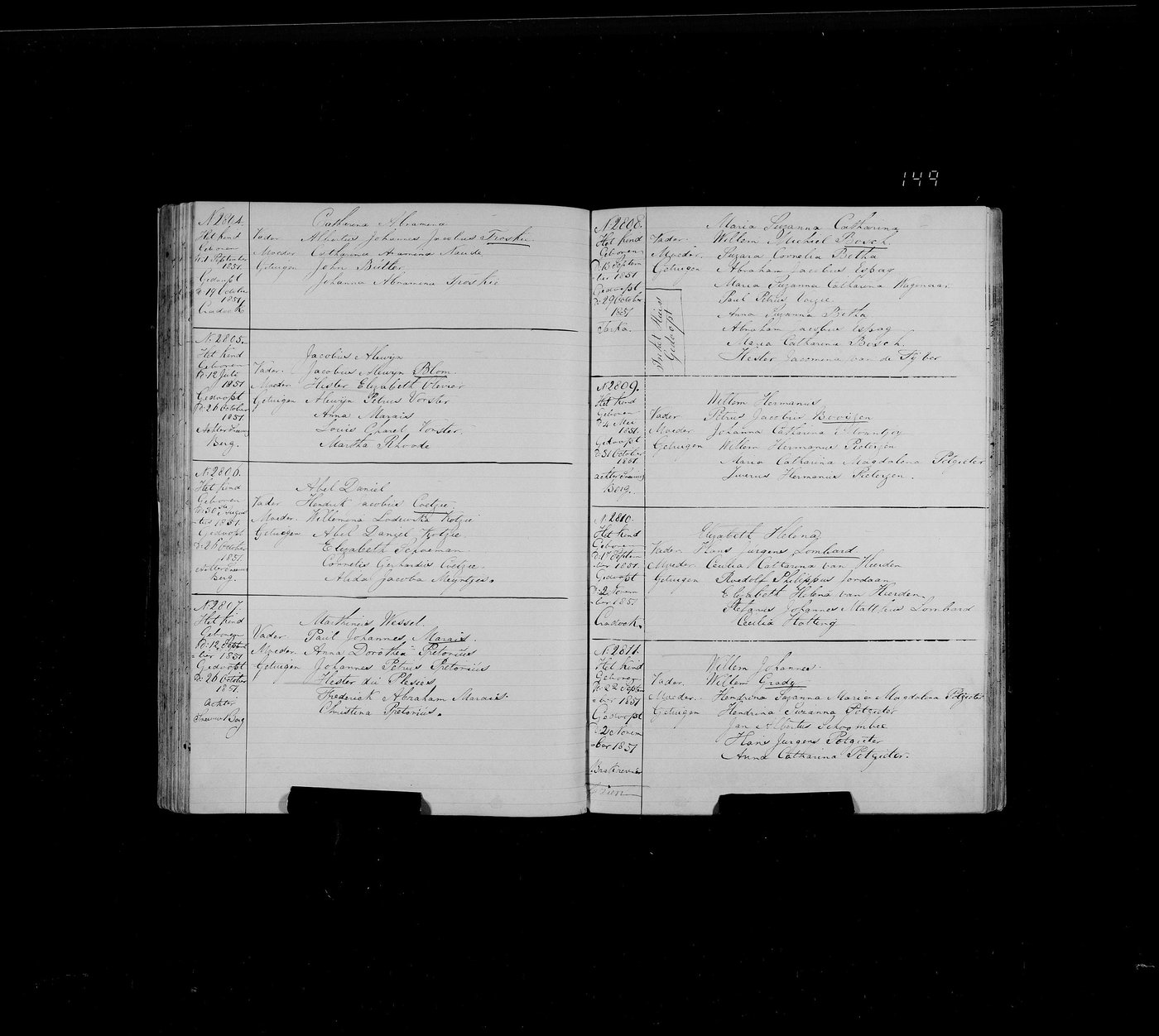
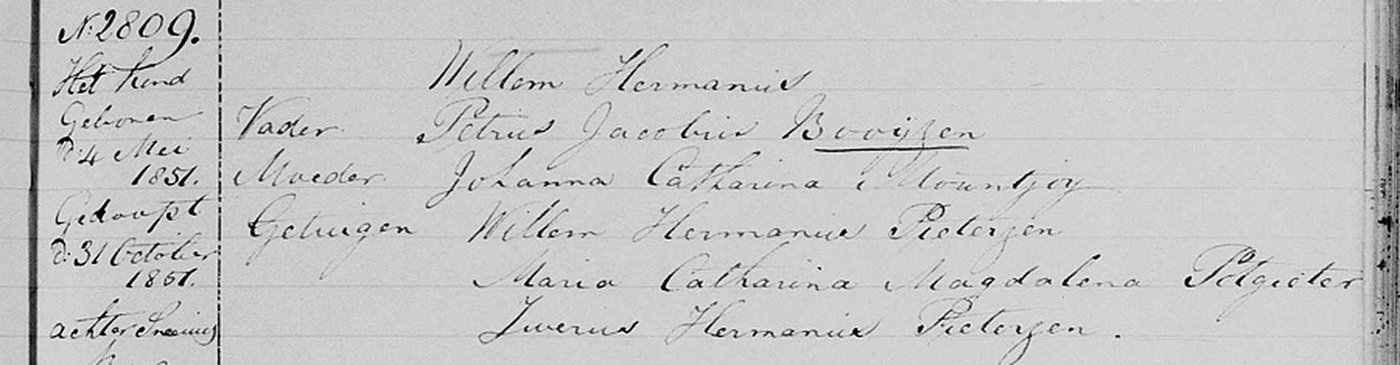
The age question is settled
Documented Born 4 May 1851, from a contemporary register, matching the tree exactly.
So of the three figures the archive had, the marriage register is the outlier: it gives his age as 22 in December 1879, when he was 28. His 1905 death registration says 55, which is right within a year. The 1879 entry is wrong by six years.
And he was named for his godfather
The witnesses are Willem Hermanus Pieterzen, Maria Catharina Magdalena Potgieter and Xaverius Hermanus Pieterzen. (The archive scan corrects this archive's earlier reading of the surname as Pietersen — see below; the first given name, earlier read as Iwerus, is still not certain.)
Johanna Catharina Mountjoy's half-brothers were Pieterzens — the sons of Anna Catharina Sleer by her first marriage. The archive had them only as names in a list. Here one of them is standing at the font, and the child takes his name. The women →
The register's place column reads achter Sneeuwberg — the family was farming behind the Sneeuberg, not living in Cradock town.
Resolved — by a better scan, and not in the direction expected
This section previously read the father's surname here as "Booij_en", with the same ambiguous medial letter as the 1879 signature, and concluded: "I cannot separate them from an image… The change is real. Its date is not established, and no scan will establish it."
That was read from a photograph of the register on the family tree. The archive has since read the Cape Town Archives scan of the register itself, at nine times magnification. It is not ambiguous at all:

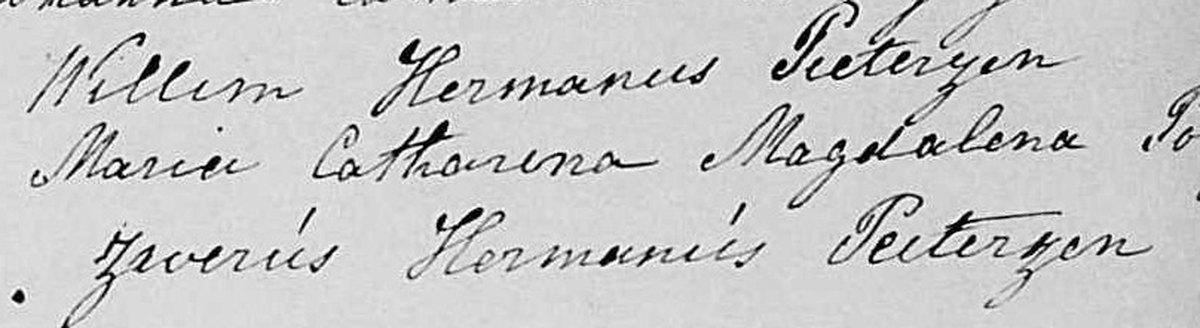
The letter is a z. And it is a z for the Pieterzens too — a family with no name-change story attached to it. In Dutch orthography -zen is simply how the patronymic ending is written, and this clerk wrote it that way for everyone.
The scan settled the letter. Settling the letter is what took the argument away.
What this costs. The z cannot have been invented by anyone in this family — it was ordinary Cape-Dutch spelling, sitting in the registers in 1851. The 1879 signature question is not merely unsettled but largely emptied: a z-shaped letter in a Dutch hand is not evidence of intent.
What survives, unchanged. The 1905 death registration, which turns on two spellings of one man's name on one sheet — clerk Booysen, son Booyzen — and not on the shape of any single letter. The tree's recorded "Former name: Booysen". And the distribution data: 646 against 53,764, Gauteng against the Cape, gathered a century later by people who had never heard of this family.
The change is real. The spelling it changed to was not new. The name →
1946 and 1947 · The two Gertrudes — a contradiction resolved
This archive flagged as Serious: two daughters recorded born on 11 May a year apart, both named Gertrude Elizabeth. Either two children given the same name and the same birthday — or one record duplicated a year out.
Both certificates exist, and they are irreconcilably different documents.
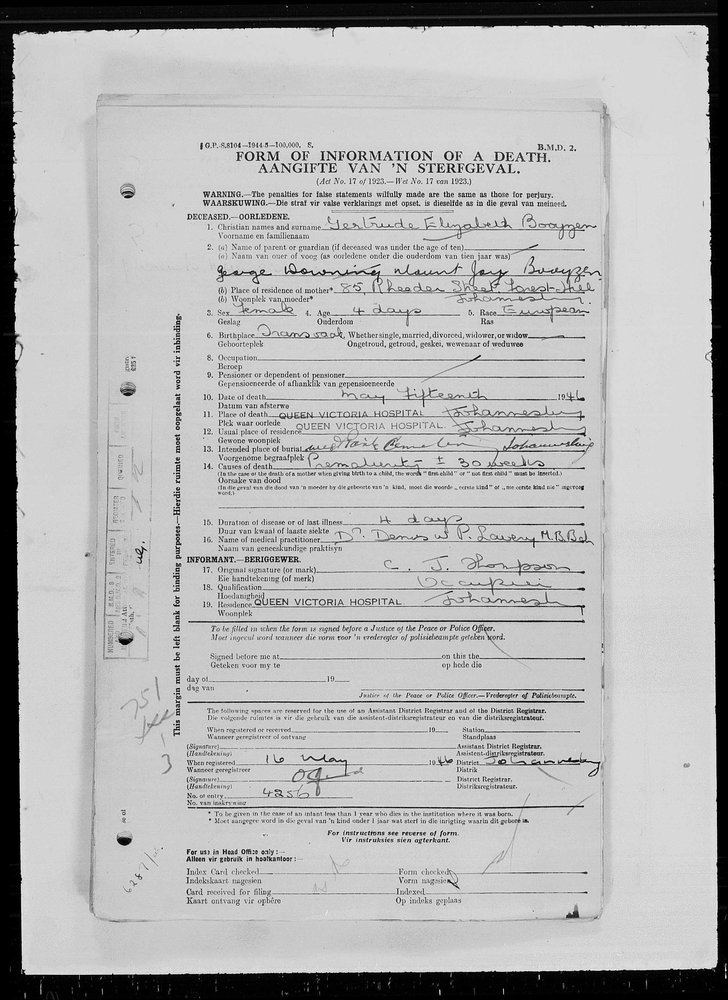
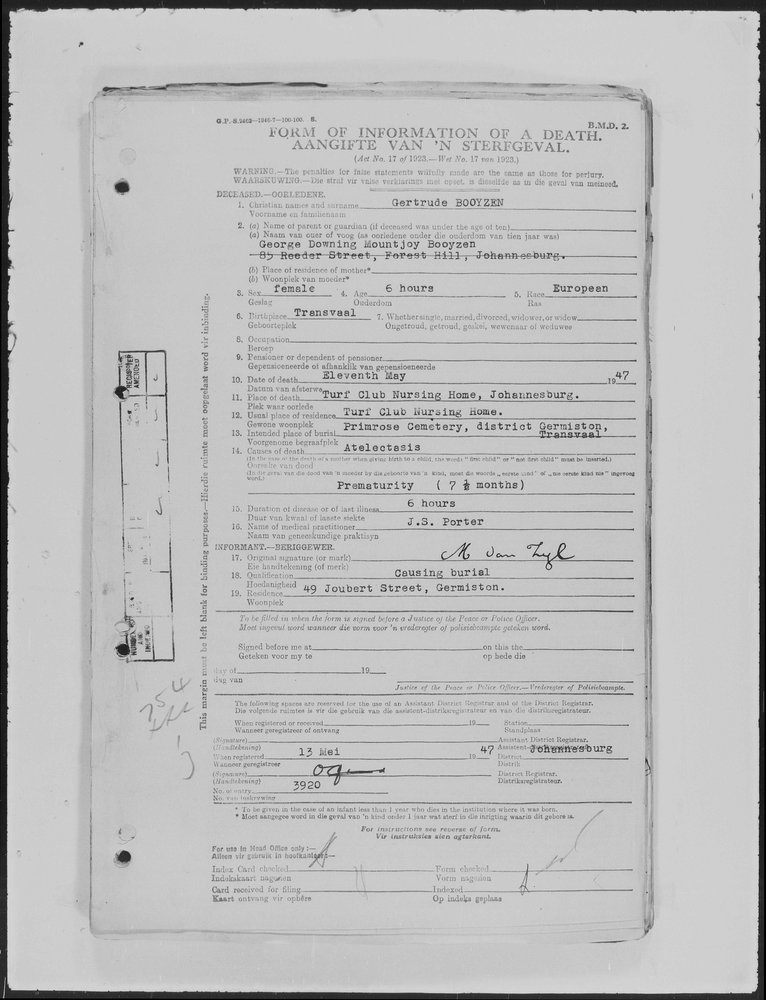
| Gertrude Elizabeth Booyzen | Gertrude Booyzen | |
|---|---|---|
| Date of death | 15 May 1946 | 11 May 1947 |
| Age | 4 days | 6 hours |
| Place of death | Queen Victoria Hospital | Turf Club Nursing Home |
| Cause | Prematurity ± 30 weeks | Atelectasis; prematurity 7½ months |
| Doctor | Dr Dennis W. P. Lavery | J. S. Porter |
| Burial | West Park Cemetery | Primrose Cemetery, Germiston |
Two hospitals. Two cemeteries. Two doctors. Two registration entries a year apart. Four days, and six hours. There were two children. Resolved
And the coincidence the archive doubted is real. Both were born on 11 May, exactly a year apart, and both were badly premature — the first at about thirty weeks, the second at seven and a half months. The first lived four days. The second lived six hours. They are not buried together.
February 1944 — Anna dies at 85 Rheeder Street, aged 37. · May 1946 — Gertrude Elizabeth, four days old. · May 1947 — Gertrude, six hours old. · December 1947 — George, aged 46.
Catherine Mary Sophia Booyzen was eighteen. Two years later she married at St Joseph's, Mayfair. Johannesburg →
Three smaller corrections. The first Gertrude did not die at 85 Rheeden Street — the certificate gives Queen Victoria Hospital and names the street only as the mother's residence. The second child is registered simply "Gertrude", not Gertrude Elizabeth. And the street appears as Rheeder, Rheeders and Rheeden across three documents.
1819 · The marriage entry — and a bride who could not sign her name
The allegation was sworn that morning. This is the register entry itself, St Leonard's Shoreditch, No. 858.
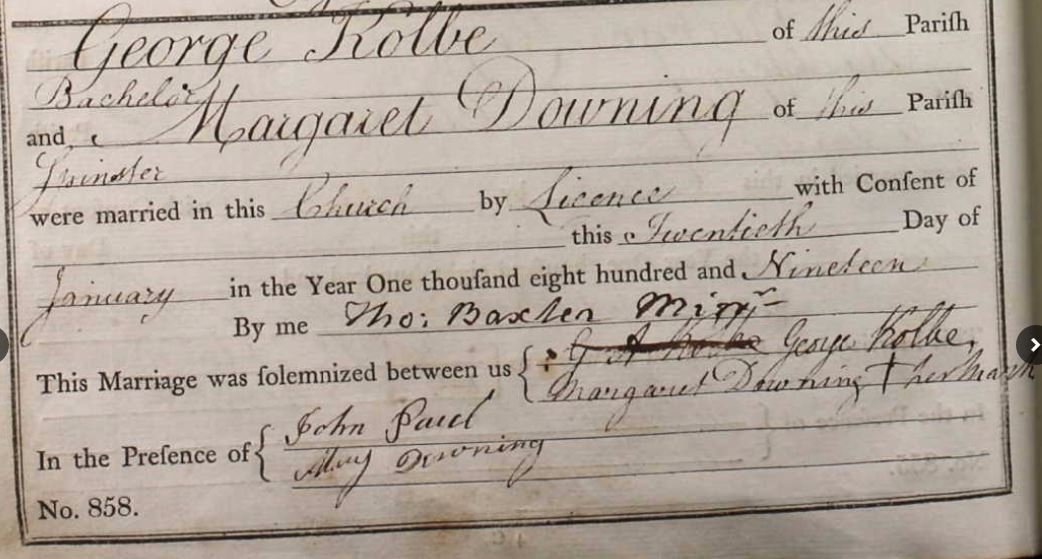
He signed George Kolbe — after striking through a first attempt. She did not sign.
Margaret Downing † her mark.
She could not write her own name. She was fifteen.
And in 1867 she died at Burgersdorp owning a dwelling house and a farm in the division of Albert, having buried her husband at forty-one and raised ten children across a mission circuit from Uitenhage to Bethulie. It is the steepest arc in this archive, and it starts with a cross in a Shoreditch register.
The blank that proves the lie
The line reading "with Consent of ————" is left empty. Under Hardwicke's Act a minor marrying by licence needed a named consenting parent. The blank is the visible consequence of the oath they had sworn that morning: that both were "of the age of Twenty-one Years and upwards." He was sixteen; she was fifteen.
And a witness called "John Paul"
The witnesses are John Paul and Mary Downing. The tree records the groom's father, Johan Gottlieb Kolbe, as also known as "John Paul" Kolbe.
Inferred If that is him, the father witnessed the marriage — which makes this something more complicated than an elopement: a parent standing by while his sixteen-year-old son swore he was of age. Unproved; "John Paul" could be an unrelated man.
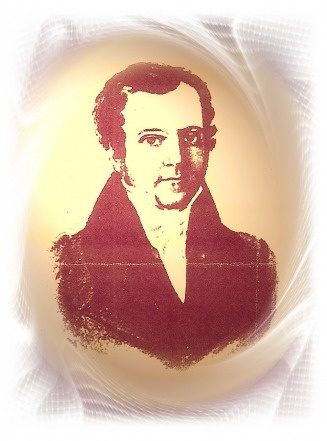
The portrait is a painting — as it had to be
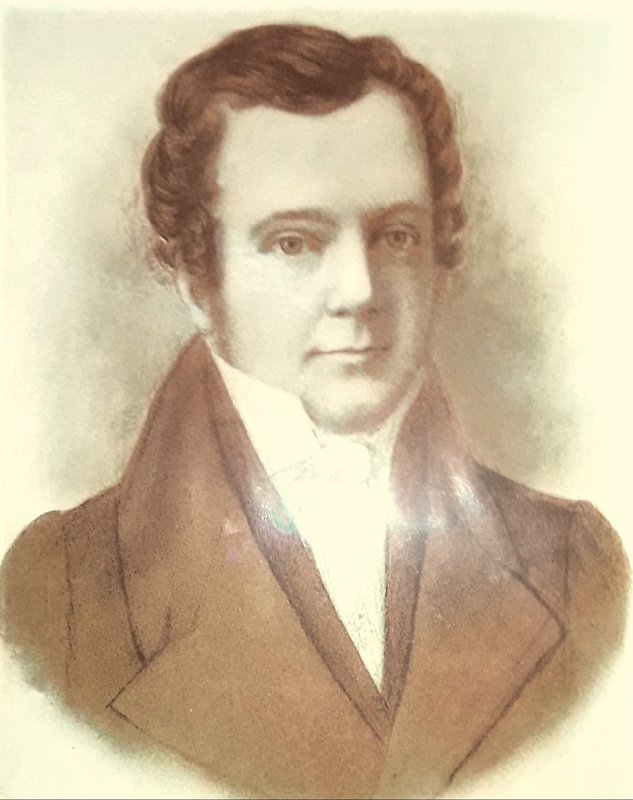
This archive had cautioned that any likeness of a man who died in 1844 — when photography was five years old and almost unknown in the Cape interior — would have to be a painted portrait, not a photograph from life.
Resolved It is. A young man with reddish-brown curling hair, clean-shaven, in a high white stock and a tan coat with wide lapels — dress of the 1820s and 30s, which fits a man born in 1802.
A third file in the same set is a left-facing profile so heavily processed — posterised, speckled, colour-fringed — that it is either a separate image or a modern "restoration" that has invented a great deal. Not relied on here for likeness.
1924 · A tree nurseryman marries at Vereeniging
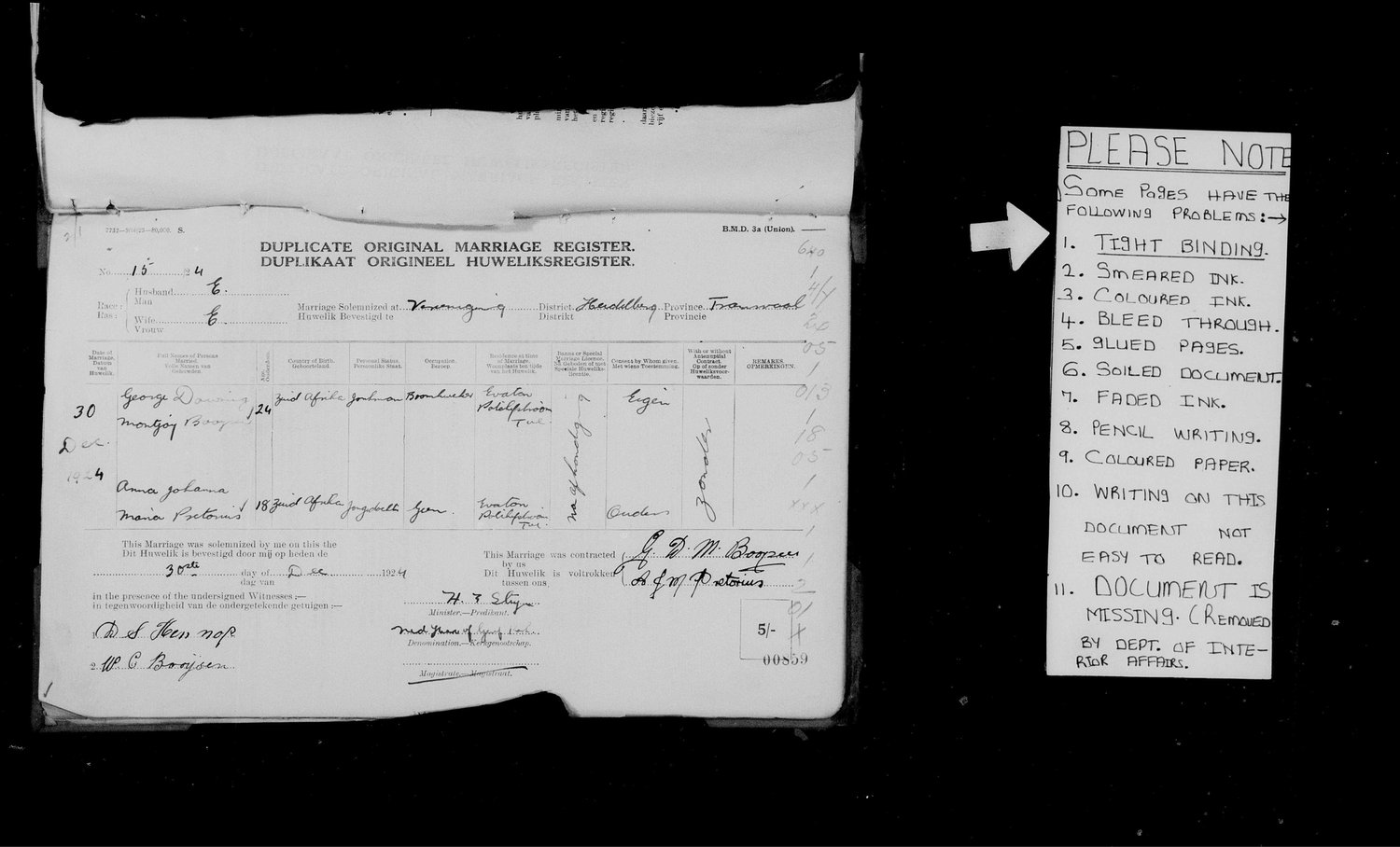
| Husband | Wife | |
|---|---|---|
| Age | 24 | 18 |
| Occupation | Boomkweker — tree nurseryman | Geen |
| Residence | Evaton | Evaton |
| Consent | Eigen — his own | Ouders — her parents' |
A third document for 1906
She is 18 at 30 December 1924 — which requires a birth in late 1906, not 1905. And her consent is recorded as "Ouders", her parents' — required because she was a minor.
With the baptism register and the death form, three independent documents now give 1906. The tree is wrong three times over.
Boomkweker
Not a miner, and not yet a railwayman. In 1924 George grew trees. A wholly new occupation for him — and by 1947 he was a clerk on the South African Railways.
Both were living at Evaton — where Anna's grandmother Anna Johanna Maria Schoeman had died the year before. The whole connection had moved north together.
1947 · The death registration, and a garbled memory vindicated
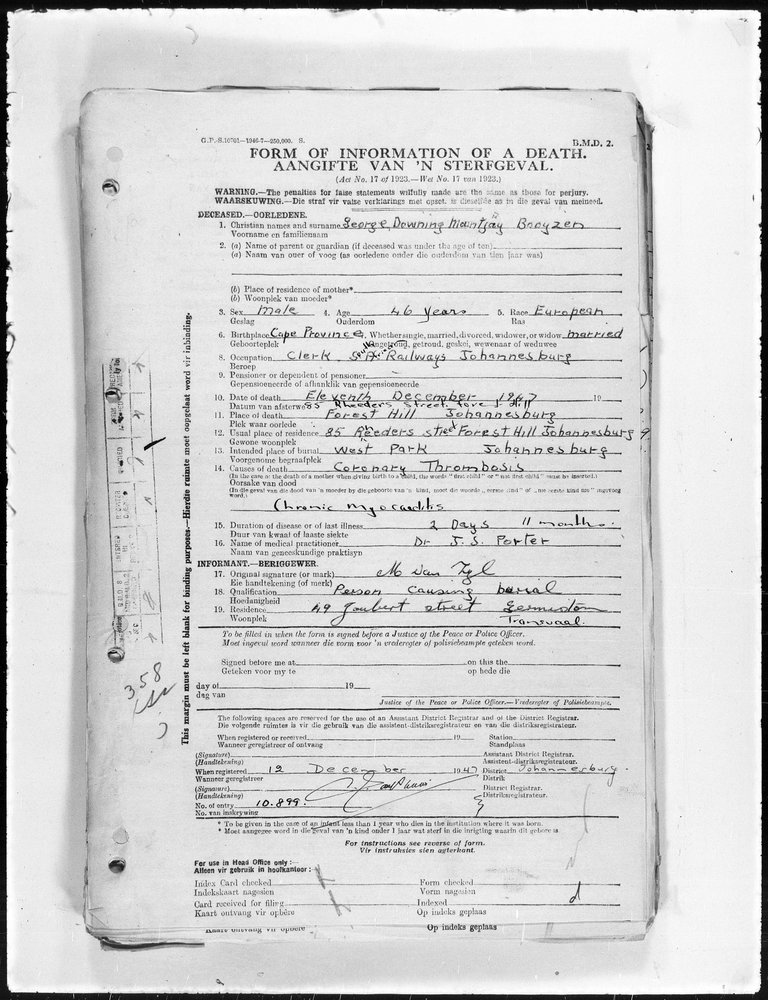
| Occupation | Clerk, South African Railways, Johannesburg |
| Date of death | Eleventh December 1947 |
| Place | 85 Rheeders Street, Forest Hill · buried West Park |
| Causes | Coronary Thrombosis; Chronic Myocarditis |
| Duration | 2 days / 11 months |
And the tree's strangest note turns out to be substantially right. It carried "Cause: HEART ATTACK 1946", which read like nonsense against a February 1947 death. The registration gives chronic myocarditis of eleven months' duration ending in a coronary thrombosis of two days. A year-long heart illness, ending in a heart attack. A garbled memory, but a true one.
1889 · Two grandparents at a font, and a name on the facing page
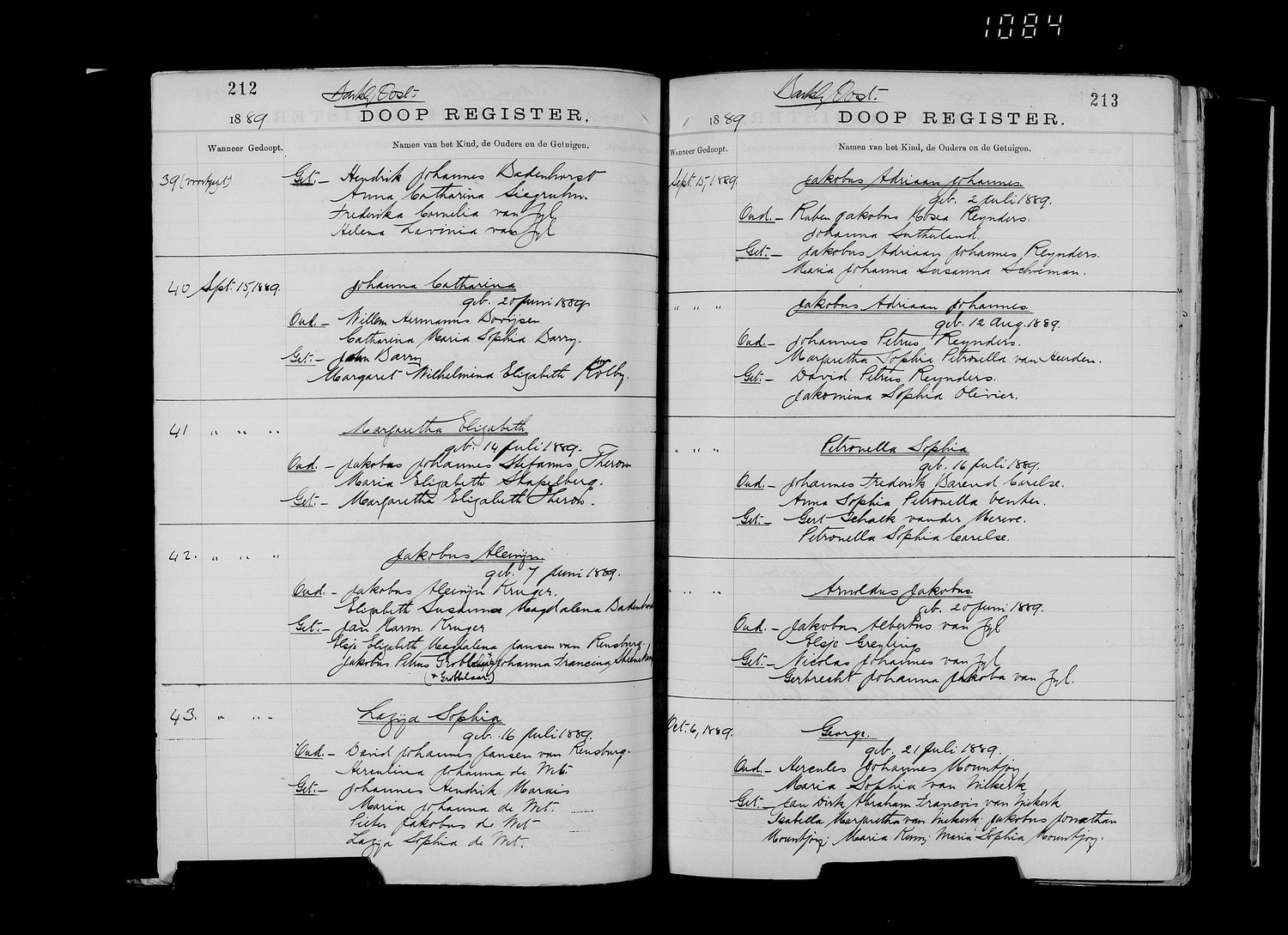
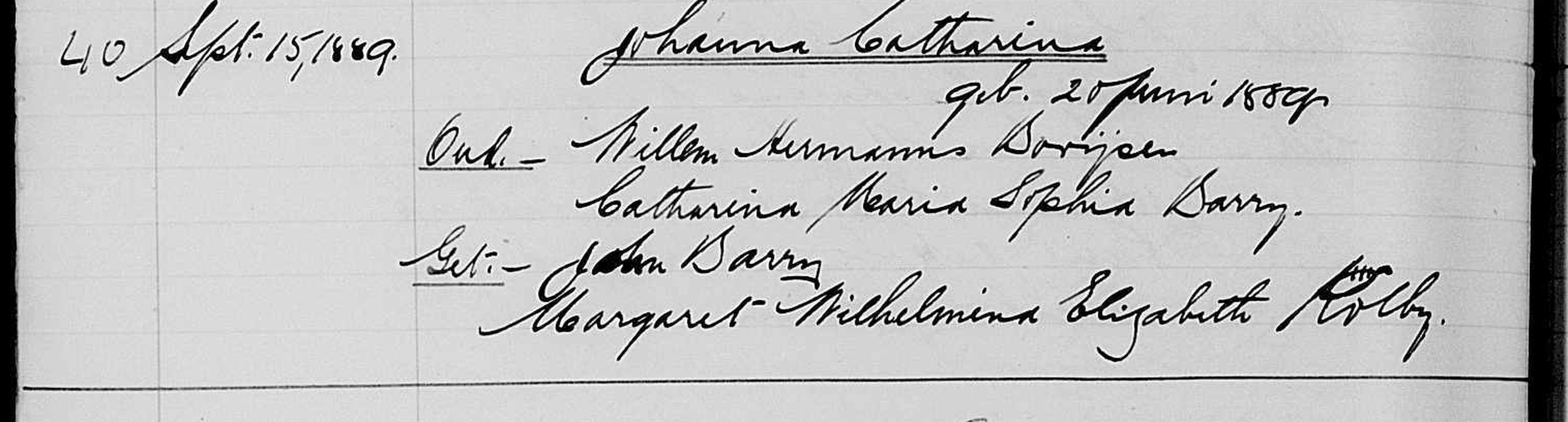
The godparents are the child's own maternal grandparents — John Augustus Barry I, the Irishman born at sea, and Margaretha Kolbe, the 1820 Settler's daughter, standing together at a font in Barkly East in September 1889.
Her surname is written "Kolby" — a phonetic variant, twenty-six years before her own son would tell a magistrate he thought his grandfather's name was James. The Kolbes →
And on the facing page, entirely by accident
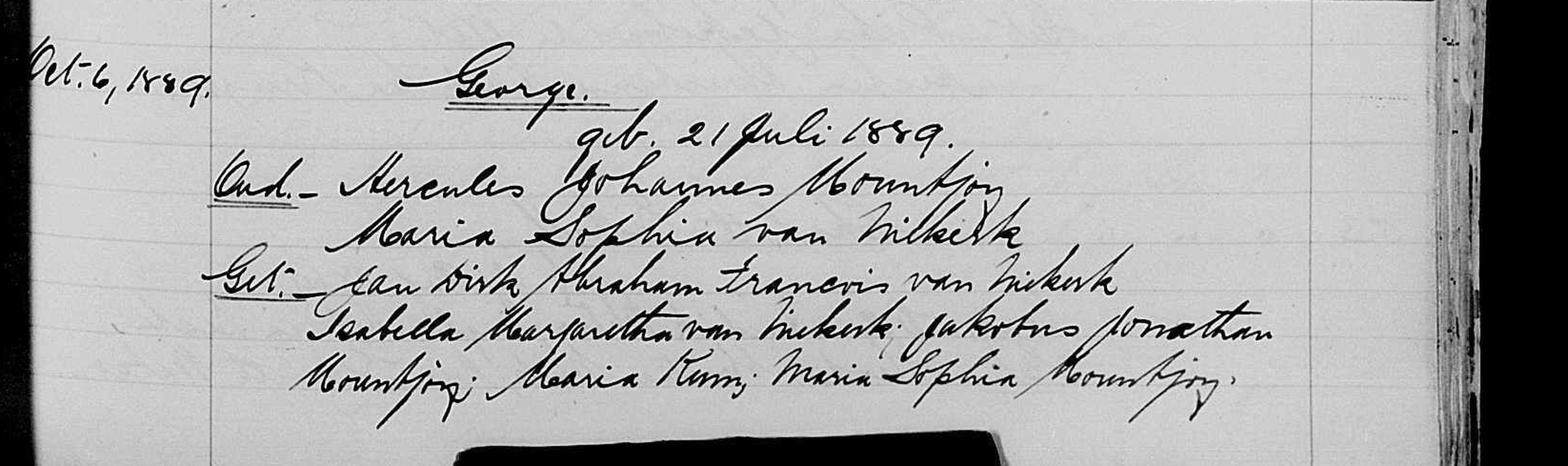
Hercules Johannes, Jakobus Jonathan and Maria Sophia Mountjoy are a named, searchable cluster in the right district, twenty-six years after her death — and they turned up on the page opposite a Booyzen baptism, found by accident. Open questions →
1863 · The death notice that adds a generation
Found by searching a spelling nobody had tried: Montjoy.
The National Archives index had been searched for MOUNTJOY — forty-two documents, none of them the one wanted. Searched for MONTJOY it returns four, and two of them are the junction between the two families:
| File | Reference | Year |
|---|---|---|
| MONTJOY, JAMES. DEATH NOTICE. | KAB MOOC 6/9/21, 4393 | 1840 |
| MONTJOY, JOHANNA CATHARINA. WIFE OF PETRUS JACOBUS BOOYSEN. WILL. | KAB MOOC 7/1/268, 87 | 1845 |
| BOOYSEN, JOHANNA CATHARINA. (NEE MONTJOY). DEATH NOTICE. | KAB MOOC 6/9/104, 499 | 1863 |
| MONTJOY, JOHANNA CATHARINA. LIQUIDATION AND DISTRIBUTION ACCOUNT. | KAB MOOC 13/1/221, 6 | 1866 |
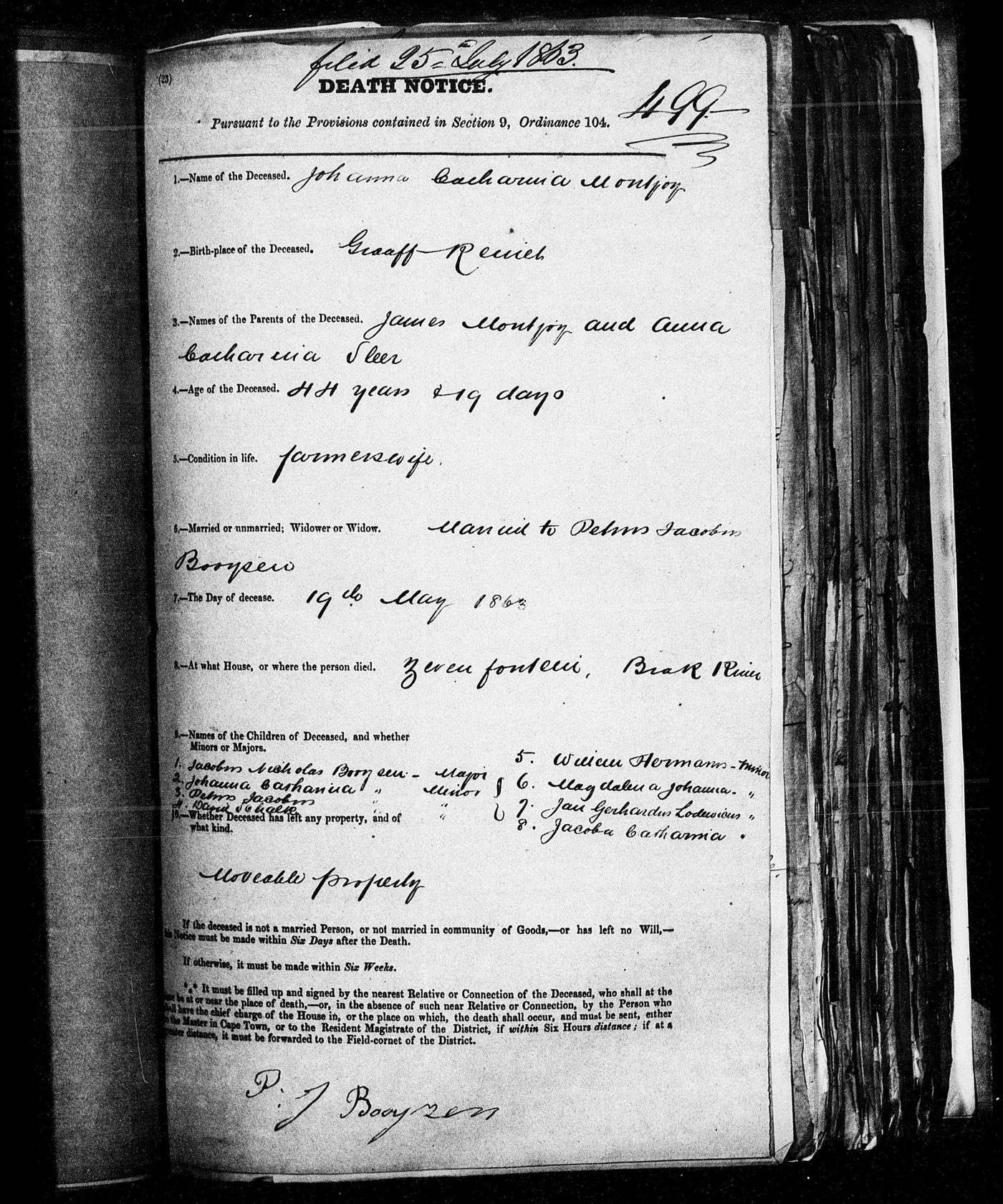
The form, as completed
| 1. Name of the Deceased | Johanna Catharina Montjoy |
| 2. Birth-place | Graaff Reinet |
| 3. Names of the Parents | James Montjoy and Anna Catharina Sleer |
| 4. Age | 44 years & 19 days |
| 5. Condition in life | farmer's wife |
| 6. Married or unmarried | Married to Petrus Jacobus Booysen |
| 7. Day of decease | 19th May 1863 |
| 8. At what House | Zevenfontein, Brak River |
| 10. Property | Moveable property |

An age given to the day
The form asks for years. The informant wrote "44 years & 19 days". Counted back from 19 May 1863, that puts her birth at 30 April 1819, at Graaff-Reinet.
The tree had "1819". The document has the date, and the informant knew it without being asked.
The surname, settled by convergence
The hand is genuinely ambiguous between Sleer and Steer, and this archive has over-read a single word before.
It is settled from outside: the family tree carries Schleher, FamilySearch's index carries Slier. Three renderings from three independent sources, all with an l and none with a t. The letter is an uncrossed l.
Eight children, and one of them is the direct line

Jacobus Nicholas · Johanna Catharina · Petrus Jacobus · David Schalk · Willem Hermanus · Magdalena Johanna · Jan Gerhardus Lodewicus · Jacoba Catharina.
The fifth child is the man the 1905 death registration is about. Willem Hermanus Booyzen, baptised at Achter Sneeuwberg on 31 October 1851, twelve years old and a minor when his mother died. His parentage — Petrus Jacobus Booyzen and Johanna Catharina Montjoy — is now carried by two original registers that agree, and the Mountjoy descent enters this family through his mother.
Seven of the eight are matched to baptisms in the Graaff-Reinet registers. An eighth child, Anna Catharina, baptised 21 September 1842, is not on the list — she died before her mother, and the notice is silent about her, as these forms are.
The signature
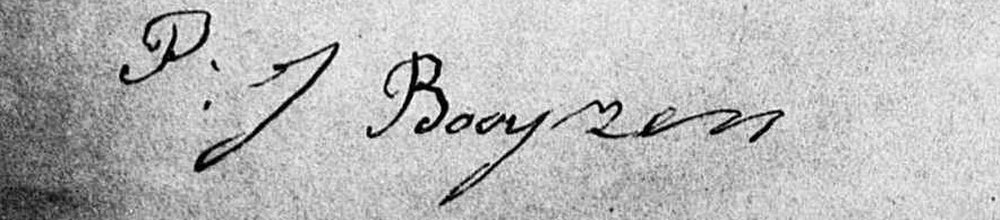
Not established The surname ends in an angular letter with a descender — the form is more consistent with z than s, and the clerk who filled in the body of the form wrote Booysen at line 6. But the archive has just finished demonstrating, on the 1851 register above, that this letterform proves nothing on its own. It is recorded here and claimed for nothing.
Still to be read: MOOC 6/9/21, reference 4393 — the 1840 death notice of James Montjoy himself. It would name his parents, and with them the point at which the name entered the Cape. It is not name-indexed; the probate collection's 846 films are catalogued by film number alone, so reaching it means finding the film that covers the 1840 volume. Open questions →
1840 · The oldest document in this archive — and it answers by refusing
KAB MOOC 6/9/21, reference 4393. Named on the previous page as the most valuable unread document here. It has now been read.
How it was found. It is not name-indexed, and the probate collection's 846 films are catalogued by film number alone. The route was arithmetic: find any indexed 1840 death in the collection, take its film — 007844936, "Cape Province. Probate Records 1840–1843", 2,223 images — and read the reference numbers pencilled in the top corner of a handful of pages. They ascend by roughly one per image. Image 700 is reference 4726; image 330 is 4386. Interpolating and then narrowing put reference 4393 at image 339. It was there.
And this page said 338 for three weeks. Corrected 9 October 2026, when all three frames were opened: 338 is the death notice of Christoffel Hendrik Olivier, trader, dead at his own house in the town of Graaff-Reinet on 15 June 1840; 340 is Willem Jacobus van der Merwe of Bouwbosch Fontein; Montjoy is at 339, which is also where the FamilySearch record 1:1:QP4Z-WK68 lands. The arithmetic above is why it was off, and it is worth keeping rather than tidying away. References do not ascend by exactly one per image — an estate running to two or three frames breaks the step — so from image 330 at 4386 the method predicts 4393 at image 337, and the narrowing that followed stopped one frame short of the right page. An interpolated citation is a prediction, and it has to be re-read off the frame it actually landed on. Nothing in the reading below changed: every line of it is confirmed.
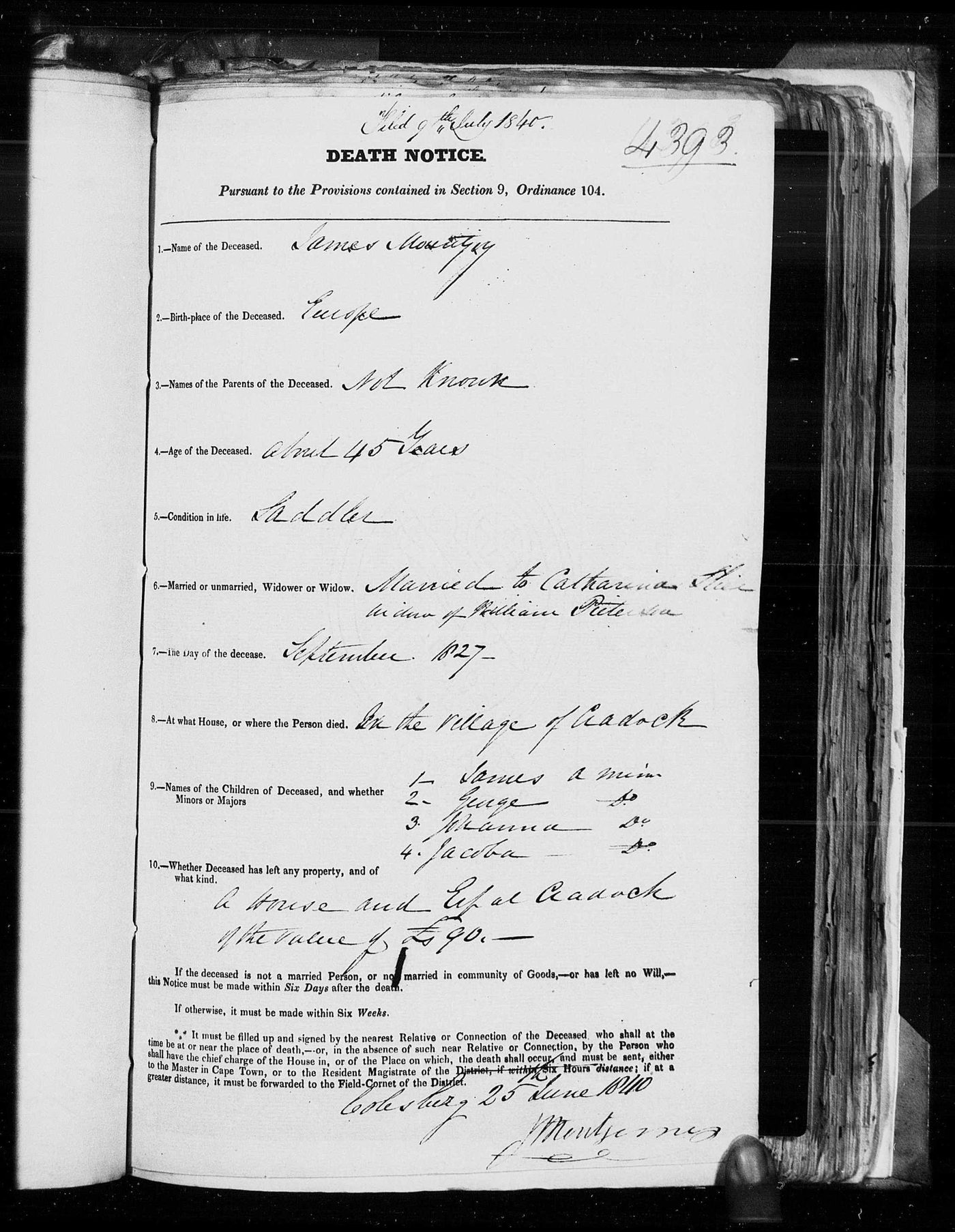
The form, as completed
| 1. Name of the Deceased | James Montjoy |
| 2. Birth-place | Europe |
| 3. Names of the Parents | Not Known |
| 4. Age | About 45 years |
| 5. Condition in life | Saddler |
| 6. Married or unmarried | Married to Catharina Sl[i/e]er, widow of William Pietersen |
| 7. Day of decease | September 1827 |
| 8. At what House | In the village of Cradock |
| 9. Children | James, George, Johanna, Jacoba — all minors |
| 10. Property | A house and erf at Cradock, of the value of £90 |
| Signed | Colesberg, 25 June 1840, by a Montjoy |
Line 3

This archive went looking for this document because it was supposed to give the generation above — the point at which the Mountjoy name entered the Cape. Instead it says, in a firm hand, that in 1840 the family did not know who James Montjoy's parents were.
And they had every chance to find out. He died in September 1827. The notice was completed thirteen years later by a relative who knew his trade, his property, the value of his house, the village he died in and the name of his wife's first husband — and could not name his mother or his father.
The wall at the top of this line is not a gap in the archive. It is a gap in the family, and it was already there in 1840.
It is the same sentence the archive found on the 1915 death notice at Barkly East, where a grandson wrote "Father: Kolbe, thinks James was christian name. Mother: Unknown" with the man's carved headstone standing forty miles away. Two families, two centuries, the same box on the same printed form, the same answer. Why this archive exists →
"Birth-place: Europe." Not a country. The most that was remembered of where he came from was that it was not here.
A trade, passed down

Documented James Montjoy was a saddler at Cradock. His son George Mountjoy — four years old when his father died — is recorded at his own 1848 marriage as a saddle maker, in the same town.
The archive had George's trade already and treated it as the first recorded for a Mountjoy. It was the second. The boy learned his dead father's trade.
The Pietersen marriage, confirmed

Documented "Married to Catharina Sl[i/e]er, widow of William Pietersen." The archive had inferred, from a godparent at an 1851 font, that Johanna Catharina's half-brothers were Pieterzens by her mother's first marriage.
Here is the first marriage, named, in a document eleven years older than the baptism. The inference was right. The women →
Four children, and a date this archive had flagged as a contradiction


The archive had raised this as an open contradiction: our tree has Johanna Catharina's father dying in 1827, but the archival file is dated 1840. Resolved Both are right. He died in September 1827; the notice was filed thirteen years afterwards, and the file carries the filing year. The tree was correct and the contradiction was mine.
The four children fix the family at September 1827 exactly. Johanna Catharina was eight — her own 1863 death notice puts her birth at 30 April 1819. Jacoba was seven, George four, James one. And Thomas Jacobus, born 1818, is not on the list — which independently supports the correction that he died in 1827 rather than in infancy in 1818.
A correction the tree needs Our tree records James Mountjoy as born and died in 1826. He is listed here alive, as a minor, at his father's death in September 1827. The infant-death date is wrong.
Where the line now ends, and why it is a real end. James Montjoy, a saddler born in "Europe" about 1782, who owned a house and erf at Cradock worth £90 and died there in September 1827 leaving four children under nine. Above him: nothing, and nothing recoverable from this family — because the people who buried him could not name his parents thirteen years later. Anything further will have to come from outside the Cape: English, Irish or Continental records for a saddler named Montjoy born around 1782 who reached the Cape before 1818. Open questions →
1884 · A farmer who died owning his clothes — and a third "not known"
The tree had carried this image for years under its own citation. Nobody had opened it.
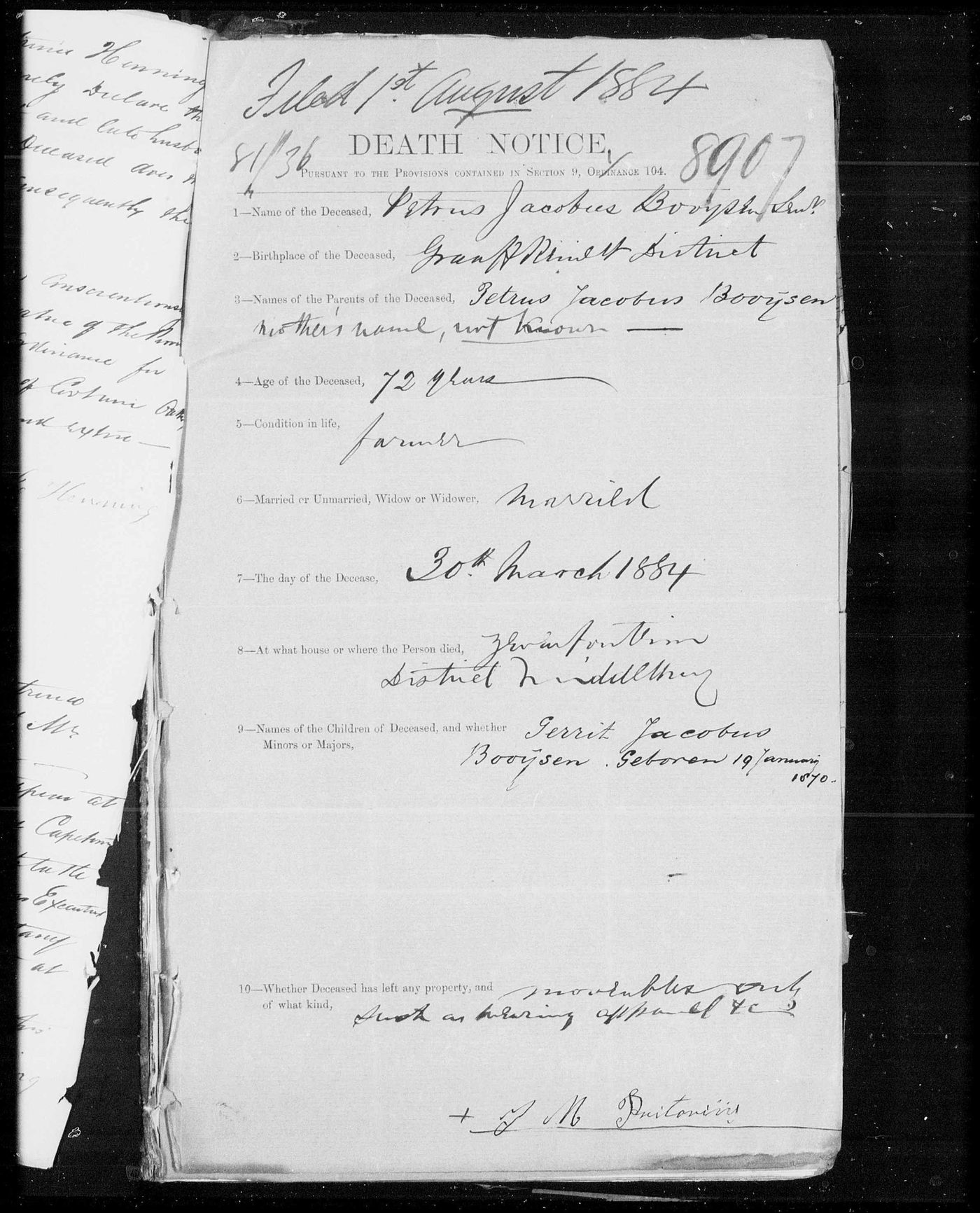
The form, as completed
| 1. Name | Petrus Jacobus Booysen, Senior |
| 2. Birth-place | Graaff Reinet District |
| 3. Parents | Petrus Jacobus Booÿsen — mother's name, not known |
| 4. Age | 72 years |
| 5. Condition in life | Farmer |
| 6. Married or unmarried | Married |
| 7. Day of decease | 30 March 1884 |
| 8. At what house | Zevenfontein, District Middelburg |
| 9. Children | Gerrit Jacobus Booÿsen, geboren 19 Januarij 1870 |
| 10. Property | Moveables only, such as wearing apparel &c |
Age 72 in 1884 puts his birth at about 1812, which matches the register exactly. Zevenfontein is the farm where his first wife had died twenty-one years before.
It happens a third time

This archive has now read three death notices that ask for the parents of the deceased. All three fail, and they fail in the same direction:
| Written | For | Line 3 says |
|---|---|---|
| 1840 | James Montjoy (d. 1827) | "Not Known." — both parents |
| 1884 | Petrus Jacobus Booysen (d. 1884) | Father named. "Mother's name, not known." |
| 1915 | Margaret Elizabeth Barry née Kolbe (d. 1912) | "Father: Kolbe, thinks James was christian name. Mother: Unknown." |
Three families, three generations, one printed box — and it is the mother who goes first. In 1884 the father's full name is written out and the mother has no name at all. In 1915 the father survives as a surname and a guess at a christian name; the mother is Unknown. Only in 1840, the oldest of the three, are both gone together.
His mother was Anna Maria van der Merwe. She had died before March 1825, when her son was twelve. By the time he died at seventy-two, nobody in the house could name her. The women →
The second wife, confirmed but still not named

Documented He is recorded as Married at his death in 1884 — twenty-one years after Johanna Catharina died. That settles the open question: there was a second wife. And the single child entered here, Gerrit Jacobus, born 19 January 1870, is new to this archive and can only be hers.
With Izak (1864) and Stephanus Francois (1875), that is now three children born to this man after 1863 — the ones the tree had wrongly attached to his first wife. Still open The form never asks her name, and so it does not give it. The marriage itself, at Cradock or Middelburg between 1863 and 1870, is the document that would. Open questions →
"Moveables only"

He is entered on line 5 as a farmer. On line 10 he leaves no fixed property at all — his clothes and whatever else would fit in a wagon. He was living at Zevenfontein; he did not own it.
Set that beside the oldest document here. James Montjoy, a saddler, died in 1827 owning a house and erf at Cradock worth £90. Fifty-seven years later his son-in-law's household has movables and wearing apparel.
The family was already landless in 1884 — fifteen years before the war.
Inferred, and it cuts both ways This does not dispose of the burned-farm claim: Willem Hermanus is entered as a boer, farmer, of Lady Grey at his marriage in 1879 — five years after his father's estate showed nothing. A son can farm land his father never owned, by lease, by marriage or by his wife's people. But it does mean the family's landlessness cannot simply be dated to the war, and any account that starts with a prosperous farm being burned has to explain 1884 first. The testimony →
1817 · The marriage register — where the blank actually begins
Two index entries existed for this marriage and neither carried an image. A third indexing, under the spelling Montyoy, did.
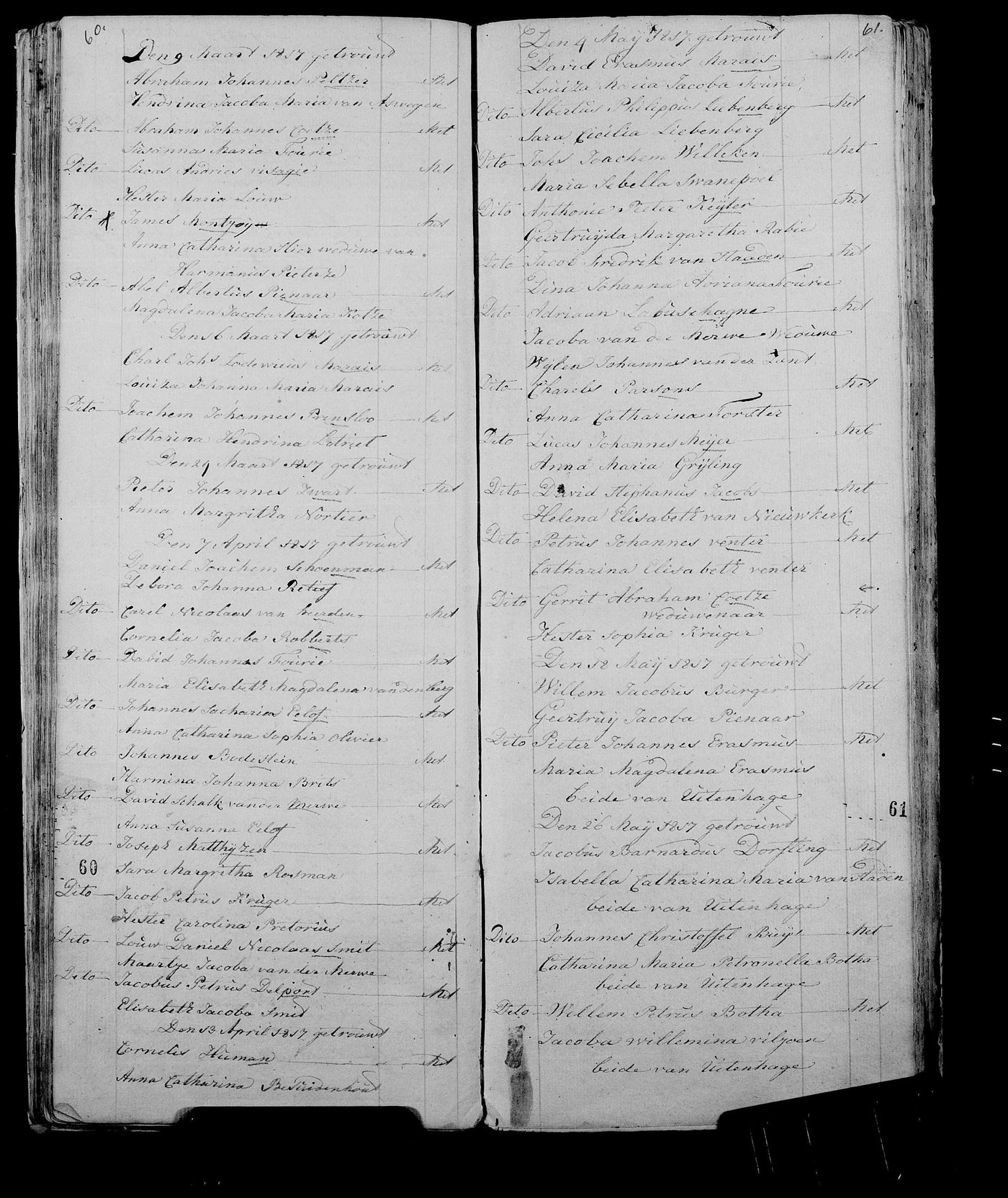

What it does not say, and that is the point
This archive went to this register expecting an origin. Cape marriage entries of this date routinely record where a party came from, and this very page does it repeatedly — three couples in the right-hand column are entered "beide van Uitenhage".
Against James Montjoy's name there is a long ruled dash and nothing else.
He arrived in the record already without a past.
So the silence is not a failure of the 1840 death notice, written thirteen years after his death. It was there at his wedding, twenty-three years earlier, while he was standing in the room.
Her surname, a sixth time
The register reads Slier. The tally across independent sources is now:
| 1817 | marriage register | Slier |
| 1863 | daughter's death notice | Sleer |
| — | FamilySearch index | Slier |
| — | family tree | Schleher |
| — | indexer, entry 1 | Sher |
| — | indexer, entry 2 | Hier |
The contemporary register agrees with the index against the tree: Slier.
And now a seventh test FamilySearch's whole South African corpus has been counted for each spelling. SLIER returns 851 people. SLEER returns 7. SCHLEHER returns nothing at all — not one record in the country.
That is not proof of what her name was. It is proof that the tree's spelling is the one form of it that no South African record uses, which is exactly what you would expect of a form arrived at by a modern hand. The register →
And a name in this family turns out not to be a family name

Three documents name Anna Catharina's first husband, and they look like three different men:
- 1817, the marriage register, contemporary — Harmanus Pieterze[n]
- 1840, the death notice, written by a relative — William Pietersen
- 1851, the baptism, the godfather who is his son — Willem Hermanus Pieterzen
The third contains both of the first two, and this archive read that as one man with a long name — “the 1817 clerk wrote the second given name, the 1840 informant the first”. That was wrong, and it was corrected on 15 September 2026. Corrected from the printed genealogy De Villiers gives “Hermanus Pietersen, namen van ouders onbekend, gehuwd 5 April 1807 met Anna Catharina Slier” and their sons as Willem Hermanus (1809) and Johan Christiaan (1810). The husband is Hermanus; the 1851 godfather is his son, which this page already said in the line above without following it. The 1840 notice is the odd one out. The entry, and a second half-brother →
Which means the name Willem Hermanus did not come down the Booyzen line at all.
It enters through Anna Catharina Slier's first marriage — a Pieterzen household with no blood relation to the Booyzens whatever. Her son by that marriage stood godfather at the Booyzen font in 1851, and the child was given his name.
That child is Willem Hermanus Booyzen, who farmed at Lady Grey, laid stone at Indwe, died of an ulcer of the stomach in September 1905, and whose son signed the death form Booyzen under a clerk's Booysen. His grandson was Willem Hermanus "Willy" Booyzen, born 1925 in Johannesburg. Four generations carried a step-relation's name, and the archive can now say exactly where it came from. The women →
1891 · The same font, two years on — and the name that runs three generations
One of the last unread images on the tree, and it turns out to be the same register as the 1889 page, at pages 262–263.
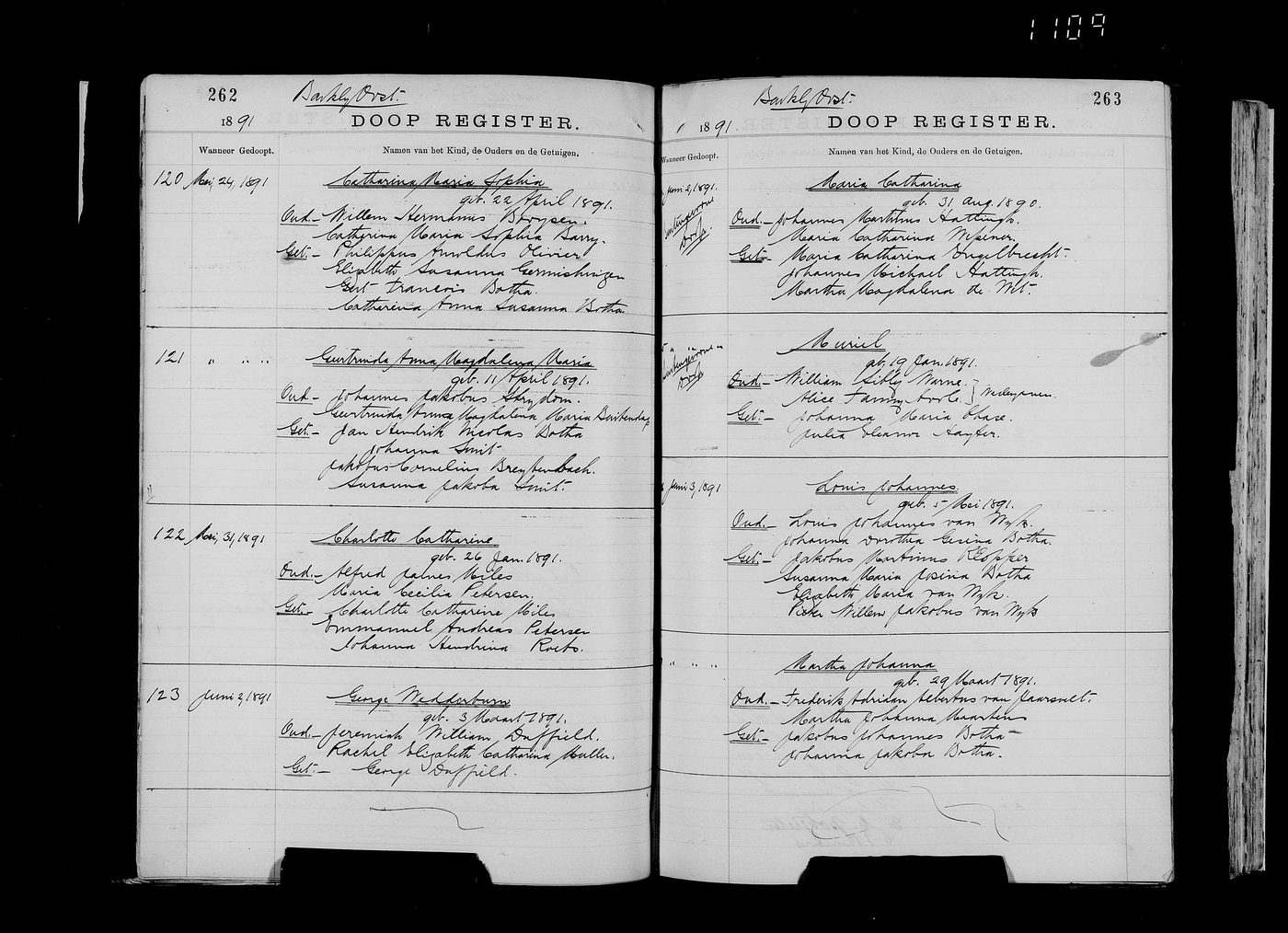
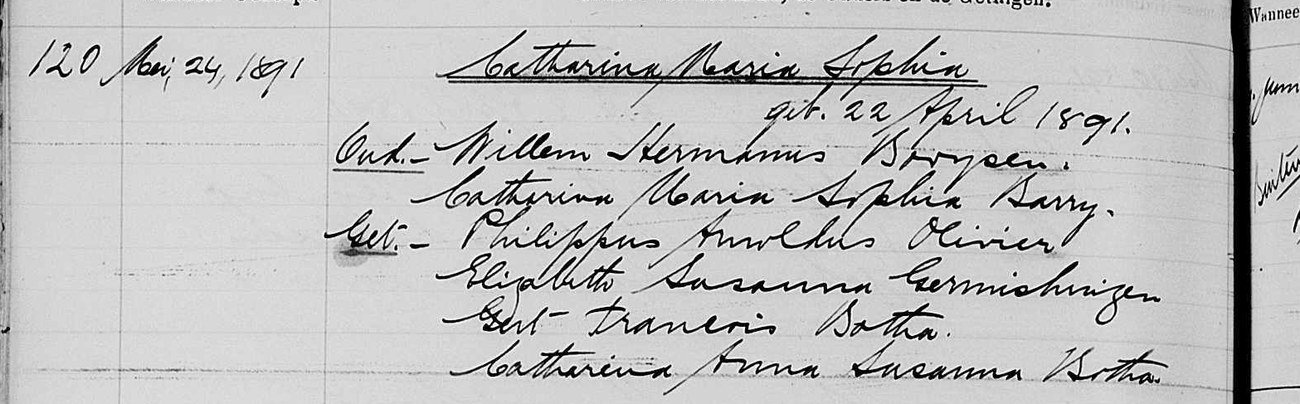
The entry
| Kind | Catharina Maria Sophia |
| Geboren | 22 April 1891 |
| Gedoopt | 24 Mei 1891, Barkly Oost |
| Ouders | Willem Hermanus Booysen Catharina Maria Sophia Barry |
| Getuigen | Philippus Rudolph Olivier · Elizabeth Susanna Germishuizen · Gert Francois Botha · Catharina Anna Susanna Botha |
The father is entered Booysen, with an s — as he is on every register entry the archive has read for him.
A daughter named for her mother
The child takes her mother's name entire: Catharina Maria Sophia. And it goes on:
| 1859 | Catherine Maria Sophia "Kathleen" Barry — the mother |
| 1891 | Catharina Maria Sophia Booysen — this entry |
| 1929 | Catherine Mary Sophia Booyzen — the granddaughter, and the starting point of this archive |
Three women, seventy years, one name — and the spelling of the surname shifts underneath it while the given names hold. The women →
New to this archive Catharina Maria Sophia Booysen, born 22 April 1891, is a daughter of Willem Hermanus and Kathleen that the archive did not have. She was fourteen when her father died at Indwe in 1905.
1940 · A fourth time the form asks for the parents, and a fourth time it fails
Found only after this archive noticed it had spent its whole life searching one province out of nine. TAB MHG 2428/40
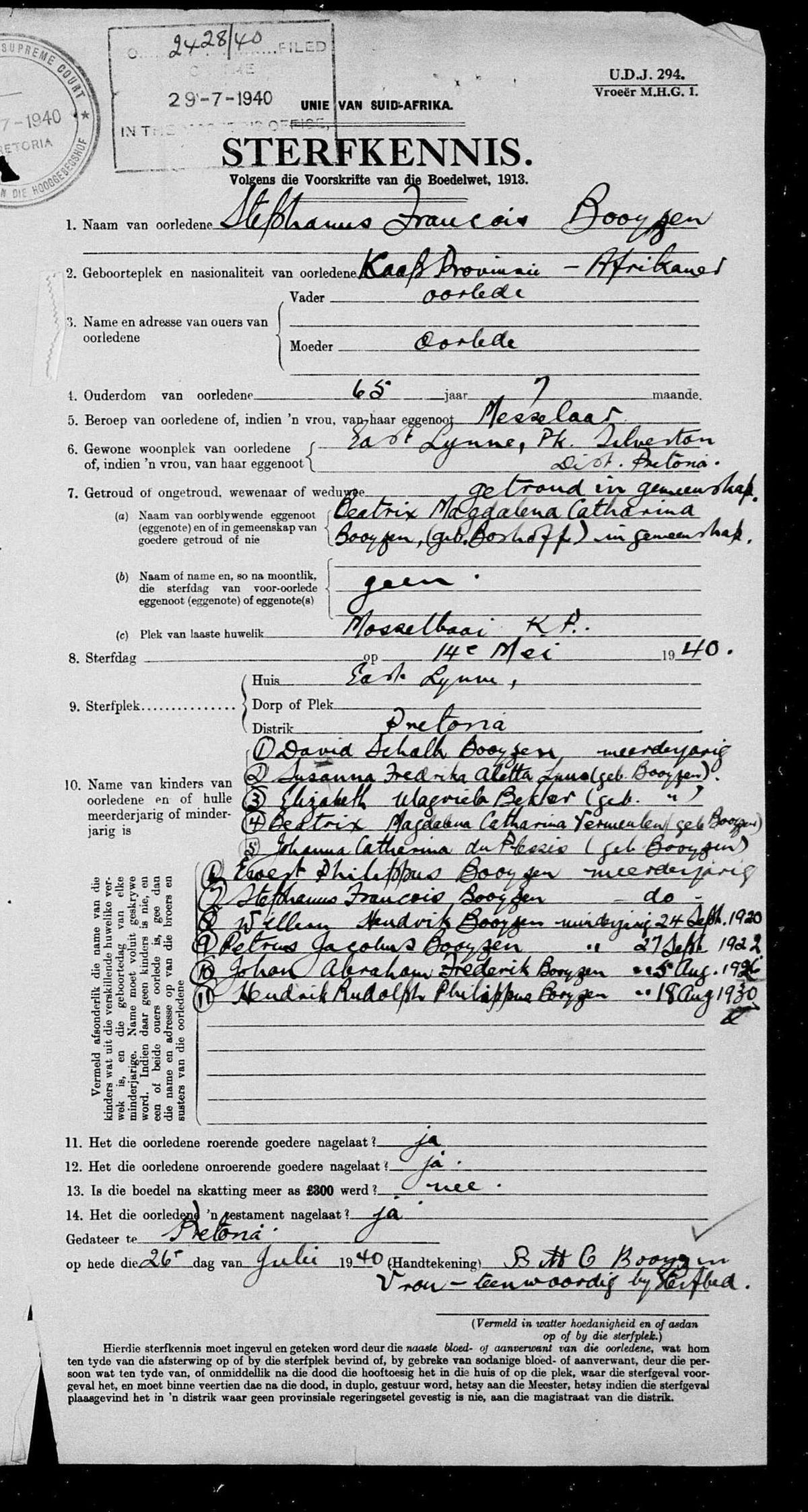
The form, as completed
| 1. Naam | Stephanus Francois Booyzen |
| 2. Geboorteplek | Kaap Provinsie — nasionaliteit Afrikaner |
| 3. Ouers | Vader: oorlede. Moeder: oorlede. |
| 4. Ouderdom | 65 jaar 7 maande — so born about October 1874 |
| 5. Beroep | Messelaar — mason |
| 6. Woonplek | East Lynne, Pk. Silverton, dist. Pretoria |
| 7. Getroud | Beatrix Magdalena Catharina, geb. Boshoff, in gemeenskap; last married at Mosselbaai, K.P. |
| 8. Sterfdag | 14 Mei 1940 |
| 10. Kinders | eleven, the youngest born 18 August 1930 |
| 11–14 | moveable and immovable property; estate over £300; a will |
Line 3

The form asks for the names and addresses of the parents. His widow answered, for both, "deceased".
This archive went to this document for one reason: Stephanus Francois was a son of the second marriage, and a death notice names its subject's parents, so his mother should have been on this line. She is the woman the archive has proved to exist and cannot name. She is not on it.
Four death notices in this family now ask who the parents were. Four fail.
| Written | For | Line 3 says |
|---|---|---|
| 1840 | James Montjoy | "Not Known." |
| 1884 | Petrus Jacobus Booysen | Father in full. "Mother's name, not known." |
| 1915 | Margaret Elizabeth Barry née Kolbe | "Father: Kolbe, thinks James was christian name. Mother: Unknown." |
| 1940 | Stephanus Francois Booyzen | "Vader: oorlede. Moeder: oorlede." |
The 1940 answer is different in kind from the other three, and worse. The earlier informants at least said they did not know. His widow answered a question about identity with a question about mortality — and nobody at the Master's office sent it back.
And a second mason

Messelaar is a mason. His half-brother Willem Hermanus Booyzen is entered as a mason on his own death registration at Indwe in 1905.
Two brothers, both in stone. The testimony ends with the boys going onto the mines. Of the occupations this archive has now actually read for the men of this family — saddler, farmer, mason, tree nurseryman, railway clerk, mason — not one is a miner. They went into trades, and two of them into the same one. What was searched →
He also left immovable property and a will, and an estate over £300 — which is more than his father managed in 1884, and more than his half-brother, who left no estate at all.
1870 · The second wife, named at last
The oldest open question in this archive, and it was answered by a christening rather than a death.
What had been established. Petrus Jacobus Booysen's first wife died in 1863. His own 1884 death notice enters him as married twenty-one years later and names one child — Gerrit Jacobus, born 19 January 1870 — who can only be a second wife's. Three children in all were born after 1863 and the tree had wrongly attached them to a woman already dead. But no document would give her name. Not his death notice, which does not ask. Not her son Stephanus Francois's, read this morning, where the widow wrote only "oorlede".
The mistake was looking at deaths. A baptism names both parents, and the child whose birth date the 1884 notice gives to the day was baptised 19 June 1870.
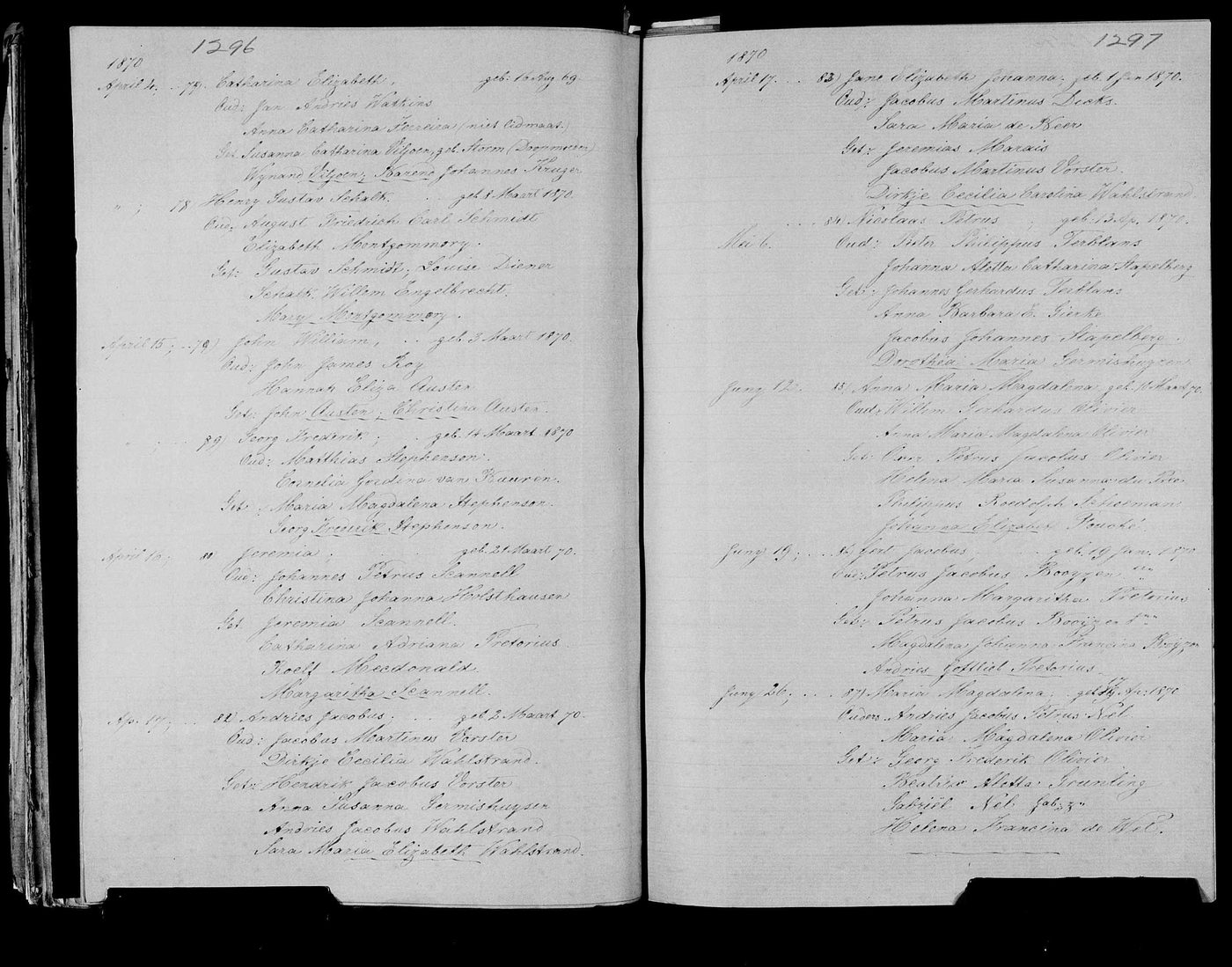
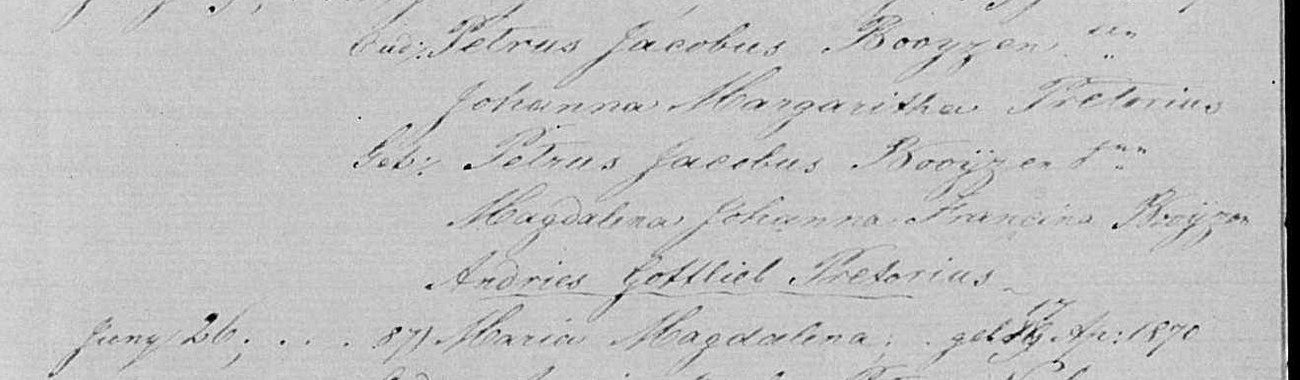
The entry
| Kind | Gert Jacobus |
| Geboren | 19 January 1870 — the exact date on the 1884 death notice |
| Gedoopt | 19 June 1870, Cape Colony |
| Ouders | Petrus Jacobus Booyzen Johanna Margaritha Pretorius |
| Getuigen | Petrus Jacobus Booijzen jr · Magdalena Johanna Francina Booijzen · Andries Gottlieb Pretorius |
Look at who stood at the font
Petrus Jacobus Booijzen junior, born 10 September 1839. Magdalena Johanna Francina Booijzen, born 16 July 1853.
Both are on the 1863 death notice — the third and sixth of Johanna Catharina Mountjoy's eight children.
Two children of the first marriage stood godparent to the first child of the second.
Whatever the household was after 1863, it was not divided. The third witness, Andries Gottlieb Pretorius, is presumably the bride's people.
Open question 7, answered Johanna Margaritha Pretorius is the second wife of Petrus Jacobus Booysen, mother of Gert Jacobus (1870), and — with the tree's other misattributions now corrected — of Izak (1864) and Stephanus Francois (1874), the mason who died at Pretoria in 1940.
One thing not to jump at Pretorius is also the surname of Anna Johanna Maria Pretorius, who married George Downing Mountjoy Booyzen in 1924 — and this archive has already shown that marriage to be between cousins, through her Barry mother. A second Pretorius connection fifty-four years earlier is not evidence of anything: Pretorius is among the commonest surnames in the Cape. It is noted here so that nobody later mistakes a coincidence for a link. The cousin marriage →
Read from the register image, not the index — this archive has been caught once already trusting a volunteer transcription, on the Pieterzen witnesses of 1851. The father is written Booyzen and the two witnesses Booijzen, in the same hand, in 1870.
1944 · The parents line, filled in
Anna Pretorius's Sterfkennis. TAB MHG 2945/44 — the second of the nine Transvaal estates, and the first in this archive where question three gets a real answer.
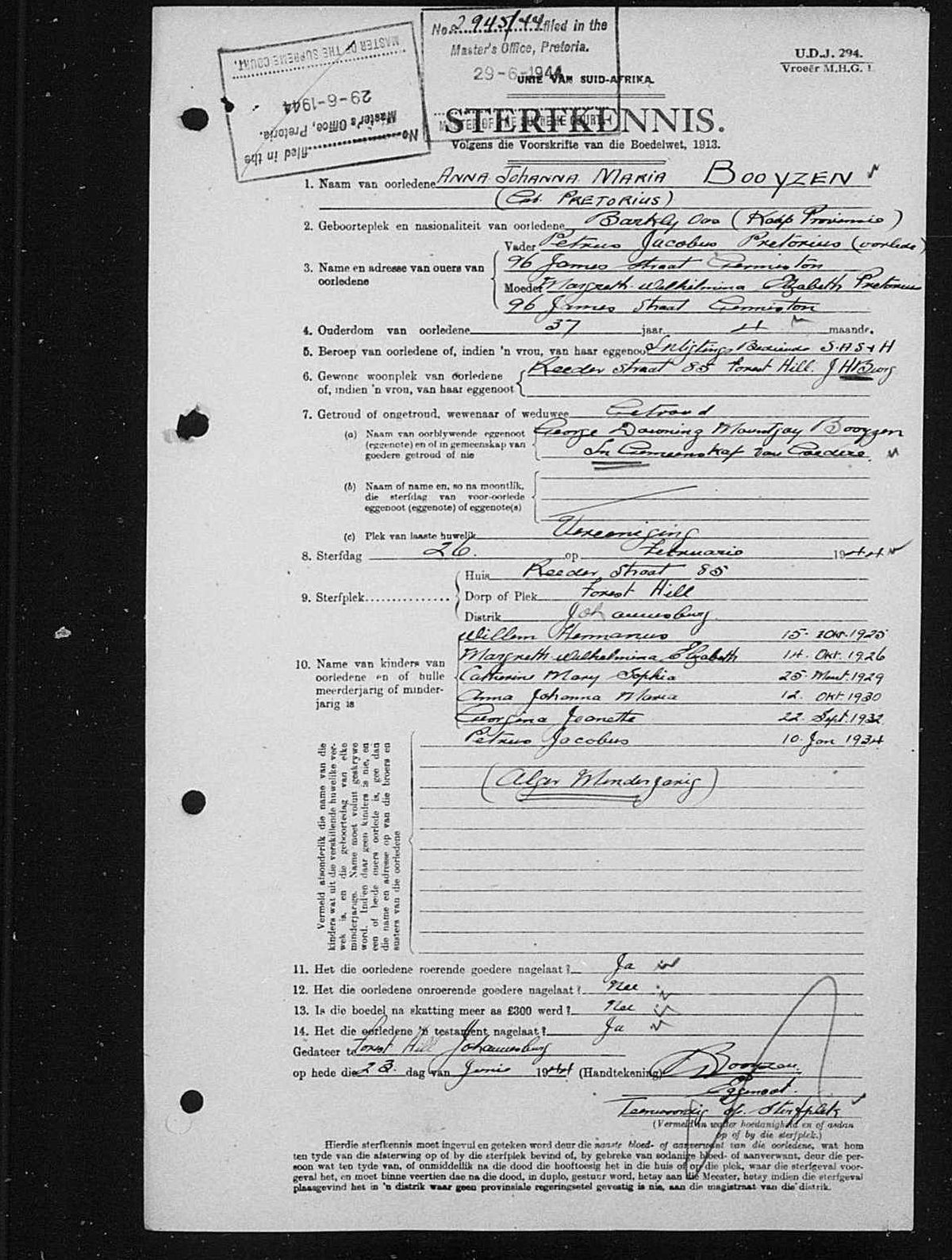
The form, as completed
| 1. Naam | Anna Johanna Maria Booyzen (geb. Pretorius) |
| 2. Geboorteplek | Barkly Oos, Kaap Provinsie |
| 3. Ouers | Vader: Petrus Jacobus Pretorius — 96 James Street, Germiston Moeder: Margareth Wilhelmina Elizabeth Pretorius — 96 James Street, Germiston |
| 4. Ouderdom | 37 |
| 6. Woonplek | Rheeder Straat 85, Forest Hill, J'hburg |
| 8. Sterfdag | 26 Februarie 1944 |
| 10. Kinders | six, alle minderjarig |
Line 3, filled in

This archive has now read five death notices that ask who the parents were. Four failed: "Not Known" in 1840, "mother's name, not known" in 1884, "Mother: Unknown" in 1915, "oorlede" in 1940.
This one is filled in completely — both names, and the street number they were living at.
The difference is not the form. It is the same printed question. The difference is who was holding the pen and what they knew. Her husband filled this in, and her parents were alive at 96 James Street, Germiston — her mother Margaretha Wilhelmina Elizabeth Barry, who outlived her by seventeen years. The cousin marriage →
Set beside the 1940 sheet, where a widow could not name her own husband's parents, it is a reminder that these blanks are not archival accidents. They record what a particular person, on a particular afternoon, actually knew about their own family.
This section first said "the one time the form worked." The next document opened after it — the 1942 Daschner notice, below — names both parents too. So the line is not unique; it is the earlier of two, and the pattern is a different one. The log →
Two documents were filed for this one death, and they are not the same document. The civil registration — entry 2045, Johannesburg, read further up this page — gives the cause of death, the cemetery and the age, but it never asks who her parents were. The Master's Sterfkennis does, because the Master needs to know who might inherit. The archive that seems less clinical is the one that carries the genealogy.
Six children, all minors
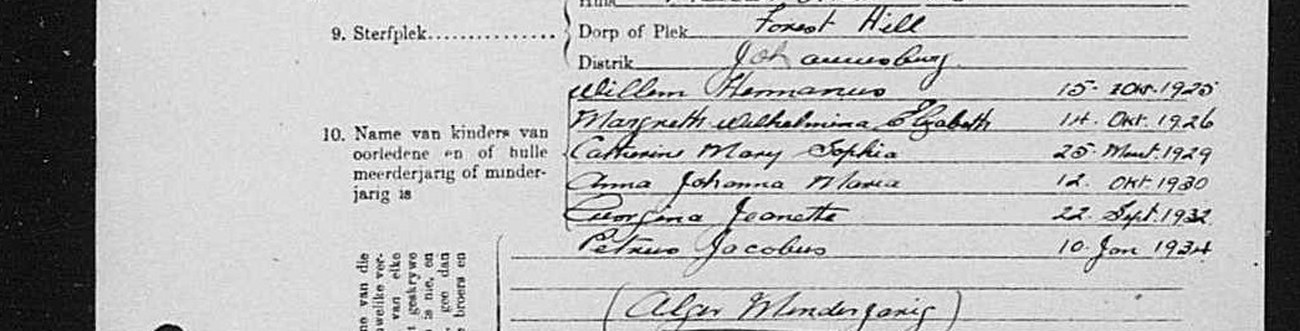
| Child | Born, per this document | Age in Feb 1944 |
|---|---|---|
| Willem Hermanus | 15 Oct 1925 | 18 |
| Margrett Wilhelmina Elizabeth | 14 Oct 1926 | 17 |
| Catherine Mary Sophia | 25 Mar 1929 | 14 |
| Anna Johanna Maria | 12 Oct 1930 | 13 |
| Georgina Jeanette | 22 Sep 1932 | 11 |
| Petrus Jacobus | 10 Jan 1934 | 10 |
A correction This archive has carried Maggie's birthday as 1 October 1926. Her mother's death notice, written by her father, gives 14 October. The document wins.
Every other date matches what the archive already held. And the bracket at the foot of the list — "Alle Minderjarig" — is the whole of it: six children under nineteen, the youngest ten, and three years and ten months later their father would be dead too. The line →
1942 · A daughter married at Indwe, and eleven cousins
Joseph Heinrich Daschner's death notice. TAB MHG 1928/42 — opened to check a marriage, and it returned a branch.
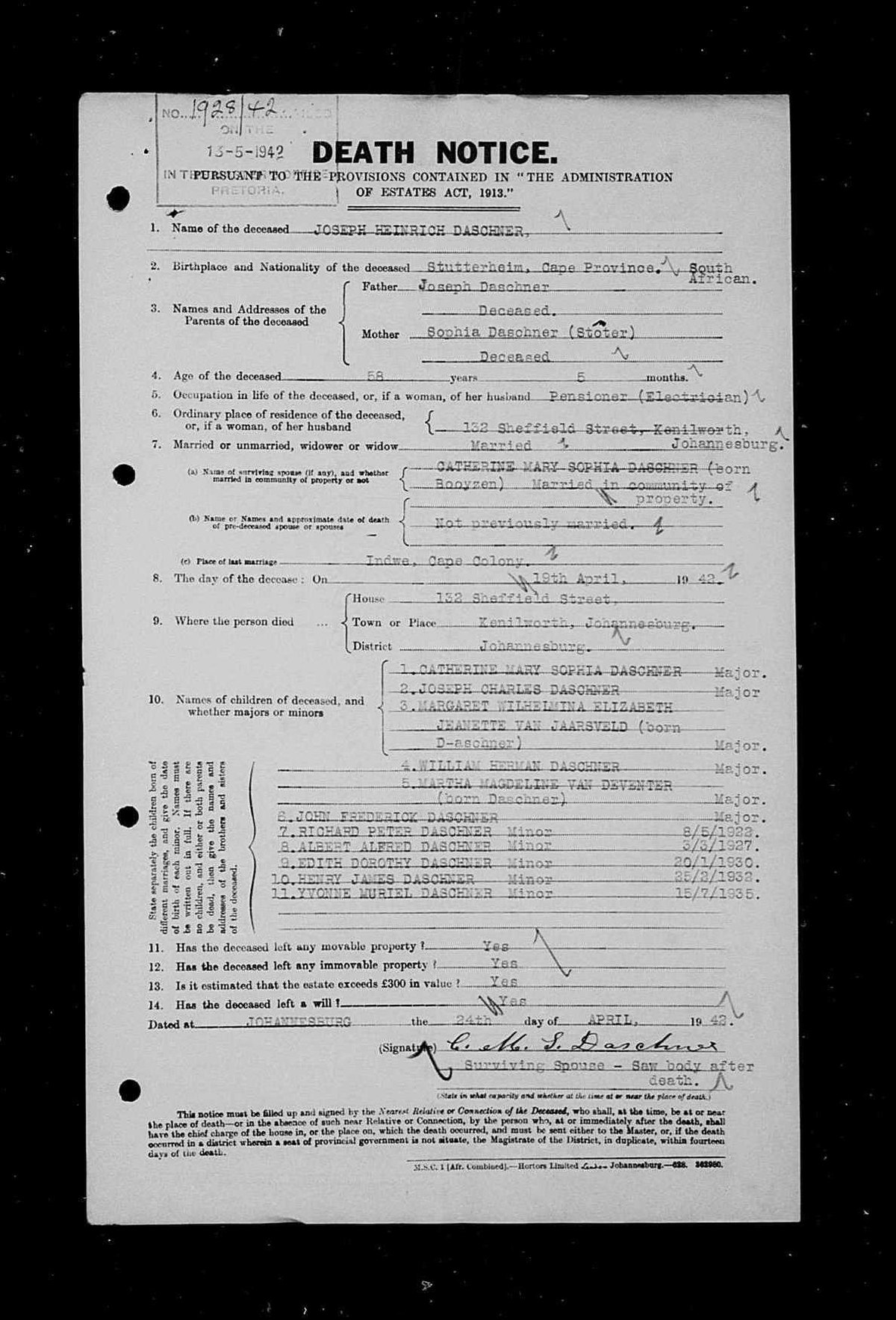
The form, as completed
| 1. Deceased | Joseph Heinrich Daschner |
| 2. Birthplace | Stutterheim, Cape Province · South African |
| 3. Parents | Joseph Daschner, deceased Sophia Daschner (Stoter), deceased |
| 4. Age | 58 years 5 months — born about November 1883 |
| 5. Occupation | Pensioner (Electrician) |
| 6. Residence | 132 Sheffield Street, Kenilworth, Johannesburg |
| 7a. Spouse | Catherine Mary Sophia Daschner (born Booyzen) — married in community of property |
| 7b. Earlier wife | "Not previously married." |
| 7c. Married at | Indwe, Cape Colony |
| 8. Died | 19 April 1942 |
| 11–14 | Movables yes · immovables yes · over £300 yes · a will yes |
Signed C. M. S. Daschner, "Surviving Spouse — Saw body after death."
Two words that close a marriage
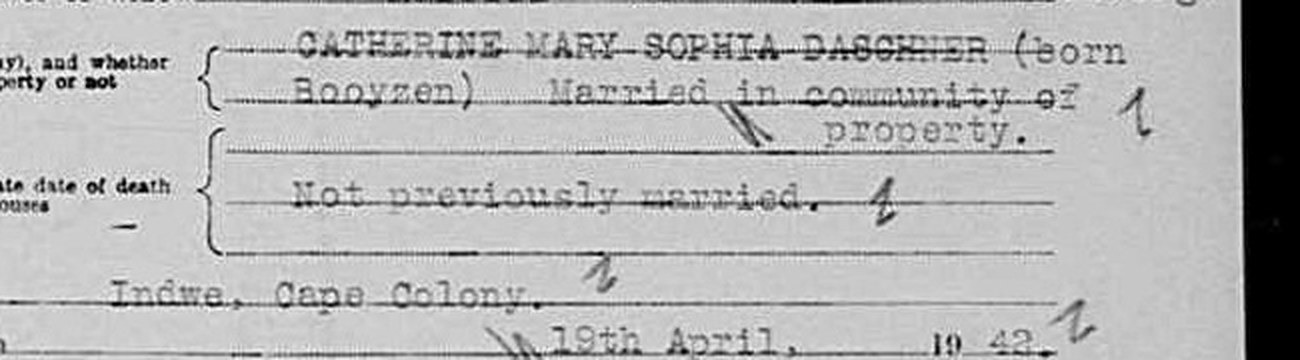
This archive already held the marriage, from the family tree: Catharina Maria Sophia Booysen, baptised at Barkly Oost on 24 May 1891, married Joseph Heinrich Daschner. What it did not have was a document. Here are two lines of one, and they do more than confirm a husband's name.
They married at Indwe. Indwe is where her father, Willem Hermanus Booyzen, died in September 1905, when she was fourteen. It is a colliery village in the north-eastern Cape that appears in this archive for exactly one reason — a death form. Now it appears for a wedding as well.
And note the spelling. The clerk who filled in her father's 1905 death form wrote Booysen, with an s, and this archive has spent some care on how little that proves. Thirty-seven years later, a Johannesburg typist taking dictation from his daughter typed Booyzen, with a z. The name →
Eleven children
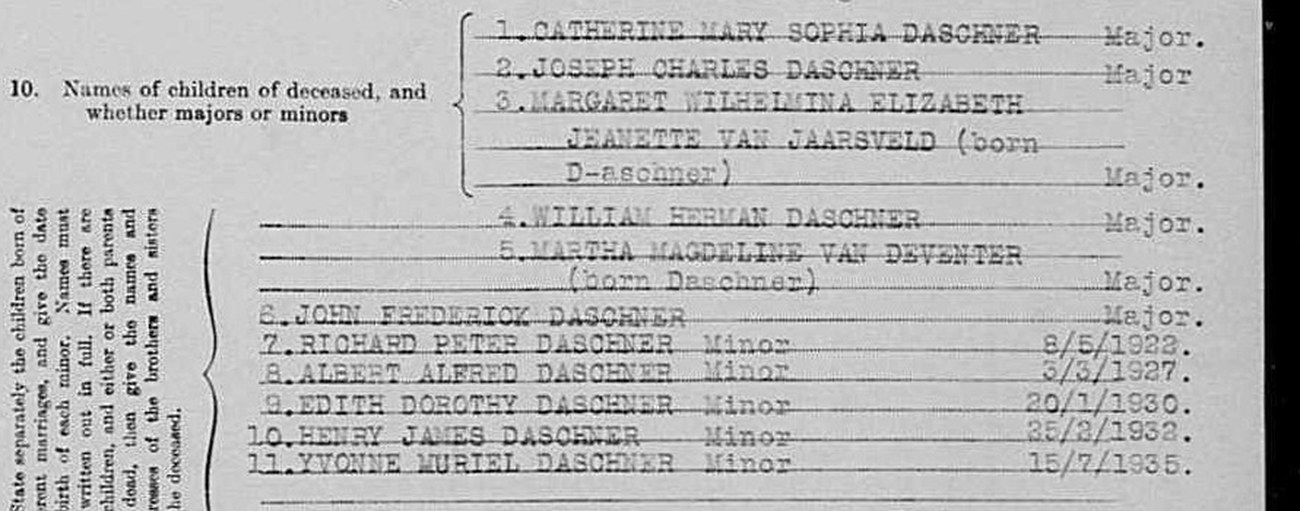
| Child | Status, 1942 | Born |
|---|---|---|
| Catherine Mary Sophia Daschner | Major | — |
| Joseph Charles Daschner | Major | — |
| Margaret Wilhelmina Elizabeth Jeanette van Jaarsveld, born Daschner | Major | — |
| William Herman Daschner | Major | — |
| Martha Magdeline van Deventer, born Daschner | Major | — |
| John Frederick Daschner | Major | — |
| Richard Peter Daschner | Minor | 8 May 1922 |
| Albert Alfred Daschner | Minor | 3 Mar 1927 |
| Edith Dorothy Daschner | Minor | 20 Jan 1930 |
| Henry James Daschner | Minor | 25 Feb 1932 |
| Yvonne Muriel Daschner | Minor | 15 Jul 1935 |
Read the bolded names again. Catherine Mary Sophia is her own name, and her mother's before her — Kathleen Barry, born 1859. Margaret Wilhelmina Elizabeth is the Barry name that runs down the other side of this family too. William Herman is Willem Hermanus, her father. Richard Peter is her uncle, Richard Peter Barry. Henry James is her brother.
Five of eleven Daschner children carry Booyzen and Barry names. The surname leaves the family in one generation. The names do not.
This is the same evidence the archive uses on the name and in the cousin marriage: in this family, forenames are inherited property, and they travel through daughters as reliably as surnames travel through sons. It is why Willem Hermanus — a name that entered by step-relation, with no blood tie at all — is still being given to children a century and a half later.
A small correction to the index, not to this archive FamilySearch's volunteer index gives Richard Peter Daschner's birth as 1923. The document reads 1922, and reads it clearly at full resolution. The table above follows the document.
And what question three actually depends on

Both parents dead, and both parents named. Put that beside the 1940 sheet two years earlier, where a widow answered the same printed question with the single word "oorlede" and nothing else, and the pattern in this archive stops being about the form at all.
Question three fails when the informant is remembering the nineteenth-century Cape interior. It works when the informant married into the family in the twentieth century and the names were still in the house. 1840, 1884, 1915 and 1940 fail. 1942 and 1944 work. All six are the same question.
It also matters which way the marriage ran. In 1940 a Boshoff widow was asked for her Booyzen husband's parents and could not do it. In 1942 and 1944 the informant was the spouse of the deceased, writing down their own in-laws — people they had met, at addresses they could quote. The method →
1876 · The oldest man in this archive, and the two names above him
Sterfkennis No. 678, written at the farm Brakfontein on 14 September 1876 under the Transvaal Republic's Wet op de Weeskamer. It is the document this archive has been looking for since the first page was written.
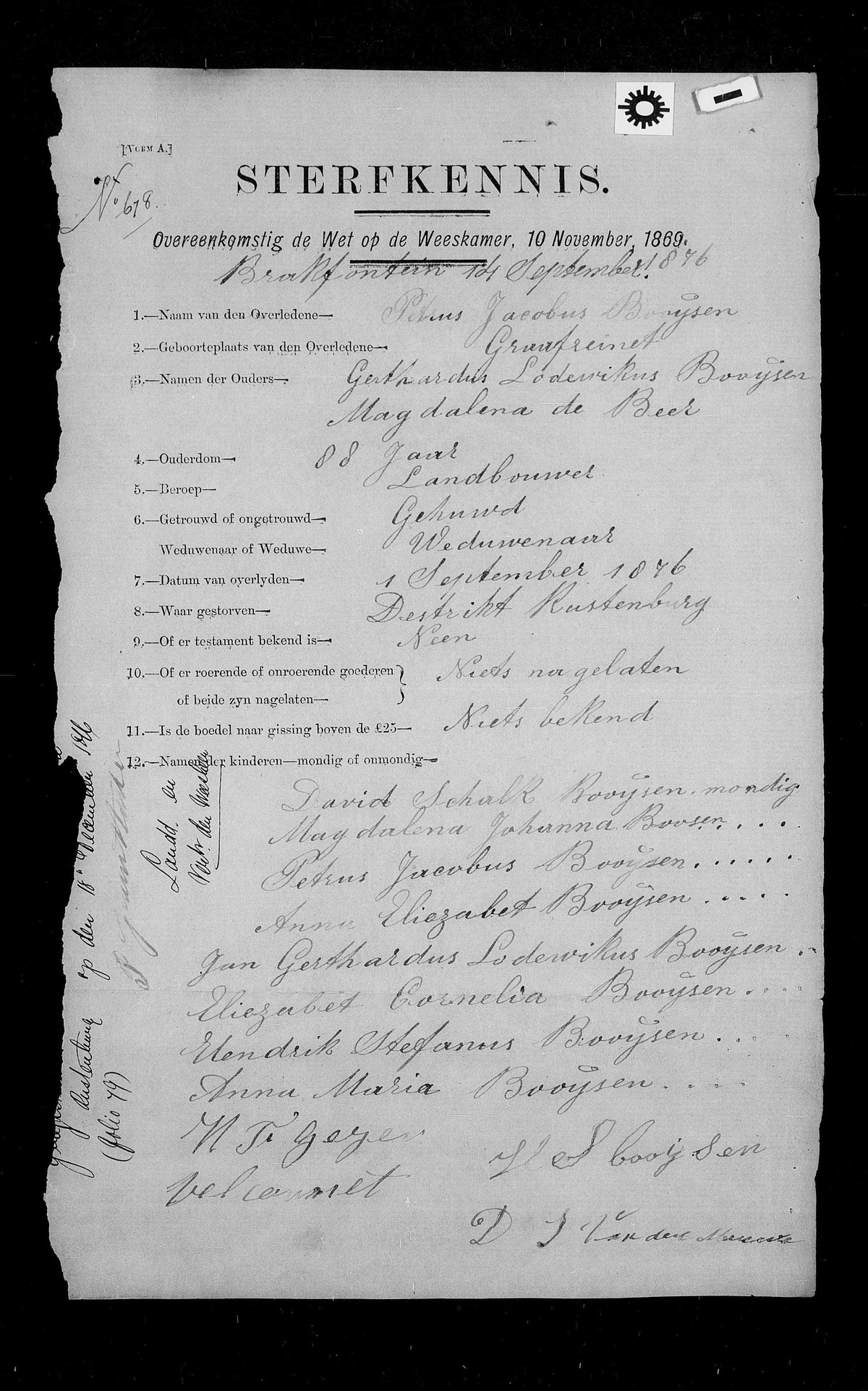
The form, as completed
| 1. Naam | Petrus Jacobus Booijsen |
| 2. Geboorteplaats | Graaffreinet |
| 3. Ouders | Gerthardus Lödewikus Booijsen Magdalena de Beer |
| 4. Ouderdom | 88 jaar |
| 5. Beroep | Landbouwer |
| 6. Staat | Gehuwd — weduwenaar |
| 7. Overleden | 1 September 1876 |
| 8. Waar | Destrikt Rustenburg |
| 9. Testament | Neen |
| 10. Goederen | Niets nagelaten |
| 11. Boven £25 | Niets bekend |
| 12. Kinderen | eight, all mondig |
The top of the line, in someone's handwriting

Generation seven of this family has stood at the head of the direct line since this archive began with the flattest entry on the site: no birth date, no death date, no father, no mother. He was there because the family tree said so, and for no other reason. Everything below him had documents. He had a name.
He now has a document too. Not his own — his son's. In September 1876, at a farm in the Transvaal, somebody was asked who the dead man's parents were and wrote down Gerthardus Lödewikus Booijsen and Magdalena de Beer.
It does not date him, and it does not name his parents, so the oldest open question on this site stays open. What it does is move the two of them out of the tree and into the record, and that matters more than it sounds, because this archive had already found a reason to distrust the pairing. Searching the Cape depot for Magdalena de Beer's estate turned up KAB NCD 2/1: 49, a notarial will of 1793 for "Jan Booysen, married to the late Magdalena de Beer" — a different husband, and a wife fifty years too early. It was recorded as a warning that Booysen–de Beer was not a unique pairing.
It still is not. But the pairing in this line is no longer an assertion, and the 1793 will can now be set aside for good rather than merely resisted.
Eight children, and three names that come back
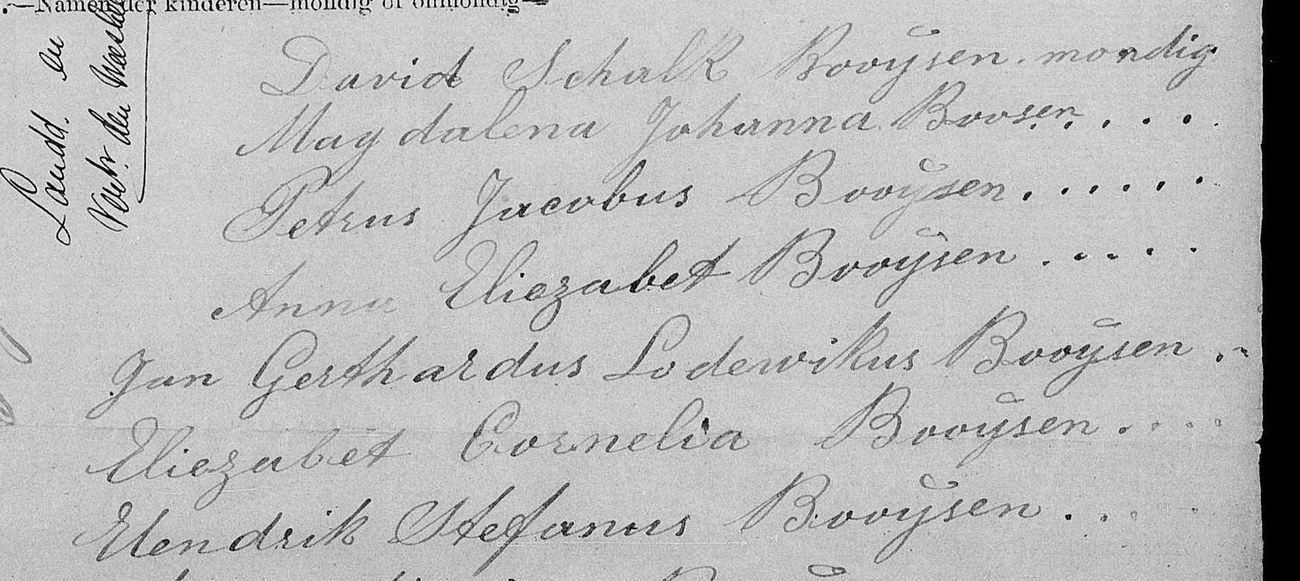
| Child, as written | What this archive already knew |
|---|---|
| David Schalk Booijsen | — |
| Magdalena Johanna Booijsen | — |
| Petrus Jacobus Booijsen | generation five, b. 10 May 1812, the farmer at Zevenfontein who signed the 1863 death notice |
| Anna Eliezabet Booijsen | — |
| Jan Gerthardus Lodewikus Booijsen | — |
| Eliezabet Cornelia Booijsen | — |
| Hendrik Stefanus Booijsen | signed this notice |
| Anna Maria Booijsen | — |
Seven of these eight were unknown to this archive an hour ago. And three of the names — David Schalk, Magdalena Johanna, Jan Gerthardus Lodewikus — are the same names that appear on the 1863 death notice as children of Petrus Jacobus the younger, born 1848, 1853 and 1855.
They are uncles and aunts and their namesake nephews and nieces, one generation apart, and nothing but a birth year tells them apart. This archive has now met that trap four times. It is why the people index says out loud when two people share a page.
The name is on this page twice — and a stranger saw it first
A man who had not seen this document predicted what is on it, in thirteen minutes. On 14 September 2026 Pieter van Zyl answered the G2G question about this document. He had not seen this page. He wrote: "His real dad, Jan, was already dead for more than 40 years when Petrus Jacobus died… Quite possibly, the informant 'thought' the dad's name was G L. I searched for a marriage between a Gerhardus Lodewicus and Magdalena de Beer but could not find one. If I remember correctly, there was a child of Petrus called Gerhardus Lodewicus on his Sterfkennis."
There is. He is in the table above. The fifth child in line 12 is JAN GERTHARDUS LODEWIKUS BOOIJSEN — and the name this archive takes from line 3, for the dead man's father, is the back half of his son's name. Both are on the same sheet of paper, eight lines apart, in one clerk's hand.
De Villiers puts Petrus Jacobus under JAN (b3c4d7). The son on this page is Jan Gerthardus Lodewikus. The informant had a compound name in the house and wrote half of it into the wrong line, dropping the half that agreed with the printed genealogy. That is a mechanism, not a guess, and it is visible without leaving the document.
What this does and does not do. It does not prove the father was Jan; this archive is not swapping one unproved father for another on the strength of a good reading. What it does is remove this document as decisive evidence for Gerthardus Lodewikus — which is a real loss, because line 3 is the only place that name has ever been found. The question stays open and gets harder. Disputed →
"Niets nagelaten"
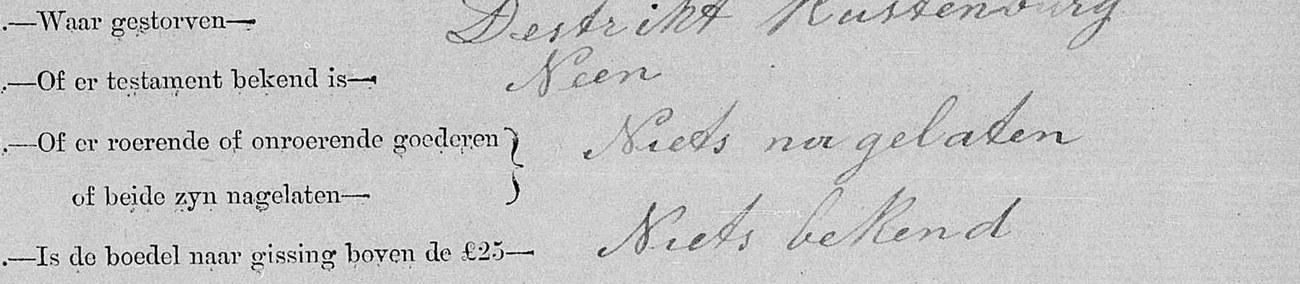
Eighty-eight years old, a lifetime of farming, and the estate is nothing. No will, no movables, no land, nothing known to be worth twenty-five pounds.
Eight years later his son's notice would read "moveables only, such as wearing apparel". Sixty-eight years after that, his great-great-grandson would be buried from a rented house in Forest Hill. Three death notices across four generations, and not one of them has anything to leave. The line →
Since then the second of those two has been settled. The farm is Brakfontein, not Boekfontein, and the maiden name is Oliefier, not Alberts. She is Anna Catharina Johanna Olivier, the first wife of Hendrik Stefanus Booijsen, and she died on the family's own farm. How that was read →
1937–38 · A whole estate, from the death to the last shilling
Estates 58379 and 58380, KAB MOOC 6/9/5047 — on this archive's Sources page as "Located, not yet read" for months. Read now, and not just the death notices: the liquidation account and the distribution account too. It is the only complete estate in this archive, and the only place where a life in this family is added up.
The two notices, written the same afternoon
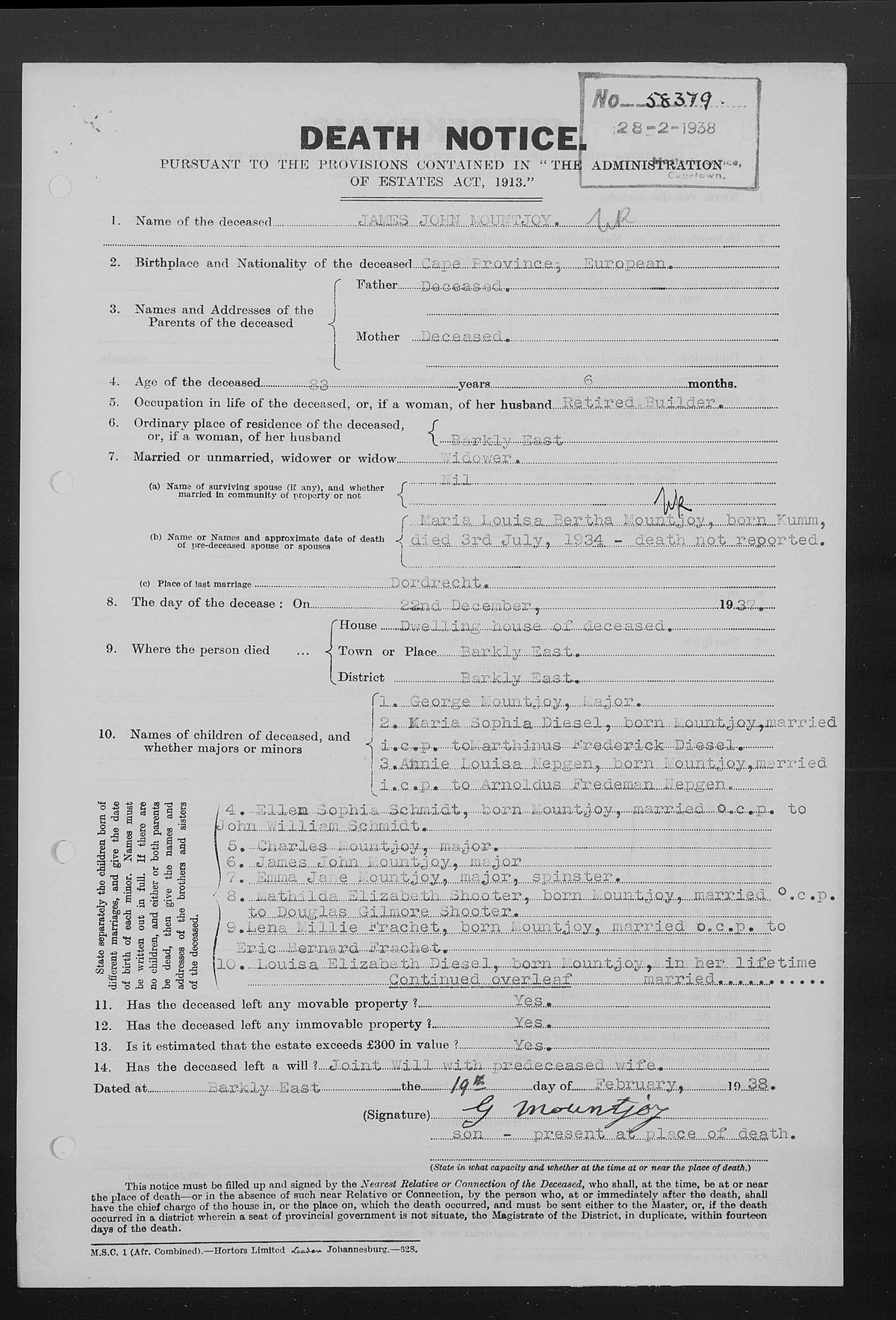
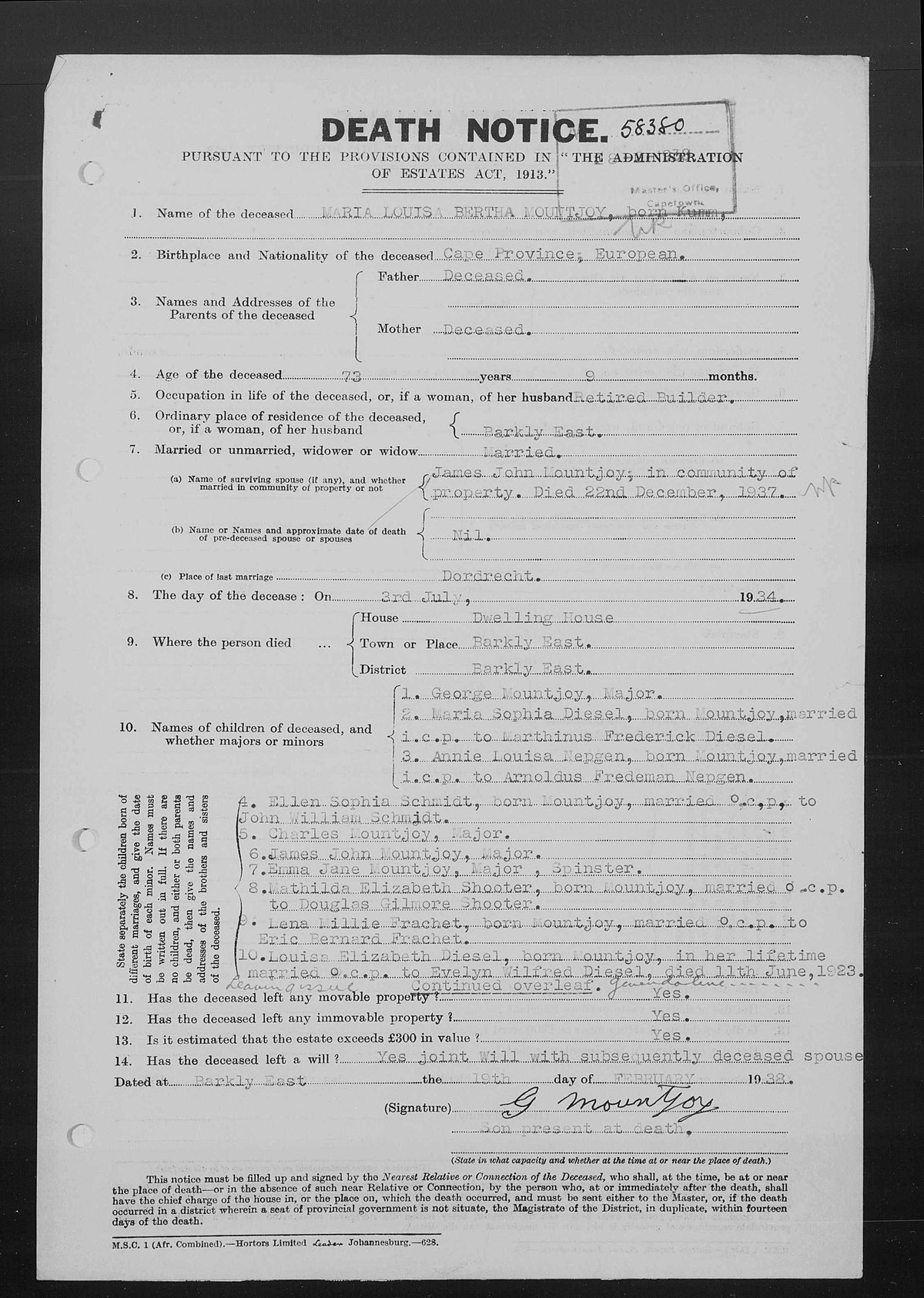
Both were dated at Barkly East on 19 February 1938, in the same typewriter, and both were signed G. Mountjoy — son, present at place of death. She had been dead for three years and seven months.
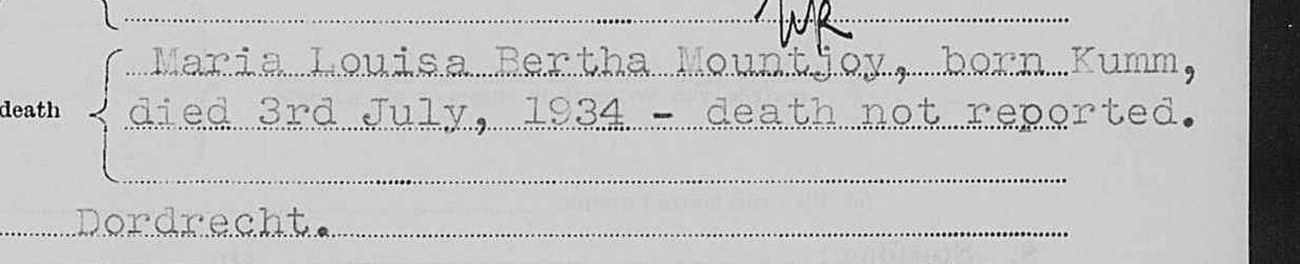
Four words, typed on his form about her. Her death was never reported to the Master, and it was only when her husband died that anyone filed for either of them. The estates were then handled as one, because they had married in community of property and left "a joint Will".
This archive already predicted the file number. The Sources page has said for months that "his wife's is the very next file, 58380", reasoning from the sequence. It was right — and the reason it was right turns out to be that both were opened on the same day by the same son, not that she died anywhere near him in time.
Documented Her age of 73 years 9 months at 3 July 1934 puts her birth at about October 1860. This archive had no birth date for her at all.
And question three, twice more

Asked for the names and addresses of the parents of a man born in the Cape in 1854, his son typed the fact that they were dead and stopped. Her form says the same. That is a fifth and a sixth failure of the line this archive keeps returning to, and it fits the pattern exactly: the deceased were born in the nineteenth-century Cape, and the informant was a generation removed. Where it works →
The account
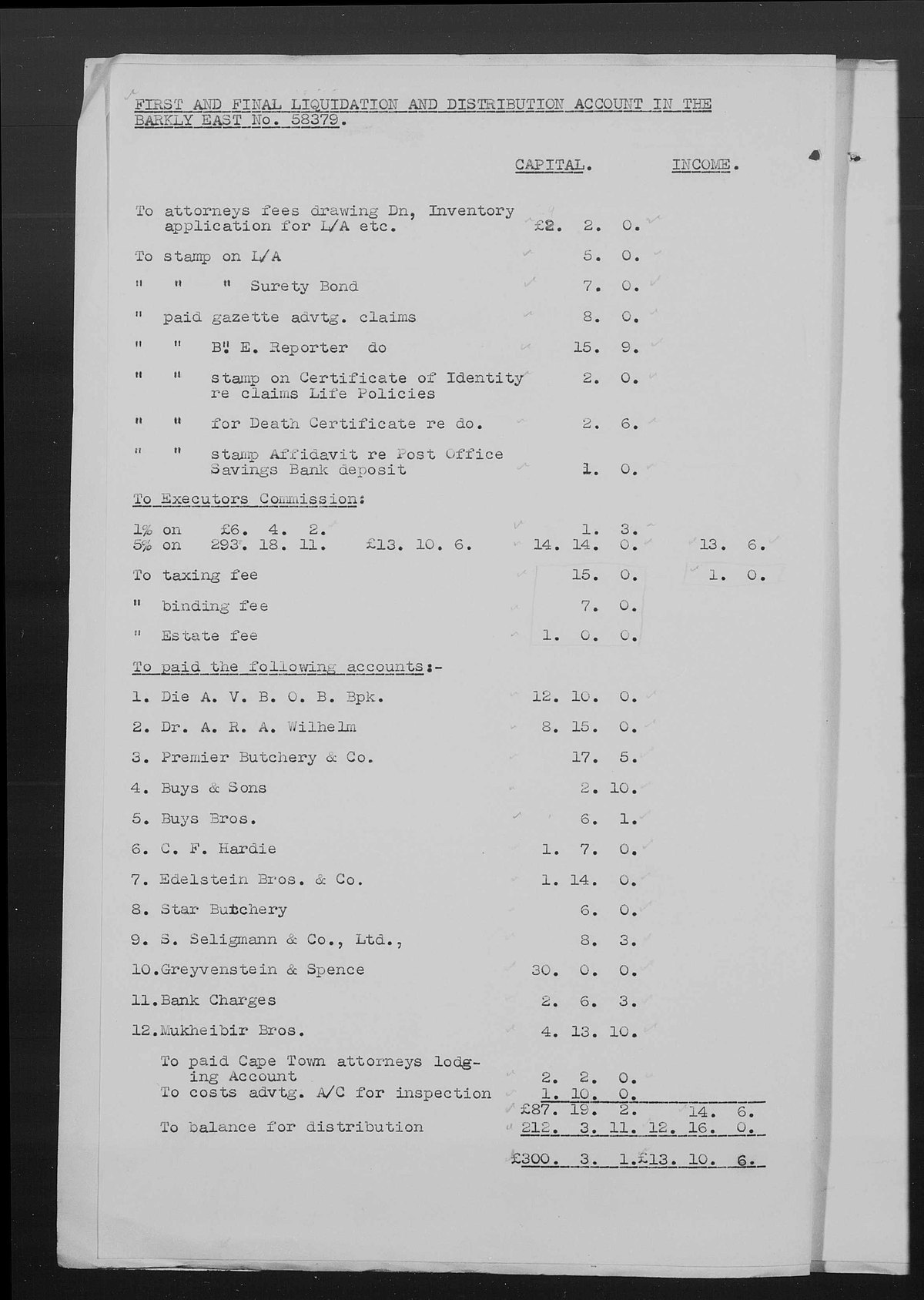
What he had
| Cash in the house | £6. 4. 2. |
| Post Office Savings Bank, joint with his late wife | £664. 11. 8. |
| Promissory note, E. W. Diesel, at 6% | £400 |
| Rent, Lot No. 380, to W. Bendeman | £2. 10. 0. a month |
Brought into this account as £300. 3. 1. capital and £13. 10. 6. income — the savings-bank deposit belonged half to his wife's estate.
The debts are a street directory of Barkly East in 1938: Die A.V.B.O.B. Bpk. — the Afrikaans burial society — twelve pounds ten; Dr A. R. A. Wilhelm, eight pounds fifteen; Premier Butchery and Star Butchery; Buys & Sons and Buys Bros.; C. F. Hardie; Edelstein Bros. & Co.; S. Seligmann & Co., Ltd.; Mukheibir Bros.; and Greyvenstein & Spence, thirty pounds, the largest single creditor.
A doctor, a burial society, two butchers, and traders whose names are Afrikaans, Jewish and Lebanese. It is a village, itemised.
"The deceased died intestate"
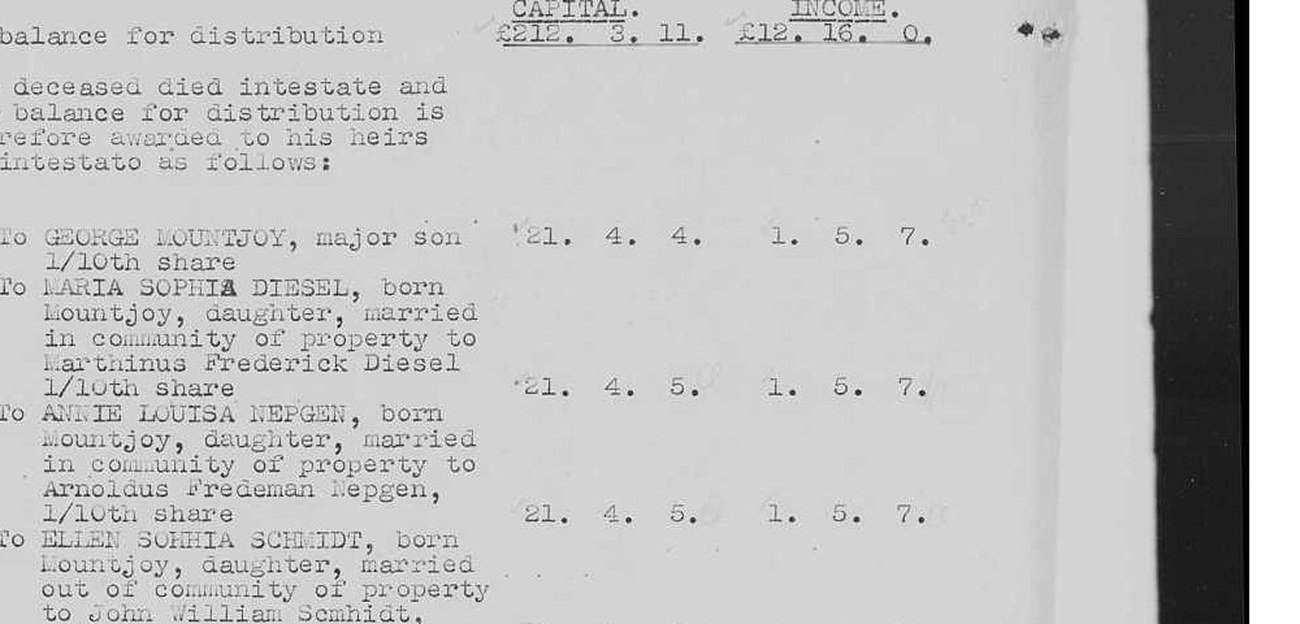
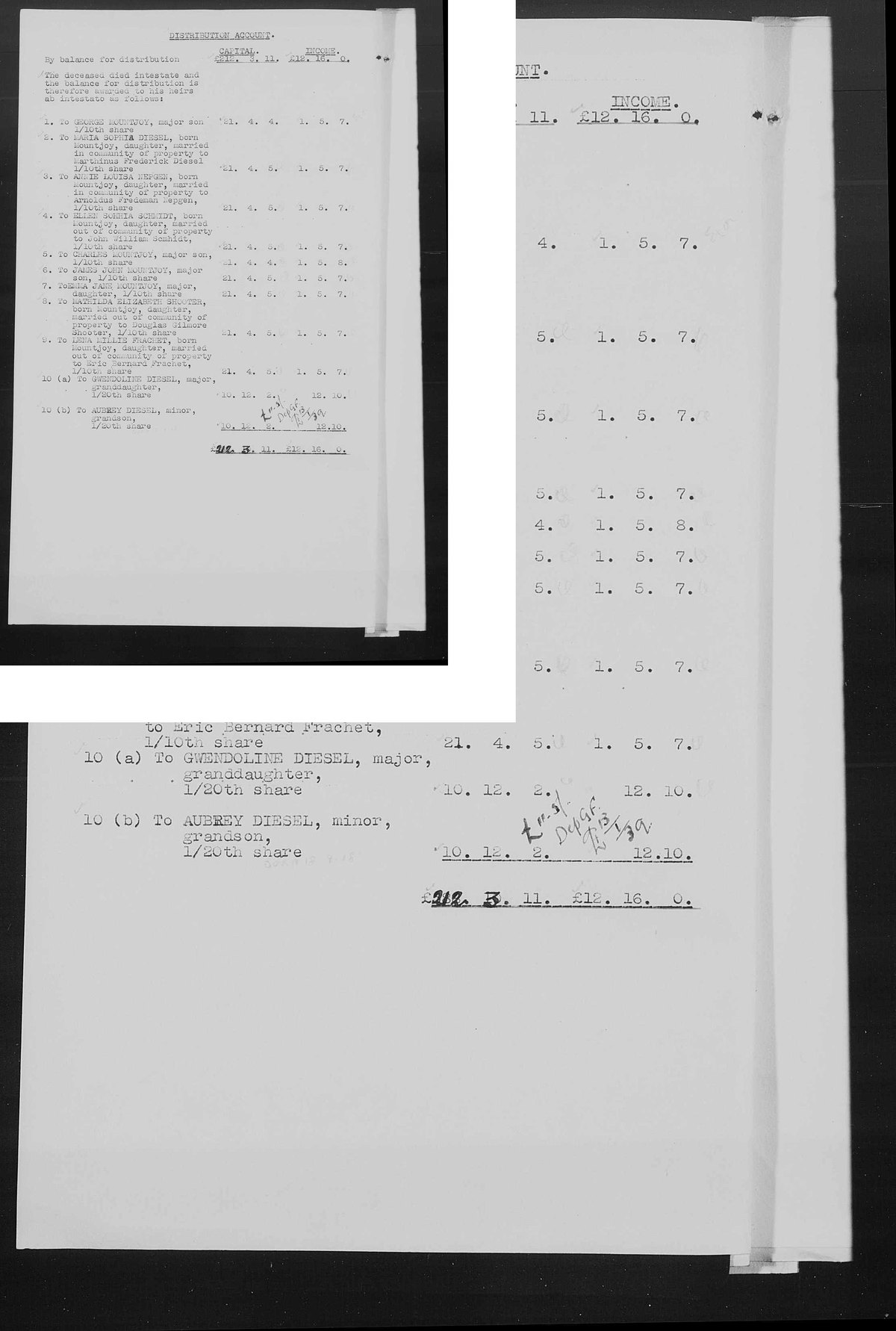
Note the contradiction, because this archive is not going to resolve it. Question 14 of the death notice, in the son's own typing, answers "Joint Will with predeceased wife." Four months later the executors' account opens with "The deceased died intestate." One estate file says both. Whatever happened between February and July 1938 — a will rejected, a will that dealt only with her half, a will that could not be found — the file as read does not say, and neither will this page.
What it does say is who got what.
| Heir | Relation | Share |
|---|---|---|
| George Mountjoy | major son — who signed both notices | £21. 4. 4. |
| Maria Sophia Diesel, born Mountjoy | daughter, m. i.c.p. Marthinus Frederick Diesel | £21. 4. 5. |
| Annie Louisa Nepgen, born Mountjoy | daughter, m. i.c.p. Arnoldus Fredeman Nepgen | £21. 4. 5. |
| Ellen Sophia Schmidt, born Mountjoy | daughter, m. o.c.p. John William Schmidt | £21. 4. 5. |
| Charles Mountjoy | major son | £21. 4. 4. |
| James John Mountjoy | major son — the second of the name | £21. 4. 5. |
| Emma Jane Mountjoy | major daughter, spinster | £21. 4. 5. |
| Mathilda Elizabeth Shooter, born Mountjoy | daughter, m. o.c.p. Douglas Gilmore Shooter | £21. 4. 5. |
| Lena Millie Frachet, born Mountjoy | daughter, m. o.c.p. Eric Bernard Frachet | £21. 4. 5. |
| Gwendoline Diesel | granddaughter, major — half of a tenth | £10. 12. 2. |
| Aubrey Diesel | grandson, minor — half of a tenth | £10. 12. 2. |
The two Diesel grandchildren take their dead mother's tenth between them: Louisa Elizabeth Diesel, born Mountjoy, who had married Evelyn Wilfred Diesel and died on 11 June 1923. She is on her mother's notice and not on her father's, because his was typed first and ran out of page.
These two families are joined by the marriage of 1838 and by the font at Barkly Oost in 1889, and they are three days' ride apart. One of them was accumulating and one of them was not. The line →
1902 · A wrong name in the index, and a right family behind it
Searching the Cape probate index for Hercules Johannes Mountjoy returns exactly one hit. It is not his.
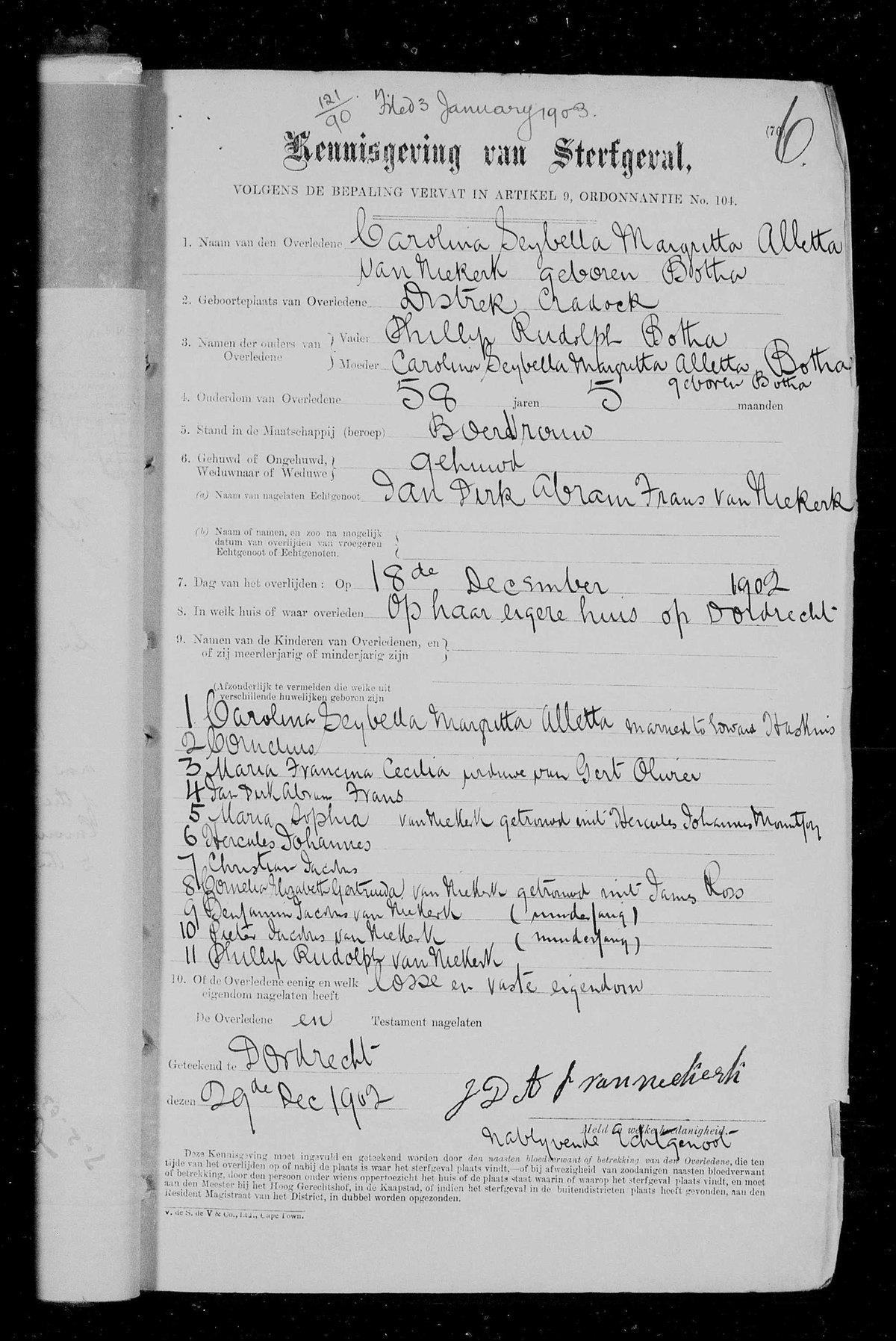
Why it comes up
Because his name is written on it. Fifth in her list of eleven children:
"5. Maria Sophia van Niekerk, getrouwd met Hercules Johannes Mountjoy."
The FamilySearch index keys every name on the page, so a search hit is not a statement about whose document it is. Hercules Johannes still has no estate file, and this archive's finding on that stands. What has changed is that the one false positive has been opened and turns out to be his mother-in-law.
So the van Niekerks are now documented. Maria Sophia van Niekerk, who married Hercules Johannes Mountjoy at Dordrecht on 8 October 1888, was a daughter of Jan Dirk Abram Frans van Niekerk and Carolina Deybella Margrietta Alletta Botha, who was herself born in the district of Cradock and whose parents were Philip Rudolph Botha and a mother of the same long name.
Her ten brothers and sisters were Carolina Deybella Margrietta Alletta, Cornelius, Maria Francina Cecilia (widow of Gert Olivier), Jan Dirk Abram Frans, Hercules Johannes, Christiaan Jacobus, Cornelia Elizabeth Gertruida (married James Ross), Benjamin Jacobus, Pieter Jacobus and Philip Rudolph.
She had a brother called Hercules Johannes, and she married a man called Hercules Johannes. This archive notes that and does nothing with it. It is the kind of coincidence that invites a story, and there is no document behind any story it invites.
The notice is signed by her widower, J. D. A. F. van Niekerk, and it is one more piece of evidence that Dordrecht is where this side of the family married. Dordrecht →
1907–1910 · An eighth child, and the word MIJNWERKER
Four documents from the Dutch Reformed congregation at Indwe, found the day the register was built by typing Indwe into it. Between them they add a son this archive did not have, and they answer the last line of the family testimony — not in the way it was told, and not in the way this archive said it could not be answered.
First, the confirmation class of 1907
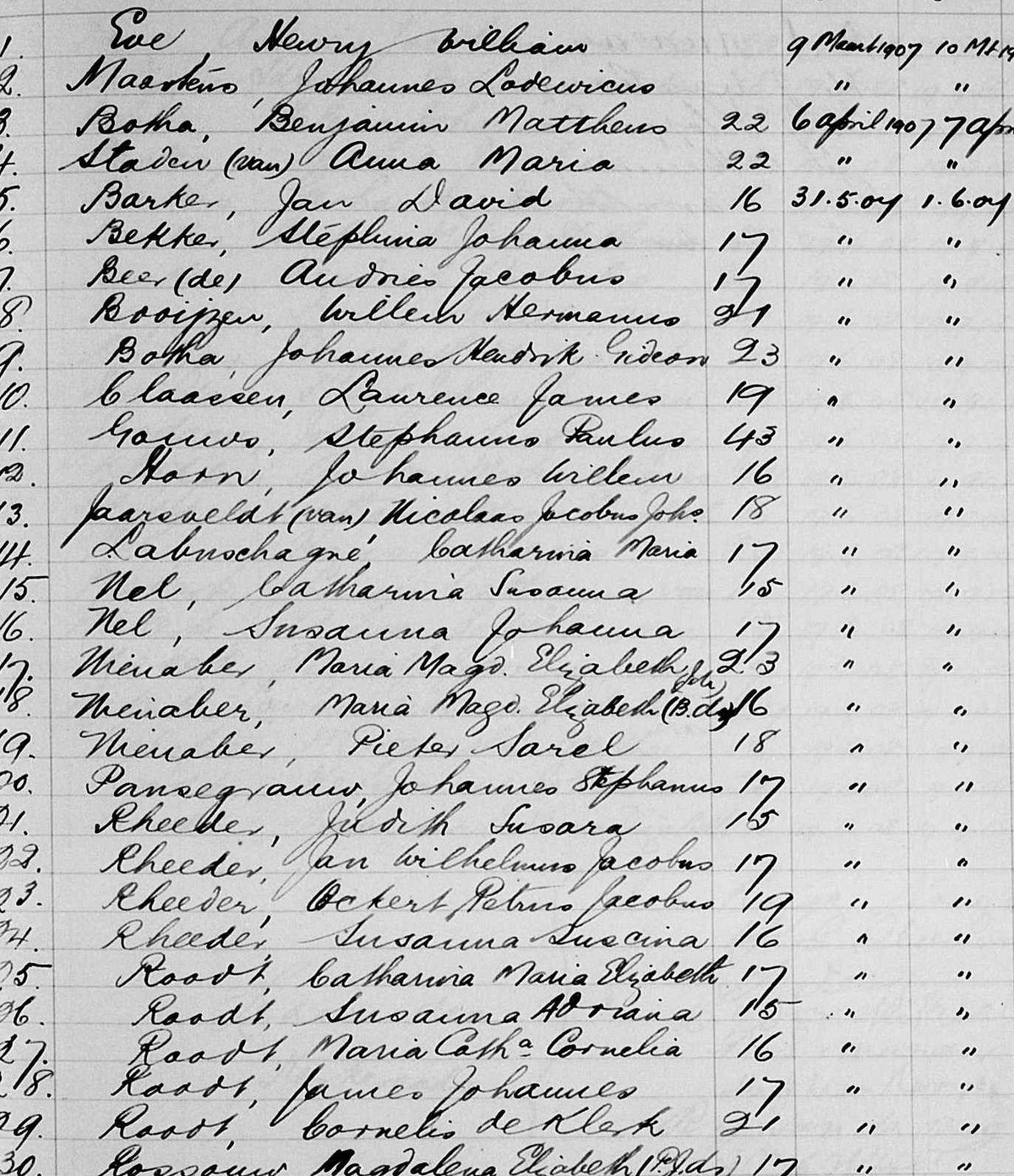
Five names off one page
| 8 | Booijzen, Willem Hermanus | 21 |
| 25 | Roodt, Catharina Maria Elizabeth | 17 |
| 26 | Roodt, Susanna Adriana | 15 |
| 27 | Roodt, Maria Catha Cornelia | 16 |
| 28 | Roodt, James Johannes | 17 |
| 29 | Roodt, Cornelis de Klerk | 21 |
Everyone who matters to the next three years is on this one page, on one afternoon, in one room.
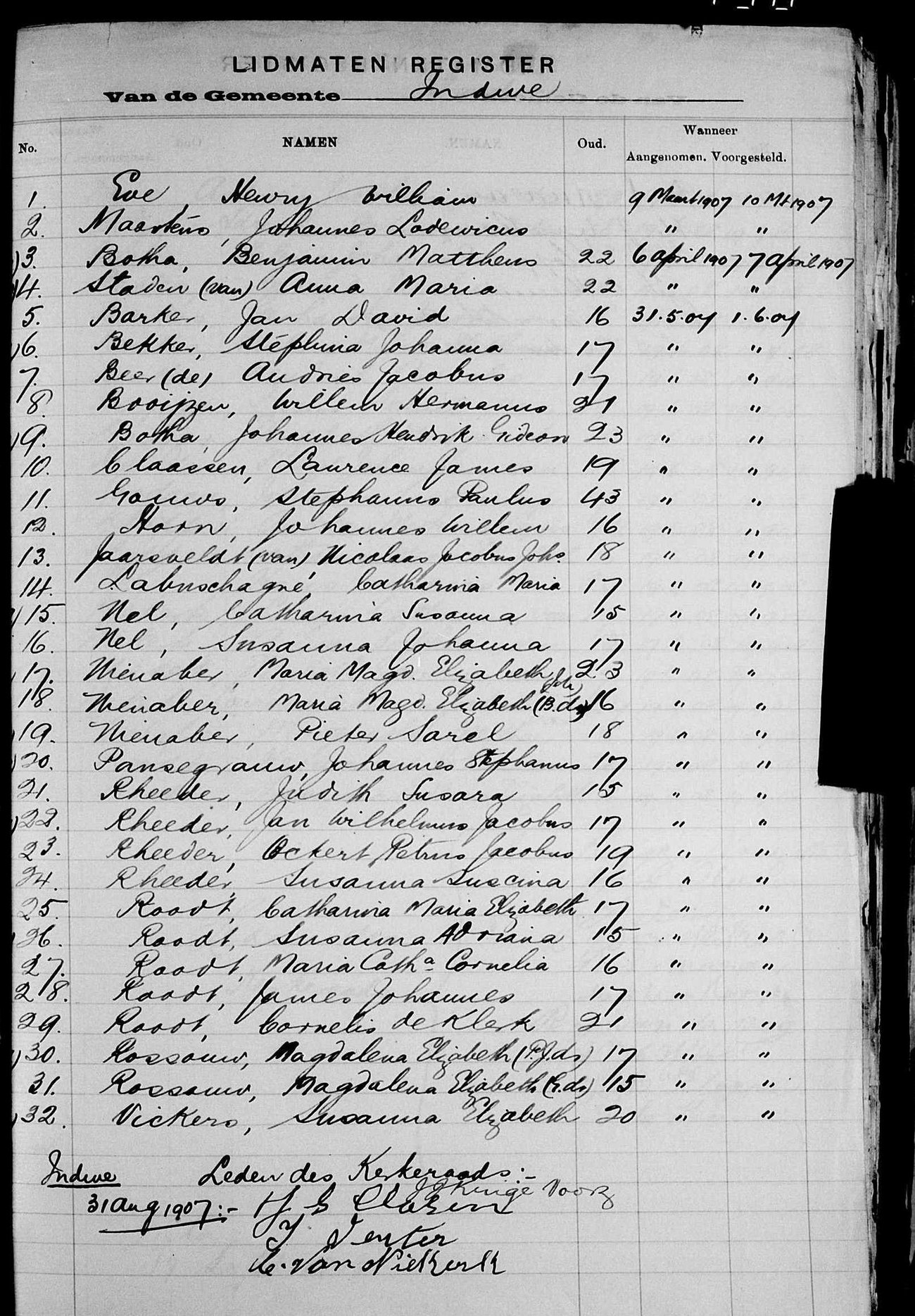

Twenty-one in May 1907 means born about 1886. This archive's list of the children of Willem Hermanus Booyzen and Kathleen Barry ran John Barry (c. 1884), then Johanna Catharina (1889). There was a gap and nobody had noticed it.
Then a marriage, and one word in it
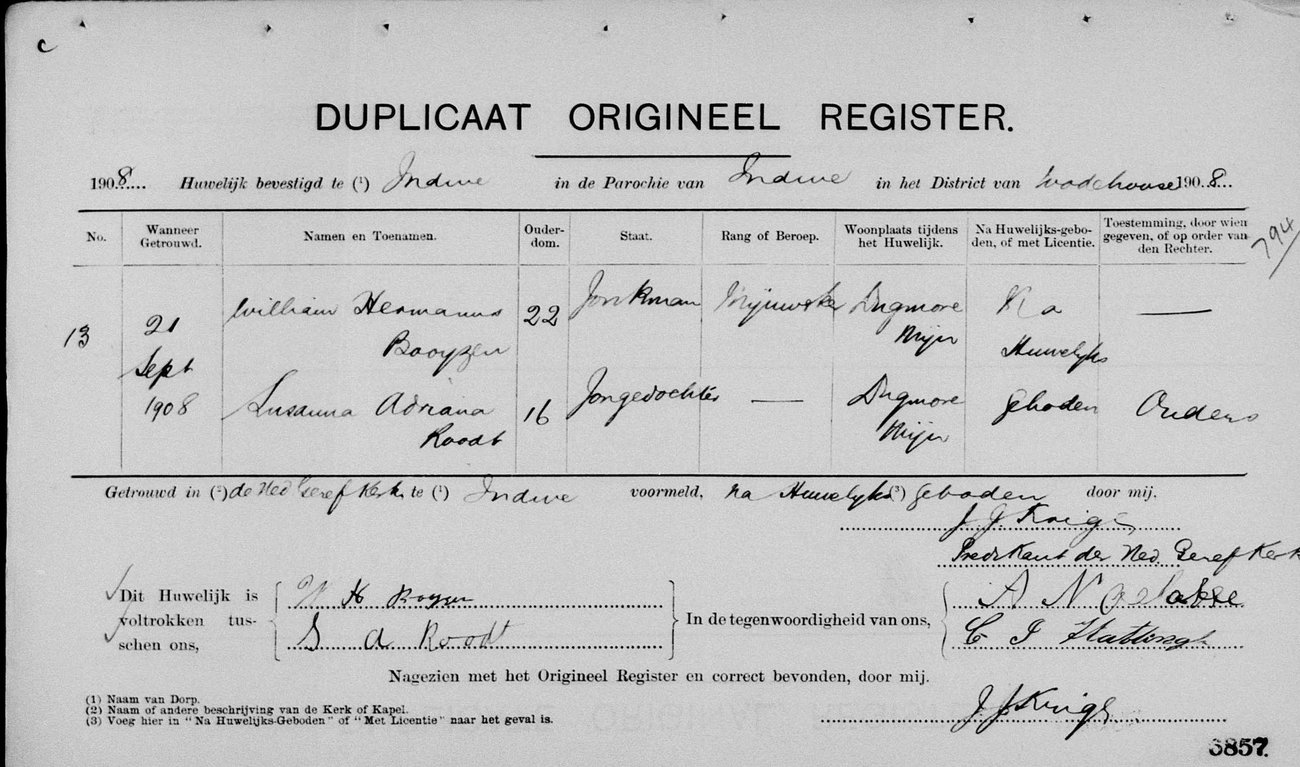
21 September 1908
| Groom | William Hermanus Booyzen, 22, jonkman |
| Bride | Susanna Adriana Roodt, 16, jongedochter |
| Beroep | MIJNWERKER |
| Woonplaats | Dugmore Mijn — both of them |
| Toestemming | Ouders — she was sixteen, so her parents had to consent |
| Married by | J. J. Krige, predikant der Ned. Geref. Kerk |
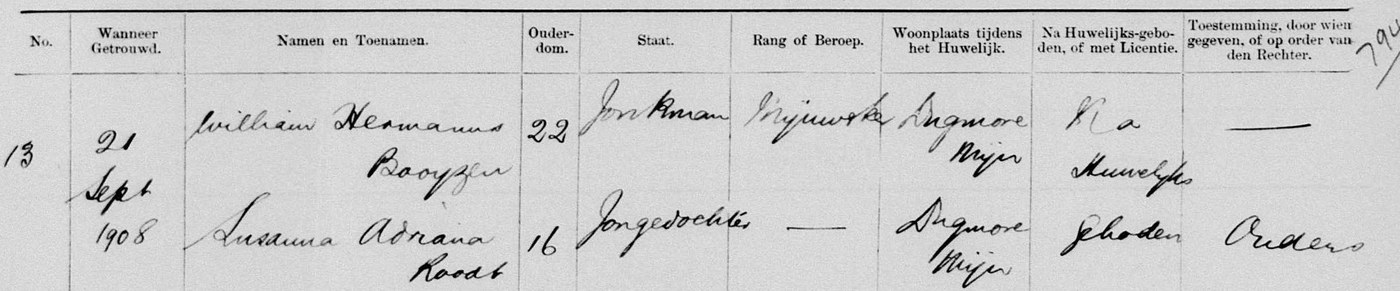
A Booyzen, on a mine, in a document.
The last line of the family testimony reads: "after the war our great great grandmother put herself and her kids on a train to Johannesburg where the boys initially all got jobs on the mines to make ends meet." This archive tested it, found six occupations across five generations — saddler, farmer, mason, tree nurseryman, railway clerk, mason — and wrote, on the open questions page: "Not one miner among them."
There is one. He is twenty-two, he lives at the mine, and the register writes his trade in the column that asks for it. The testimony →
And his mother was standing at the font
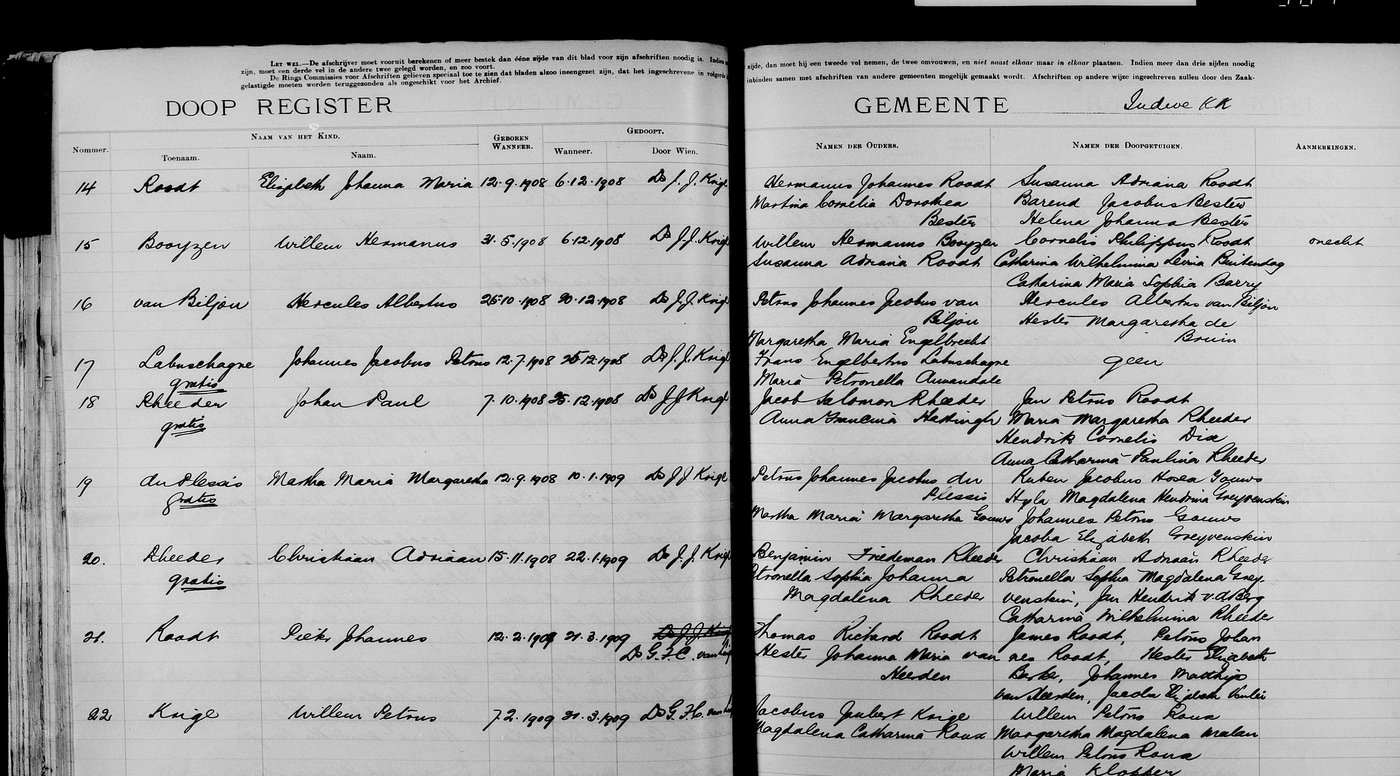
Entry 15
| Kind | Willem Hermanus Booyzen |
| Geboren | 31 May 1908 |
| Gedoopt | 6 December 1908 |
| Ouders | Willem Hermanus Booyzen Susanna Adriana Roodt |
| Getuigen | Cornelis Philippus Roodt Catharina Wilhelmina Levina Buitendag Catharina Maria Sophia Barry |
| Aanmerkingen | onecht |

The archive holds exactly one Catharina Maria Sophia Barry: Kathleen, born 1859, married to Willem Hermanus Booyzen in 1879, widowed at Indwe in September 1905. Dutch Reformed registers enter women under their maiden names, and there she is, in December 1908, standing godmother.
Inferred The miner is her son. No document says so in words. What the documents say is that a Willem Hermanus Booyzen born about 1886 was living at Indwe, and that Kathleen Barry stood at his child's font. This archive is satisfied and says which of those two things is the evidence.
The remark column is the harder reading. Onecht — born out of wedlock. The child was born on 31 May 1908; the parents married on 21 September 1908; the baptism was on 6 December. The register records the child's status at birth and does not revise it.
It also fixes where the family was. Kathleen Barry was still at Indwe in December 1908, three years and three months after her husband died there. Whatever else the train to Johannesburg was, it was not immediate.
And then a second child, by a second Roodt
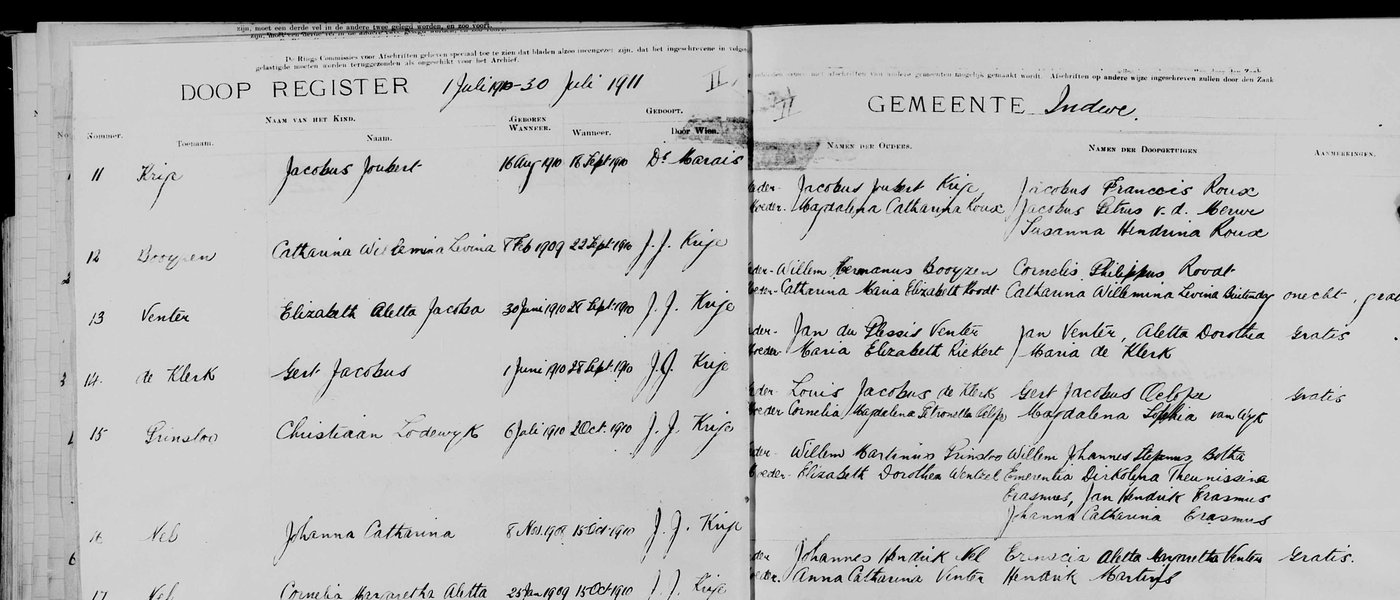
Entry 12
| Kind | Catharina Willemina Levina Booyzen |
| Geboren | 8 February 1909 |
| Gedoopt | 22 September 1910 |
| Vader | Willem Hermanus Booyzen |
| Moeder | Catharina Maria Elizabeth Roodt |
| Getuigen | Cornelis Philippus Roodt Catharina Willemina Levina Buitendag |
| Aanmerkingen | onecht · gratis |

A different woman. Both were confirmed in the same class on 31 May 1907 — Catharina Maria Elizabeth at seventeen, number 25 on the page, and Susanna Adriana at fifteen, number 26. The two children were born eight months and eight days apart, which settles the question of whether the second name is a clerk's slip for the first: it cannot be.
| Date | What the register says |
|---|---|
| 31 May 1907 | Willem Hermanus Booijzen, 21, confirmed at Indwe alongside Catharina Maria Elizabeth Roodt, 17, and Susanna Adriana Roodt, 15 |
| 31 May 1908 | Willem Hermanus born to Susanna Adriana Roodt |
| 21 Sep 1908 | he marries Susanna Adriana Roodt, 16, at Indwe — both of Dugmore Mijn, her parents consenting |
| 6 Dec 1908 | the boy baptised, entered onecht; his grandmother Kathleen Barry stands godmother |
| 8 Feb 1909 | Catharina Willemina Levina born to Catharina Maria Elizabeth Roodt — four and a half months after the wedding |
| 22 Sep 1910 | she is baptised, entered onecht, gratis |
This archive sets that down because the register does, and stops there. The two Roodt women are not further identified here and the relation between them is not stated anywhere read so far. The daughter is named for her godmother, Catharina Willemina Levina Buitendag, who stood at both fonts.
1885 · The estate this archive gave to the wrong man
No image, no transcription, no new document read. Just an index line, set against two that have been read — and a correction that moves a whole branch of this family onto the map.
Since the Transvaal references were first pulled out of NAAIRS, this archive has carried a row saying TAB MHG O/2899 — Jan Gerhardus Lodewikus Booyzen — 1885, and attached it to the seventh child on the 1863 death notice: Jan Gerhardus Lodewicus Booysen, born 4 December 1855. His entry on the people index read "he died in the Transvaal at about thirty."
He did not. That sentence had no source except the estate reference itself. The archive read the year off the file number, wrote it into his life as a death date, and then quoted the death date back as if it were evidence.
FamilySearch's index of the same Transvaal probate series gives the estate's deceased in full:
What the index says
| Name | Jan Gerardus Lodewicus Booijzen |
| Relationship | Deceased |
| Age | 67 |
| Birthplace | Distrik Graaf Reinet — birth year about 1818 |
| Died | 25 May 1885 |
| Death place | Vaalbank, distrik Lichtenburg |
ark 1:1:QPTJ-R6KB and 1:1:Q2DG-52P9, two index passes over the same estate.
A man born in 1818 is not a man born in 1855. And the archive already holds a Jan Gerthardus Lodewikus Booijsen born in the right decade in the right place: he is fifth on the 1876 Sterfkennis of Petrus Jacobus Booysen of Brakfontein, born Graaff-Reinet about 1788. The 1876 notice →
So the estate is the uncle's, not the nephew's, and two things follow.
First, a date comes off a man
Jan Gerhardus Lodewicus Booysen, born 4 December 1855, no longer dies in 1885. This archive does not know what became of him, and now says so. He was seven when his mother died and twenty-nine when his father's estate was wound up, and after that there is nothing.
One more name back in the queue at open questions.
Second, a farm joins the line
The uncle died at Vaalbank, district Lichtenburg. This archive has already read a Sterfkennis from that farm: Magdalena Susanna Maria van den Berg, born Booyzen, died there on 1 May 1920, aged 59 years 9 months, father entered as Jan Gerhardus Lodewicus Booyzen.
She was recorded here as a lead that was "NOT PROVED". She is his daughter, born about 1860, on a farm where her father had died thirty-five years before.
What this section is not. The estate file itself has not been read. FamilySearch offers no image for it — the record page says "Check Image Availability" where the others say "View original document" — so what is above rests on an index entry, checked against two documents that have been read. The file is at the Transvaal Archives in Pretoria and this archive has not seen it. Sources →
1930, filed 1943 · A death notice thirteen years late
Death notice 84992, Cape Town. This archive went looking for it because the Master's own index files it under BOOYZEN, with a z. It found that, and a correction of exactly the kind it had just finished making about somebody else.
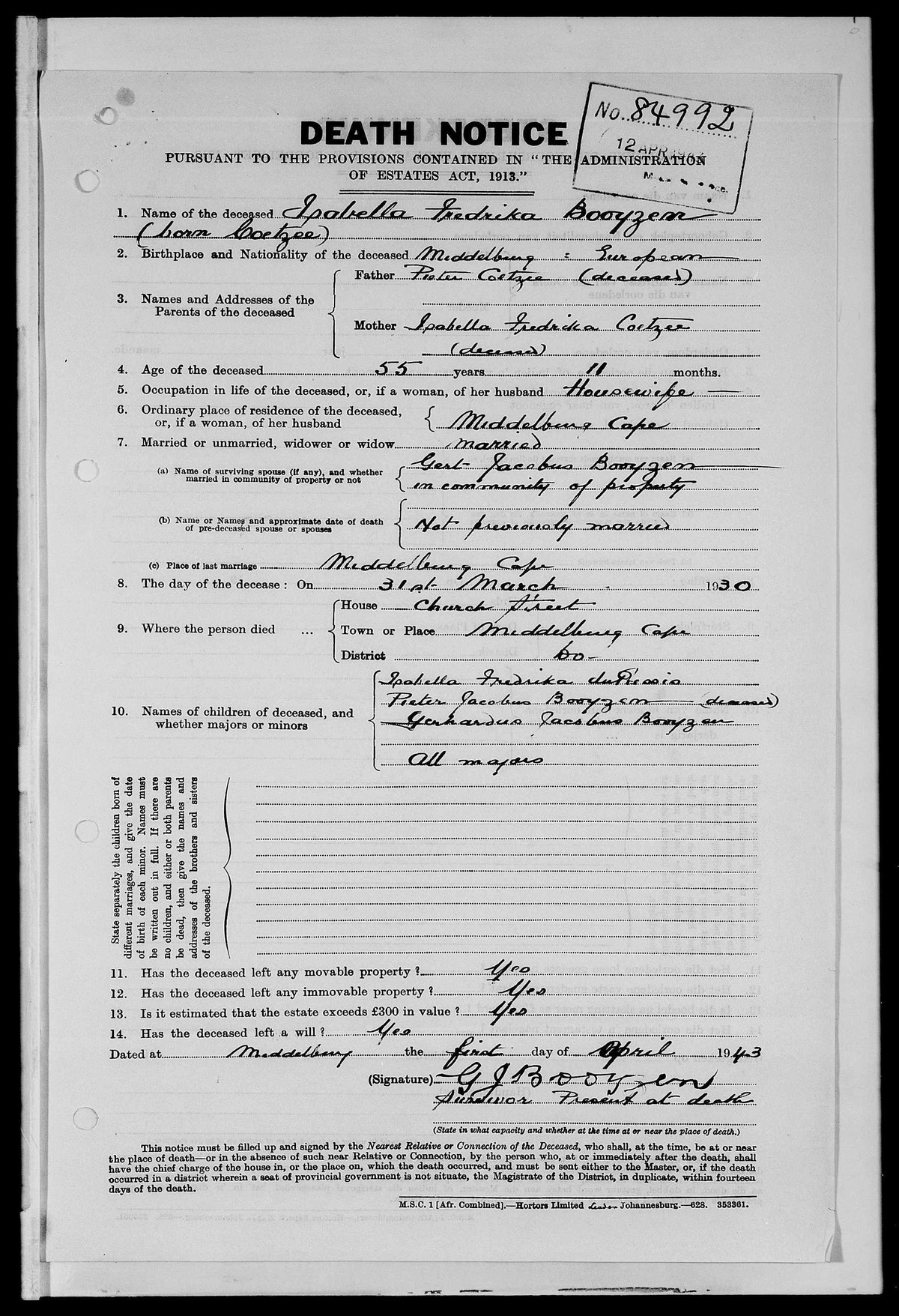
The form, as completed
| 1. Name | Isabella Fredrika Booyzen (born Coetzee) |
| 2. Birthplace | Middelburg · European |
| 3. Parents | Pieter Coetzee, deceased Isabella Fredrika Coetzee, deceased |
| 4. Age | 55 years 11 months — born about May 1874 |
| 7a. Husband | Gert Jacobus Booyzen, in community of property |
| 7c. Married at | Middelburg, Cape |
| 8. Died | 31 March 1930 |
| 9. Where | Church Street, Middelburg |
| 10. Children | Isabella Fredrika du Plessis · Pieter Jacobus Booyzen (deceased) · Gerhardus Jacobus Booyzen — all majors |
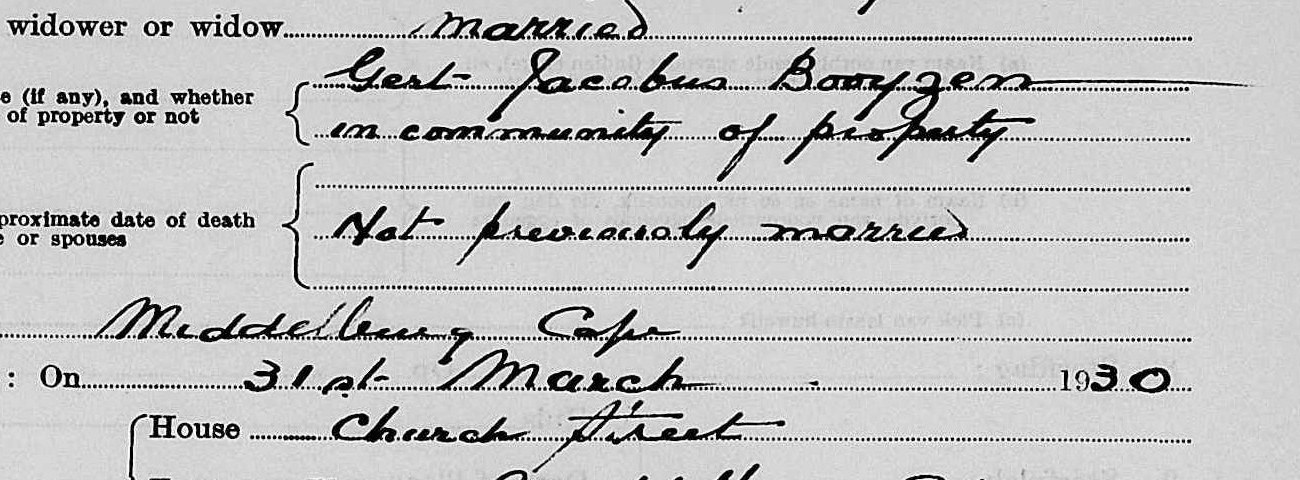
A correction This archive had her dying in 1943. She died on 31 March 1930. 1943 is when her husband finally filed.
The wrong date came from the same place as the last one: the year in the estate reference, read as though it were the year of the death. Three days ago the archive took a death date off a man on exactly that ground. It had made the same mistake here and had not noticed. What was taken back →
Thirteen years is a long gap, and the form does not explain it. What it does show is that Gert Jacobus Booyzen was alive on 1 April 1943, signing as survivor, eight years before his own estate was opened in the Transvaal.
And their son Pieter Jacobus — the boy baptised with a z at Middelburg on 12 February 1905, whom this archive has been carrying as a living name — is entered here as deceased. The Cape civil index gives a Petrus Jacobus Booyzen dying at Middelburg on 7 June 1937, aged about thirty-two.
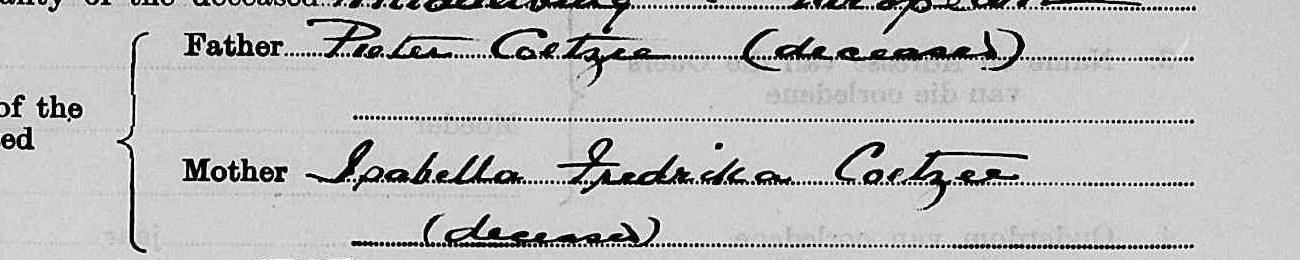
And the spelling. Every occurrence on this form is BOOYZEN — in the Master's file number, in her name, in her husband's, in her sons', and in the signature. A Cape official document of 1943, thirty-eight years after the Indwe clerk wrote Booysen on her father-in-law's death form. The name →
1843 · The oldest Booyzen death notice in the Cape — and a warning
Death notice 6167, filed at Cape Town on 21 June 1843. It is not this family. It is put here because of what it nearly is.
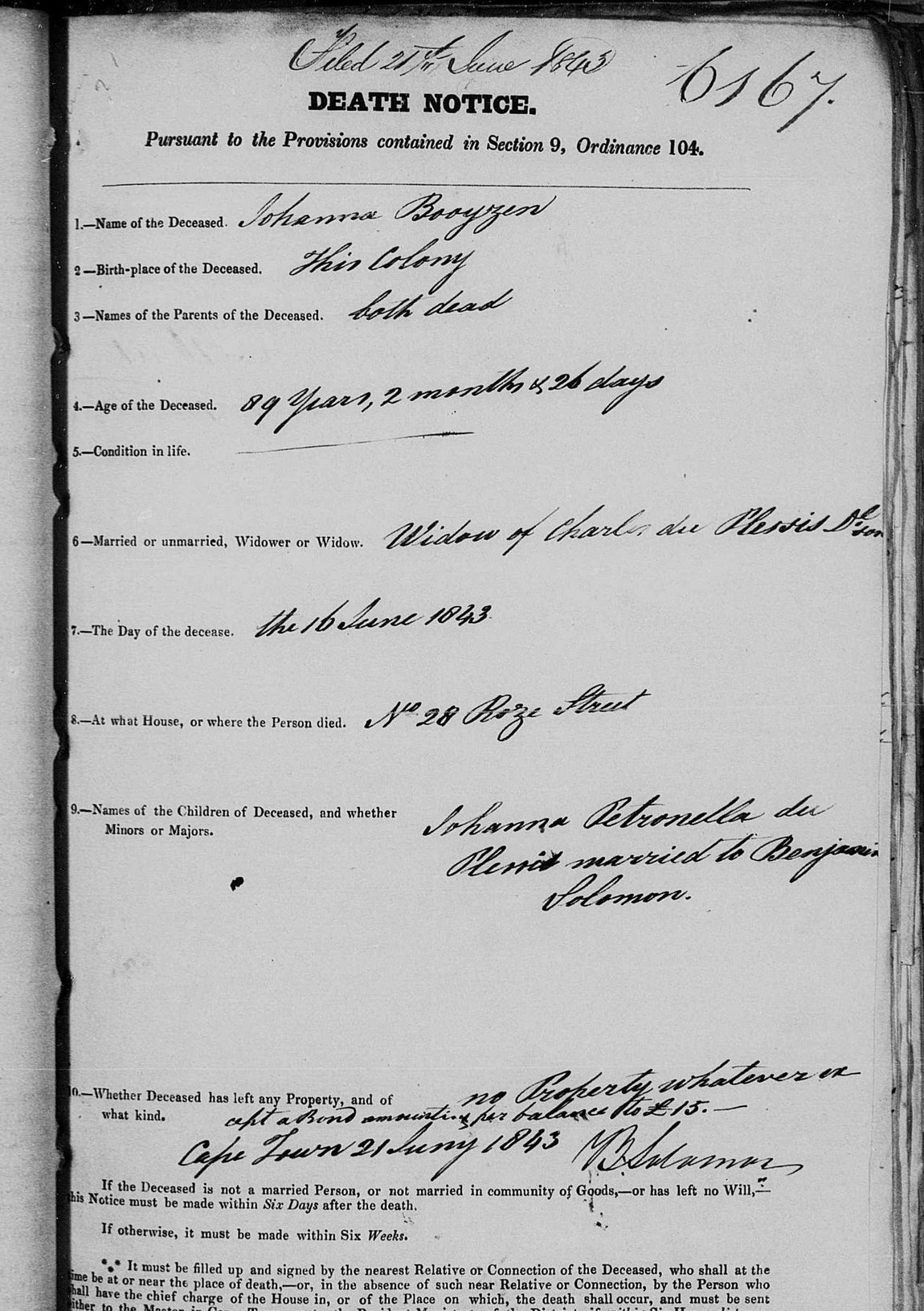
The form
| 1. Name | Johanna Booyzen |
| 2. Birth-place | This Colony |
| 3. Parents | "both dead" |
| 4. Age | 89 years, 2 months & 26 days — born about 20 March 1754 |
| 6. Condition | Widow of Charles du Plessis, Dls son |
| 7. Died | 16 June 1843 |
| 8. Where | No. 28 Roze Street, Cape Town |
| 9. Children | Johanna Petronella du Plessis, married to Benjamin Solomon |
| 10. Property | "no property whatever except a Bond amounting per balance to £15" |


Question three has now failed seven times in this archive, and this is the earliest and the bluntest. Asked for the names of the parents, the informant wrote down whether they were alive. Where it works →
Here is a woman named Booyzen, born about March 1754, who died in 1843, whose estate sits in the Cape Master's papers — and whose name is not Magdelena, not Elisabeth, and not de Beer. She was the widow of a du Plessis and she died in a rented house in Cape Town.
This archive does not say they are the same person. It says the opposite. But a birth year and a death year matching to the year, on the only two facts the tree offers, is exactly the material a records-matcher builds a wrong person out of — and it is worth knowing that such a record exists before somebody finds it and decides it is her. Open question zero →
One thing she does show, and it is not nothing. Booyzen was a Cape surname before this family's paper trail starts. She was born in the Colony in 1754, which is a year earlier than anything else in this archive, and she died owning fifteen pounds of somebody else's debt.
1903 · "Irishman born in Ireland"
Entry 74, district Barkly East. The registration of John Barry's death, made by the son who was standing there — and it settles a question this archive has carried since its first week.
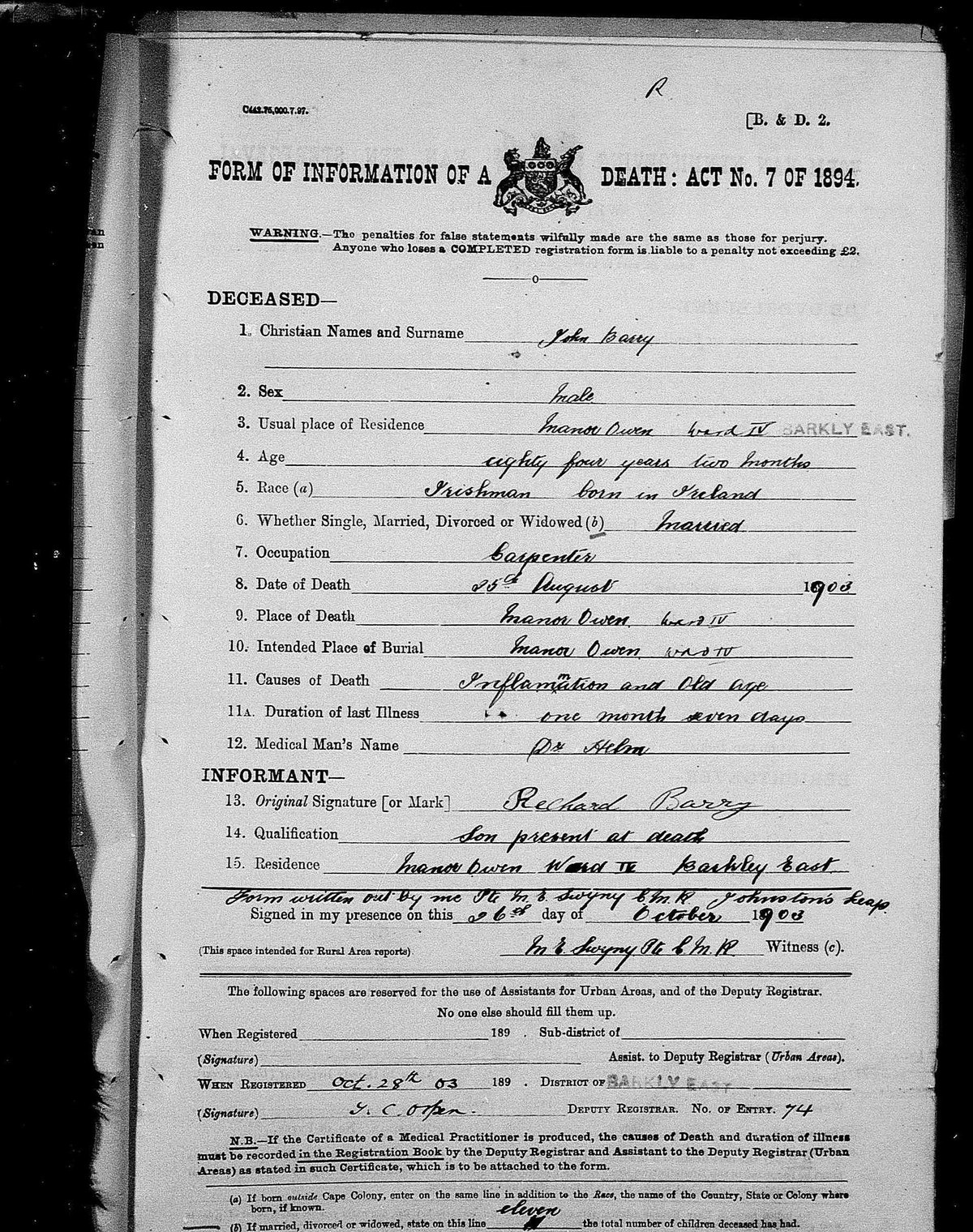
The form, as completed
| 1. Name | John Barry |
| 3. Residence | Manor Owen, Ward IV, Barkly East |
| 4. Age | eighty four years two months — born about June 1819 |
| 5. Race | "Irishman born in Ireland" |
| 7. Occupation | Carpenter |
| 8. Died | 25th August 1903 |
| 11. Causes | Inflammation and Old Age, one month seven days |
| 12. Doctor | Dr Helm |
| 13–15. Informant | Richard Barry — "Son present at death", of Manor Owen |
| Footnote (b) | "eleven" children |

Open question 5, answered He was born in Ireland. Not at sea, not in Sunderland, not in an unknown place. His son wrote it down eight weeks after burying him, on a form that carries the penalties for perjury at the top of the page.
This archive has run that question three ways for weeks. The family tree guessed Sunderland, Durham with a question mark. His own 1915 death notice — sworn by a different son, twelve years after the fact — types "At sea, exact whereabouts unknown. British." And a research note on the same tree called him "an Irishman … reputed to be anti English."
The 1903 form beats the 1915 notice on every count that matters. It is twelve years closer to the man; it was made by a son who was in the room; and it is a statutory registration rather than an estate paper. Where the two disagree, this archive now follows 1903. Open questions →
Which also settles the date. The tree says 25 August 1903; the 1915 notice says the 3rd. The registration says 25th August, and the man who signed it was present. Disputed →


And Manorowen was his own house. This archive knew the farm only from 1915, when Margaretha Kolbe died there and Richard Peter Barry signed as "son in whose house deceased died". The 1903 form puts John Barry himself there, living and dying at Manor Owen, Ward IV, with Richard resident at the same address.
Eleven children. The footnote asks for the total and the answer is eleven. This archive has named nine. The Barrys →
1912 · "Dutch, born in the District of Barkly East"
Nine years later, the same farm, the same registrar's form — and a grandchild of the Irishman is entered under a different nation.
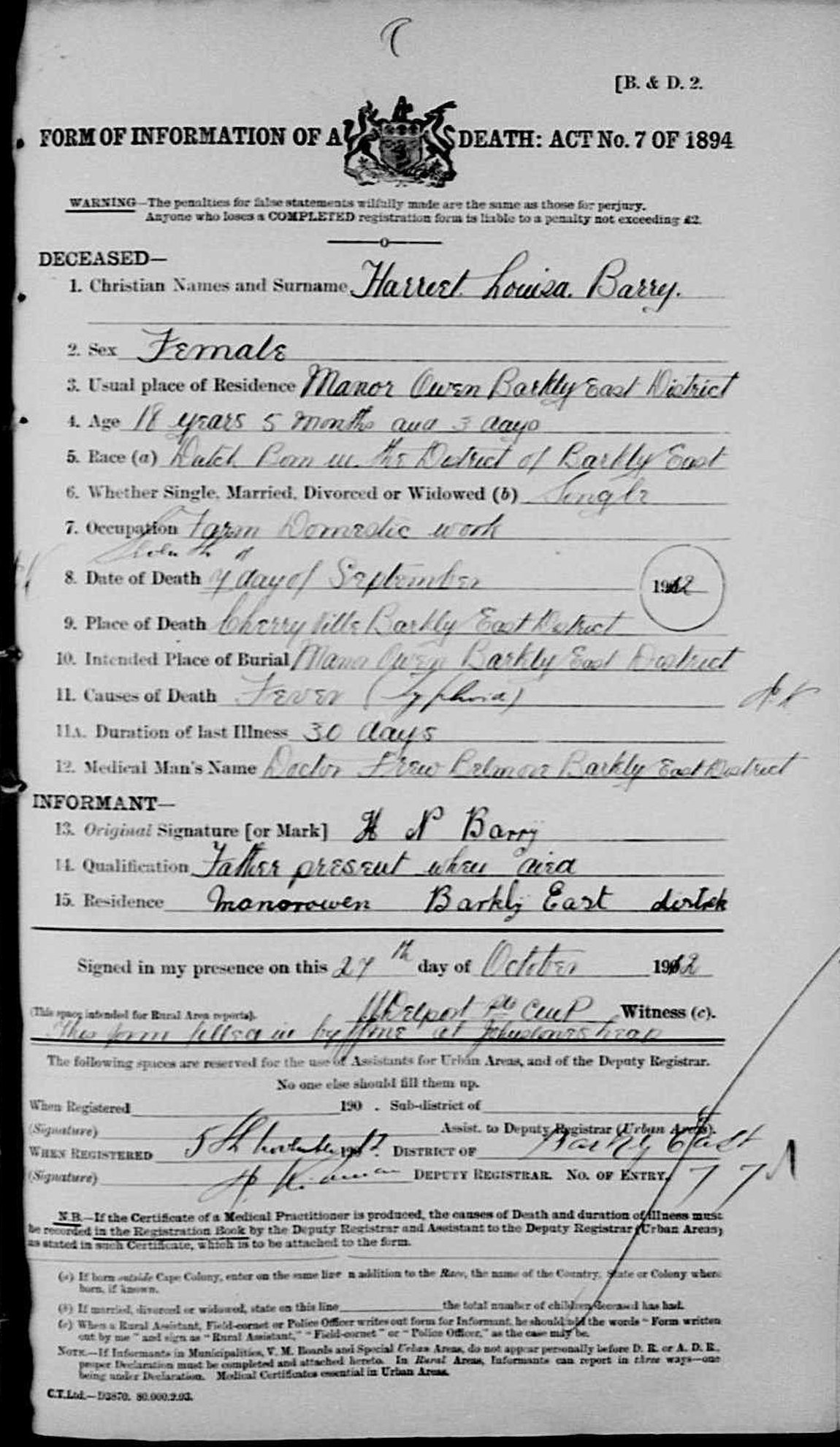
The form
| 1. Name | Harriet Louisa Barry |
| 3. Residence | Manor Owen, Barkly East District |
| 4. Age | 18 years 5 months and 3 days |
| 5. Race | "Dutch, born in the District of Barkly East" |
| 7. Occupation | Farm domestic work |
| 8. Died | 7 September 1912 |
| 9. Where | Cherry Ville, Barkly East District |
| 10. Burial | Manor Owen |
| 11. Cause | Fever (Typhoid), thirty days |
| 13–15. Informant | H. N. Barry — "Father present when died", of Manorowen |
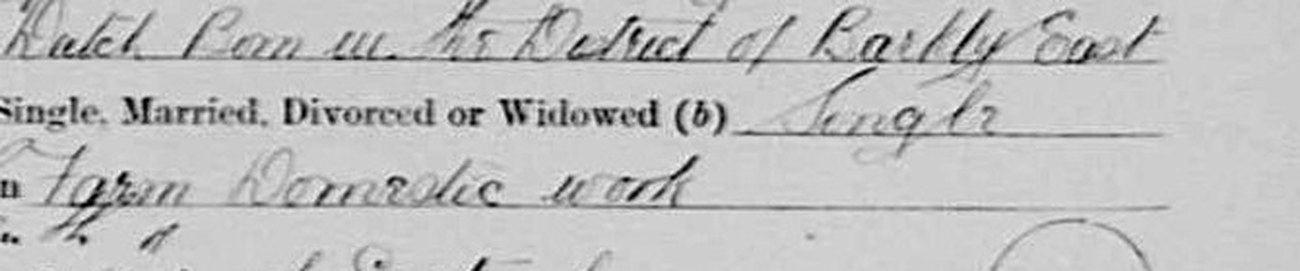
She is Hendrik Nicholaas Barry's daughter — he signs as father, present when she died — and her mother is Anna Johanna Maria Schoeman. Her baptism is on record at Barkly West in October 1894.
Two generations, two nations, one registrar's form. In 1903 the grandfather is an Irishman born in Ireland. In 1912 the granddaughter, dead of typhoid at eighteen on the same farm, is Dutch.
That is what the family's own testimony says happened, in the one line of it nobody has questioned: "as his son and grandson were married to Dutch girls their activity during the Boer War would be interesting." Here it is on a government form, and it took nine years. The testimony →
She also fixes a farm. She lived at Manorowen, died at Cherryville and was buried at Manorowen — so both are Barry places, and Cherryville is the third named Barry farm in this archive after Manorowen and Jerpoint. The atlas →
1908 · The son who signed the 1876 notice, found — and a mother nobody had
Estate 14380, Transvaal. Hendrik Stephanus Booysen put his name to his father's Sterfkennis at Brakfontein in September 1876. Thirty-two years later his own was filed, and it resolves a contradiction this archive has carried as Serious since the first week.
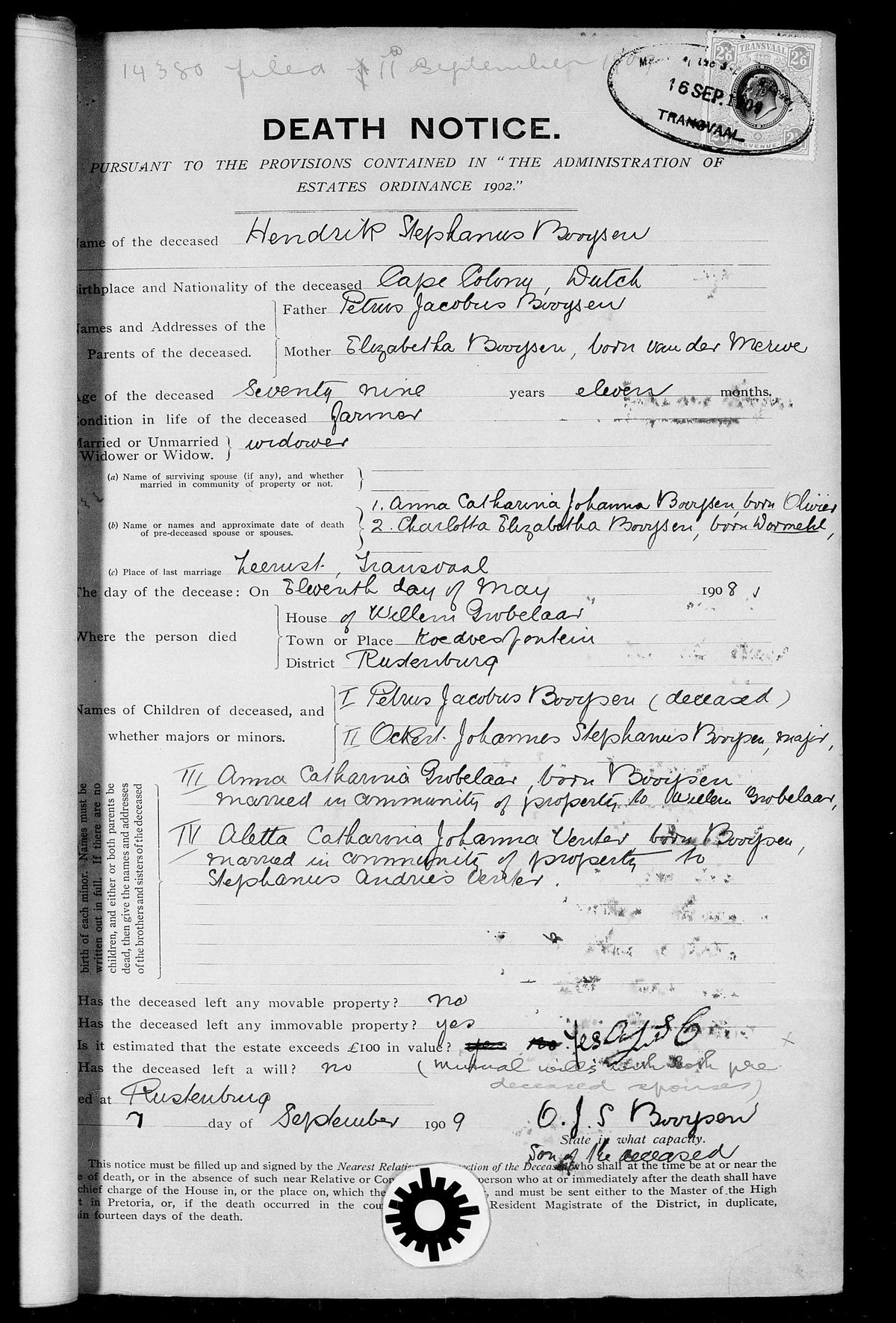
The form, as completed
| Name | Hendrik Stephanus Booysen |
| Birthplace | Cape Colony · nationality Dutch |
| Father | Petrus Jacobus Booysen |
| Mother | Elizabetha Booysen, born van der Merwe |
| Age | 79 years 11 months — born about June 1828 |
| Condition | Farmer · widower |
| Wives | 1. Anna Catharina Johanna, born Olivier 2. Charlotta Elizabetha, born Dormehl |
| Married at | ZEERUST, TRANSVAAL |
| Died | 11 May 1908, at the house of Willem Grobelaar, Koedoesfontein, district Rustenburg |
| Children | Petrus Jacobus (deceased) · Ockert Johannes Stephanus · Anna Catharina Grobelaar · Aletta Catharina Johanna Venter |
A mother this archive did not have

This archive's disputed page has carried a contradiction marked Serious since the beginning:
"Anna Maria van der Merwe (1785–1825) dies before 8 March 1825 — but Hendrik Stefanus is recorded born 23 August 1829. The same pattern one generation earlier: an unrecorded second marriage."
The second marriage is no longer unrecorded. The mother is Elizabetha van der Merwe, and the son's own age on the form — seventy-nine years eleven months at 11 May 1908 — puts his birth at about June 1828, three years after the first wife died. Two van der Merwe wives, one after the other. The contradiction was never a contradiction; it was a missing row.
And it repairs something this page has been apologising for. The 1876 Sterfkennis lists eight children and names no mother for any of them, so this archive drew them all under Anna Maria van der Merwe with a warning printed beside them. At least one of the eight is Elizabetha's. The households →
And then the place of the marriage

Zeerust is the principal town of the district of MARICO.
This archive spent weeks saying of the Marico Booyzens that "they are not this family", and has been walking that back for three days — Rustenburg in 1876, Lichtenburg in 1885 and 1920, and Marico left standing as the one district still held at arm's length.
Here is a son of the 1876 man marrying at Zeerust. It is still not a link to any of the seven compensation claims, and the atlas still says unresolved. But the last district in the row has now had a documented Booysen marriage in it, and the sentence this archive withdrew was wronger than it knew. The atlas → · What was taken back →
He died in his son-in-law's house at Koedoesfontein, a farmer with no movables, some land, and mutual wills with both of his dead wives. His son Ockert Johannes Stephanus signed for him, as he had signed for his own father thirty-two years before.
1892 · The marriage the 1908 notice named, found — and it takes four children off one mother
Entry 13 of the Duplicaat Origineel Register, Huwelijks-Bevestiging te Zeerust, Distrikt Marico, 14 April 1892. The 1908 death notice said only Zeerust, Transvaal. Here is the register page, and it answers three questions the notice left open and contradicts one thing this archive published about it.
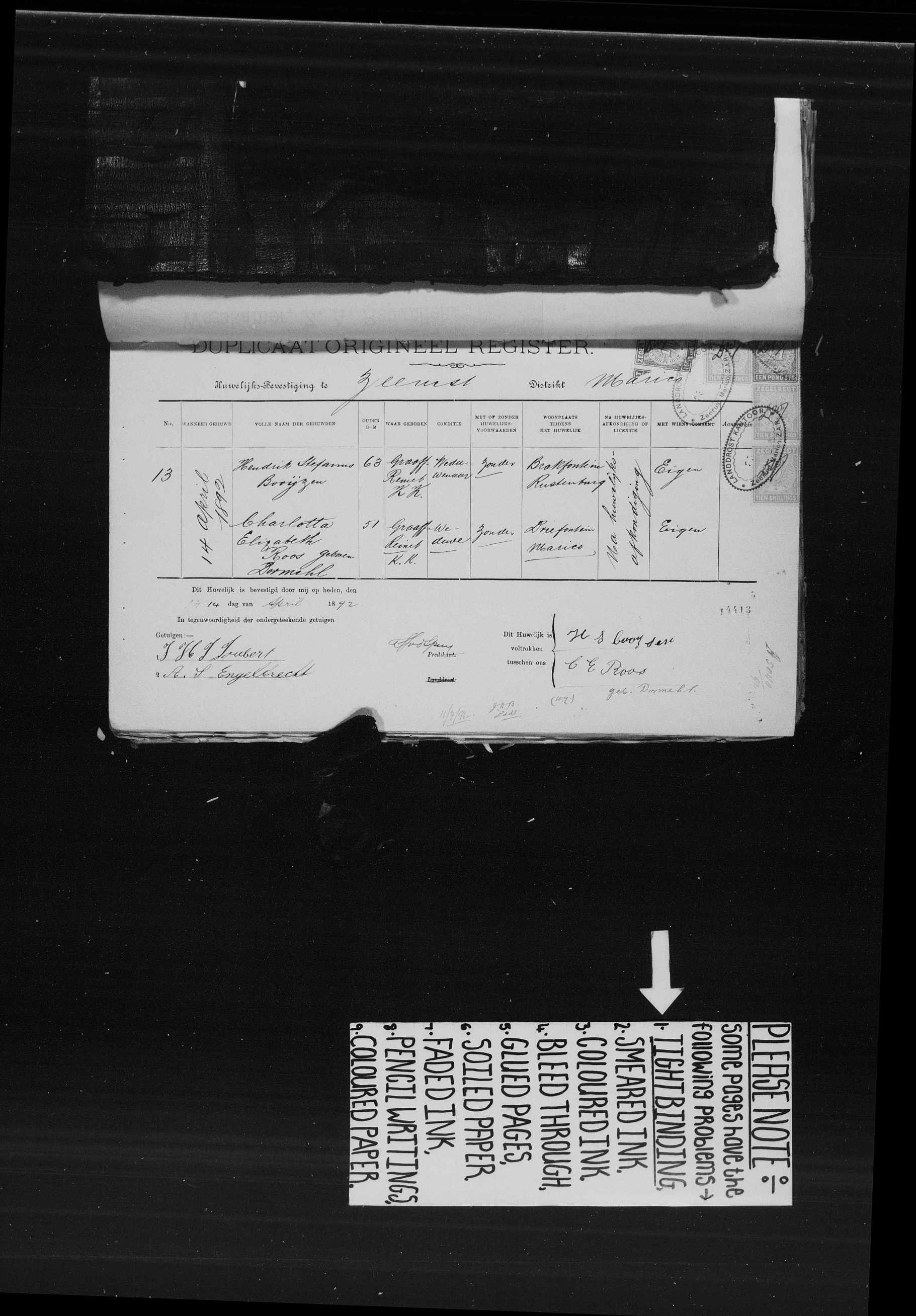
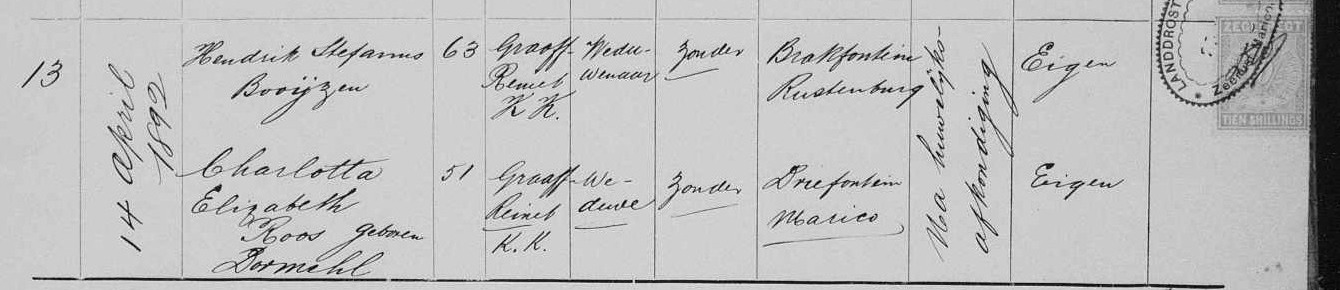
| Column | Hendrik Stefanus Booijzen | Charlotta Elizabeth Roos |
|---|---|---|
| Ouderdom | 63 — born about 1829 | 51 — born about 1841 |
| Waar geboren | Graaff-Reinet, K.K. | Graaff-Reinet, K.K. |
| Conditie | Weduwnaar | Weduwe |
| Huwelijksvoorwaarden | zonder | zonder |
| Woonplaats | Brakfontein, Rustenburg | Driefontein, Marico |
| Consent | eigen | eigen |
Graaff-Reinet, in his own marriage
The 1908 notice gave his birthplace as Cape Colony and nothing finer. This gives the town. It is the fourth man of this family documented as born at Graaff-Reinet — Petrus Jacobus baptised there in 1788, Petrus Jacobus born there in 1812, Jan Gerardus Lodewicus born there in 1818, and now Hendrik Stefanus about 1829. The atlas →
Brakfontein, sixteen years on
In September 1876 he signed his father's Sterfkennis at Brakfontein in the district of Rustenburg. In April 1892 he gives his home as Brakfontein, Rustenburg. He did not leave. The family that this archive spent weeks placing in the north-eastern Cape had a branch sitting on one farm in the Transvaal for at least sixteen years. The 1876 notice →
She was a widow, and her name is not what we published
This archive has called her Charlotta Elizabetha Dormehl. The register writes Charlotta Elizabeth Roos, geboren Dormehl, condition weduwe, and she signs C. E. Roos geb. Dormehl. Dormehl was her maiden name and Roos was her first husband's. She came to this marriage from Driefontein in Marico with a married name of her own.
And he signs with an s
The clerk writes him into the register as Booijzen. Two inches below, in the box headed Dit Huwelijk is voltrokken tusschen ons, he signs his own name H. S. Booysen. The z and the s are not two families and they are not even two clerks. On this page they are one man and the official writing him down. The name →
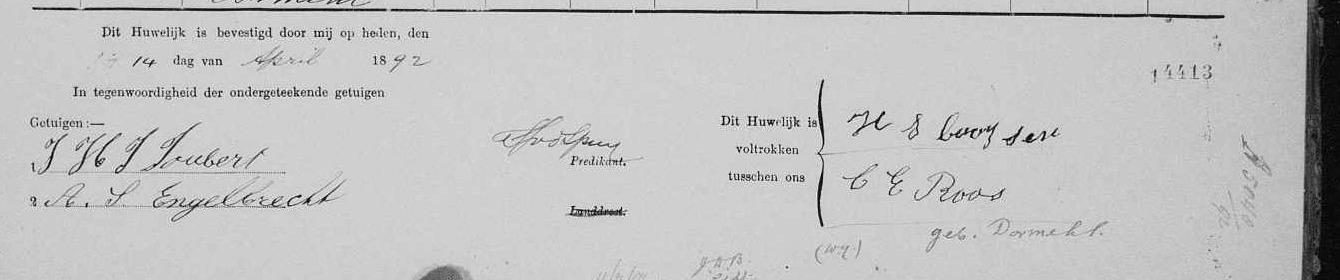
The 1908 death notice names four children — Petrus Jacobus (deceased), Ockert Johannes Stephanus, Anna Catharina Grobelaar and Aletta Catharina Johanna Venter — and does not say which wife they belong to. This archive drew all four under the second wife, Charlotta, because she was the marriage it could name.
They cannot be hers. She married him on 14 April 1892 at the age of fifty-one, a widow. By 1908 two of the four are married women carrying their husbands' surnames, one is dead, and the fourth signs his father's death notice as an adult son. Every one of them was born long before 1892. The four children belong to the first wife, Anna Catharina Johanna Olivier, and the household that has stood empty on this site since the 1908 notice was read is the one they go in. The households → · What was taken back →
What it does not give. The register has no column for parents. Neither party's father or mother is named, so this page cannot be used to test Hendrik Stefanus against the 1876 list a second time — the 1908 notice is still the only document that puts Elizabetha van der Merwe in this family. What 1892 adds is the town, the farm, the condition of both parties, and a date the archive did not have.
South Africa, Transvaal, Civil Marriages, 1870–1931 · FamilySearch 1:1:QPH1-9CX8, film 007747932 image 01608, read 13 September 2026.
1891 · Two deaths at Brakfontein in five days, and a woman this archive had thrown away
This site has carried a woman called Anna Johanna Booijzen, born Alberts for a week, under the heading NOT PROVED TO BE KIN, on a farm this site called Boekfontein. Read at full resolution, her death notice says neither of those things. She is the first wife of Hendrik Stefanus Booijsen, she died on Brakfontein — the family farm — and the surname the archive read as Alberts has no b, no r, no t and no s in it.
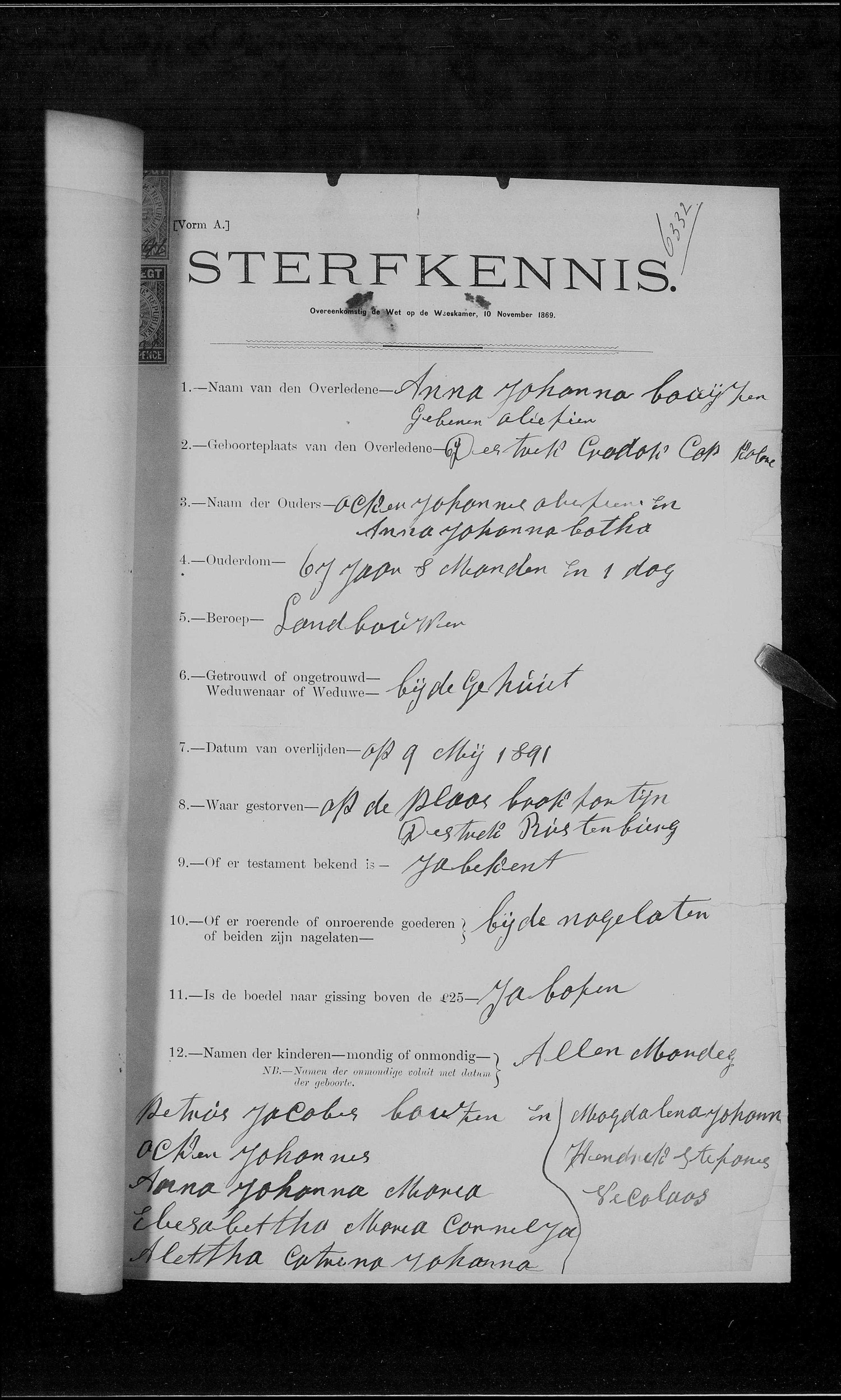
The form, as completed
| 1. Naam | Anna Johanna Booijzen, gebooren Oliefier |
| 2. Geboorteplaats | District Cradock, Cap Kolonie |
| 3. Ouders | Ocken Johannes Oliefier en Anna Johanna Botha |
| 4. Ouderdom | 67 jaar 8 maanden en 1 dag — born about 8 September 1823 |
| 5. Beroep | Landbouwster |
| 6. Staat | gehuwd — not a widow. Her husband outlived her. |
| 7. Overleden | 9 Mei 1891 |
| 8. Waar | op de plaas BRAKFONTIJN, district Rustenburg |
| 9. Testament | Ja, bekend |
| 10–11. Boedel | roerend en onroerend, boven £25 |
| 12. Kinderen | Allen mondig — seven, all of age |
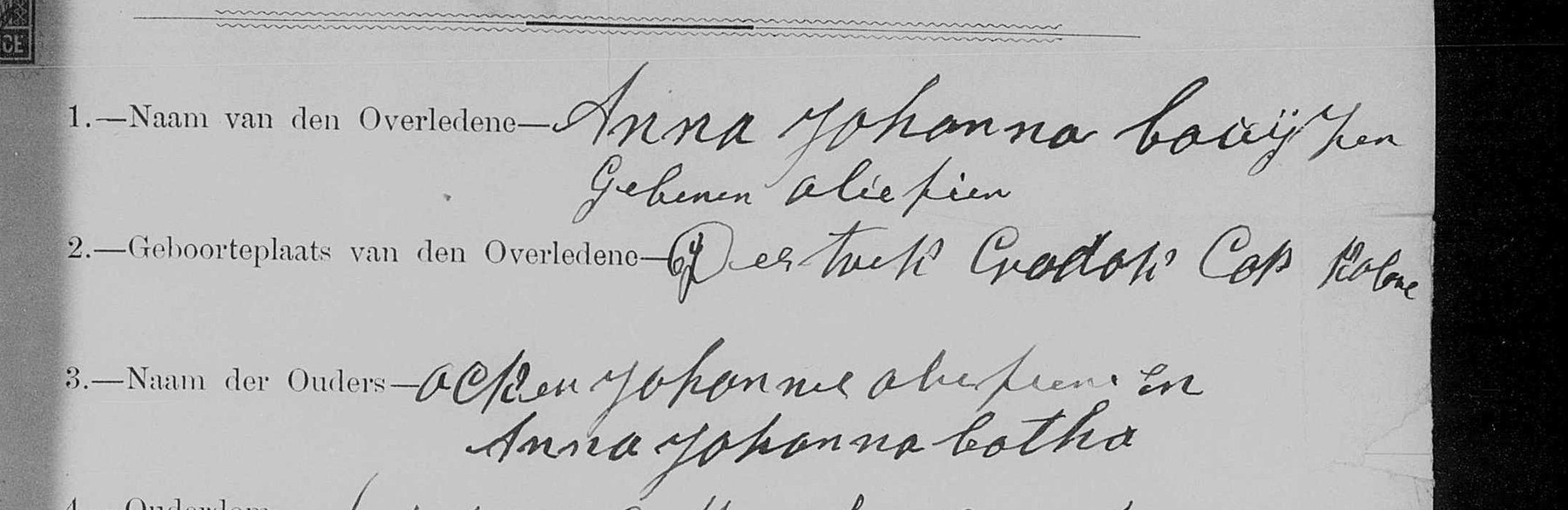
First, the farm
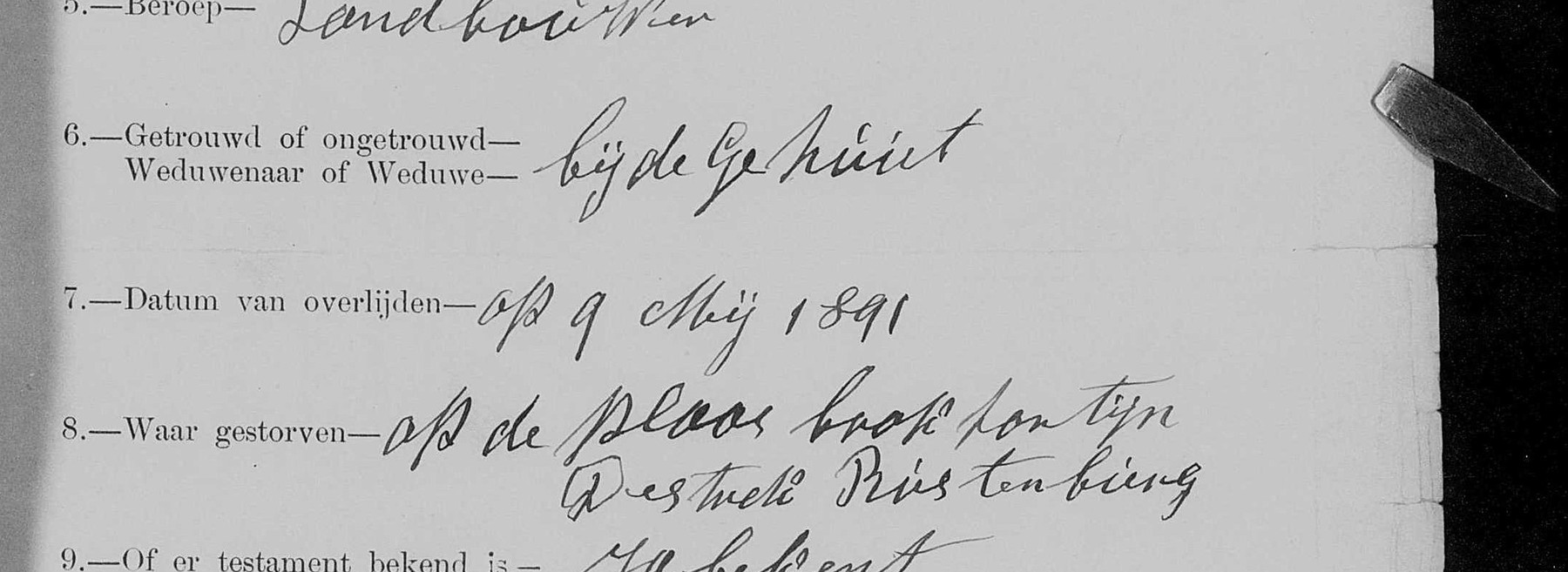
Brakfontein is not a strange farm. It is the farm. Sterfkennis No. 678 for Petrus Jacobus Booijsen, the oldest document on this site, was written at Brakfontein on 14 September 1876 and signed there by his son Hendrik Stefanus. Sixteen years after that, the Zeerust register gives Hendrik Stefanus's home as Brakfontein, Rustenburg. A woman dying on that farm in 1891 was never a stranger. One letter — a k read for an r — kept her off this family for a week.
Then the name
The letters are o · l · i · e · f · i · e · r. There is no b, no r-t-s, and no second syllable that could carry -berts. Oliefier is how a man who writes Booijzen, Stefanes and Brakfontijn spells OLIVIER.
And the archive does not have to guess, because her own son wrote her name down again. Seventeen years later, filling in his father's death notice, Ockert Johannes Stephanus Booysen gave the first wife as "Anna Catharina Johanna Booysen, born Olivier". The 1908 notice →
Three documents, three spellings of one woman: Anna Johanna on her own notice, Anna Catrena on her son's, Anna Catharina Johanna on her husband's. Put together, she is Anna Catharina Johanna Olivier, and every one of them agrees on the surname.
Seven children, all of age
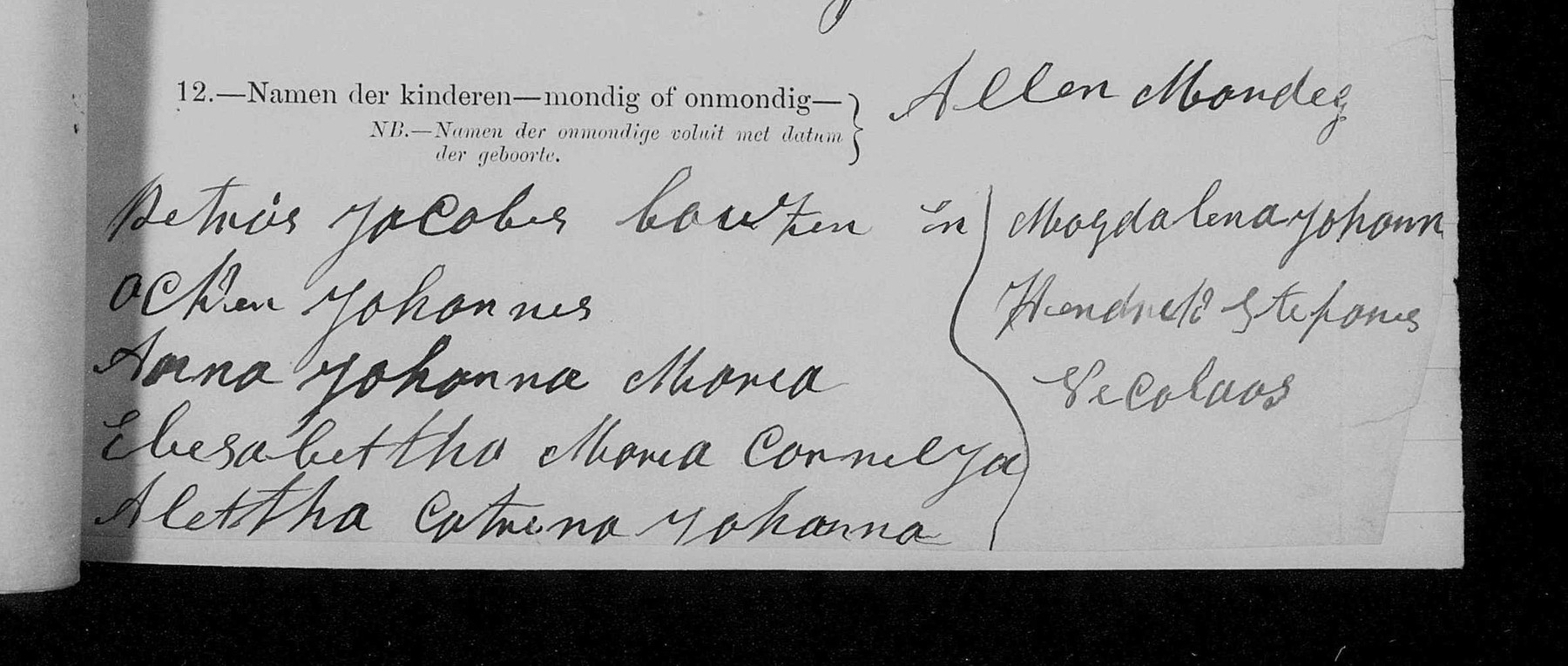
| As written, 1891 | What became of them |
|---|---|
| Petrus Jacobus Booijsen | On the 1908 notice, and already dead by then. |
| Ocken Johannes | Ockert Johannes Stephanus Booysen, who signed his father's death notice in 1908 — and who is named for his mother's father. |
| Anna Johanna Maria | Not yet traced. |
| Elesabettha Maria Cornelya | Not yet traced. |
| Alettha Catrina Johanna | Aletta Catharina Johanna Venter on the 1908 notice, married in community of property to Stephanus Andries Venter. |
| Magdalena Johanna | Not yet traced. The name comes down from Magdalena Elisabeth de Beer. |
| Hendrick Stefanus Nicolaas | Dead five days after his mother, on the same farm. His notice is below. |
And five days later, her son
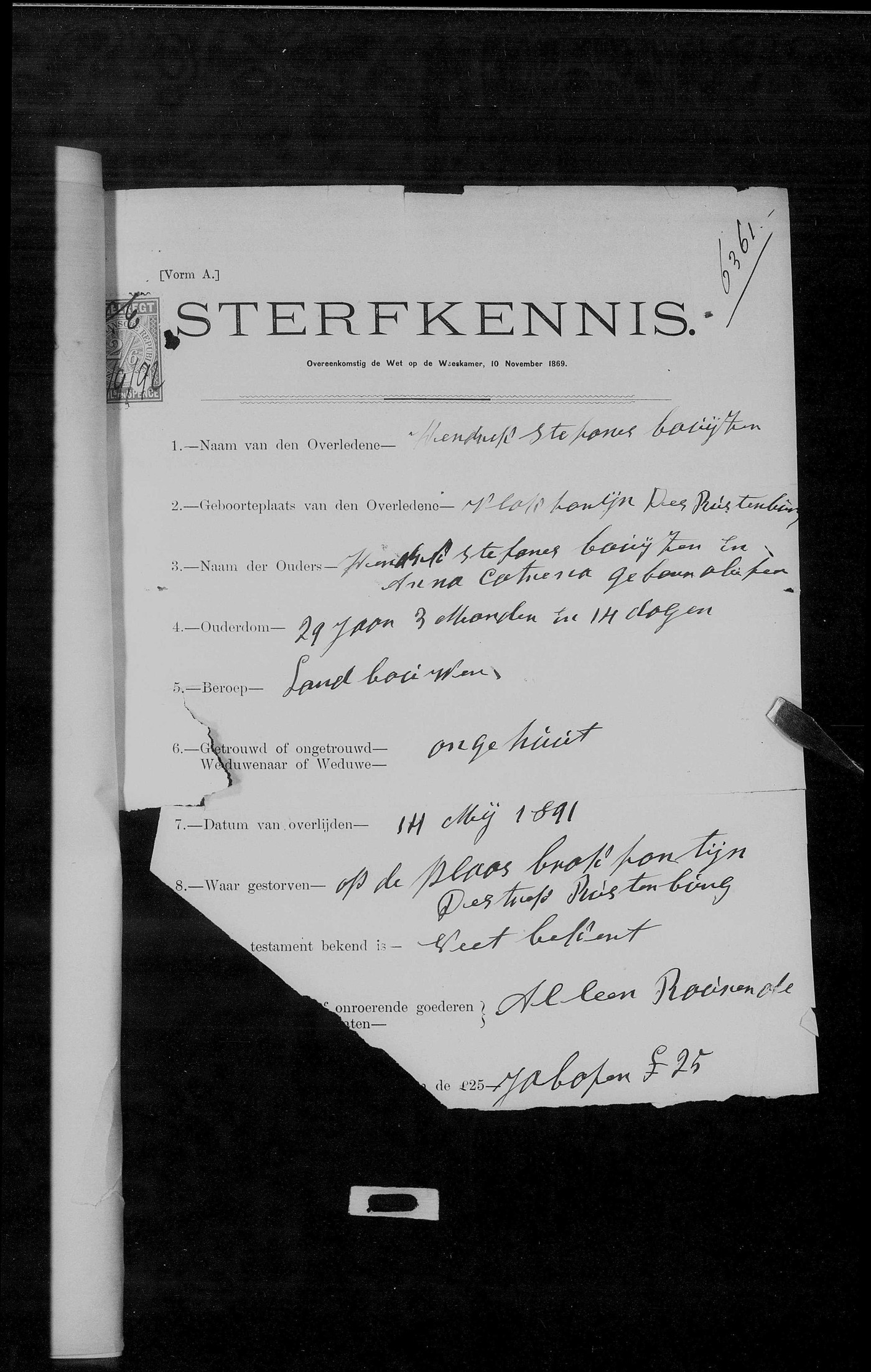
The form, as completed
| 1. Naam | Hendrick Stefanes Booijsen |
| 2. Geboorteplaats | a farm in district Rustenburg |
| 3. Ouders | Hendrick Stefanus Booijsen en Anna Catrena, gebooren Oliefier |
| 4. Ouderdom | 29 jaar 3 maanden en 14 dagen — born about 31 January 1862 |
| 5. Beroep | Landbouwer |
| 6. Staat | ongehuwd |
| 7. Overleden | 14 Mei 1891 |
| 8. Waar | op de plaas BRAKFONTIJN, district Rustenburg |
| 9. Testament | Niet bekend |
| 10–11. Boedel | alleen roerende, niet boven £25 |
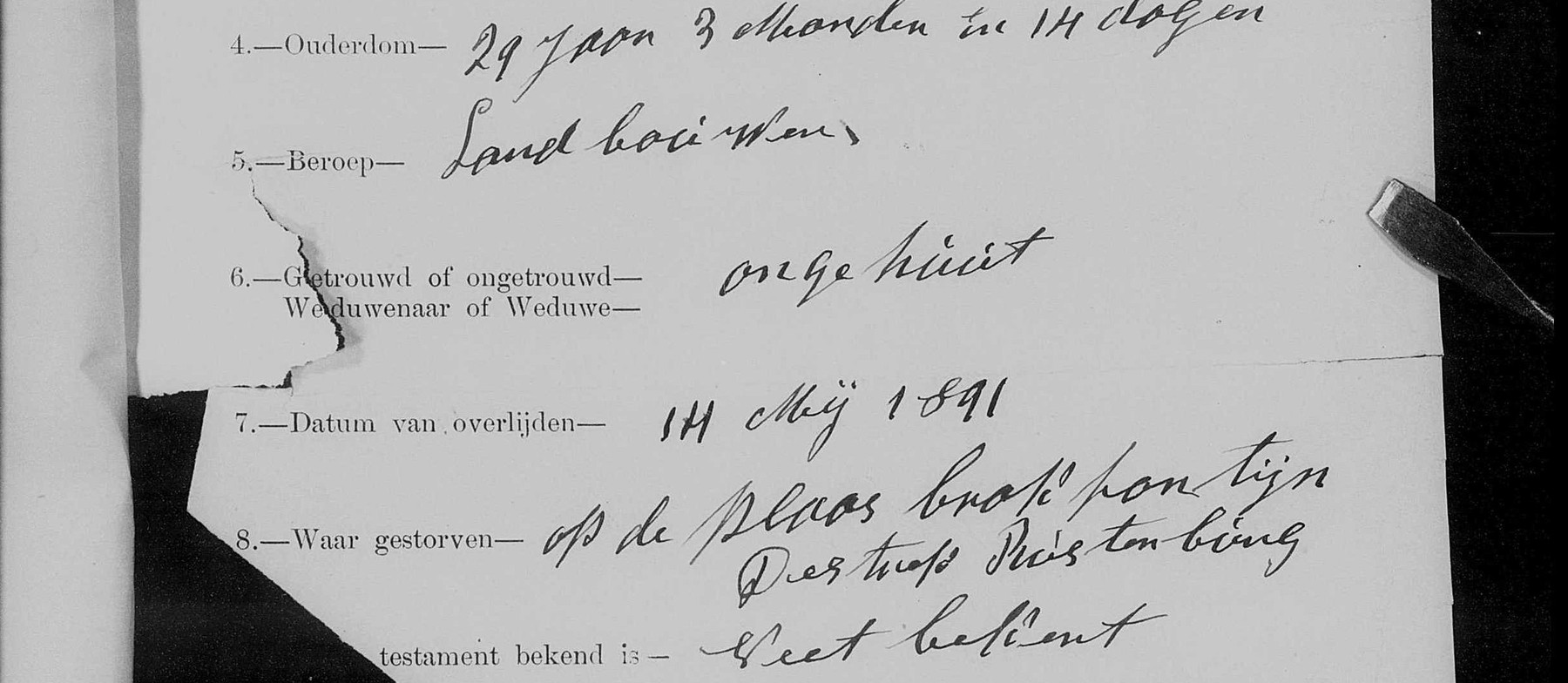

A twenty-nine-year-old farmer, unmarried, with nothing but movables worth under twenty-five pounds, dead on his father's farm five days after his mother. The archive cannot say what killed either of them and the notices do not ask. What it can say is that Brakfontein lost two people in one week in May 1891, and that the man left standing was a widower of sixty-two with six grown children — who married again, at Zeerust, eleven months later.
This is what the archive gets back. A wife with a name, her parents, her birth district and her seven children; a son nobody knew existed; a farm confirmed as the family's own; and the origin of a forename that had no business being there. All of it came out of a page this site had already found, already filed, and read wrongly twice.
South Africa, Transvaal, Probate Records from the Master of the Supreme Court, 1869–1961 · Sterfkennis 6332 (FamilySearch 1:1:QPTM-SCPJ, film 007897335 image 00647) and Sterfkennis 6361 (FamilySearch 1:1:QPRB-R43G, same film image 00675). Read 13 September 2026.
1862–1894 · The Rustenburg register, where an index has to stand in for the page
Five entries from the Netherdutch Reformed Church registers of Rustenburg, held at the Pretoria archive. Not one of them has an image — FamilySearch says Image Unavailable against every one, so what follows is a volunteer's transcription and nothing else. It is set out separately from the read documents for that reason. It also contains the single most useful line this archive found today.
| Date | Entry | What it says |
|---|---|---|
| 25 Dec 1862 rec. 1046, p. 185 | Baptism — Hendrik Nicolaas Stephanus Booijsen, born 31 Jan 1862 | Father Hendrik Stephanus Booijsen. Mother Anna Johanna Olivier. |
| 3 Apr 1869 p. 75 | Lidmaat — Petrus Jacobus Booÿsen | Born 20 April 1851. Admitted a member at Rustenburg, aged seventeen. |
| 3 Apr 1869 | Lidmaat — “Ceker” Johannes Stephanus Booÿsen | Born 15 September 1852. Admitted the same day as his brother. The forename is indexed Ceker and is Ockert. |
| 30 Jan 1882 rec. 6134, p. 469 | Baptism — Hendrik Stephanus Nicolaas Booyen, born 4 Jan 1882 | Father Ockert Johannes Stephanus Booysen, mother Elisabetta Johanna Sophia Myburgh. |
| 1889 & 4 Nov 1894 | Baptisms — Petrus Jacobus (b. 21 Jun 1889) and Ockert Johannes Stefanus (b. 16 May 1894) | Father Petrus Jacobus Booijsen, mother Anna Catharina Sofia Benadi. |
31 January 1862 is not a date this archive had. It is a date it calculated, an hour earlier, by subtracting 29 jaar 3 maanden en 14 dagen from 14 Mei 1891 on a torn death notice. The two agree to the day. And the register spells the mother's name in full, in a hand a volunteer could read, thirty years before the death notice this archive misread as Alberts. The 1891 notices →
Two brothers, one Sunday
On 3 April 1869 two sons of the house were admitted to membership at Rustenburg together: Petrus Jacobus, born 20 April 1851, and Ockert Johannes Stephanus, born 15 September 1852. They are the first and second names on their mother's 1891 list, seventeen and sixteen at the time, and they are the two who appear again on their father's 1908 notice — one of them dead by then, the other signing it.
Ockert died at Klerksdorp on 16 January 1921, aged sixty-nine. That is a civil registration and it names no parents, which is the whole difficulty with civil death records in this country and the reason this archive keeps going back to Sterfkennisse.
Where a name goes once it is in
Ocken Johannes Oliefier, of the district of Cradock, had a grandson called Ockert Johannes Stephanus Booysen — who had a nephew called Ockert Johannes Stefanus, baptised at Rustenburg in 1894. Three generations of a forename that came into this family with one marriage, and this archive could not account for any of them a day ago.
The other direction runs the same way. Hendrik Stephanus Nicolaas Booyen was born on 4 January 1882 and named for his uncle — who was twenty at the time and would be dead on his father's farm before the boy was ten. The nephew lived until 8 October 1959, at Kempton Park, and outlived the man he was named for by sixty-eight years. The namesakes →
South Africa, Netherdutch Reformed Church Registers (Pretoria Archive), 1838–1991 · FamilySearch 1:1:QPLV-KSW2, 1:1:4ZCG-XRZM, 1:1:4ZCG-XRN2, 1:1:Q57R-8CPN, 1:1:QPLK-N324, 1:1:CSNF-M5N2. Transvaal Civil Death 1869–1954 · 1:1:W9CB-BNMM. All read 13 September 2026. No image is available for any of the church entries.
1908 & 1932 · The second Willem Hermanus — married at sixteen and twenty-two, dead in Booysens
This archive has had Willem Hermanus Booyzen of Indwe as a name with a beginning and no end: a lidmaat at Indwe in 1907, a mijnwerker on two baptisms, a marriage known only from an index, and then nothing at all after 1910. Two things are new here. The marriage register page itself has now been read, and it is worth reading. And the end of him has been found: he died in a Johannesburg hospital on 29 July 1932, an ex-miner, and was buried at Brixton two days later.
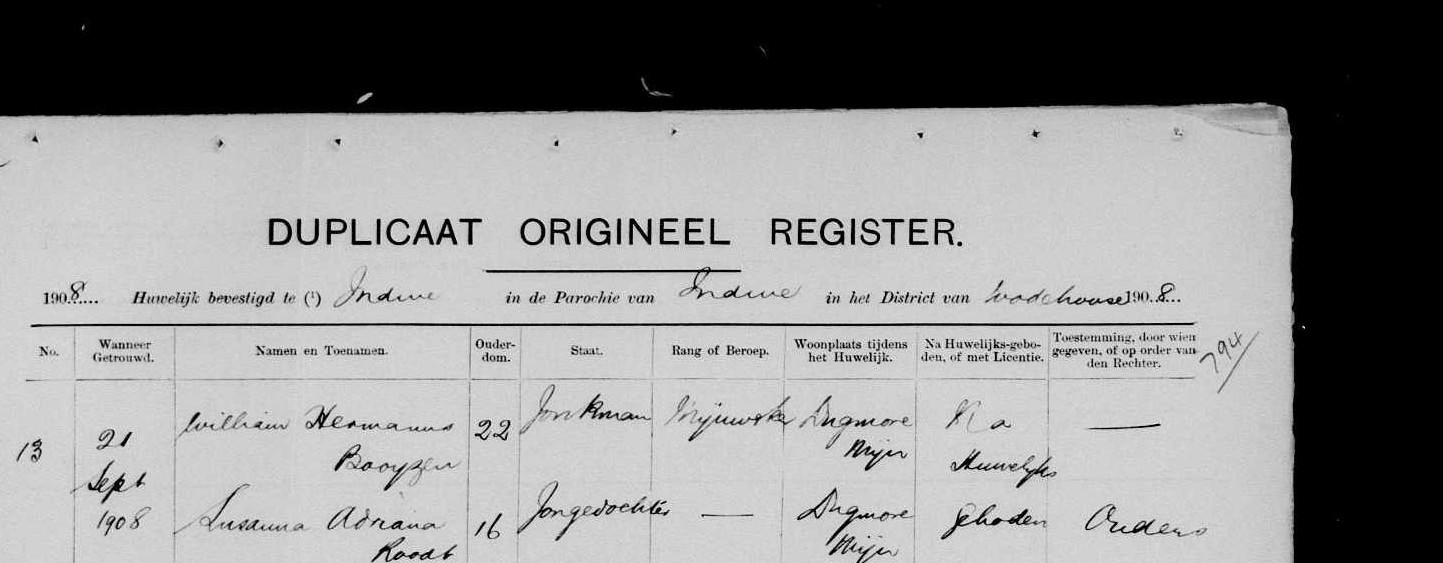

| Column | William Hermanus Booyzen | Susanna Adriana Roodt |
|---|---|---|
| Ouderdom | 22 | 16 |
| Staat | Jongman | Jongedochter |
| Rang of beroep | MIJNWERKER | — |
| Woonplaats | Dugmore Mijn | Dugmore Mijn |
| Geboden of licentie | na huwelijksgeboden | geboden |
| Toestemming | — | OUDERS — she was sixteen |
Married in the Ned. Geref. Kerk at Indwe. Signed W. H. Booyzen and S. A. Roodt, before D. N. Claase and C. J. Slabbert, and checked against the original register by J. J. Knight.
And twenty-four years later, Johannesburg
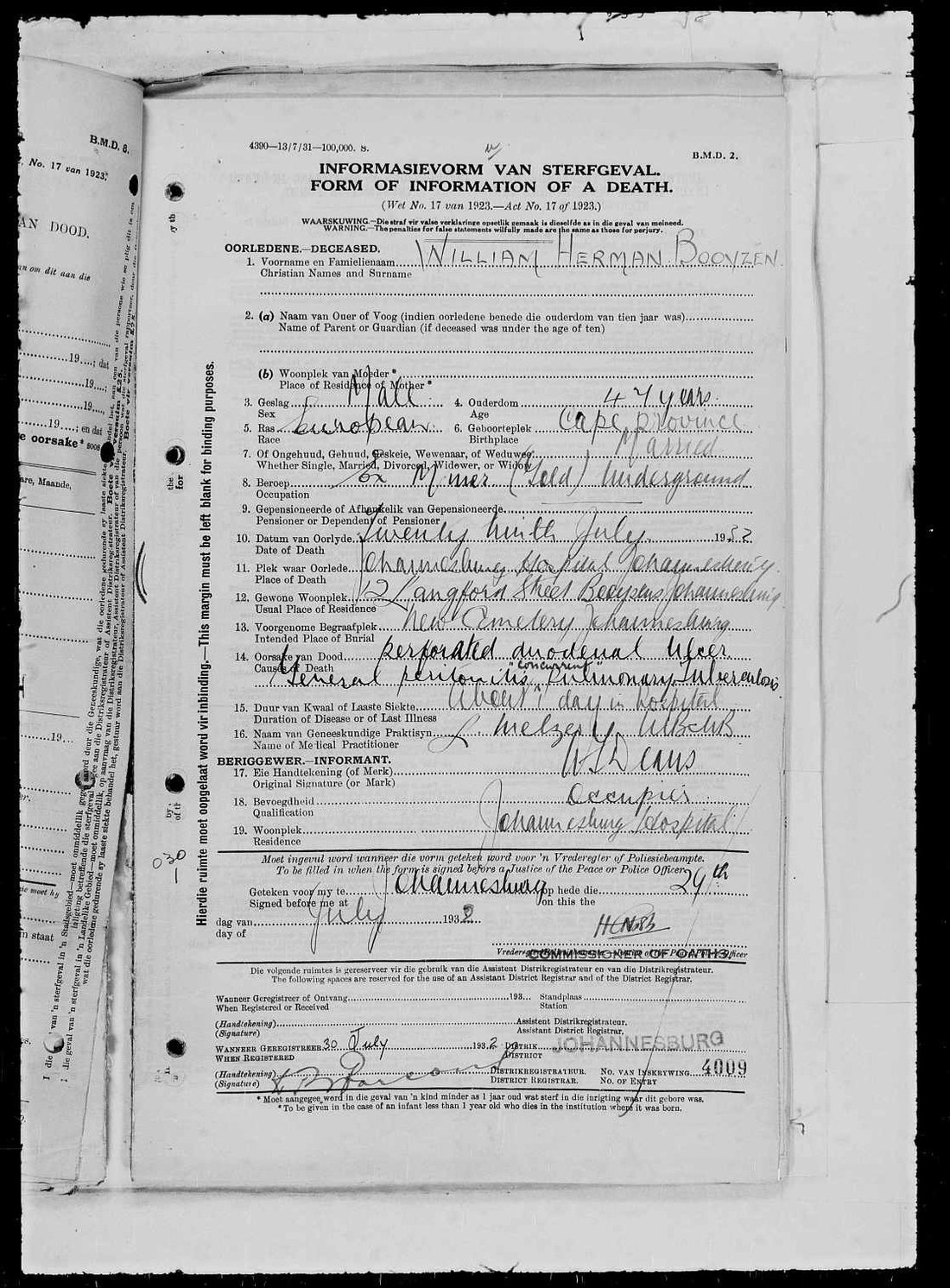
The form, as completed
| Name | WILLIAM HERMAN BOOYZEN |
| Age | 47 years — born about mid-1885 |
| Birthplace | Cape Province |
| Condition | Married |
| Occupation | EX MINER (told) UNDERGROUND |
| Died | 29 July 1932, Johannesburg Hospital |
| Residence | 62 Langford Street, BOOYSENS, Johannesburg |
| Cause | Perforated duodenal ulcer; general peritonitis; pulmonary tuberculosis |
| Last illness | about one day in hospital |
| Informant | an occupier of the Johannesburg Hospital. No relative signed. |
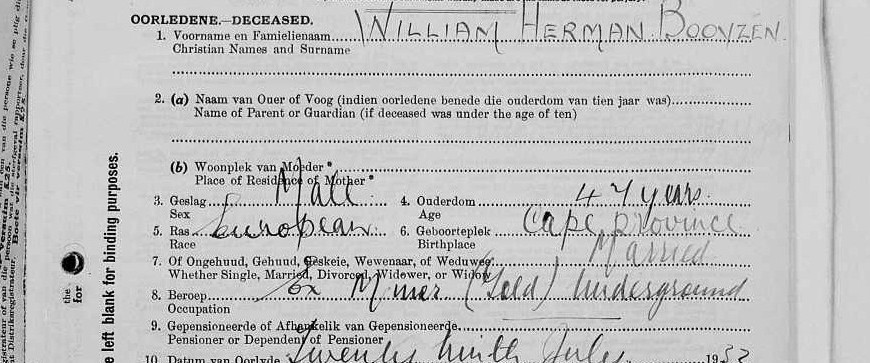
Why this is him
What agrees
Ex miner, underground. He was a mijnwerker at Dugmore Mijn in 1908 and the word
appears on no other Booyzen document this archive holds.
Born Cape Province. Indwe.
Married. Since 1908.
Forty-seven in July 1932 against twenty-two in September 1908 — which makes him
forty-six. One year.
Brixton Cemetery, 31 July 1932, where the burial register gives his birth as 1885
and where this family already buries its Johannesburg dead: Anna J. Mary Booyzen in 1914,
John Barry Booyzen in 1916, George Downing Daschner in 1925.
And “Sasanna Adriana Booyzen” was buried at Johannesburg in 1968 — his widow, under
his name, thirty-six years after him.
What does not
No parents are named, because a South African civil death registration does not ask for
them unless the deceased is under ten. That is the whole reason this archive keeps going back to
Sterfkennisse, and it is why this identification is marked
Inferred and not documented.
FamilySearch indexes his age as 44. The form says 47. Read the image, not the index
— a lesson this site learned twice today.
The occupation itself was “told” to the clerk, by a hospital official who wrote the word in
brackets. Nobody who knew him was in the room.
Grave 6889 — and the identification closes

Note how the clerk spells him: Boysen. That is the same spelling an English clerk put on John Barry’s 1915 death notice — “Kathleen Mary Boyson, born Barry, married in community of property to William Boyson” — for a different man of the same family, seventeen years earlier and eight hundred kilometres away. The name →
His father died of a stomach ulcer at Indwe in 1905, aged fifty-four. This man died of a perforated duodenal ulcer at Johannesburg in 1932, aged forty-seven. Twenty-seven years and eight hundred kilometres apart, and the same organ.
He left the coal at Indwe for the gold on the Rand, as the whole family did, and he was living at 62 Langford Street in Booysens — a Johannesburg suburb that has nothing to do with this family and is spelled like it. He was in hospital about a day. The man who reported his death was the hospital's own officer. The atlas → · Open questions →
South Africa, Civil Marriage Records, 1801–1974 · FamilySearch 1:1:6ZHR-PCSV, film 007729488 image 02719. South Africa, Transvaal, Civil Death, 1869–1954 · 1:1:736J-96W2, film 007731503 image 01056. Johannesburg Cemetery Records · 1:1:6N1B-JVP9 and 1:1:6J3R-2Q1R. Read 13 September 2026.
1940 · Grave 9760 — where Kathleen Barry actually is
This archive has carried the great-great-grandmother of the line as Catherine Maria Sophia “Kathleen” Barry, 1859–1940 — two years and nothing else. The City of Johannesburg Register of Persons Buried at New Cemetery gives the day, the section and the number of the grave.
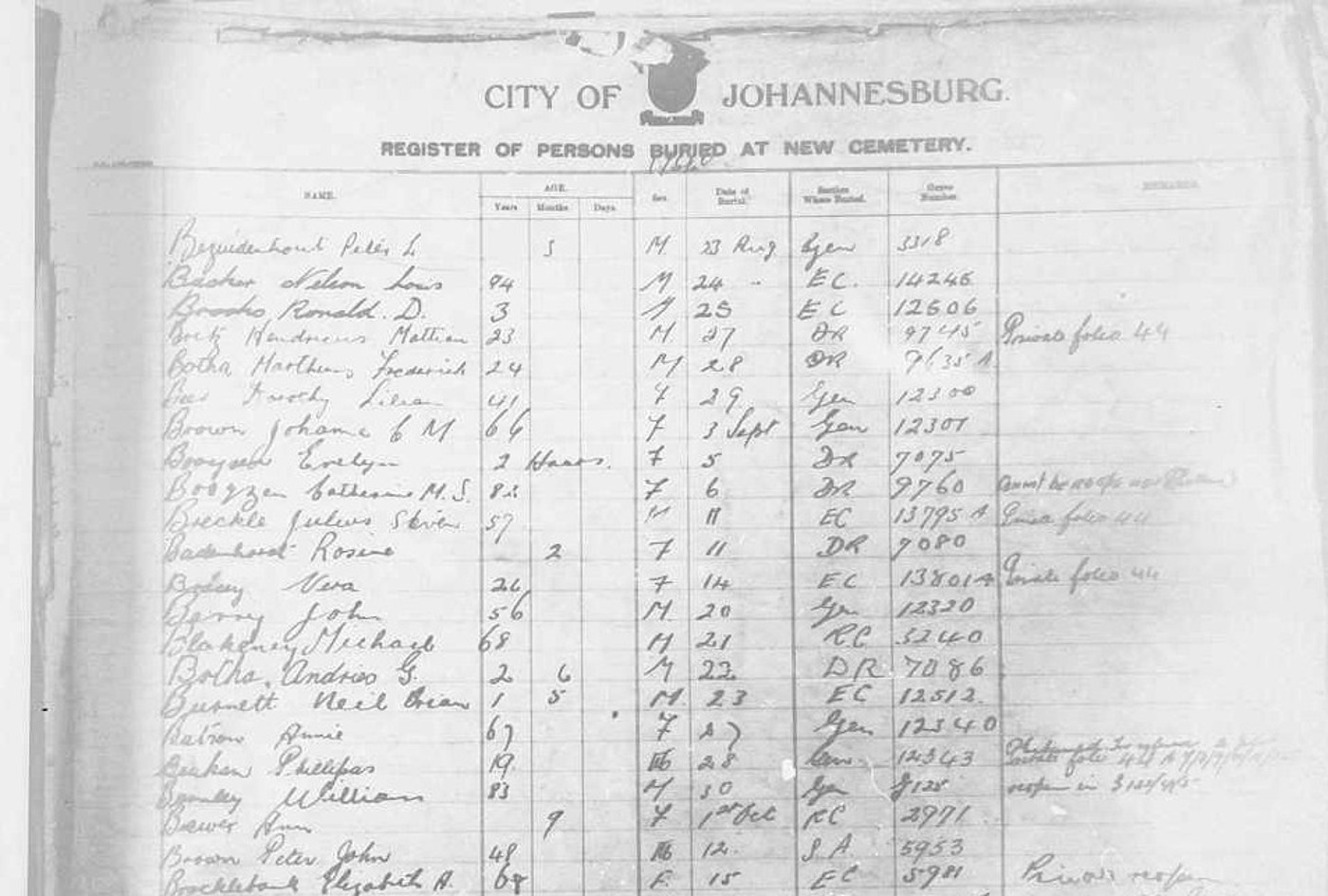

What the register says
| Name | Booyzen, Catherine M.S. |
| Age | 82 — born about 1858 |
| Date of burial | 6 September 1940 |
| Section | D.R. — Dutch Reformed |
| Grave number | 9760 |
| Cemetery | Johannesburg New — which is Brixton |
Why it is her
She is entered under her married surname with her own initials: Booyzen, Catherine M.S. — Maria Sophia. The age fits within a year of the birth this archive holds. And she is in the Dutch Reformed section, which is where a woman who married Willem Hermanus Booyzen in the Ned. Geref. Kerk at Lady Grey in 1879 belongs.
The remarks column carries an administrative note about the grave not being reopened, which this archive has not fully read.
She is an Irishman's daughter from Barkly East, buried in the Dutch Reformed section of a Johannesburg cemetery. Her father John Barry called himself an Irishman, born in Ireland on his 1903 registration; her mother was a Kolbe out of Württemberg and Soho. She married a Booyzen at Lady Grey, buried him at Indwe in 1905, and finished on the Rand thirty-five years later.
Brixton already holds this family. Anna J. Mary Booyzen was buried there in January 1914, John Barry Booyzen — a child of two — in December 1916, George Downing Daschner in June 1925, and the man this archive believes to be Willem Hermanus Booyzen of Indwe in July 1932. Her son George Downing Mountjoy Booyzen went to West Park instead, in December 1947. Brixton →
South Africa, Gauteng, Johannesburg, Cemetery Records, 1840–2019 · FamilySearch 1:1:6NBS-NR1Q, film 107663873 image 00020. Read 13 September 2026.
1902 · Charlotta’s own death notice — three husbands, six children, and none of them his
Death Notice 844, filed 11 September 1902 and stamped by the Master of the Supreme Court, Transvaal, on 23 September. This archive has carried the second wife as Charlotta Elizabetha Dormehl, died before 1908. Here she is entire, and she proves from a second direction the thing the 1892 marriage register only implied.
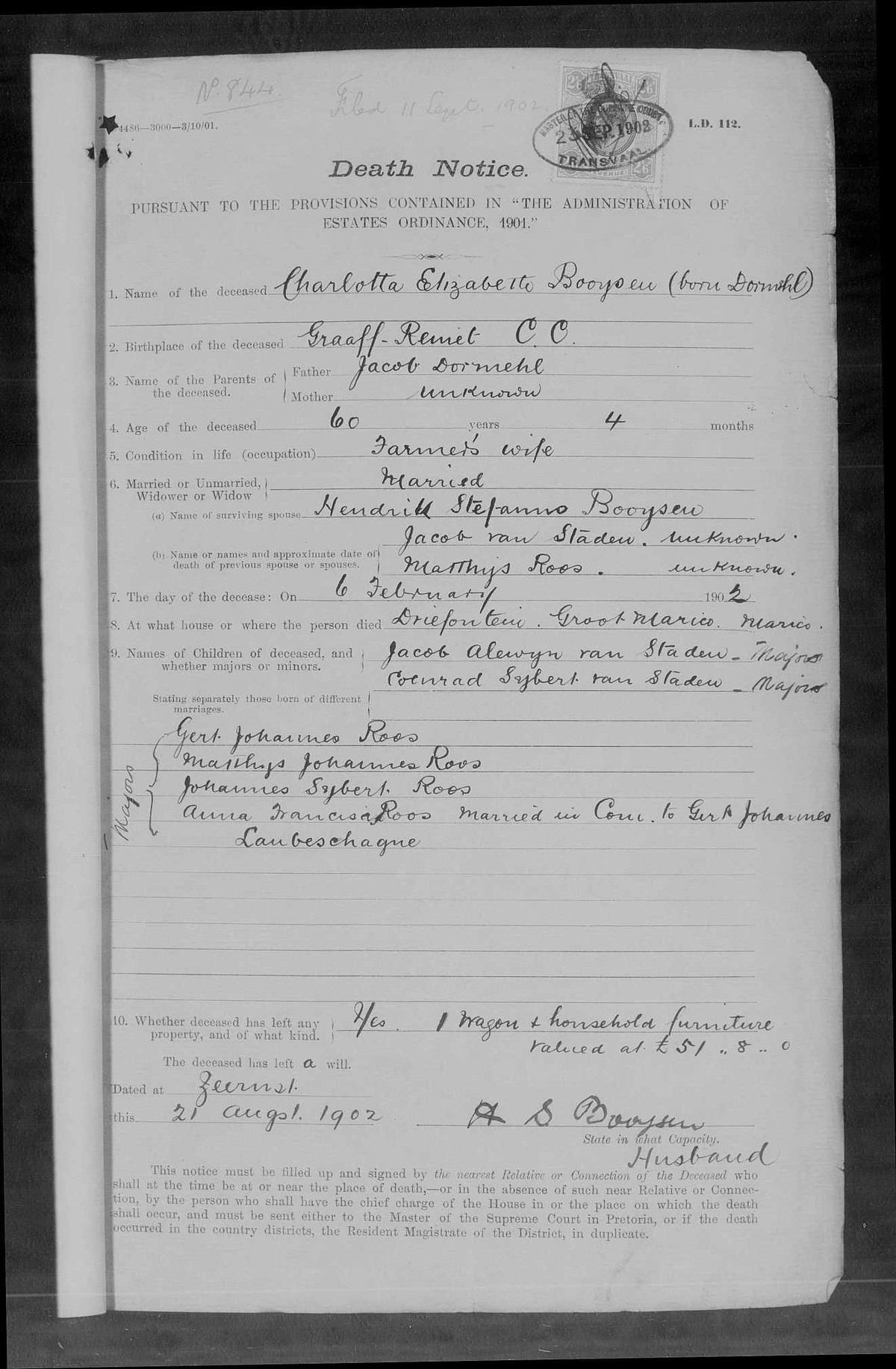
The form, as completed
| 1. Name | Charlotta Elizabetta Booysen (born Dormehl) |
| 2. Birthplace | Graaff-Reinet, C.C. |
| 3. Father | Jacob Dormehl |
| 3. Mother | unknown |
| 4. Age | 60 years 4 months — born about October 1841 |
| 5. Condition | Farmer’s wife |
| 6. Married | surviving spouse Hendrik Stefanus Booysen |
| 6b. Previous spouses | Jacob van Staden — date unknown Matthys Roos — date unknown |
| 7. Died | 6 February 1902 |
| 8. Where | Driefontein, Groot Marico, Marico |
| 10. Property | one wagon and household furniture, £51 8s 0d. She left a will. |
| Signed | H. S. Booysen, at Zeerust, 21 August 1902, in the capacity of Husband |
Three husbands, in her own notice
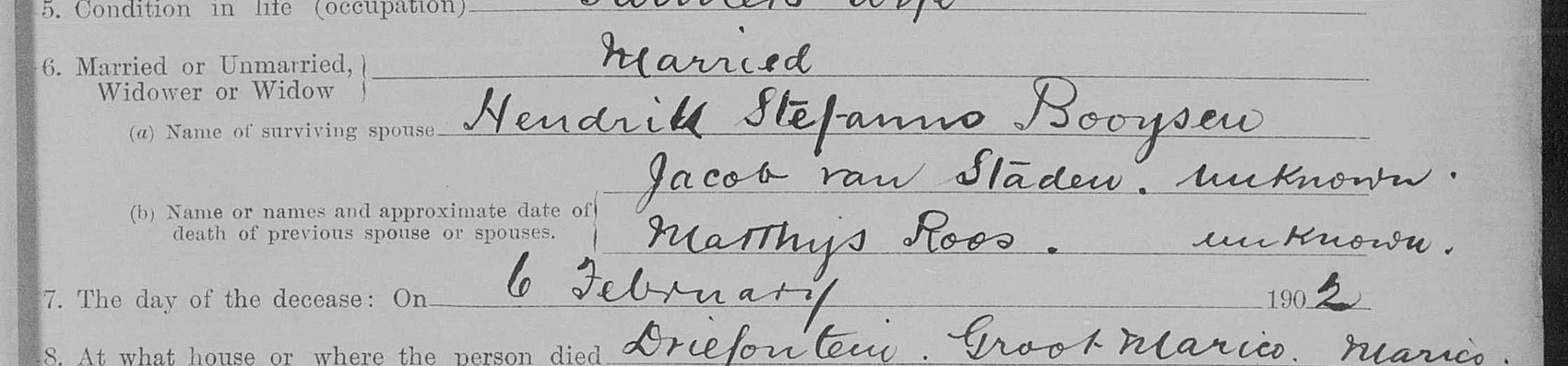
The 1892 register called her weduwe and wrote her in as Charlotta Elizabeth Roos, geboren Dormehl, which told this archive she had been married once before. She had been married twice before. Jacob van Staden first, then Matthys Roos, then at the age of fifty-one a farmer of Brakfontein.
Six children, and the point of them
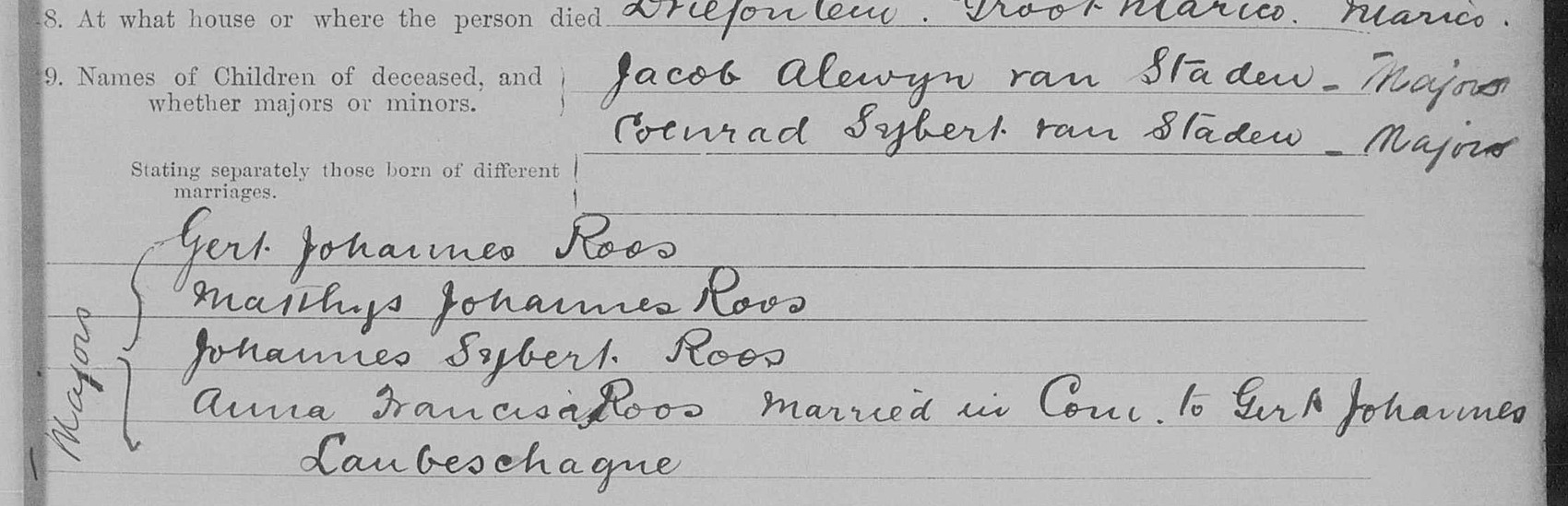
Two van Stadens — Jacob Alewyn and Coenrad Sybert. Four Rooses — Gert Johannes, Matthys Johannes, Johannes Sybert, and Anna Francisa, married in community of property to Gert Johannes Laubeschagne. All of age. And after ten years of marriage to Hendrik Stefanus Booysen, no child of his is named, because she was fifty-one when she married him.
This archive spent a month drawing his four children under her. Earlier today the 1892 marriage register — her age, her condition — made that impossible. Her own death notice now says the same thing from the other side, in her husband’s handwriting. The children belong to the first wife →
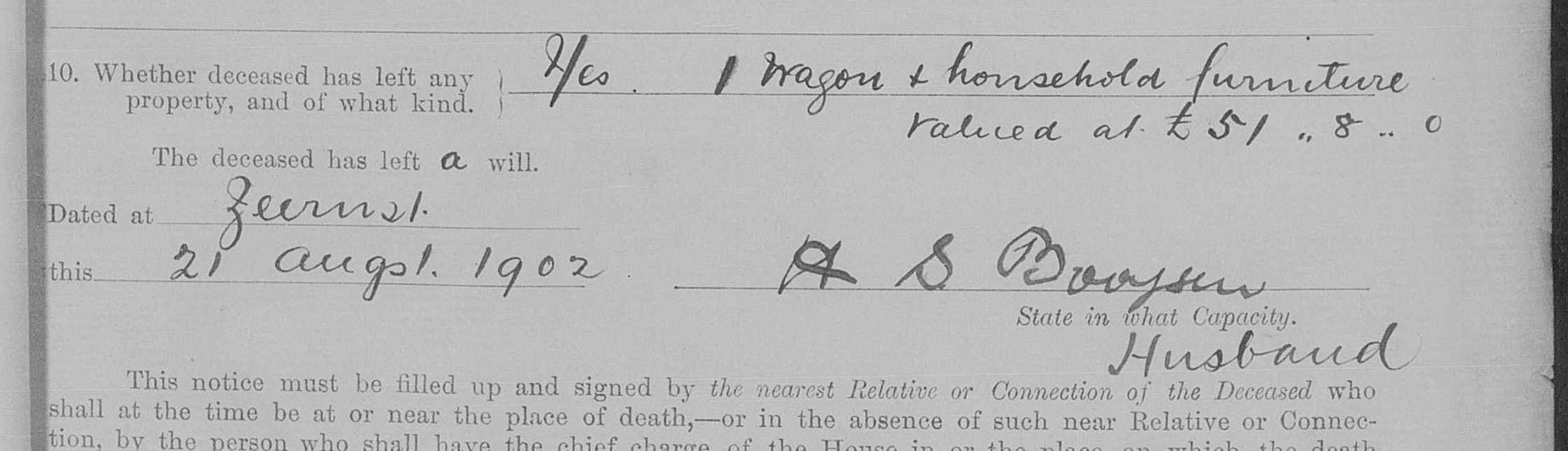
And one more parent nobody could name
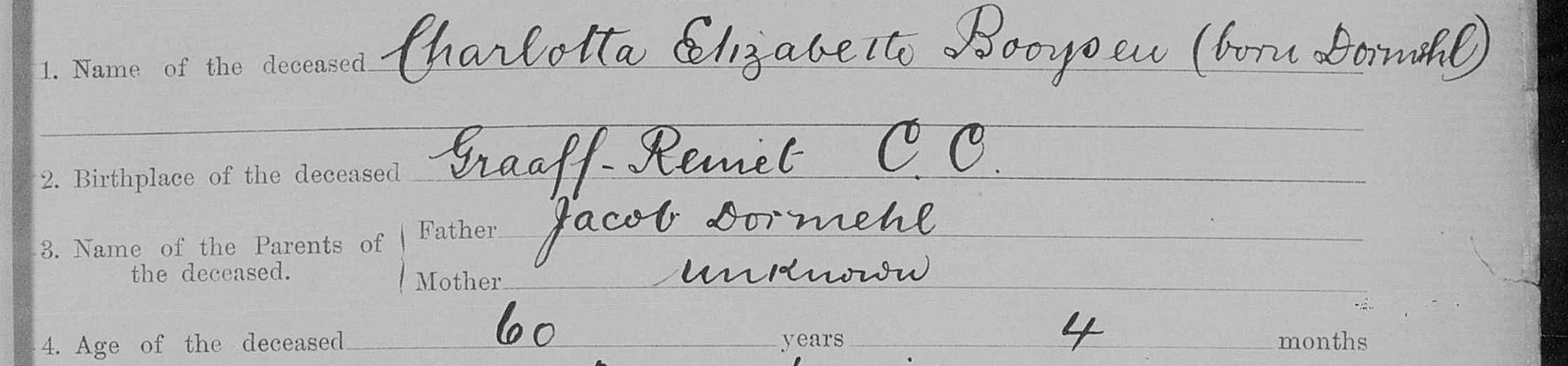
That is the seventh death notice in this archive that fails to name a parent. A husband of ten years knew his wife’s father’s name and not her mother’s. It is the same failure as James Montjoy in 1840, as John Barry’s son in 1915 writing Neagle and admitting he had neither her Christian names nor an address, and as the 1876 Sterfkennis that names eight children and no mother for any of them.
She never left Marico. In April 1892 she gave her home as Driefontein, Marico and married a man of Brakfontein in Rustenburg; ten years later she died at Driefontein, Groot Marico. He signed her notice at Zeerust, the town they had married in, six months after her death and three months after the peace. She had one wagon and her furniture. The atlas →
South Africa, Transvaal, Probate Records from the Master of the Supreme Court, 1869–1961 · Death Notice 844 of 1902 · FamilySearch 1:1:7FTM-QD6Z, film 007897350 image 00906. Read 13 September 2026.
1935 · Looking for Ockert’s estate and finding his son’s
Ockert Johannes Stephanus Booysen died at Klerksdorp on 16 January 1921. His name appears six times in the Transvaal probate index and not once as the deceased — four of those six are duplicate copies of two documents, and in both he is somebody else’s relative. One of the two, though, is worth the whole search.
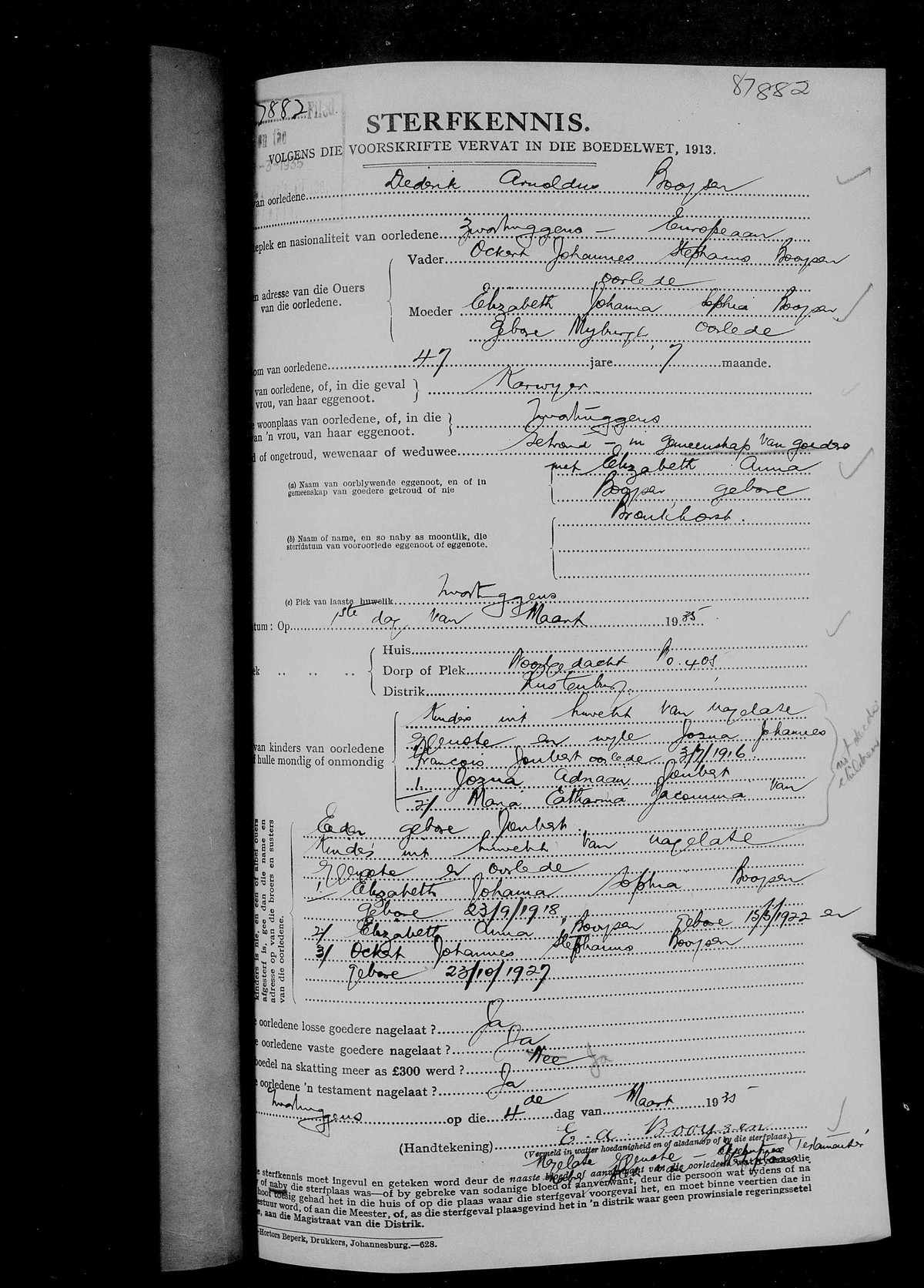
The form, as completed
| 1. Naam | Diederik Arnoldus Booysen |
| 2. Geboorteplek | Zwartruggens · Europeaan |
| 3. Vader | Ockert Johannes Stephanus Booysen — oorlede |
| 3. Moeder | Elizabeth Johanna Sophia Booysen, gebore MYBURGH — oorlede |
| 4. Ouderdom | 47 jare 7 maande — born about August 1887 |
| 5. Beroep | KARWEIER — a transport rider |
| 6. Woonplaas | Zwartruggens |
| 7. Getroud | in gemeenskap van goedere met Elizabeth Anna Booysen, gebore BRONKHORST |
| 8. Sterfdatum | 1 Maart 1935 |
| 9. Sterfplek | Voorbedacht No. 401, distrik Rustenburg |
| 11–14 | losse goedere ja · boedel meer as £300 · testament ja |
The line that matters
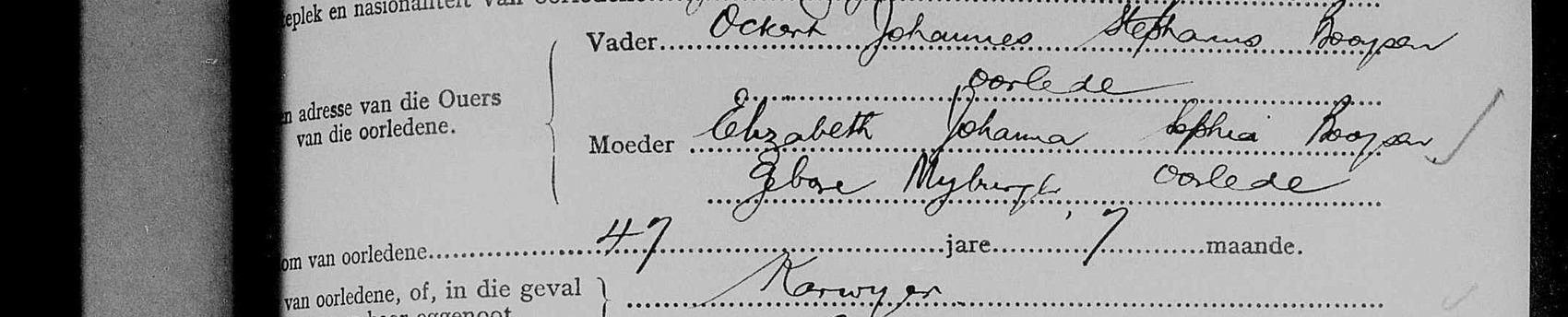
Earlier today this archive took the marriage of Ockert Johannes Stephanus Booysen and Elisabetta Johanna Sophia Myburgh from a Rustenburg baptism entry that has no image — a volunteer’s transcription and nothing more, published on its own page with a warning saying so. Here is the same couple on a document that can be read. The index entry stands.
It also extends them. Their known son Hendrik Stephanus Nicolaas was baptised at Rustenburg in January 1882. Diederik Arnoldus was born about August 1887, and both parents were dead by March 1935 — which agrees with Ockert’s death at Klerksdorp in 1921.
Two families on one form, and a pencil correction
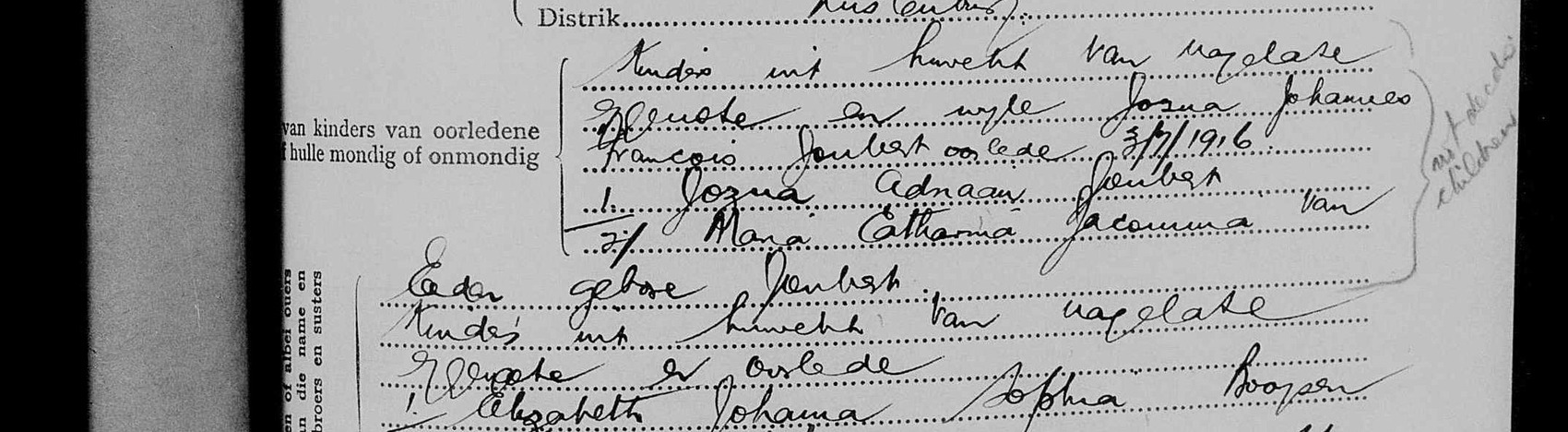
| On the form | What it means |
|---|---|
| Josina Adriaan Joubert Maria Catharina Jacomina Eden, born Joubert | The widow’s children by her own late husband Joubert, who died 31 January 1916. Stepchildren — and somebody at the Master’s Office picked up a pencil and said so in the margin. |
| Elizabeth Johanna Sophia Booysen, born 23/9/1918 Elizabeth Anna Booysen, born 15/3/1922 Ockert Johannes Stephanus Booysen, born 23/10/1927 | His own three, by Elizabeth Anna Bronkhorst. The eldest two carry their mother’s and their grandmother’s names. The youngest carries his grandfather’s. |
And the negative
Ockert Johannes Stephanus Booysen has no estate file of his own in the indexed Transvaal probate records. Searched under Ockert, Okkert, Ocker and Ocken against Booysen, Booyzen and Booijsen. Six hits, all of them him as a relative: four duplicate copies of this 1935 Sterfkennis, and two of his own father’s 1908 notice, where he is entered as Child.
He died at Klerksdorp on 16 January 1921 and it is a civil death registration, which names no parents. If an estate was raised for him it is not name-indexed, and the archive has no way to browse to it — the films are not ordered by estate number. What has been searched →
South Africa, Transvaal, Probate Records from the Master of the Supreme Court, 1869–1961 · Sterfkennis 87882 · FamilySearch 1:1:QPKJ-LLZQ, film 007897967 image 00898, and the duplicate at film 007820977 image 01397. Read 13 September 2026.
1824 & 1850 · The Olivier line, and the marriage that puts this family north of the Vaal in 1850
Yesterday Anna Catharina Johanna Olivier did not exist on this site. This morning she was recovered from a death notice the archive had misread twice. This afternoon there are two more documents: her baptism at Cradock in 1824 and her marriage at Potchefstroom in 1850 — and the second of them moves the whole family’s history twenty-six years.
Cradock, 4 October 1824
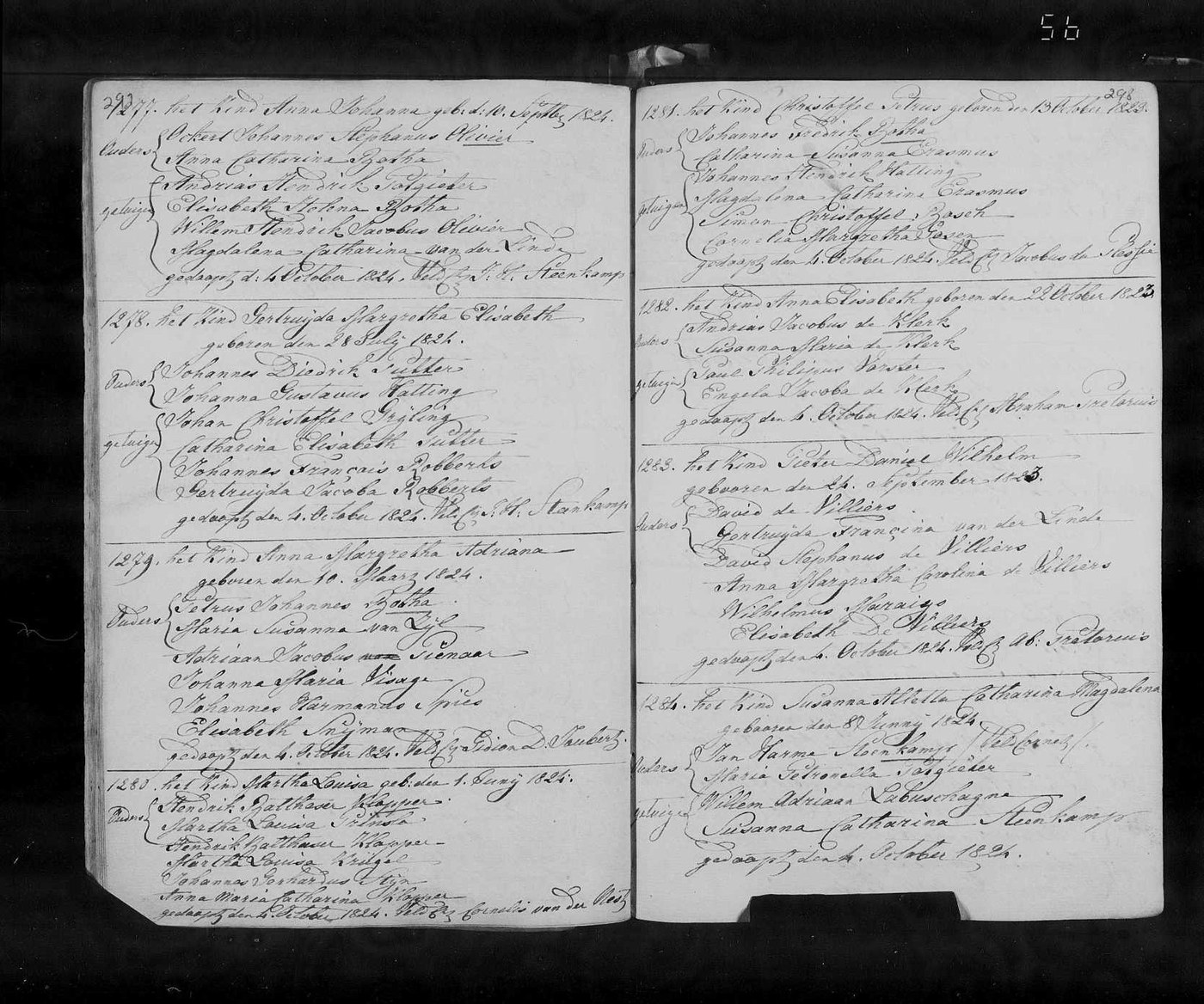
| Child | Anna Johanna Olivier, born 10 September 1824 |
| Baptised | 4 October 1824, Cradock |
| Father | Ockert Johannes Stephanus Olivier |
| Mother | Anna Catharina Botha |
And she had a sister baptised at Cradock eleven months earlier: Aletta Catharina Olivier, 4 October 1823, same parents. Anna Johanna’s own daughter is Aletta Catharina Johanna. The names in this family go back up the female line and this archive could not see it until today. The namesakes →
Potchefstroom, 3 July 1850
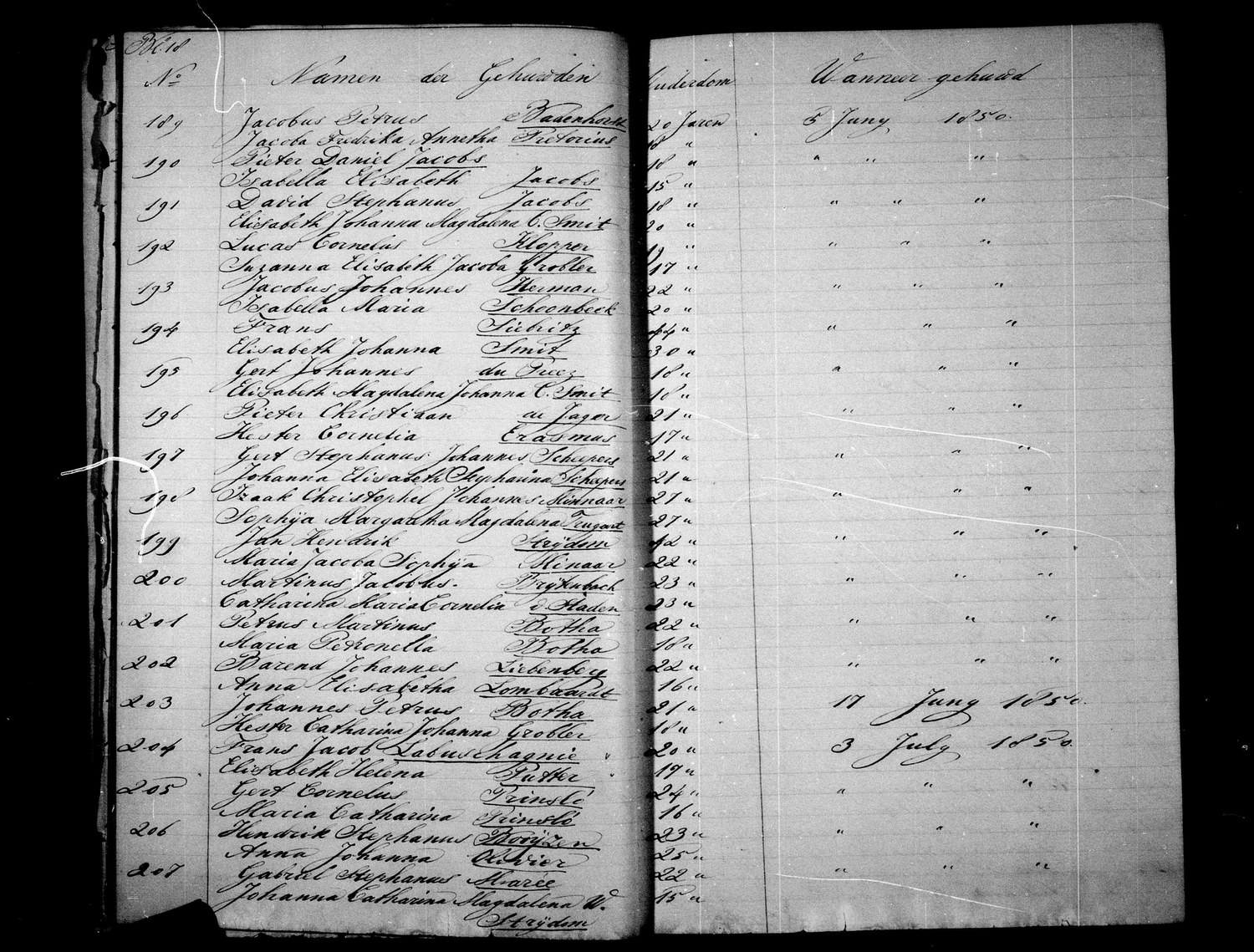

Her name, written plainly, forty-one years early
The 1891 death notice spells her maiden name Oliefier in a hand so bad this archive read it as Alberts and threw her out of the family for a week. Here it is in 1850, in a clerk who could write: OLIVIER. Four documents now agree — 1850 Potchefstroom, 1862 Rustenburg, 1891 Brakfontein, 1908 Koedoesfontein. How it was misread →
And the ages hold
He was 23 in July 1850, so born about 1827 — against about June 1828 from the 1908 notice and 63 at Zeerust in 1892. She was 25, so born about 1825 — against a baptism of 10 September 1824. Four independent estimates, all inside two years. Their eldest son Petrus Jacobus was born on 20 April 1851, nine and a half months after the wedding.
This archive has spent its whole life pushing back the moment this family crossed into the Transvaal. It began by saying they went north to Johannesburg by railway in the twentieth century. Then the 1876 Sterfkennis put the direct ancestor dead in the district of Rustenburg — twenty-five years before the war, a generation before Johannesburg — and that was already the earliest evidence there was.
They were married at POTCHEFSTROOM on 3 JULY 1850. That is twenty-six years earlier again, fourteen years after the Great Trek, and two years before the Sand River Convention made the South African Republic a state at all. A Booijzen was standing in a Transvaal church before there was a Transvaal. The atlas →
What is still open. Ockert Johannes Stephanus Olivier and Anna Catharina Botha have a daughter, a second daughter, a town and nothing else. Neither has a death notice in this archive, neither has parents, and the Oliviers of Cradock in the 1820s are numerous — there are at least four other men of nearly this name baptising children in that church in those years. This archive has not separated them and will not guess. What is still to ask →
Baptism: South Africa, Dutch Reformed Church Registers (Cape Town Archives), 1660–1994 · FamilySearch 1:1:6KRN-K37Y, and the sister at 1:1:6KRL-Q4H4. Marriage: South Africa, Netherdutch Reformed Church Registers (Pretoria Archive), 1838–1991 · 1:1:Q29M-ZJPM, entry 206. Read 13 September 2026.
1806 · Anna Maria van der Merwe stops being a rumour
The ancestor chart carries a wall against her marked Disputed, and the reason printed beside it is “Only a family tree puts her here.” That is no longer true.
| Child | DAVID SCHALK BOOIJZEN, born 12 December 1806 |
| Baptised | 4 January 1807 |
| Father | Pieter Jacobus Booijzen |
| Mother | ANNA MARIA VAN DER MERWE |
Dutch Reformed Church Registers (Cape Town Archives). The index carries an explicit Couple relationship between the parents and ParentChild to the boy — this is not two names that happen to sit near each other on a page.
So Anna Maria van der Merwe is documented. Not as a name on a tree; as a mother on a baptism register, married to a Pieter Jacobus Booijzen, with a son who is first on the 1876 list.
And it settles a dispute this archive marked Serious
The disputed page has carried this since the first week:
“The tree marries her to Petrus Jacobus Booysen in 1805 at Graaff-Reinet and has her dead before March 1825. FamilySearch carries a Dutch Reformed marriage of PETRUS JACOBUS BOOŸZEN and ANNA MARIA VAN DER MERWE dated 9 MARCH 1825, at Cape Town, indexed three separate times. Either the death date was derived from this very record by someone reading it as an end rather than a beginning, or the 1825 marriage is a different couple entirely. The archive is not going to guess which.”
It does not have to guess any more. A son born to that couple on 12 December 1806 means they were married by 1806. The 1805 marriage at Graaff-Reinet stands; the 1825 record is not this couple’s wedding — it is a different pair of the same two very common names, six hundred miles away at Cape Town. Resolved.
What the wall becomes
What is now proved
Anna Maria van der Merwe was married to Pieter Jacobus Booijzen and bore him a son in 1806 who is the eldest of the eight on the 1876 Sterfkennis. She is a real, documented wife and mother in this family.
What is still not
That she is the mother of the 1812 man — the one in the direct line. No document says so. The 1876 notice still names eight children and no mother for any of them, and Elizabetha van der Merwe is documented as the mother of a ninth child born about 1828. Two van der Merwe wives, and the middle of the family unassigned.
The wall on the chart stays, because the chart is about this descent and the link it needs is still missing. But the reason printed on it was wrong and has been rewritten. The chart →
A second baptism, at Lady Grey
| Child | PETRUS JACOBUS BOOIJSEN, born 29 May 1873 |
| Baptised | 24 August 1873, LADY GREY |
| Father | David Schalk Booijsen |
| Mother | Elizabeth Margaritha Marais |
This is the eldest of the eight on the 1900 Pretoria death notice — “Petrus Jacobus Booijzen (unmarried — major)” — and he now has a birth date and a font. And the font is Lady Grey, which is where his parents married and where his uncle Willem Hermanus would marry Kathleen Barry six years later. The family was in that small Cape church across at least a decade before any of them went north.
South Africa, Dutch Reformed Church Registers (Cape Town Archives), 1660–1994 · FamilySearch 1:1:6VTL-YJ25 and 1:1:65M7-16ZC. Both read from the index: FamilySearch is refusing this archive’s record-page requests, so neither image has been opened. Read 13 September 2026.
1900 · A zinc building in Market Street, Pretoria — and the direct line’s own brother
A run of ten index entries under Booijzen in the Transvaal probate records carried no dates, no places and nothing to identify them. They all belong to one death notice, and it opens a household this archive did not have: the family of David Schalk Booysen, born 9 June 1848 — the brother of the direct ancestor.
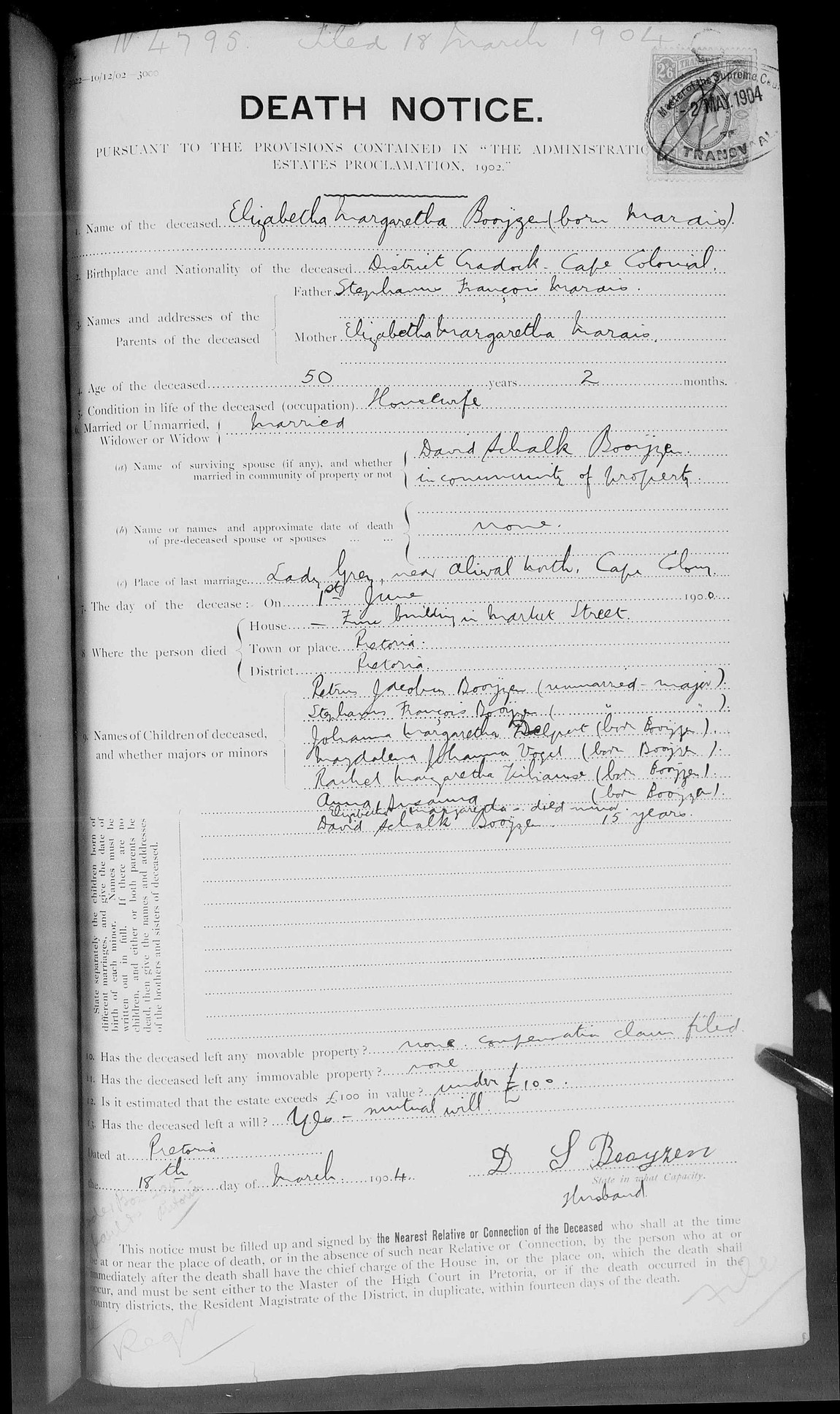
The form, as completed
| 1. Name | Elizabetha Margaretha Booijzen (born Marais) |
| 2. Birthplace | District Cradock, Cape Colonial |
| 3. Father | Stephanus François Marais |
| 3. Mother | Elizabetha Margaretha Marais |
| 4. Age | 50 years 2 months — born about April 1850 |
| 5. Condition | Housewife |
| 6a. Spouse | DAVID SCHALK BOOIJZEN, in community of property |
| 6b. Previous spouses | none |
| 6c. Married at | LADY GREY, near Aliwal North, Cape Colony |
| 7. Died | 1 June 1900 |
| 8. Where | a zinc building in MARKET STREET, PRETORIA |
| 10. Movables | none — compensation claim filed |
| 11–12 | no immovable property; estate under £100 |
| 13. Will | Yes — mutual will |
| Signed | D. S. Booijzen, at Pretoria, 18 March 1904, as Husband |
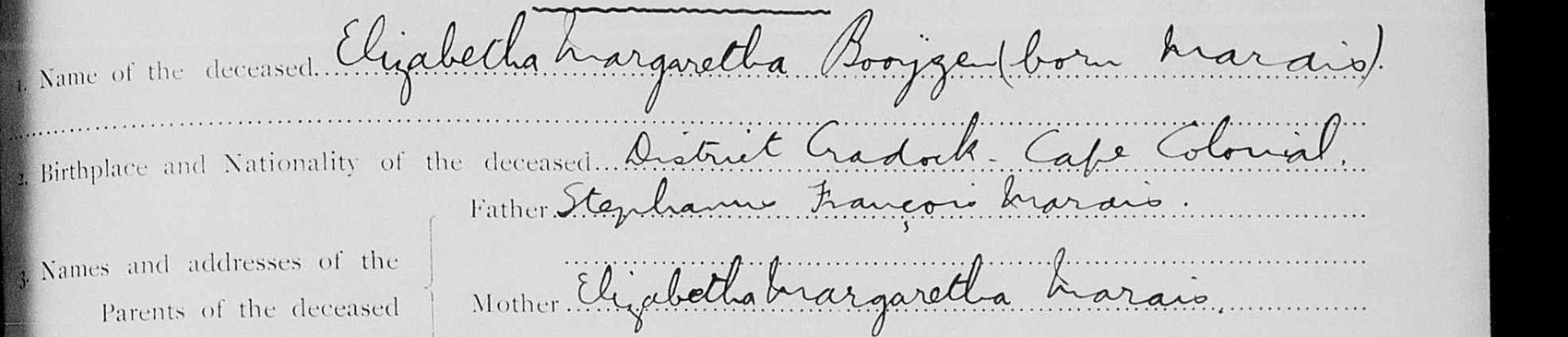
Lady Grey, which this archive already knows
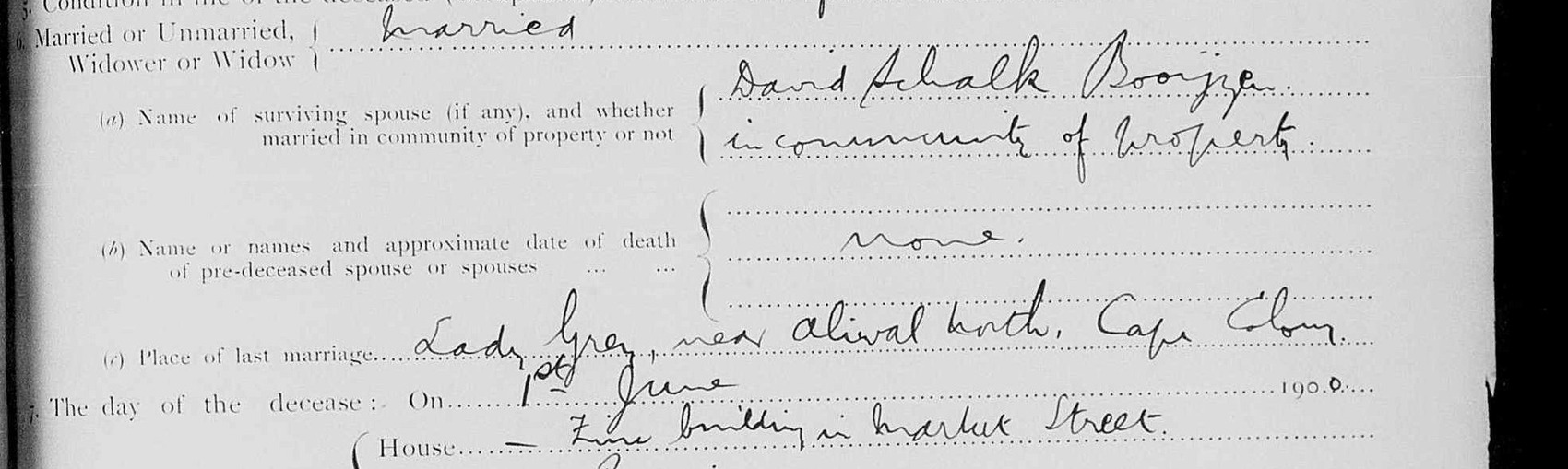
Two brothers married out of one small Cape church; one went east to the coal at Indwe and died there in 1905, the other went north to Pretoria. This archive has had David Schalk as a line on a list since the beginning — “Fourth on the 1863 list”, no wife, no children, no death. Here is his whole household. The line →
Eight children
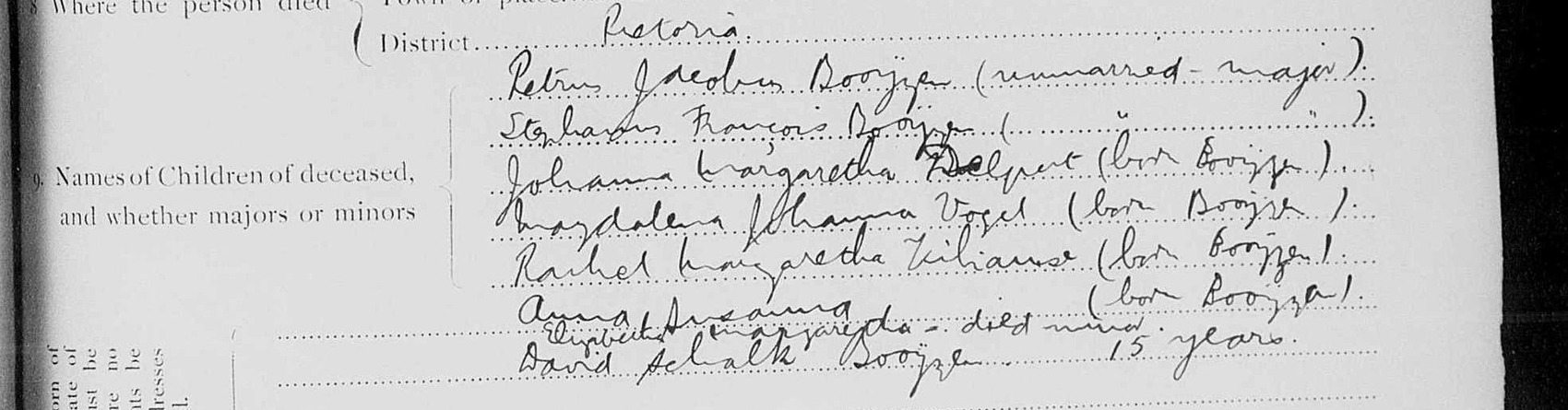
| As written | |
|---|---|
| Petrus Jacobus Booijzen | unmarried — major |
| Stephanus François Booijzen | ditto — and see below |
| Johanna Margaretha Delport, born Booijzen | |
| Magdalena Johanna Vogel, born Booijzen | |
| Rachel Margaretha Williamse, born Booijzen | |
| Anna Susanna, born Booijzen | |
| Elizabeth Margarietha | died a minor — the interlineation |
| David Schalk Booijzen | 15 years — born about 1889 |
Her father was Stephanus François Marais, and her second son is Stephanus François. Her own names were Elizabetha Margaretha, and the daughter who died a minor was Elizabeth Margarietha. The naming runs up the female line again, exactly as it does in the Olivier household. The namesakes →
She died four days before Pretoria fell

1 June 1900. Lord Roberts entered Pretoria on 5 June 1900. She died in a zinc building in Market Street — the main street of the capital — four days before the British took the town, and her husband did not file her death notice for three years and nine months, under a proclamation that did not exist when she died.
And against the question about movable property he wrote “none. Compensation claim filed.” This archive has a page about the War Losses Compensation Commission and has recorded that it found no Booyzen claim — while noting that the Commission’s records are catalogued by sub-commissioner and not by claimant, so the zero was weak. Here is a Booijzen claim, named on a different document entirely. The searches → · The war →
This site carries a Stephanus Francois Booyzen (c. October 1874 – 14 May 1940, East Lynne, Pretoria), a messelaar, placed as a son of Petrus Jacobus Booysen and his second wife Johanna Margaritha Pretorius — marked inferred, because his own 1940 Sterfkennis names neither parent: his widow wrote only oorlede for both. He was put there on his birth date alone.
This notice names a Stephanus François Booijzen as a son of David Schalk Booijzen and Elizabetha Margaretha Marais — an unmarried major at Pretoria in 1904, where the 1874 man died in 1940. And the forename is his mother’s father’s: Stephanus François Marais.
That is a better argument than the one this archive was running, and it is still not proof. Flagged on the disputed page, not resolved. Disputed →
South Africa, Transvaal, Probate Records from the Master of the Supreme Court, 1869–1961 · Death Notice 4795 · FamilySearch 1:1:QPLV-G1R4 and nine sibling personas on the same record, film 007897354 image 00802. Read 13 September 2026.
1905 · David Schalk marries again — and the register cites the estate number
This archive lost the direct ancestor’s brother in March 1904, signing his wife’s death notice at Pretoria. Here he is nineteen months later, in the same city, marrying again — and the Remarks column does something this archive has never seen a marriage register do.
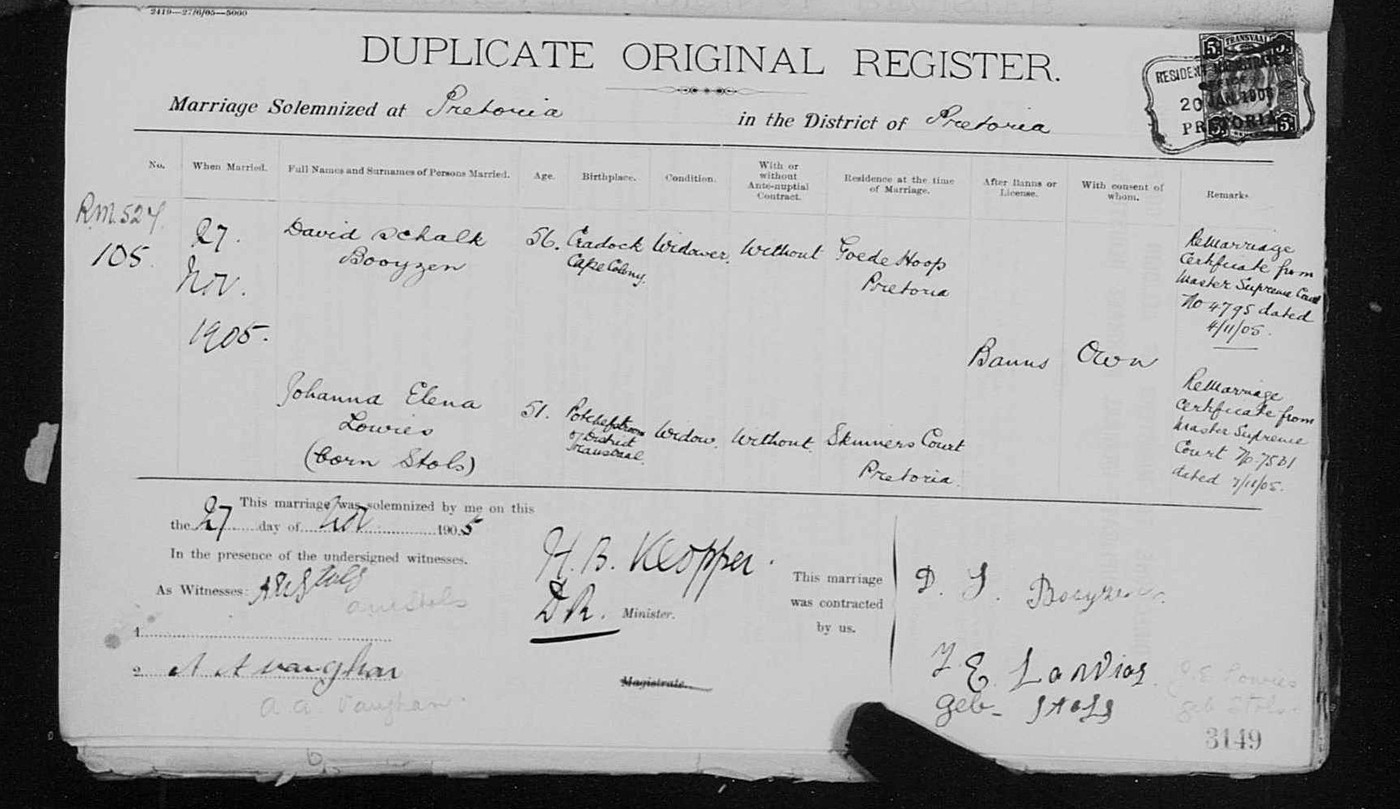
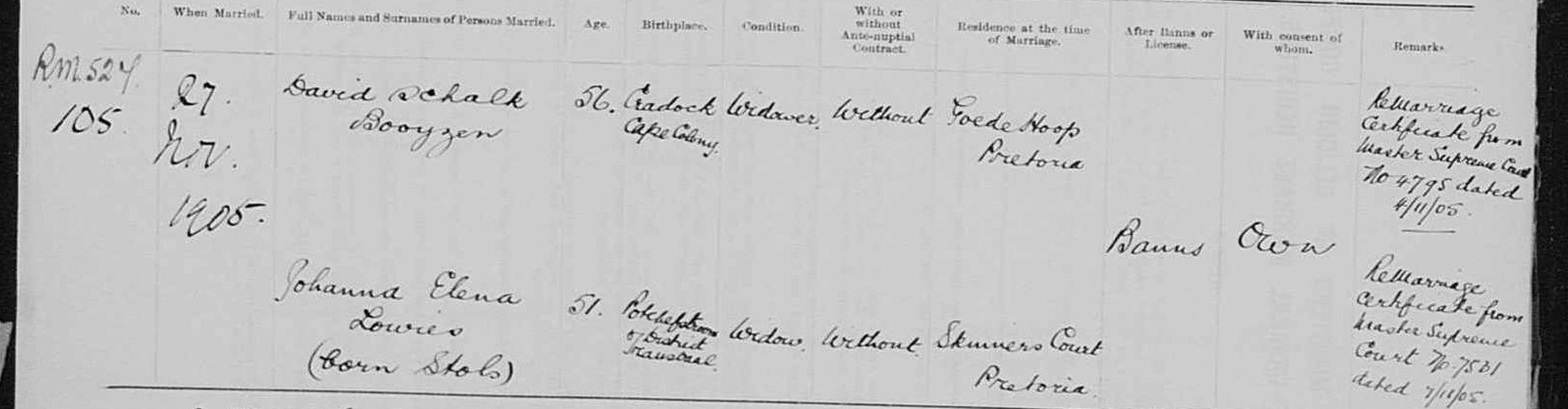
| Column | David Schalk Booyzen | Johanna Elena Lowies |
|---|---|---|
| Age | 56 | 51 |
| Birthplace | CRADOCK, Cape Colony | Potchefstroom District, Transvaal |
| Condition | Widower | Widow, born Stols |
| Antenuptial contract | without | without |
| Residence | Goede Hoop, Pretoria | Skinners Court, Pretoria |
| Banns or licence | Banns | Banns |
| Consent | Own | Own |
| Remarks | “Remarriage Certificate from Master Supreme Court No. 4795 dated 4/11/05” | “… No. 7081 dated 7/11/05” |
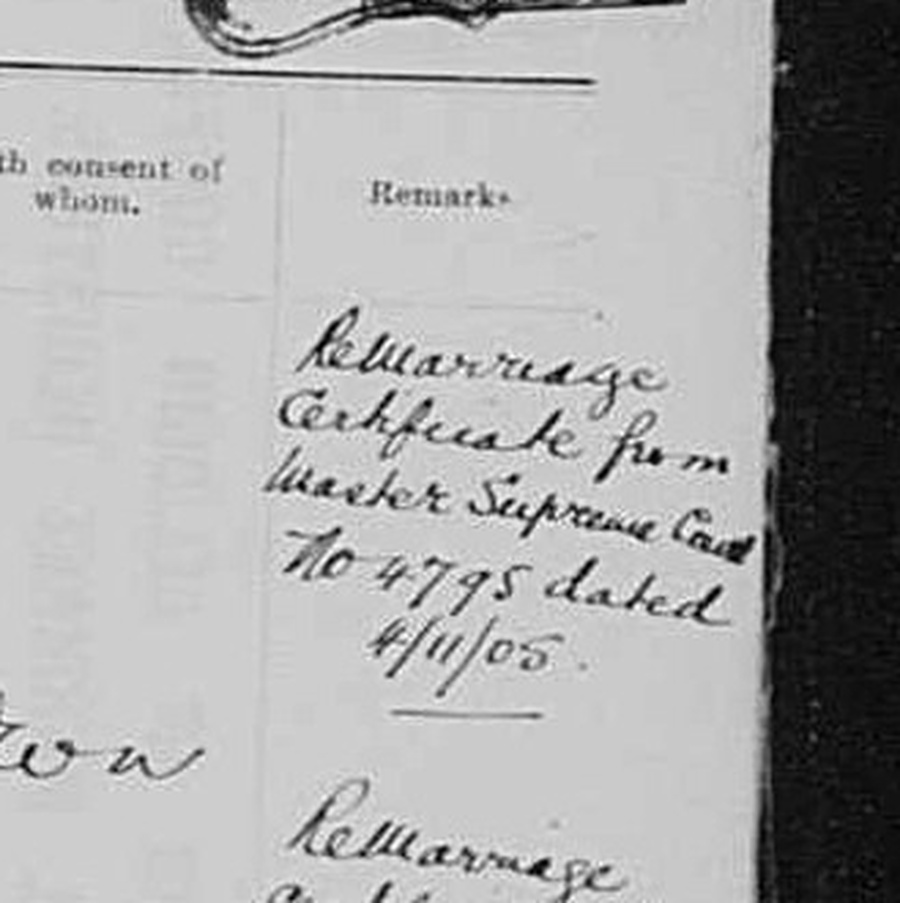
It is the document read on this same page a few sections up: the notice for Elizabetha Margaretha Booijzen, born Marais, who died in a zinc building in Market Street on 1 June 1900 and whose file he did not open until March 1904. The Master would not let a widower remarry until the first estate was in order, so he issued a certificate out of that file on 4 November 1905 — and the marriage clerk copied the estate number into the register three weeks later.
This is not an inference. It is a reference number written on one document pointing at another. The David Schalk Booyzen who married at Pretoria in 1905 is the David Schalk Booijzen who was widowed there in 1900, and both of them are the David Schalk Booysen born 9 June 1848 — fourth on the 1863 list, the direct ancestor’s brother.
And the birthplace is CRADOCK. His mother Johanna Catharina Mountjoy was married at Cradock in November 1838; his first wife was born in the district of Cradock about April 1850; and his brother Willem Hermanus was born achter Sneeuberg three years after him. The family was moving around one corner of the Karoo and this is the first document to say where he started.
A method worth keeping. The Remarks column of a Transvaal civil marriage register carries the Master’s estate number whenever a widow or widower remarries. That is a direct index from a marriage to an estate file — and it works in the direction this archive usually cannot go, from a person who is alive to a file about somebody who is dead.
What is still missing: his own death. He was alive and fifty-six in November 1905, at Goede Hoop in Pretoria, and this archive still cannot find the end of him. What is still to ask →
South Africa, Transvaal, Civil Marriages, 1870–1931 · entry 105, RM 524, reference 3149 · FamilySearch 1:1:QGR1-Q7WY. Solemnized by J. B. Klopper, minister; witnesses J. P. Stols and A. Vaughan. Read 13 September 2026.
1905 · Estate 7081 — the other number, and the same address
The Pretoria marriage register of 27 November 1905 cites two remarriage certificates from the Master, one for each party. 4795 was David Schalk’s and led back to his first wife’s death notice. This is 7081, read entire — and it is not the document this archive expected.
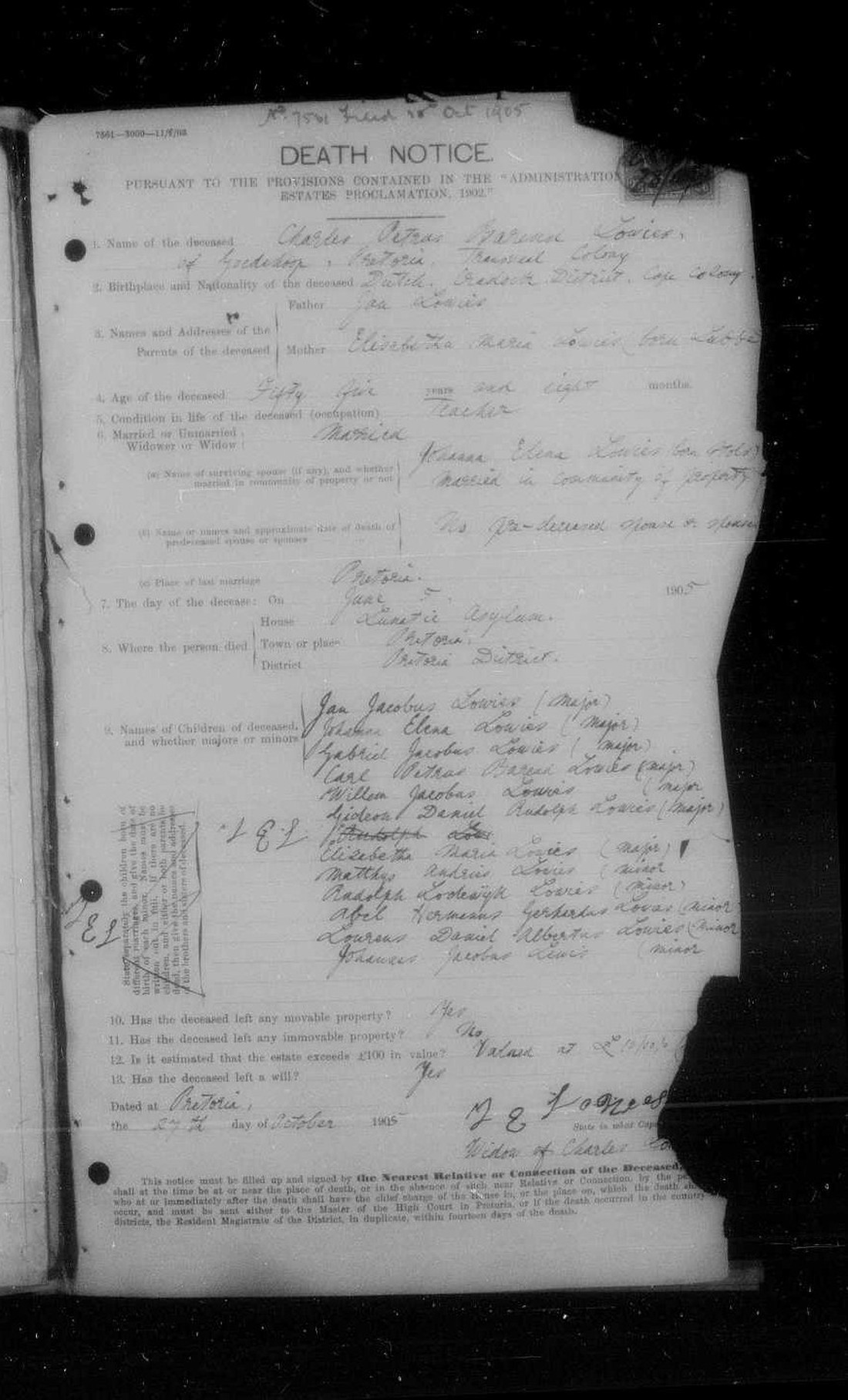
The form, as completed
| 1. Name | Charles Petrus Barend Lowies, of GOEDEHOOP, PRETORIA |
| 2. Birthplace | Dutch, CRADOCK DISTRICT, Cape Colony |
| 3. Father | Jan Lowies |
| 3. Mother | Elizabetha Maria Lowies, born LUBBE |
| 4. Age | 56 years 8 months — born about October 1848 |
| 5. Occupation | HAWKER |
| 6a. Spouse | Johanna Elena Lowies, born Stols, in community of property |
| 6b. Previous spouses | “No pre-deceased spouse or spouses” |
| 6c. Married at | Pretoria |
| 7. Died | 5 June 1905 |
| 8. Where | the LUNATIC ASYLUM, Pretoria |
| 9. Children | TWELVE — six majors, six minors |
| 10–13 | movables yes, no immovables, over £100, and he left a will |
| Signed | J. E. Lowies, at Pretoria, 27 October 1905, as Widow |
The address

This archive read that register this morning and wrote down “a widower of Goede Hoop, Pretoria” without knowing what it meant. The two men lived in the same place. David Schalk did not marry a widow from across the town; he married the widow of a man from his own address — and the two of them were born in the same Cape district within four months of each other, he in June 1848 and Lowies about October.
And where he died

The twelve
| Status | Named on the notice |
|---|---|
| Majors | Jan Jacobus · Johanna Elena · Gabriel Jacobus · Carl Petrus Barend · Willem Jacobus · Gideon Daniel Rudolph · Elizabetha Maria |
| Minors | Matthys Andries · Radolph Lodewyk · Abel Hermanus Gerhardus · Lourens Daniel Albertus · Johannes Jacobus |
Three of the twelve carry the grandparents’ names straight through — Jan Jacobus for Jan Lowies, Elizabetha Maria for Elizabetha Maria born Lubbe, and Carl Petrus Barend for his father. Johanna Elena carries her mother’s. None of the twelve is a Booysen and none of them is kin to this family; they are set down because David Schalk Booysen became their stepfather a month after their mother signed this page.
A hawker of Goedehoop with twelve children, six of them still minors, who died on 5 June 1905 in the Pretoria asylum. His widow signed the notice on 27 October and married David Schalk Booyzen one month later, on 27 November. The Master cleared her remarriage certificate on the 7th of that month and David Schalk’s on the 4th.
Between the two certificates stand twenty children — eight Booijzens and twelve Lowieses, six of the Lowieses under age. That is what the Remarks column of a marriage register is protecting, and it is why the Master would not let either of them marry until the estates were settled.
This archive published this estate from the index a few hours ago and said so at the time. The index gave the name, the district, the parents and the twelve children. It did not give Goedehoop, the asylum, the trade, or the eight months on his age — and Goedehoop is the whole point. The marriage →
South Africa, Transvaal, Probate Records from the Master of the Supreme Court, 1869–1961 · Death Notice 7081 · FamilySearch 1:1:QLQ7-PFC4. Read 13 September 2026.
1914–1963 · The Johannesburg burial registers, swept
Grave 9760 took twenty minutes and gave a direct-line ancestor a place you could walk to. So the whole collection was swept — 298 entries under Booyzen, Booysen, Booijzen, Daschner, Mountjoy and Lerena. Most are other families. These are not, and every one of them turns a year this archive was carrying into a day.
| Person | Buried | What it adds |
|---|---|---|
| Catherine Maria Sophia “Kathleen” Barry (1859–1940) | 6 Sep 1940 | Aged 82, section D.R., grave 9760, New Cemetery. Read in full → |
| Willem Hermanus Booyzen of Indwe (c.1886–1932) | 31 Jul 1932 | Aged 47, Brixton, grave 6889 — with his wife, thirty-six years later. Read in full → |
| Susanna Adriana Roodt | 29 Aug 1968 | Grave 6889, in her husband’s. |
| Henry James Booyzen | 12 Dec 1956 | Died 8 December 1956, aged 69 — born about 1887. This archive had him only as the name on Transvaal estate MHG 10/57, with no dates at all, and that estate number is one of the six in the letter to Pretoria. |
| Joseph Heinrich Daschner (1884–1942) | 21 Apr 1942 | Aged 58, West Park Cemetery. His estate is MHG 1928/42, which this archive has read; it did not give the burial. |
| Hendrik Stephanus Nicolaas Booyen (1882–1959) | 12 Oct 1959 | Aged 77. Found this morning as a baptism at Rustenburg and a civil death at Kempton Park; here he is buried at Johannesburg. The register → |
| George Downing Mountjoy Booyzen (1901–1947) | 14 Dec 1947 | Aged 46, West Park — already held, and confirmed against the register. |
| George Downing Daschner | 20 Jun 1925 | 0 days, Brixton. Already held. |
| John Barry Booyzen the infant | 28 Dec 1916 | 2 years, Brixton, born 1914. Not the John Barry Booyzen who signed his father’s death registration at Indwe in 1905 — a second child of the name, and the archive did not have him. |
| Anna J. Mary Booyzen | 23 Jan 1914 | 0 days, Brixton. Not previously held. |
And then October 1918
That is the exact centre of what Johannesburg called Black October — the second wave of the influenza, which killed something like fourteen thousand people on the Rand in six weeks.
This archive does not have a Richard Peter Booyzen. It should. Richard Peter Barry is Kathleen Barry’s brother, named on their father’s 1903 registration and on the Cape Rebel roll; and a boy born about 1894 falls exactly in the gap in Willem Hermanus and Kathleen’s children, between Catharina Maria Sophia in 1891 and George Downing Mountjoy in 1901. A Booyzen child named after his mother’s brother, buried in the cemetery where this family buries. Inferred, and added as a ninth child with the reasoning on his page — a burial register names no parents and this one is no exception.
He is not alone in that register. John Zacharia Booysen, twenty-nine, was buried at Brixton on 26 November 1918, and Johanna A. Booysen, nought days old, on 19 December 1918. This archive cannot show that either is kin — there is no forename in this family that reaches them, and Booysen is a common name on the Rand. They are set down here because the shape is the point: three Booysens into one cemetery in eight weeks, in the worst two months South Africa has had.
South Africa, Gauteng, Johannesburg, Cemetery Records, 1840–2019. 298 entries read under six surnames, 13 September 2026. Grave numbers are given where the register carries them; most of these entries are name-and-date index rows whose images have not yet been read one by one. What has been searched →
1942–47 · West Park — graves 2171, 50 and 51
Three more register images read page by page, and three more graves this family could stand at. One of them is the direct line.
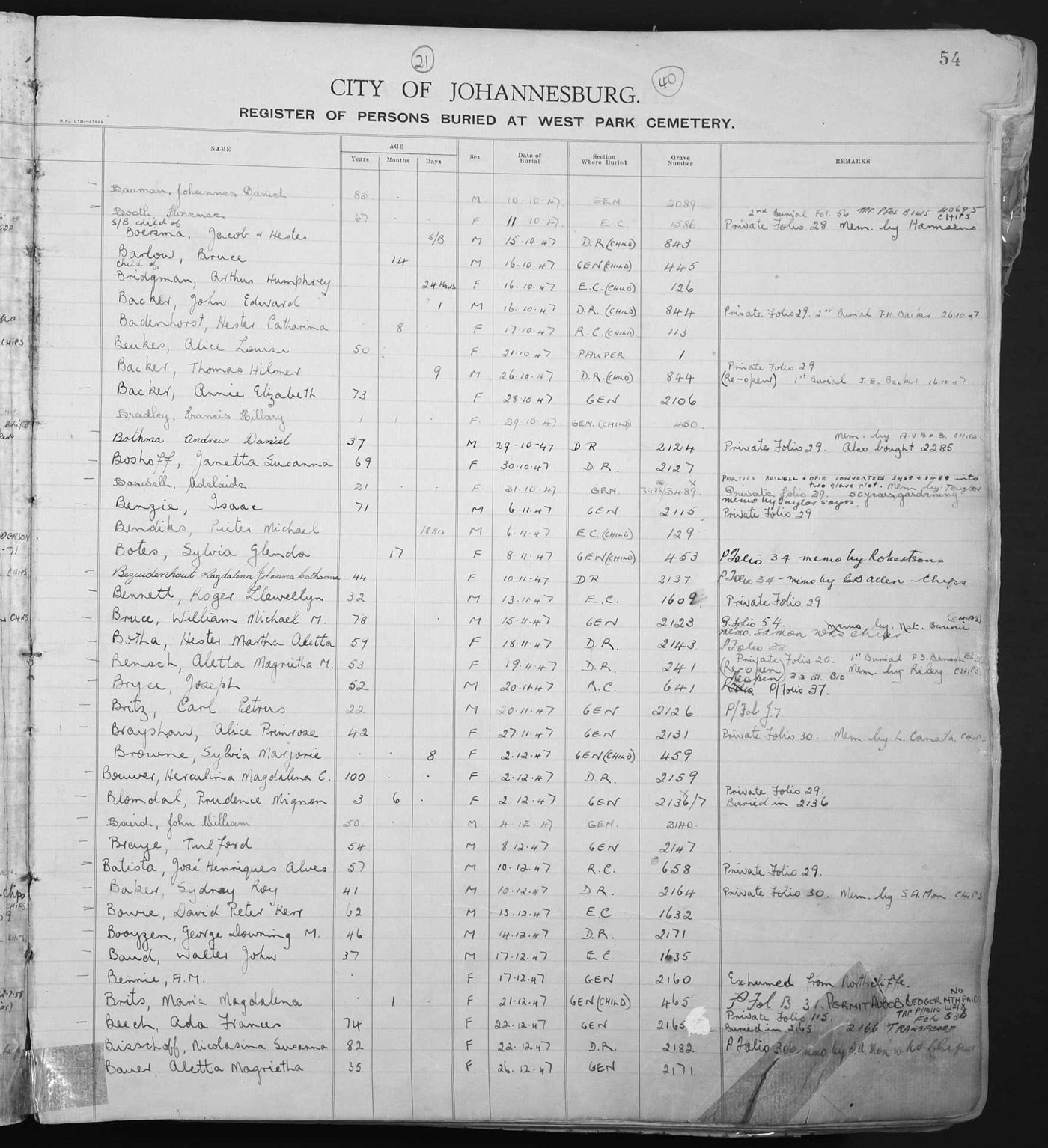

His mother is at Brixton in grave 9760, seven years earlier, in the same denomination’s ground at a different cemetery. His brother is at Brixton in grave 6889. The three of them are in three separate graves in two cemeteries, which is what happens to a family that arrives on a goldfield one at a time.
And a double plot, bought in 1942

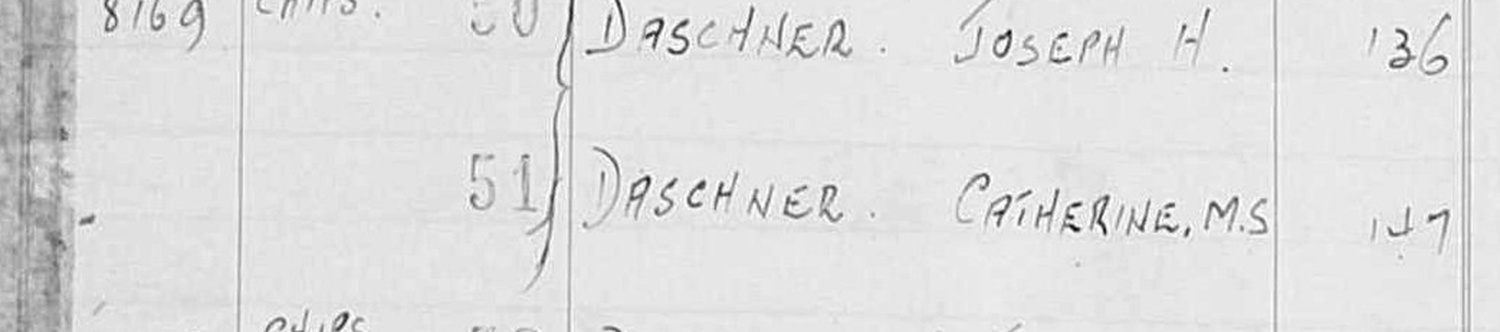
Catherine M.S. Daschner is CATHARINA MARIA SOPHIA BOOYSEN, born 22 April 1891 and baptised at Barkly Oost — a daughter of Willem Hermanus Booyzen and Kathleen Barry, and George Downing Mountjoy Booyzen’s own sister. Her estate, TAB MHG 3734/46, is one of the six files in the letter sitting at the National Archives in Pretoria; this archive has been asking that letter for her parents’ names. It now knows where she is.
Their infant son George Downing Daschner had gone into Brixton in June 1925, seventeen years before his father. The 1942 estate →
Where the family lies, so far as this archive can say
| Person | Cemetery | Section | Grave |
|---|---|---|---|
| Catherine Maria Sophia “Kathleen” Barry | Brixton (New) | D.R. | 9760 |
| Willem Hermanus Booyzen of Indwe & Susanna Adriana Roodt | Brixton | — | 6889 |
| George Downing Mountjoy Booyzen | West Park | D.R. | 2171 |
| Joseph Heinrich Daschner | West Park | D.R. | 50 |
| Catharina Maria Sophia Booysen, his wife | West Park | D.R. | 51 |
Still unread, page by page: Henry James Booyzen (1956), Hendrik Stephanus Nicolaas Booyen (1959), George Downing Daschner (1925), Richard Peter Booyzen (1918), John Barry Booyzen the infant (1916) and Anna J. Mary Booyzen (1914). Their dates and cemeteries are known; their grave numbers are on register images nobody has opened. What has been searched →
South Africa, Gauteng, Johannesburg, Cemetery Records, 1840–2019 · FamilySearch 1:1:661J-JNBM (West Park register p. 54), 1:1:6XQR-BDSG (West Park register p. 136) and 1:1:6NRC-B9DK (consecutive grave numbers, p. 2). Read 13 September 2026.
1914–59 · The last six graves — and three things this archive had wrong
Six register images were left unread when FamilySearch stopped answering. They are read now. All ten of this family’s Johannesburg burials have a grave number or a section — and three of the six corrected something published the same afternoon.
| Person | Buried | Cemetery | Section | Grave |
|---|---|---|---|---|
| Anna J. Mary Booyzen | 23 Jan 1914 | Brixton | D.R. | 2472 · Private |
| John Barry Booyzen the infant | 28 Dec 1916 | Brixton | D.R. | 2951 |
| Richard Peter Booyzen | 27 Oct 1918 | Brixton | D.R. | 1119 |
| George Downing Daschner | 20 Jun 1925 | Brixton | D.R. | 4410 |
| Henry James Booyzen | 12 Dec 1956 | Johannesburg | D.R. | 7110/1 |
| Hendrik Stephanus Nicolaas Booysen | 12 Oct 1959 | Roodepoort–Maraisburg Central | Sek I D.R. | — |
Grave 1119, and the page it sits on

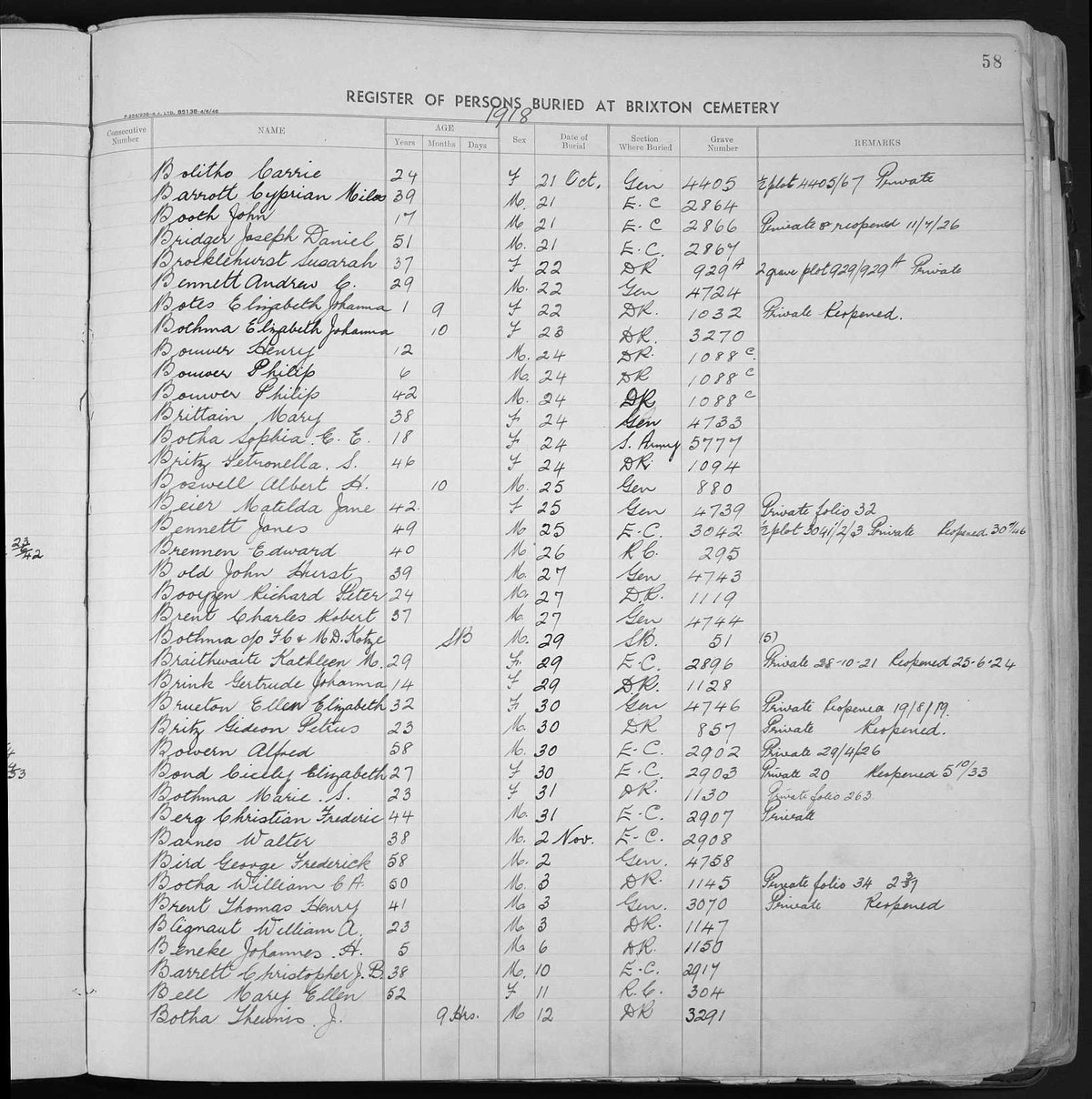
Thirty-nine burials on one page, in three weeks, of surnames beginning with B alone. Six on the 24th. Richard Peter Booyzen is the twentieth name down, between a John Hurst Bold of thirty-nine and a Charles Robert Brent of thirty-seven, both buried the same day. That is what Black October looks like in a ledger.

Two children who were not stillborn


Anna J. Mary Booyzen lived six months and was buried in a bought grave. George Downing Daschner lived three months and five days. Neither was stillborn, and the difference matters to anybody reading this about their own family.
And one that is not in Johannesburg at all
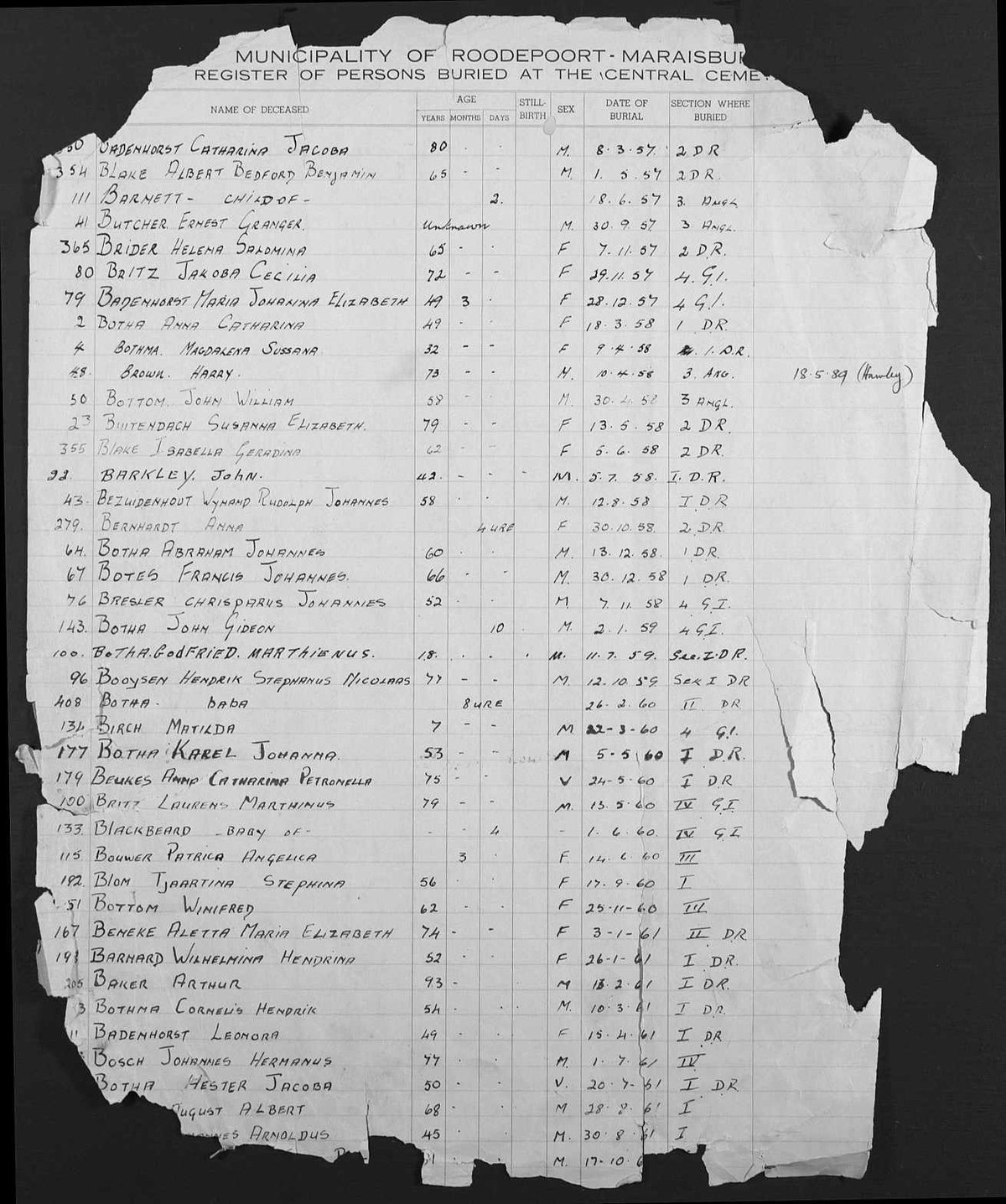
Henry James, in full


| Died | 8 December 1956 |
| Where | Florence Nightingale Nursing Home |
| Usual residence | 3 15th Avenue, MAYFAIR |
| Cause | coronary pulmonary sclerosis |
| Age | 69 |
| Burial order | 5013, dated 11 December 1956 |
| Buried | 12 December 1956, D.R. section, grave 7110/1 — a double plot |
MAYFAIR. His mother Kathleen Barry died at Mayfair in 1940. His great-niece Catherine Mary Sophia Booyzen was married at St Joseph’s, Mayfair in January 1949. And here is Henry James at 3 15th Avenue in the same suburb, dying in 1956. This archive has had Mayfair as a word on two pages and never as an address. Johannesburg →
He is also the man whose Transvaal estate, MHG 10/57, is one of the six files in the letter now sitting at the National Archives in Pretoria. This morning he was a name on that list with no birth and no death. He now has both, an address, a nursing home, a cause and a grave.
South Africa, Gauteng, Johannesburg, Cemetery Records, 1840–2019 · FamilySearch 1:1:6N3M-21Y6, 1:1:6N3H-JL26, 1:1:6NS6-229Q, 1:1:6N3S-3D2X, 1:1:6N19-R9HH, 1:1:6FLQ-7X7Y. Read 13 September 2026.
1806–1817 · The regiment James Mountjoy left, tracked through the London papers
Question 12 has been blocking since it was written. A memoirist put James Mountjoy in the 21st Light Dragoons, discharged at the Cape; his own death notice answers not known where his parents are concerned and his marriage register rules a line through the column that should say where he came from. The regiment itself can be followed, day by day, in the British press. Sixty-seven articles, read in order.
| Date | What the papers say |
|---|---|
| 5–6 May 1806 | The Scots Greys relieve them at York. “That fine regiment, the 21st Light Dragoons, lately passed through [Egham] from York, on their way to Portsmouth to embark for the Cape of Good Hope.” Bath Journal; Limerick Gazette |
| 19 May 1806 | “The remaining three troops of the 21st light dragoons…” embark for the Cape and the East Indies. Hampshire Chronicle |
| 2 Aug 1806 | Admiral Stirling to sail for the Cape, “there to take on board part of the 21st light dragoons, and proceed to South America”. Caledonian Mercury |
| 10 Dec 1807 | “Ten Transports with the 21st Light Dragoons, 47th and 87th foot had arrived from South America at the Cape…” Government Gazette (India) |
| 4 Mar 1809 | In Parliament: “it was thought an unaccountable circumstance, that the 21st light dragoons should [be] sent to the Cape of Good Hope, where they could have nothing to do”. Globe |
| 1–5 Sep 1810 | The Cape garrison under Lieutenant-General the Hon. Grey: the 1st battalions of the 24th, 72nd, 83rd, 87th and 93rd, with the 21st Light Dragoons. Beef 3d. a pound, bread 2d. Star; Johnson’s Sunday Monitor; Caledonian Mercury; Bury and Norwich Post |
| 27 Oct 1810 | “A large reinforcement of officers and men are to be sent out by the first ship to that excellent and highly-disciplined regiment…” Oxford Journal |
| 2 Jan 1812 | “CAPE OF GOOD HOPE. The 21st Light Dragoons are in the highest state of discipline. The following is a Copy of General Orders given [by] SIR JOHN CRADOCK, after reviewing that regiment…” London Courier and Evening Gazette |
| 9 Nov 1812 | “General TARLETON’s regiment, the 21st Light Dragoons, which have been stationed some time back at the Cape of Good Hope…” Sun (London) |
| 4 Oct 1813 | Detachments of the 21st Light Dragoons and 83rd Foot arrive at Hilsea depot to wait embarkation for the Cape. Star; Hampshire Chronicle |
| 19–20 Oct 1813 | Lord Charles Somerset’s military command at the Cape is to consist of the 21st Light Dragoons and the 1st battalions of the 59th, 60th, 83rd and 93rd. Saint James’s Chronicle; Public Ledger |
| 26 Oct 1813 | “a detachment of 140 men for the 21st Light Dragoons, and about the same number for the 81st Foot, embarked for the Cape of Good Hope.” Star (London) |
| Oct 1817 | At St Helena, guarding Napoleon: the 66th Regiment of about 1,000 men, a detachment of the 21st Light Dragoons of about 100, and two or three companies of Royal Artillery. Star; Oxford Journal; Belfast News-Letter |
| 14–17 Nov 1817 | Extract of a letter from the Cape of Good Hope, dated 1 and 10 September 1817: “THE 21ST LIGHT DRAGOONS HAVE EMBARKED FOR INDIA.” Sun; Star; Public Ledger; Morning Herald; Hampshire Chronicle |
And this is the sentence the whole table was read for
James Montjoy married Anna Catharina Slier at Graaff-Reinet on 9 March 1817. His regiment sailed for India six months later.
A soldier who married in March 1817 and was keeping a house and a saddler’s trade at Cradock by January 1822 was discharged at the Cape before September 1817, and the thing he was choosing between was a wife at Graaff-Reinet and a transport to India. This archive has been trying to date his discharge from the Cape end for weeks. The London end dates it in one line.
Three windows, not one
He could have come out with the regiment in 1806 at about twenty-four, with the 1810 reinforcement, or with the draft of 140 men in October 1813.
All three are now dated, and the WO 97 attestation years for the regiment cluster at 1799–1801 and 1805 — which favours the first. The WO 97 sweep →
Why a cavalryman would take his discharge
Parliament said it out loud in March 1809: the 21st were at the Cape “where they could have nothing to do”. Eleven years of garrison duty, one review, and a colonel — Banastre Tarleton — who never saw them.
A trade and a marriage at Graaff-Reinet against another eleven years in Madras is not a difficult choice.
A name that turns up twice
The regiment was reviewed at the Cape by Sir John Cradock, Governor, and pronounced in the highest state of discipline.
The town James Mountjoy settled in is named after the man who reviewed his regiment. There is nothing in that but a coincidence of governors and place-names — and it is still worth writing down.
What this does not do. It does not name him, and it does not touch his parentage. WO 97 still holds no Mountjoy of that regiment, and the reason still stands: the pre-1855 discharge papers hold only men discharged to a pension, and a man who took his papers at the Cape to marry and make saddles is not one. What has changed is that his discharge now has a deadline, and the muster books — WO 12 at Kew, which list every man by name, quarter by quarter — would show him leaving it. Question 12 →
17 September · The errand is one piece, and the piece this archive had written down was the wrong one
The Kew catalogue was searched again before the letter went. It gives the regiment a continuous run of muster books, and the run ends where the regiment does — disbanded in 1820, with nothing again until the 1860s.
| Piece | Covering | What was happening |
|---|---|---|
| WO 12/1442–1445 | 1798–1804 | Home service. The WO 97 attestations cluster here. |
| WO 12/1446 | 1805–06 | York, then Portsmouth, then the Cape |
| WO 12/1447 | 1807–09 | Back from South America; “nothing to do” |
| WO 12/1448 | 1810–12 | The reinforcement; Cradock’s review |
| WO 12/1449 | 1813–15 | The draft of 140 men |
| WO 12/1450 | 1816–17 | THE MARRIAGE, AND THE EMBARKATION FOR INDIA. One piece covers both. |
| WO 12/1451–1452 | 1818–20 | India, then disbandment |
Held at The National Archives, Kew, with no access conditions recorded. Not name-indexed — they have to be read, and a man’s disappearance from a muster dates his discharge.
And the correction, which is the reason for going back at all
On 15 September this archive searched the same catalogue, concluded correctly that WO 97 would not hold him, and named the piece to read instead: WO 12/1430. That went into a letter drafted to Kew.
WO 12/1430 is the 20th and 21st Dragoons for 1867–1868. Fifty years late, and the re-raised regiment rather than the one that garrisoned the Cape.
The letter was never posted. It now names WO 12/1450, gives the newspaper evidence for the September 1817 departure, and tells them in as many words that an earlier version had the wrong piece. A letter that asks the wrong archivist for the wrong box gets one answer and burns a month, and the only thing that caught it was searching a catalogue twice. The corrections →
1868–1914 · Leeuwberg, a commando, and a farmers’ president — the Free State Kolbes in the British press
Commandant John Gerson Eliezar Kolbe, the Settler’s eldest child, died of typhus caught on commando on 3 April 1868, on the farm Leeuwberg, leaving a widow and twelve children — eight sons and four daughters. This archive can put a hand on two of the twelve. The prisoner list and the newspapers between them now put Kolbes back on that farm, in the field, and at the head of the Free State’s farmers.
1901 · A Kolbe still on Leeuwberg
Andries Frederick Kolbe, aged 45, taken prisoner and entered on the War Office list as of LEEUWBERG, Bloemfontein — WO 108/368 folio 431, sent to Cape Town and Natal.
Thirty-three years after the Commandant died there, a Kolbe is farming it. Born about 1856, he would have been twelve when his father—or whoever it was—died at Leeuwberg, and he is inside the age bracket of the eight sons.
No descent is documented and none is claimed. What is documented is a farm, a surname and a date.
1901 · A Kolbe commando in the field
May 1901, Colesberg. “Kritzinger, with 200 men, has passed through this district. The Hertzog, Brand and Kolbe commandos…” — London Evening Standard, Globe and Westminster Gazette, 21 May; Leominster News, 24 May.
September 1901. “Kolbe’s attitude is doubtful. He is reported to have expressed a wish to surrender.” — Derby Daily Telegraph and Derby and Chesterfield Reporter, 5–6 September.
November 1901. “GENERAL KOLBE CAPTURED. Bloemfontein, Wednesday. — Hamilton’s column, operating in the district of Reddersburg…” — Birmingham Mail, 21 November; Warwick and Warwickshire Advertiser, 23 November.
Colesberg, Bethulie, Reddersburg, Bloemfontein. That is Leeuwberg country, and 1901 is exactly when the Commandant’s sons would have been commanding.
1914 · A Kolbe at the head of the Free State’s farmers
“A cordial welcome was given to the South African farmers at the general meeting, and at luncheon in the yard Mr G. A. KOLBE, President of the Orange Free State Agricultural Association and Chairman of the Orange Free State delegation…” — Western Daily Press, Dundee Courier, Cork Free Press and Exeter and Plymouth Gazette, 2 July 1914.
Named in the delegate list of 26 June 1914 in the Daily Telegraph as “Mr. G. A. Kolbe (Bethulie)”, beside Mr E. W. Hunt of Pretoria and Mr J. H. Perks of Koingha. On 22 July the Daily Malta Chronicle has him sending a telegram of respectful greeting to Queen Wilhelmina on the delegation’s behalf.
And the War Office list of 1901 holds a GEORGE AUGUSTUS KOLBE of Sterkfontein, BETHULIE, aged 32, a Free Stater, sent to Natal — WO 108/368 folio 581. Same initials, same district, and thirteen years between them.
What this is and what it is not
It is four documents and a district. A man on the Commandant’s farm in 1901; a commando under the Commandant’s surname in the Commandant’s own country in the same year; a general of that name taken at Reddersburg in November; and a farmers’ president of Bethulie in 1914 carrying the Settler’s forenames and, very probably, a prisoner’s number thirteen years earlier.
It is not a pedigree. The document that would make it one is VAB MHG M777, the 1896 estate of the Commandant’s widow Anna Jacoba van der Merwe, filed under her second husband’s name McCabe — which would name all twelve children. It is identified, it is unread, and it is in Bloemfontein. The Commandant →
One limit worth stating. FindMyPast’s newspaper archive is British and Irish. Its own coverage facet lists England, Scotland, Wales, both Irelands, India, Barbados, China, Jamaica, Australia and New Zealand — and no South Africa at all. Everything above is the Cape and the Free State seen from Fleet Street, through Reuter’s wire and a war correspondent. It is not a substitute for the South African papers, and the eGGSA newspaper index remains the only route into those.
23 August 1830 · “Your affectionate father, J G Kolbe”
This archive has held a tailor of Conduit Street and a missionary of Colesberg and not one document showing the two men in contact. A catalogue line said one existed. On 15 September it wrote to the National Library of South Africa; on 18 September Melanie Geustyn, Senior Librarian, sent four pages. This is the first document in this archive that Johan Gottlieb Kolbe wrote himself.
London August 23d 1830
Dear George,
About a month ago I wrote to you by Dr Philip informing you that Mr Miles had called
at our house & informed me that you had been fully accepted by the [L.M.S.] as one of their
Missionaries — to which I do congratulate you, now, accompanied with fervent prayers to
God that he may vouchsafe to bless your ministry amongst the poor Bushman & other
heathens to whom it may please him to send you…
The question it was asked, and did not answer
The enquiry asked, above everything, whether the letter carries an address at its head. An 1844 obituary puts the family at Brunswick-square; the rate books, the Gazette, the census and the burial register put him in Soho and then Conduit Street.
It says “London” and nothing finer. The one line that would have settled it is not there.
Written down as plainly as the finds, because a document that arrives and does not answer the question is still a result.
And the question it answered completely
The enquiry also asked whether “LMS missionary” in the catalogue came from the papers or from the donor — because the only other evidence was John Montgomery’s memoir, written down forty-five years after the fact.
It is in the father’s own hand, in 1830. Mr Miles of the Society called at the house; Dr Philip — John Philip, the LMS superintendent at the Cape — carried the previous letter and “was exceedingly glad to hear of your being accepted”. Two independent witnesses to the mission, forty-five years apart.
Henry, dying
The longest passage in the letter is about another son.
Henry had wrote to you himself & left his letter at the Mission house to be forwarded to you with the first opportunity… he keeps up pretty well at present, but what effect the winter may have upon him if it should set in very cold, as it did last winter, is perhaps not doubtful, since it must prevent him from taking exercise by walking, & which is a great means of keeping down the Dropsy, of which he bears still the Symptoms… I trust also that you will join your prayers, that he may vouchsafe to prepare him to a fit state of meeting his God… he appears at present to be resigned to the Catastrophe.
This is John Henry Kolbe, baptised at Westminster on 29 July 1800. This archive has his font, his deposition in the Old Bailey in January 1819 (“my father is a tailor, and lives in Church-street, Soho”), his marriage to Matilda Ford three months later, his bankruptcy in 1824, and his burial in the German Lutheran register on 22 April 1832. Now it has his illness, and his father’s grief, twenty months before the end. The trial →
“kind love from your Sisters & brother”
Sisters plural. Brother singular.
In August 1830, of the eight sons the 1844 obituary counts, exactly two were alive: George Augustus at the Cape, and Henry in London with dropsy. Henry died on 13 April 1832.
From that day George Augustus was “the last remaining of eight sons” — and the Grahamstown Journal did not say so until December 1844. The obituary is corroborated, and the date it became true is now known to within a fortnight.
Elizabeth, who is Betsey, and lives in Edinburgh
“Milne with Elizabeth & family had transferred their residence to EDINBURGH… he says that Betsey likes the situation very well, & they think that they will settle there rather than in London; Milne & Betsey desire their best to you.”
Four days ago this archive found, in the Westminster marriage register, Elizabeth Kolbe married John Milne in 1817 at St Clement Danes. That was a line in an index. This is her father calling her Betsey and saying where she went.
Charlotte stops being an inference
“Charlotte sends you an Evangelical Magazine, with the account of the death of the Rev. W. Orme, late Secretary to the L.M.S.”
On 17 September this archive wrote that Marianne, Charlotte and Amelia of the 1841 Conduit Street household match no baptism in the family’s own register run, and that their place in the family was an inference from living in the house. Charlotte’s is an inference no longer.
What a father sends
“a Suit of Black clothes, hope they may be wide enough for you, as I understand that you are stout as long” — clerical black, for a newly accepted missionary — with a sash and waistcoat, and a set of last year’s newspapers, some of which Henry, who read them every week after his father had finished with them, seems to have lost.
And the news
“on the 26 June last we lost by death our King George 4th and have now a William the 4th, formerly Duke of Clarence… he appears to be a King after the people’s heart”, and in France “a New Revolution has taken place” — Charles X and the Ordinances, three weeks old when he wrote.
A tall story, to be checked
He has read in The Mirror of a Scottish colonist near the Caffres whose farm was raided by baboons. London thinks it “a fictitious romance”. “I should think that your Society would have heard some thing about it, & therefore I should be glad to hear from you, whether that report may be founded in truth or falsehood.”
A tailor in Conduit Street asking his missionary son to fact-check a magazine.
What this cost and what it took. One letter, sent on 15 September to an address checked first against the host table on this site’s own source register. A holding reply the next morning saying the manuscript collections live in off-site vaults. The document itself on the third day, with a second one nobody asked for — a two-page entry written for the Dictionary of South African Biography by Dr Karel Schoeman, with a list of sources, which this archive has not yet read. The Background File holds nothing further on the donation or on Dr Griffiths, so where the original is remains unknown and unpursuable from that end.
It ends: “commending you to God’s holy keeping, & if it should not be his will to see each other again in this world, that I may have the happiness of seeing you shine as a great Star before the throne of God & the Lamb.” They did not see each other again. George Augustus died at Wirtemberg on 1 December 1844; his father died at 34 Conduit Street on 18 November 1845, not knowing it.
Read again, from the file itself — and a preview is not a document
Everything above was read in a mail client’s preview overlay, on a screen eight hundred pixels wide. On 20 September the two PDFs were opened properly. Nothing already published turned out to be wrong. A good deal turned out to be missing, and the list above was written as though it were an inventory. It was a sample. Corrections →
Dr Philip was in London, and he was pleased
“Dr Philip was exceedingly glad to hear of you being accepted by the L.M.S. as you may well imagine, he has promised to write to you a letter by the first opportunity…”
This archive had Philip only as a courier — the man who carried the previous letter. He is in the room. The most powerful man in the Society’s southern African work heard that a Soho tailor’s son had been accepted, was exceedingly glad, and undertook to write to him personally. That letter, if it was written, is another document with George Augustus Kolbe’s name on it, and the place to look is the same CWM archive at SOAS that holds his journal.
A box, and clothes for a boy
The suit of black clothes was not the whole of it. The letter encloses a jacket and waistcoat “for John”, and a further jacket also for him —
“tell him his old father has sent it him, & to make haste to fill them out.”
Clothes for a growing child. George Augustus’s eldest son was John Gerson Eliezar Kolbe, born 7 July 1822 — eight years old in August 1830, and the man who would die a commandant on the farm Leeuwberg in 1868. If that is who “John” is, this letter is the earliest document in this archive that mentions him, and it mentions him growing out of a coat.
And in August 1830 he was the only John in that house. The Settler named a later son John too — and that child was born in 1834 and died in 1835, four years after this letter was written. There is no other candidate.
“His old father” is the remaining difficulty, and it is not glossed over: the writer is the boy’s grandfather. It may be a German-speaker’s English for the old man of the family, or a word this archive cannot resolve at this resolution. The identification is an inference and is marked as one — but the household has only one John in it. inference
A year of newspapers, and who read them
“I have also enclosed a Set of Newspapers of last year, with the exception of the one of the 4th of Decr last, which cannot be found, supposing that Henry, who has them every week, after I have done with them, — has lost.”
The household read a paper weekly; the father first and then Henry; a year of them was kept and packed for the Cape; and one number had gone astray and the blame was placed, mildly, on a son who had four months to live when the sentence was written. It is the only description this archive has of what anybody in that house did with an ordinary evening.
And the house had friends, who have names
The archive has had this family entirely through official paper — rate books, a census, the Gazette, a burial register. The letter carries the first names of people who simply knew them:
Mr & Mrs Stanhope, who “desire their best regards to your family”. Mr Warner, who asked that his and Mrs Warner’s best regards be presented. Mrs Field and her daughters — and “the eldest, Miss Mary, that was, has married a Mr Bellew, a Surgeon, whom I do not know whether you may recollect”.
A marriage in another family, reported across six thousand miles because the two households knew each other. None of these five people is anywhere else in this archive, and a surgeon named Bellew marrying a Miss Mary Field about 1829 or 1830 is a searchable thing.
“Whether there is any truth in a Story published in a work called the Mirror”
This archive summarised this as a baboon story he wants fact-checked. It is two pages long, and it is the strangest thing in the letter. A Scottish colonist — “I believe his Name to have been either Williams, or Williamson” — settled close to the Xhosa. Orang-outangs raid his fruit; his servants drive them off and he shoots a young one, which turns out to be a chief’s son. Weeks later Mrs W. is carried off. He suspects a Xhosa chief who had earlier offered oxen and “2 or 3 of his finest caffre women” in exchange for her and been refused, and whose messenger had said, shaking his head, “you will repent of your obstinacy”. He gets a company of soldiers under Capt Johnson and is on the point of war when a man is produced who saw a large orang-outang carrying a woman across the river. The chief then furnishes men of his own to help find her, and after nearly two years she is recovered, living among the animals as their queen, with the son also carried off.
The father’s own verdict, and it is the reason this belongs on the page:
“here we look upon the Story as a fictious & romance, but it is by some inserted … as a true Story… Should there be any thing like truth in it, I should think that you should have heard something at least about it, & therefore I should be glad to hear from you, whether that report may be founded in truth, or falsehood.”
A seventy-year-old tailor in London, reading a cheap weekly, declines to believe a sensational story about Africa and writes to the one person he knows who is actually there to ask whether it is true. There is no better description of what this archive tries to do, and it was in the first document it ever found that he wrote. The Mirror of Literature, Amusement, and Instruction ran from 1822 and is digitised; the number carrying this is now on the work list. to find
What it still does not say. No street address, as before — the margins of pages two and four carry notes about how to direct the box, naming the Revd Mr Murray and Dr Philip, and they are written across the fold and are partly illegible. They are the only lines in four pages this archive has not been able to read, and they are not guessed at here.
The second attachment — a historian’s draft, and the two things in it that are wrong
Melanie Geustyn sent two files. The first was MSB 751 itself. The second was a two-page Afrikaans typescript headed MSB 751 … for DSAB / VOORLOPIGE TEKS — a draft entry for the Dictionary of South African Biography, initialled and dated 18/2/92. It is a secondary work, and this archive does not take secondary works as evidence. It is something better: a reading list, by somebody who had been to the archives this family has never reached.
The typescript carries no name, only the initials KS and the date 18/2/92. This archive worked out from the inside that it had to be Karel Schoeman — the Bethanie claim in it has one published source, Schoeman’s Die Huis van die Armes (1985), and the paper was typed at the South African Library where Schoeman worked — and then published that as an inference it would not assert.
It did not need to. The Library had already said so, in the email that carried the file. Melanie Geustyn, who had the Background File open in front of her: “I am also sharing with you a two page document that was written for the DSAB (Dictionary of South African Biography) which was in the Background File. The author, KS, would be Dr. Karel Schoeman who worked here at the National Library. He includes a list of Bronne (Sources).” This archive read the two attachments and not the sentence they were attached to. Corrections →
Note her “would be”. It is a librarian’s hedge and it is the right one: the initials are an identification, not a signature, and she is reading them the same way this archive did — only with the institution’s own knowledge behind her. So: written by Karel Schoeman, on the word of the library that holds the file, and still not signed. The Background File, she adds, holds nothing further about the donation or about any other deposit by Dr Griffiths — which closes a question the enquiry asked.
What matters even so is not who wrote it but how it behaves when it is checked, and this archive is in the rare position of being able to check it.
Nine things it says that this archive already knew — by nine other roads
| The entry | This archive | Held on |
|---|---|---|
| born 7.12.1802; “his death notice and his gravestone both confirm” 1802 | born 7 Dec 1802, baptised 2 Feb 1803 — the same day, to the day | the Westminster register and the Karoo gravestone |
| J.G.E. Kolbe (1822–68) | born 7 Jul 1822, died 3 Apr 1868 | the Grahamstown Journal obituary |
| J.G.E. at Leeuberg, famed as a commandant | “DEATH OF COMMANDANT KOLBE”; farm fixed two hours from Bloemfontein | an 1870 auction advertisement |
| Margaret Downing (1803–1867) | born 23 Feb 1803, died 25 Nov 1867 | the monument, and her death notice for the day the stone has lost |
| married at London, 1819, very young | the 1819 allegation — married at sixteen on a sworn falsehood | the marriage allegation |
| trade on the settler roll: apothecary | “George Augustus Kolbe, PHARMACIST” | the NLSA catalogue |
| the farm Wurthemberg, dist. Colesberg | “his Farm, Wirtemberg, near the Orange River” | the obituary |
| ten children | “has left a WIDOW AND TEN CHILDREN” | the obituary |
| at Philippolis from March 1831 | a daughter born at Philippolis in 1831 | the register |
Nine agreements, every one reached from a different direction. It is careful work, and that is what makes the tenth line worth the whole exercise.
The first error — “a German apothecary resident in London”
He was a tailor. Not by inference — by one hundred and twenty-one Westminster rate book entries, the printed roll of 234 master tailors of 1799, the master tailors’ list of April 1834, three London Gazette partnership dissolutions every one of which reads TAILORS, the occupation column of the 1841 census, the Westminster burial register, and his own son’s deposition on oath at the Old Bailey in 1819: “My father is a tailor, and lives in Church-street, Soho.”
The German is right. The London is right. The trade is the son’s, moved one generation up — George Augustus sailed as an apothecary, and the apothecary has been handed to his father.
This is the whole value of the document. The entry is accurate wherever its author had a record in front of him. The single thing he had no record for is the thing he got wrong here — and this archive can only say so because it spent a day in the Westminster rate books. A secondary work is a reading list, not a witness. Church Street South →
The second error — and it is in the source he lists first
“Hy het tien kinders nagelaat, alhoewel sy sterftekennis slegs agt vermeld” — he left ten children, although his death notice records only eight.
The death notice names ten. This archive has read it, photographed the detail and the whole sheet, and published the transcription: KAB MOOC 6/9/35: 7698 (1845), made at Colesberg in January 1845 and signed M. Kolbe by his widow. It is source number one on his own list. The notice →
So the count of thirteen — ten left, eight on the notice, three dead as infants — rests on a miscount and does not stand as published. Ten is what the notice says and ten is what the obituary says. Whether three more died as infants is a separate claim, and this archive has no source for it either way. That the error sits in the one document he cites first, and that this archive could only see it because it had ordered the same document, is the argument of this whole page in a line.
What it settles, and what it corrects
Wurtemberg is Knapdaar
The entry’s heading kills him at Knapdaar. Its body explains why: “die plaas Wurthemberg (soms ook aangegee as Knapdaar)” — two names for one farm.
This archive had both names and did not know they were one place. The 1844 obituary says “his Farm, Wirtemberg”; his own death notice says he died “at Knapdaar, in the field cornetcy of Rhenosterberg”. Two documents, two names, run together on this site into a single address that nothing actually supported. Schoeman says in terms that they are the same farm — which is the difference between an assumption and a statement. resolved
MSB 751 is not a letter “on his ordination”
The catalogue said it was, and this archive repeated the catalogue. The entry dates the ordination to 25 May 1833 — nearly three years after the letter — and the letter itself says he had been “fully accepted… as one of their Missionaries”.
Three steps, now in order: mission assistant 8 Feb 1828 · accepted as a missionary Aug 1830 · ordained 25 May 1833. The letter and the entry date each other. Corrections →
Nine years of his life that this archive did not have
Published here as what the entry says, every line of it untested:
Boesmanskool, 8 February 1828
Accepted by the LMS as a mission assistant and placed at the new station Boesmanskool — the present Bethulie — across the Orange, with James Clark, among the San.
Boesmanskool is literally “Bushman school”, which is what John Montgomery called what he saw, in English, forty-five years afterwards. They are not the same place — Montgomery’s was at Koolskop where Colesberg now stands, and this is across the river — and this archive is not going to weld them because the words match. open
Among the slaves, from about 1824
Four years with the Graaff-Reinetse Zendelings Genootschap, working among the slaves of the district, until the society could no longer afford him and merged with the LMS.
This archive had nothing at all for 1820–1828 but one old man’s memory. untested
November 1828 — and it is in print
A journey with Melvill to the Caledon River valley, as far as present-day Ladybrand: the earliest journey in the present Free State of which a written record survives, and he wrote it.
The DSAB cites it as an 1829 journal extract. It has now been run to ground, and the hunt turned up more than the citation. found
1836 — the accusation, the inquiry and the acquittal
At Philippolis, with the station split between Griqua and Baster and his marriage under strain, Kolbe was accused in 1836 of adultery with the wife of one of his congregation — a charge, the entry says, “often used as a means of revenge against missionaries of the period”. H. Hendricks, secretary of the Griqua Council, led the agitation. An inquiry by the neighbouring French missionaries acquitted him. His younger colleague T. Atkinson went on opposing him from August 1836; he left the station in March 1837, and on 19 June 1837 the LMS dismissed him.
This archive held none of it. It is one sentence in a draft, about a man who cannot answer, and it is set down here in full because the alternative — keeping the founding of Bethanie and quietly dropping the accusation — would be the worst thing this archive could do with a source. He was accused, he was investigated, and he was cleared. All three belong on the page. the Captaincy’s own papers now say it too
The papers that would test it are the Griqua Council’s own — and they are printed: Karel Schoeman (ed.), Griqua Records: the Philippolis Captaincy, 1825–1861, Van Riebeeck Society II/25, 162 documents including the correspondence between the Captaincy’s officials and the missionaries. It was published after this typescript was typed, which is why its own author could not cite it. This page said “two years after” until 11 October 2026, when the catalogue record was read: it gives 1996, which is four.
The journal of 1828, run to ground — and the man it is addressed to
The DSAB gives it as “Extract from the journal of Messrs Melvill and Kolbe…”, Transactions of the Missionary Society (1829), and searching under Kolbe found nothing at all. The reason is that the printed version is filed under the other man’s name.
“Extracts of the Journal of Messrs Melvill and Kolbe, addressed to the Rev. Richard Miles, Superintendent of the Society’s Missions in Africa, Philippolis, 25 Nov. 1828”, Council for World Missions (London Missionary Society) Archives. An edited version, dated 18 Nov. 1828, appears in Melvill (1829).
The citation as it is given in the scholarship — Eldredge, Sources of Conflict in Southern Africa, c. 1800–30 (1992), and again in Eldredge and Morton, Slavery in South Africa.
So: the manuscript is at SOAS, in the CWM archive — which is source 4 on the DSAB’s own list, two lines above source 6, and the entry never says they are the same document. And Legassick quotes it: Melvill and Kolbe travelled to the Caledon and met refugee groups with “no other means of subsistence than the wild animals found in these parts” — the first words of George Augustus Kolbe’s that this archive has ever read. They are about famine.
And the journey is printed in full, in English, in a book still in the shops. Karel Schoeman (ed.), Early White Travellers in the Transgariep, 1819–1840 (Pretoria: Protea Book House, 2003), page 30: “The journey of John Melvill and G.A. Kolbe from Philippolis to the Caledon (1828)”. An edited collection of the travellers’ own texts. That is the fourth Schoeman title standing behind this one one typescript, and it is the one that would put his own account of the journey on this page. to buy
“Mr Miles had called at our house”
The letter of 23 August 1830, in the tailor’s own hand, opens by telling his son how the news reached London:
“Mr Miles had called at our house & informed me that you had been fully accepted by the [L.M.S.] as one of their Missionaries…”
This archive read that as a name and moved on. The journal of 1828 is addressed to the Rev. RICHARD MILES, Superintendent of the Society’s Missions in Africa — and Richard Miles, formerly pastor of Brigg in Lincolnshire, was sent to Cape Town to act as Dr Philip’s substitute while Philip was in England. Philip was in England from 1826; Miles was acting Superintendent at the Cape in 1828, which is why Kolbe addressed his journal to him there; and by 1830 Philip was back and Miles was in London, where he called at a tailor’s house in Soho.
The LMS official Kolbe reported to from Philippolis is, very probably, the man who knocked on his father’s door with the news. The 1830 letter says only “Mr Miles” and gives him no forename, so this is an identification and not a document — but the office, the continent and the dates all fit, and the same letter has Dr Philip carrying the previous letter out. Two documents six thousand miles and two years apart, and the same two men are moving between them. inference, stated as one
And there may be a face
This archive holds no likeness of anybody in it born before 1850. The entry ends by naming two:
- A portrait of Kolbe as a young man, in 1992 in the possession of a descendant, C.J. du Plessis of Ruigtevlei, district Bethulie, and reproduced in Burger Olivier, So onthou ons die oewerbewoners van ou “Grootrivier” (Bloemfontein, 1973).
- A watercolour by Charles Bell of a church service at Philippolis in 1834 with Kolbe in the pulpit — Africana Museum, Johannesburg, reproduced in The Journal of Andrew Smith, ed. William F. Lye (Cape Town: Balkema, 1975).
A book of 1973 and a museum catalogue are both reachable. The second would be a picture of this family’s ancestor at work, drawn from life, in the year after he was ordained.
And it is catalogued in Edinburgh, under the wrong denomination
The entry sends the reader to Johannesburg. The picture is also in Scotland. The University of Edinburgh, Centre for the Study of World Christianity, holds CSWC 60 — five photographs, 1834–1840, “photograph copies of sketches by the South African artist C. Bell of African congregations”. Item 3 is “Mr. Kolbe”, “at Philippolis in 1834”.
The five are James Archbell (Wesleyan), William Edwards (London Missionary Society), Kolbe, Jean-Pierre Pellissier (Paris Mission), and a service at Ebenezer on the Elephants River. Pellissier is source 9 on the DSAB’s own list — the Bethulie missionary whose biography the entry cites. The same small circle, a hundred and ninety years later, five photographs in a Scottish archive.
Edinburgh calls him “a moravian missionary?” — with the question mark, so the catalogue already doubts itself. He was London Missionary Society, and this archive holds two independent documents that say so: the catalogue of MSB 751 at the National Library of South Africa, and his own father’s letter of 23 August 1830, which reports him “fully accepted by the [L.M.S.] as one of their Missionaries”. This archive can correct a university catalogue, and intends to write and do it. The work list →
Edinburgh holds photograph copies; the DSAB puts the original watercolour in the Africana Museum, Johannesburg. Two institutions, one picture, and neither catalogue mentions the other.
Eleven sources, and what happened to each
| Bronne | Where it stands |
|---|---|
| Sterftekennis G.A. Kolbe, MOOC 6/9/35 no. 7698 | already read, photographed and transcribed here — and it is where his second error is |
| Albany Museum, Grahamstown — photocopy of the 1819 marriage certificate | a certificate, not the allegation. The archive has the allegation only |
| Gravestone of G.A. and M. Kolbe, Burgersdorp | held and photographed — it is how Margaret’s dates were got |
| CWMA: Incoming letters (South Africa), microfiche | the LMS South Africa correspondence — at SOAS, and where his own reports are |
| Sibree, A register of missionaries, 4th ed. (1923) | would give his LMS service dates in one line; not found online |
| “Extract from the journal of Messrs Melvill and Kolbe” (1829) | his own words in print. Searched Internet Archive and Google Books — not found |
| Nash, The Settler handbook (1987) | would carry the Nautilus roll entry giving his age as 20 |
| Legassick, The Griqua, the Sotho-Tswana, and the missionaries | the standard thesis on the region in these years |
| Pellissier, Jean Pierre Pellissier van Bethulie (1956) | Bethulie — where Kolbe was placed in 1828 and where his son was born in 1839 |
| Olivier, So onthou ons die oewerbewoners… (1973) | carries the portrait |
| Private information: mev. Martie Venter, Bloemfontein | a living descendant in 1992, unnamed in any record here |
Two more that are not in the list, because they had not been written or had not been reached: Schoeman’s Griqua Records (VRS II/25), the Philippolis documents, published two years later; and Schoeman’s Die Huis van die Armes (1985), which is the only authority behind the Bethanie claim — so that the entry and the encyclopaedia article that repeats it are one witness, not two.
The story the tailor asked his son to check — found, and it is a novel
Two of the four pages of the letter of 23 August 1830 go on a story its writer had read and did not believe. This archive searched for it on Google Books, on the open web and on the Internet Archive, five ways, and recorded a clean negative. On 21 September it was found by downloading the volumes and reading them.
SPIRIT OF THE PUBLIC JOURNALS
A SINGULAR LETTER FROM SOUTHERN AFRICA.
Communicated by Mr. Hogg, the Ettrick Shepherd.
The Mirror of Literature, Amusement, and Instruction, Volume XIV (1829), pages 313–318.
It is fiction, and by a famous hand. “Mr Hogg, the Ettrick Shepherd” is James Hogg — the author of The Private Memoirs and Confessions of a Justified Sinner, Walter Scott’s friend and rival. The Mirror reprinted his tale as though it were a letter home from a settler, which is exactly how the tailor read it, and exactly why he wrote to the one man he knew who was actually there.
Every detail in the letter is in the story
| The letter, 23 August 1830 | Hogg, 1829 |
|---|---|
| “a Caffre chief who had sent… for his wife, offering in exchange some oxen, & 2 or 3 of his finest caffre women” | the chief Karoo offers four oxen, then “ten cows and a bull for my wife, and a choice virgin to boot” |
| the messenger said “you will repent of your obstinacy” | “telling me I was the son of foolishness, and that he foretold I should repent it” |
| “Capt Johnson the officer” and a company of soldiers | captain Johnstone, and “nine British soldiers” in a party of nearly a hundred |
| Mrs W. carried off across the river by orang-outangs | “he himself saw my wife carried across the river by a band of pongos, (ourang-outangs)” |
| found “as the Queen” of the animals, with the son also taken | “the Great Spirit had sent them a Queen from the country beyond the sun” — and the boy William is with them |
And the one detail he got wrong explains itself. He wrote: “a Scottish Colonist … I believe his Name to have been either WILLIAMS, or WILLIAMSON.” The narrator has no name at all — the piece is addressed “My dear Friend” and signed by nobody. His son is called WILLIAM. A man recalling a magazine story a year later took the child’s name for the family’s, which is the most ordinary mistake a reader can make and is the reason five searches for Williams and Williamson found nothing.
He was right, and he was right for the right reason. “Here we look upon the Story as a fictious & romance, but it is by some inserted… as a true Story… I should be glad to hear from you, whether that report may be founded in truth, or falsehood.” A seventy-year-old tailor in Soho, reading a cheap weekly, declined to believe a sensational story about Africa and wrote to the one person he knew who could check it. It was by one of the most celebrated authors in Britain, printed as a genuine letter, and he was not taken in. This archive spent a day and five failed searches proving he was right. found
The tailor’s own marriage — searched properly, and it is not there
This archive has said for a fortnight that “her surname before marriage is not known and no marriage has been found”, and separately carried “Mary Larman” off the family tree. On 20 September it corrected a page that had welded the two together. Then it went and looked, with a tool it did not have before.
FindMyPast’s SpouseLastName filter, both directions, whole Life Events collection:
| KOLBE × LARMAN | 0 |
| LARMAN × KOLBE | 0 |
| KOLBE × nonsense (control) | 0 — the filter is working |
And the control that makes the nil mean something
A nil return is worth nothing until a control shows the search works — which is this archive’s own rule, written on /method/. The control here is a marriage this archive already knows about: the eldest Kolbe daughter married George Kottlich KOHLBECK at St Anne’s, Soho in 1811.
1810 · KOHLBECK · St Anne, Soho, Middlesex, England · Westminster Banns
The banns are indexed, a year before the wedding, in the family’s own parish. So FindMyPast’s coverage reaches this household, this church and this period. The Larman zero is not a hole in the index.
Which leaves three doors, and one of them is closed by an Act of Parliament
The obvious thought is that a German family buried its dead in the German Lutheran church — this archive has five of them in TNA RG 4/4631 — so perhaps it married there too, outside the Anglican indexes.
It could not have. Under Hardwicke’s Marriage Act of 1753 — the same Act this archive already invokes for the sworn ages at Shoreditch in 1819 — every marriage in England except those of Quakers and Jews had to be performed in an Anglican parish church to be legal at all. Foreign Protestant congregations were not exempt. A German Lutheran couple marrying in England between 1754 and 1836 married in a parish church, and the entry is in a parish register.
The Savoy congregation could bury them and baptise them. It could not marry them.
So three possibilities remain, and they are not equally likely:
- The marriage is in an English parish FindMyPast does not index. Possible — the London coverage is wide but not complete.
- “Larman” is wrong. The archive’s own person record has always said her surname is not known, and the name comes from the family tree and from nowhere else read here. Today the same tree was caught giving Margaret Downing’s mother two different surnames in two different versions, so it is not a careful witness about maiden names.
- They did not marry in England. He was born in Württemberg in 1765 and his birth county is entered as “FOREIGN” in the 1841 census in his own words. The first child of the house was baptised in London in 1792, when he was twenty-seven. Where he was before that, this archive does not know — and a marriage in a German state would be in a German register, indexed nowhere this archive has looked.
The gain is not a fact, it is a narrowing. Before today “no marriage has been found” was a shrug. It is now a negative with a control behind it and three named doors left, one of which — the German Lutheran register — has been closed by reading the law rather than by searching anything. The next place to look is not another English index. It is Württemberg. narrowed
Looking for a Downing–Pooley marriage — and finding that two trees cannot agree what she was called
The FamilySearch tree gave Margaret Downing’s mother as Mary King Pooley, a name this archive had never held. The obvious thing to do with a new name is look for a marriage under it, so FindMyPast’s whole Life Events collection was swept for one.
Devon Marriages And Banns ·
GBPRS/M/514168016/1
John DOWNING married Mary POOLEY
10 May 1802 · Welcombe (Bishop’s Transcripts), Devon · Anglican
Transcriptions © Devon Family History Society
It is the only Downing–Pooley marriage before civil registration in the entire collection — against 231,425 Downing records and 65,460 Pooley records. Twelve records match the pair at all; three are indexed marriages, and the other two are 1882 and 1955.
What is for it
- The date works, and only just. Margaret Georgina Elizabeth Downing was born 23 February 1803. A marriage on 10 May 1802 is nine months and thirteen days earlier — exactly right for a first child.
- The county is the right one. This archive’s own family tree puts the Downings in Devon: Edward Downing (1700–1792) m. Mary Heard; Thomas Downing (1736–1801) m. Mary Trick; John Trick m. Margaret Hooper. Trick, Heard and Hooper are Devon names, and Welcombe is a North Devon parish on the Cornish border. The tree and the register agree about the county without either knowing about the other.
What is against it
- Margaret was born in London. A couple married in a remote North Devon parish in May 1802 with a child in London nine months later is possible — people move — but it is not what the record says, and nothing here shows them moving.
- John Downing and Mary Pooley are not rare names, and this is a name match and a date. It is what this archive calls a candidate, not a finding.
- No baptism has been found for Margaret Downing in London in 1803. The collection was searched and returns nothing of the kind — which matters, because a baptism naming both parents is the document that would settle this outright, and its absence is why the marriage cannot be tied to her.
And then the archive’s own tree contradicted the one that started this. The FamilySearch Family Tree calls her Mary King Pooley. The family tree this archive was built from calls her Mary P King — surname King, with an initial.
So the “P” may be Pooley, or “Pooley” may be a later reading of the “P”. Two collaborative trees, one woman, and they cannot agree whether she was a King or a Pooley. Neither can settle it, and the search that was launched on one of them was looking for a surname that may not be hers.
They disagree about her husband too: John Paul Downing is 1769–1839 in one and 1765–1839 in the other.
The baptism that would settle it — and why its absence proves little
One document ends the Welcombe question: a London baptism for Margaret Georgina Elizabeth Downing in 1803, naming both parents. Her monument at Burgersdorp says she was “BORN IN LONDON 23 FEBRUARY 1803”, so it should exist.
| Margaret Downing, baptism, 1801–1805 | 5 — two in Edinburgh, three at Madeley, Shropshire (one event indexed three times) |
| under Georgina | 0 |
| nonsense forename (control) | 0 — the filter restricts |
| In London | none |
This archive first published the wrong conclusion here, within the hour, and the way it went wrong is worth more than the result. Widen the search to every Downing baptism in England for 1800–1806 and FindMyPast returns 1,131, of which almost none are in London. That was read as a failure of coverage — “a picture of the index, not of London” — and the nil was declared worthless.
That was the wrong control. Counting one surname by county tests where the Downings were. It does not test whether the index covers London at all. The right control is a common name.
| Baptisms, 1800–1806 | In the collection | London in a sample of 100 |
|---|---|---|
| SMITH | 86,942 | 37 |
| KOLBE | 76 | 6 (of 76) |
| DOWNING | 1,131 | 2 |
Thirty-seven per cent of Smith baptisms in those seven years are London, Middlesex or Westminster. The coverage is excellent. So the near-absence of London Downings is not the index failing — it is that there were very few Downings in London.
Which means the nil is real, and it points the other way from the one this archive published. Margaret Downing was born in London on 23 February 1803, the index covers London baptisms well, and there is no baptism for her. Either she was not baptised in an Anglican London parish, or her family was not a London family.
And that strengthens Welcombe rather than weakening it. A couple married in a North Devon parish in May 1802, with a child born in London in February 1803 and no London baptism and no London kin in the registers, is exactly what a family newly arrived from the country looks like. candidate, strengthened
And a check on this archive’s own reasoning, which failed
The Welcombe case rested partly on county: the family tree puts the Downings in Devon through Trick, Heard and Hooper, and Welcombe is a North Devon parish. It was worth asking whether the surname itself is a West Country surname, because if it were, that would strengthen the case considerably.
It is not. A sample of 160 of those 1,131 baptisms, tallied by county: Yorkshire (West Riding) 20, Suffolk 16, Norfolk 16, Cornwall 14, Staffordshire 9, Yorkshire 9, Shropshire 7, Devon 5. Downing is a national name, and the West Country is about an eighth of it, behind Yorkshire.
So the Devon argument stands only on the tree’s own specific ancestry — Edward Downing and Mary Heard, Thomas Downing and Mary Trick — and gains nothing at all from the geography of the surname. This archive tested its own inference and took half of it back.
Withdrawn — they stayed in Devon
The candidate raised this morning, strengthened at lunchtime, is dead by the evening, and it was killed by the simplest question available: did the Welcombe couple stay?
Every Downing record in the parish of Welcombe, in order:
1792 Ann burial · 1792 William marriage · 1793 Thomas baptism · 1795 Damaris baptism · 1798 Mary baptism · 1800 Peter burial · 1801 Philip baptism · 1802 John marriage · 1803 John baptism · 1806 William baptism · 1809 Emmey baptism · 1810 Elizabeth baptism · … · 1834 Mary burial · 1839 John burial
They married at Welcombe in May 1802 and baptised a child at Welcombe in 1803, and more in 1806, 1809 and 1810. Margaret Georgina Elizabeth Downing was born in London on 23 February 1803. The Welcombe couple never went anywhere. The Pooleys are equally rooted there — baptisms in 1792, 1801 and 1813, a burial in 1810. withdrawn
And the last line of that list is the interesting one: a MARY DOWNING buried at Welcombe in 1834. Both family trees give Margaret’s mother as dying in 1834.
That is almost certainly where “Pooley” came from. A researcher looking for Margaret Downing’s parents finds one Downing–Pooley marriage in all of England, and a Mary Downing burial in the very year they wanted, in the same small parish — and attaches both. It is exactly the search this archive ran today, reaching exactly the same two records, and stopping one question earlier.
So “Mary King Pooley, 1768–1834” is most likely not a record at all. It is a previous researcher’s reconstruction — which would also explain why this archive’s own copy of the tree calls her Mary P King instead: two compilers, the same fragments, two different guesses. Margaret Downing still has no mother, and the position is now better understood than it was this morning.
So the other surname was swept too — and a better tool was found
If she may have been a King rather than a Pooley, the same sweep had to be run under King. Searching for “king” as a keyword returns 144 records for 1790–1806 and almost every one of them is King’s Lynn — a surname that is also half a place-name poisons the field completely.
The marriage transcripts carry SpouseFirstName and SpouseLastName, and SpouseLastName turns out to work as a real filter — a nonsense value returns nothing, which is the test this archive insists on before trusting a narrow count. Run properly:
| Downing × Pooley, all years | 3 — Welcombe 1802, Penzance 1882, Birmingham 1955 |
| Downing × King, 1790–1806 | 3 — and all three are one Norfolk event indexed three times: a Mary Downing, at King’s Lynn and Norwich in 1790 |
| either surname, nonsense control | 0 |
A Mary Downing marrying a King in Norfolk in 1790 is the wrong person in the wrong county in the wrong direction. Under either surname, there is no London marriage for a John Downing in the years this family needs. The Welcombe entry of 1802 remains the only candidate in England.
Her own death notice is still the only document in this archive that was ever asked about her parents, and it answered “Both dead” and gave no names. That remains the position. A Welcombe marriage of 1802 is now on the work list as a candidate to be tested — by the Welcombe register itself, by a London baptism for Margaret in 1803, or by a burial for a Mary Downing at the right date. Nothing has been adopted, and the person record still has no mother. candidate
A collaborative tree names the Commandant’s twelve — and two of its claims are already on this site
This archive does not take family trees as evidence, and it is not about to start. But there is a difference between a tree that is your own work read back to you and a tree compiled by strangers that turns out to agree with documents you hold — and the test for the second is the same as for a historian’s draft: check it where you can, before you believe it anywhere.
Frederik Fortunatus Kolbe · Birth
22 October 1857, Bloemfontein · Death 18 December 1930, Bloemfontein
Son of Commandant.Gen. John Gherson Eliezer Kolbe and Anna Jacoba Kolbe
Husband of Maria Petronella Elizabeth Antoinette Kolbe
Father of Maria Francina; Annie Nelson Marais; John Gerson Eliezar; Francis Elizabeth Krone;
Rosa Magdalene Styger; Magdalena Jacoba; Ada Francis Styger; Petronella Antoinetta Botha;
Maria Margaretha Downing Rousseau; Frederik Fortunatus; Andries Rowan
Brother of Catharina Wilhelmina Magdalena Pienaar Anderson; George Augustus Kolbe;
General Willem Johannes Kolbe; Jan Hendrik Kolbe; Petrus Jacobus (Pieter) Kolbe
and 6 others
Geni, added 2014, four profile managers, one source attached. It is a collaborative tree and nothing about it is documentary.
Why this is not the same as the last tree
A search on another member of this family returned her parents through MyHeritage, and that was this family’s own tree handed back to it — circular, and worth nothing as corroboration. This is not that. The Commandant’s twelve children have never been in this archive at all; his obituary counts them and names none, and the work list has carried a row for two weeks asking for VAB MHG M777, his widow’s estate, on the ground that it is “the document that would name the twelve”. A stranger’s tree naming them is independent of anything here.
And it agrees with two documents this archive reached by another road
A baptism register, 1890
This archive holds, from the Bloemfontein register: a ROSA MAGDALENA KOLBE baptised in 1890 to Frederik Fortuna Kolbe and MARIA PETRONELLA ELIZABETH ANTOINETTA McCABE.
The profile gives this man’s wife as Maria Petronella Elizabeth Antoinette and his daughter as Rosa Magdalene. Wife and daughter, both, against a register entry the tree’s compilers are most unlikely to have seen.
An estate index, 1968
This archive holds TAB MHG 5450/68 — ROUSSEAU, surviving spouse MARIA MARGARETHA DOWNING ROUSSEAU, picked up in a sweep for the Downing forename and never attached to anybody.
The profile lists Maria Margaretha Downing Rousseau as his daughter. That is an orphan reference in this archive acquiring a father.
Two independent hits is not proof and this archive is not adopting twelve people on it. What it is, is the same thing Schoeman’s bibliography was: a list worth working. The difference between a tree and a source is not that one is always wrong — it is that one has to be tested and the other has already been.
What it would answer, if it holds
- The twelve. The Commandant died on 3 April 1868 leaving eight sons and four daughters, and this archive could put a hand on two. The profile names six siblings and says there are six more — among them a General Willem Johannes Kolbe, which is a rank, and therefore findable in a way a farmer is not.
- The Kolbe–McCabe question, which this archive raised and could not settle. It wrote of the 1890 baptism: “a second Kolbe–McCabe marriage in the same small Free State world, and this archive does not yet know whether that is a coincidence.” If this profile is right, it is not a coincidence: the Commandant’s widow Anna Jacoba van der Merwe married Francis McCabe, Landdrost of Bloemfontein, about April 1871 — and her son married a McCabe. Stepmother and daughter-in-law out of the same family.
- A fourth Frederik Fortunatus. This one is born 1857 at Bloemfontein and dead there in 1930. He is not the Settler’s tenth child (born 1839 at Bethulie, died 1929 at Utrecht), and not Frederick Fortunatus Downing Kolbe (died 1918, TAB MHG 40293). This archive has already had to withdraw a claim once over two men sharing a name in one town, and it is going to be slower this time, not faster.
The document that tests all of it is still the one on the work list. VAB MHG M777 at Bloemfontein — the 1896 estate of Anna Jacoba van der Merwe, filed under her second husband’s name McCabe, which would name her surviving children as of that year. A tree says twelve names; an estate file proves them. What has changed today is that the file now has something to be checked against, which is a better position to order a document from than an empty page. The work list →
The Kolbe–McCabe “coincidence” is a stepbrother marrying a stepsister
This archive raised the question itself and could not answer it. Of a baptism at Bloemfontein it wrote: “a second Kolbe–McCabe marriage in the same small Free State world, and this archive does not yet know whether that is a coincidence.” The answer was already in two of its own files, and it took a stranger’s tree to make them speak to each other.
| Held here | What it says |
|---|---|
| A baptism register | Bloemfontein, 1890 — Rosa Magdalena Kolbe, to Frederik Fortuna Kolbe and MARIA PETRONELLA ELIZABETH ANTOINETTA McCABE |
| An estate index | VAB MHG C129 — FRANCIS McCABE, Landdrost of Bloemfontein, 1872, naming both his wives: MARIA PETRONELLA ELISABETHA ANTOINETTA RAATH and Anna, born van der Merwe |
| An obituary | McCabe “married his second wife about ten months since — the widow of the late Commandant J.G.E. Kolbe”, and died on 23 February 1872 leaving “four sons and two daughters, besides a large family of step-children” |
Read those three together and the four-part name does the work. Maria Petronella Elisabetha Antoinetta is not a name that recurs by chance. Francis McCabe’s first wife was a Raath of that name; a McCabe of that same name married a Kolbe and had a child baptised at Bloemfontein in 1890. She is his daughter, named for her mother entire — which is the naming habit this archive has documented across four families.
So the sequence is this. Commandant J.G.E. Kolbe dies on 3 April 1868, leaving Anna Jacoba van der Merwe and twelve children. She marries Francis McCabe, a widower with six children of his own, about April 1871. He dies ten months later. And on 8 November 1880, at Bloemfontein, one of her sons marries one of his daughters.
Two households were one household for less than a year, and a marriage came out of it nine years afterwards. That is not a coincidence in a small world. It is what happens when children are thrown together and then orphaned twice over.
What is documented and what is not. The 1890 baptism is a register entry; C129 is an estate index; the obituary is a newspaper. All three are held here. The one link that is not documented is that the Frederik Fortunatus who married her is the Commandant’s son — that comes from user trees and is not adopted. VAB MHG C129 would settle it by naming McCabe’s daughters, and it has just become a more valuable document than it was this morning. one link from a tree
Two marriages, not one — and the widow’s own is now dated
The Kolbe–McCabe question was answered above from an estate index and a baptism register, with one link borrowed from a user tree. On 21 September it was searched in the civil and church registers directly, and it turns out to be larger than the thing this archive was arguing about.
| Date | Entry | Collection |
|---|---|---|
| 13 July 1871 | ANNA JACOBA KOLBE, bride, born 1825 — spouse FRANCIS McCABE, Free State | South Africa, Civil Marriage Records, 1801–1974 |
| 4 June 1872 | JAN HENDRIK KOLBE, groom, born 1849 — spouse ROSE MARIA McCABE, Bloemfontein | South Africa, Civil Marriage Records, 1801–1974 |
| — | FREDERIK FORTUNATUS KOLBE and MARIA ELIZ PETRONELLA ANTOINETTE McCABE, as parents of Magdalena Jacoba | Free State Dutch Reformed Church Records, 1848–1956 |
| — | JOHN HENRY KOLBE and ROSA MARIA McCABE, as parents of JOHN GERSON ELIEZER, Elizabeth Magdalena, Ada Francis, Anna Jacoba | Free State Dutch Reformed Church Records, 1848–1956 |
Two of the Commandant’s sons married two of Francis McCabe’s daughters. This archive wrote of one such marriage that it “does not yet know whether that is a coincidence”. Two is not a coincidence. It is a stepfamily marrying within itself, and the household that produced it lasted seven months.
And Jan Hendrik married four months after his stepfather died. Francis McCabe died on 23 February 1872; the marriage is 4 June 1872. John Henry is Jan Hendrik anglicised — the same man under two spellings, as this archive has seen across four families — and his eldest son is named JOHN GERSON ELIEZER, which is the Commandant’s name entire. That is the strongest thing yet said, from a register rather than a tree, that these are the Commandant’s sons.
And a date this archive had only by inference is now written down. It had the remarriage from McCabe’s obituary, which said he “married his second wife about ten months since” before dying on 23 February 1872 — giving about April 1871. The civil register says 13 JULY 1871. Seven months, not ten. A journalist rounding, again, which is the second time on this site that an obituary’s interval has been out by the same kind of margin. dated
These are index entries from named collections, not images read. The images would give ages, fathers and witnesses, and are the obvious next step.
And the FamilySearch Family Tree, which this archive had never opened
It uses FamilySearch constantly and had never once looked at the tree. Every FamilySearch citation on this site is a record — an indexed register entry with an ark. The Family Tree is a different thing, a single collaborative tree the whole site edits, and /sources/ lists it among the leads. Nobody here had opened it. David did, and sent the link.
The pedigree at LJNY-BLP runs straight up this archive’s own spine: Frederick Fortunatus Kolbe (1859–1930) → John Gerson Eliezar Kolbe, 1822–1868 → George Augustus Kolbe, 1802–1844 → John Gottlob Kolbe, 1765–1845. Three generations whose dates this archive established from an obituary, a death notice, a census, a will and a burial register — and the tree has them right.
Three more hits against documents held here
| The tree says | This archive holds |
|---|---|
| Anna Jacoba van der Merwe, 1824–1896 | VAB MHG M777 — her estate, 1896, filed under McCabe. The year matches. |
| Pieter Gerhardus Cloete Rousseau, 1898–1968, husband of Margaretha Maria Downey Kolbe | TAB MHG 5450/68 — ROUSSEAU, surviving spouse Maria Margaretha Downing Rousseau, 1968. The estate year is his death year. |
| Rosa Magdalena Kolbe, 1890–1946 | her baptism at Bloemfontein in 1890, to Frederik Fortuna Kolbe and Maria Petronella Elizabeth Antoinetta McCabe |
Two orphan index references in this archive have just acquired people, and a baptism has acquired a death. None of that makes the tree evidence — it makes it a lead list that has now passed the same test three times.
And two places it disagrees, one of which it loses
Mary Larman, and a burial register
FamilySearch gives her as 1768–1819. This archive holds TNA RG 4/4631 folio 62: died 2 August 1814, buried 5 August, aged 46.
The register wins, and it is not close. A tree’s death year against a burial entry that gives the day, the burial and the age is no contest — and her surname remains tree-only in any case, which this archive corrected itself about earlier today.
Two trees, two birth years
Geni gives Frederik Fortunatus Kolbe as born 22 October 1857. FamilySearch gives 1859. Two collaborative trees, two years, and no document behind either of them here.
Which is the useful thing to notice: they are not independent witnesses corroborating each other. Where they agree it may be because one copied the other; where they differ, neither can settle it. Only the register can.
One genuinely new name, and it is tree-only. FamilySearch gives Margaret Downing’s mother as MARY KING POOLEY, 1768–1834, and her father as John Paul Downing, 1765–1839. Margaret’s own death notice of 1867 says her parents were “Both dead” and gives no names at all, so this archive has never had a mother for her. It still does not. But it now has a name to look for in the London registers, which is not nothing — and a Downing–Pooley marriage in the 1790s would be a document. from a user tree, not adopted
Four journals in his own hand — and the catalogue names every one
This archive has spent the day working a historian’s reading list, and every road on it ended at the same door: the Council for World Mission archive at SOAS. The door turns out to be open, and the catalogue item-level.
Until this afternoon, the sum of George Augustus Kolbe’s own words in this archive was one sentence, quoted at second hand in Legassick. The SOAS catalogue returns sixty-two records on the surname, and among them:
| Reference | What it is |
|---|---|
| CWM/LMS/05/05/100 | Extracts from the Journal of John Melvill and George Augustus Kolbe, during a tour to the north-eastwards of Philippolis, 13–22 Nov 1828 |
| CWM/LMS/05/05/102 | Extracts from the Journal of George Augustus Kolbe, Philippolis, 1828–1831 |
| CWM/LMS/05/05/106 | Journal of George Augustus Kolbe, Philippolis, 1831–1834 |
| CWM/LMS/05/05/108 | Journal of George Augustus Kolbe, Philippolis, 6 Oct 1832 – Sep 1833 |
Six years of a man’s life in his own writing, in a building in Russell Square. The first of them is source 6 on Schoeman’s list — the printed extract this archive hunted all morning and could not find — and here is the manuscript behind it, with the days of the journey on it: 13 to 22 November 1828.
And the year of the accusation is a single box
| CWM/LMS/05/02/02/044 | South Africa, 1835 — the catalogue lists “George Augustus Kolbe, Philippolis” among the correspondents. Box 14B |
| CWM/LMS/05/02/02/046 | South Africa, 1836, 4 Jan – 29 Dec. Box 15 |
| — | the 1837 file, in the same box |
1836 is the year of the adultery charge; 1837 is the year of the dismissal. The Society’s incoming correspondence for southern Africa is filed by year, and 1836–1837 is Box 15. Whatever the Directors were actually told about H. Hendricks’s agitation, about the French missionaries’ inquiry and about the acquittal, it is in that box — and this archive has been repeating a one-sentence summary of it since breakfast.
What else the search turned up
A portrait. CWM/LMS/01/09/02/01/525, in the Missionary Portraits series — “SYKES, Charlotte née Kolbe (S. Africa 1858–1887)”. She is not this family’s Charlotte: she is the sister of the Rhenish missionary Friedrich Wilhelm Kolbe, and the same afternoon’s work put that whole household outside this tree. Recorded so that nobody here mistakes her for the Settler’s daughter, as Sibree did.
And Friedrich Wilhelm Kolbe’s own career, in the Society’s files: reports from Paarl in 1867, 1868, 1870, 1871, 1872, 1873 and 1875 and from Stellenbosch in 1876; incoming letters from him from George in 1854, Paarl from 1858, Cape Town to 1899; and, in the file for 1893, “Frederick Kolbe, Cape Town — death of Mrs Kolbe [née Isabella Maria Elliott]”, which matches the S2A3 entry to the person. A wrong man, confirmed wrong from four directions in one afternoon.
The letter is written. Seven references, a stated reason for wanting 1836 and 1837, an offer to start with one item, and one question that needs no searching — whether candidate papers survive as a class, since Frederick William Kolbe’s would settle Sibree’s error outright. Drafted, not sent. The letters →
Owen’s party on the Nautilus — and the lie was still running
Source 7 on Schoeman’s list is M.D. Nash, The Settler Handbook. Its entry for Owen’s party is published in full online, and it gives the roll as the Colonial Department had it.
KOLBE, George Augustus 20. Chemist. w Margaret 19.
He was sixteen. Born 7 December 1802, he sailed from Gravesend on 3 December 1819 — four days before his seventeenth birthday. She was sixteen, born 23 February 1803. The roll adds about three years to each of them.
And it is the second sworn falsehood about their ages in eleven months, and the two do not even agree with each other. At Shoreditch on 20 January 1819 both swore they were “of the age of Twenty-one Years and upwards”, because under Hardwicke’s Act a minor could not marry by licence without a parent’s consent. Anybody twenty-one and upwards in January 1819 is not twenty in December.
So they were not keeping a story straight. They were saying, each time, whatever the paper in front of them needed — old enough to marry without a father, old enough to be counted as a man on an emigration list. He was a sixteen-year-old married to a fifteen-year-old, and by the time they reached Algoa Bay they had told the British government two different untruths about it. The allegation →
What kind of party he joined
Fifty-two people, No. 3 on the Colonial Department list, led by Thomas Owen of 9 Carey Street, Horseferry Road, Westminster — a joint-stock party, probably recruited in London, whose correspondence with the Department was handled by Owen’s father, the Rev J Owen of Fulham.
Deposits were paid for eleven men. Sailed Gravesend 3 December 1819, Table Bay 17 March 1820, Algoa Bay 14 April 1820. Located near the Kap River, at a place they called Spanish Reed Place, between the Wellington and Kap rivers.
A London tailor’s son joined a London party got up by a clergyman’s son from Westminster. He did not go out among farmers. The trades in the list are a bricklayer, a ropemaker, a goldsmith, two edged-tool makers, a smith, three farmers — and one chemist.
And it fell apart almost at once
Thomas Owen — “this querulous man”, in Special Commissioner Hayward’s words — refused to draw rations for his people, and his brother W.S. Owen was appointed director in his place. Thomas Owen left the location early in 1821 and the party dispersed soon afterwards.
Which is the whole explanation of the gap this archive has never been able to fill. He was eighteen, in a party that had lost its leader and its rations, on a location that no longer existed — and the next thing anybody records of him is the Graaff-Reinet mission, working among slaves, about three years later.
Three Cape Archives references, and this archive is already writing to that building. Nash’s sources for the party list are CO 6137/1,4 (the list of settlers under Thomas Owen’s direction), CO 8543 (Special Commissioner Hayward’s notes) and CO 3917 — the Memorial of independent settlers aboard the Nautilus. A memorial is a petition, and a petition is signed. That last one could carry George Augustus Kolbe’s signature at seventeen, which would be the earliest thing of his own hand anywhere. No Agent of Transports’ Return has ever been traced for the Nautilus, so the roll as it stands is the best there is.
The Society’s own register — and it had been free all along
Source 5 on Schoeman’s list is James Sibree, A Register of Missionaries, Deputations, etc., from 1796 to 1923, 4th edition, London Missionary Society, 1923. This archive searched the Internet Archive for it, failed, and wrote it up as not found. It is a free PDF, 225 pages, at missiology.org.uk. The failed search looked in one place and reported a negative about the world.
278. KOLBE, George Augustus (8). Was previously connected with the Graaff Reinet Missionary Society, and laboured among the slaves around Graaff Reinet. Was accepted provisionally by Mr. Miles, Feb. 8, 1829, which action was confirmed by the Directors, July 29, 1829. First laboured with Mr. Clark, at the Bushman Station, Caledon River. Thence proceeded to Philippolis, arriving there, March 13, 1831. On May 26, 1833, he was ordained by the French missionaries, Messrs. Lemue, Pellisier, and Arbousset. His connection was dissolved by the Directors, June 19, 1837.
The whole of his mission life, in eight lines, compiled by the Society that employed him. The index gives his service as 1829 – 1837.
It settles Mr Miles, and it settles the word “fully”
The letter of 23 August 1830 says “Mr Miles had called at our house & informed me that you had been fully accepted by the [L.M.S.] as one of their Missionaries”. This archive published that identification as an inference two hours ago, on the ground that a Rev. Richard Miles — Acting Superintendent of the LMS at Cape Town from 1825, sent out to stand in for Dr Philip while Philip was in Britain — was the man Kolbe addressed his 1828 journal to.
Miles did not merely carry the news. Miles is the man who accepted him. “Accepted provisionally by Mr. Miles, Feb. 8, 1829, which action was confirmed by the Directors, July 29, 1829.”
And the father’s adverb is not decoration. Provisionally by Miles at the Cape; confirmed by the Directors in London; and a father told that his son had been “fully accepted”. The letter is using the Society’s own vocabulary, correctly, because the officer concerned was standing in the room explaining it. settled
Where the register and the DSAB draft disagree
Both are printed works and neither is the manuscript. But Sibree is the Society’s own record of its own officers, and Schoeman was working sixty-nine years later. Where they differ this archive gives both and prefers neither in print:
| Schoeman, 1992 | Sibree, 1923 |
|---|---|
| Graaff-Reinet society, among the slaves of the district | the same, in almost the same words |
| accepted 8 February 1828 | accepted provisionally 8 February 1829, confirmed 29 July 1829 |
| Boesmanskool, the present Bethulie, with James Clark, among the San | “Mr. Clark, at the Bushman Station, Caledon River” |
| Philippolis, March 1831 | Philippolis, 13 March 1831 — to the day |
| ordained 25 May 1833 by Arbousset and Casalis | ordained 26 May 1833 by Lemue, Pellissier and Arbousset — three men, and no Casalis |
| dismissed 19 June 1837 | “dissolved by the Directors, June 19, 1837” |
Pellissier is source 9 on Schoeman’s own list — S.H. Pellissier’s life of Jean Pierre Pellissier van Bethulie. Sibree puts Pellissier at the ordination and Schoeman does not.
And then the line that stops the page
522. KOLBE, Frederick William (22). Born, Nov. 3, 1821, in South Africa. SON OF REV. G. A. KOLBE (No. 278). Had been connected with the Rhenish Mission in S. Africa. In 1853 he was accepted by the L.M.S.… removed to Paarl in 1856… retired from the Pastorate at Paarl in 1875… Mr. Kolbe died at Cape Town, Dec. 25, 1899, aged 78. Books written: An English-Herero Dictionary. Cape Town: J. C. Juta, 1883.
Schoeman writes: “F.W. Kolbe (1821–99) van die Rynse Sendinggenootskap was NIE aan hierdie familie verwant nie” — was not related to this family. He names the same man, the same society and the same two years, and cuts him off. The London Missionary Society’s own register makes him the Settler’s son.
He is not the Settler’s son. Sibree is wrong, and Schoeman is right. This archive published the contradiction as open two hours ago and then went and worked it, and it came apart quickly — because the register’s own arithmetic was already against it.
The chronology. Sibree gives his birth as 3 November 1821, and his age at death agrees. The Settler’s known eldest, John Gerson Eliezar Kolbe, was born 7 July 1822, and his age at death agrees. Eight months apart. They cannot both be Margaret Downing’s sons, and that alone meant the claim could not simply be believed.
And three independent works say who he actually was.
| Source | What it says |
|---|---|
| New Catholic Encyclopedia, on his son Mgr F.C. Kolbe | “He was the son of a WESTPHALIAN (GERMAN) PROTESTANT MISSIONARY who had married the daughter of a member of the London Missionary Society.” |
| S2A3 Biographical Database, on his wife | Isabella Maria Elliott, daughter of Rev. William Elliott, “married Reverend FRIEDRICH WILHELM KOLBE, missionary and Herero scholar, in Cape Town in 1849”. |
| Dictionary of South African Biography, Vol. 5 (HSRC, 1987) | Carries its own entry on F.W. Kolbe — which is why Schoeman’s draft marks him with an asterisk, and it was in print five years before he wrote. |
Friedrich Wilhelm, not Frederick William. A Rhenish missionary of the German form of the name, married at Cape Town in 1849, at Okahandja in present Namibia by April 1850, fled to Otjikango when Jonker Afrikaner attacked the Hereros in August 1850, back in the Colony from 1852 — George, Paarl, Stellenbosch, Cape Town — and the father of Monsignor F.C. Kolbe. He has nothing to do with this family, and Schoeman knew it because the DSAB had already published him.
How the Society came to misfile one of its own
Sibree’s register has two Kolbes in South Africa: entry 278, Rev. G. A. Kolbe, and entry 522, Frederick William. A compiler joined them. It is the same species of error as the one this page spent the morning on — Schoeman giving the father the son’s trade — two adjacent facts welded because they looked like they belonged together.
And the lesson runs the other way from this morning’s. At breakfast this archive proved a historian wrong from primary documents it had ordered itself. By the afternoon it had proved the Society’s own register wrong and the historian right. Neither is a witness. Both are reading lists. The only reason the claim was not swallowed is that this archive checked an arithmetic it could do from its own records before it checked anything else.
Sibree’s Charlotte Kolbe, born 25 December 1829, “sister of Rev. F. W. Kolbe”, who married Rev. William Sykes at Paarl in 1860, goes with him. She is not the Settler’s daughter either. resolved
Indwe and Barkly East past 1910 — and most of what came back was already here
A work-list row has stood since 15 September: “the archive stops where its leads stopped… nobody has read what the register says after that.” It has now been read. The honest result is a small one, and the reason it is small is the interesting part.
Indwe is a membership register, not a baptism register
The two entries this archive already had at Indwe — Willem Hermanus Booijzen confirmed 31 May 1907 and a Mountjoy dying in 1911 — sit in the lidmate roll, the list of who joined the congregation. That is a different book from the baptisms and it is where a colliery town’s incomers are written down.
Knowing which register holds your people is half of knowing where to read next.
The Mountjoy has a joining date
Johanna Catharina Mountjoy — membership at Indwe, 23 July 1907. This archive had her death there in June 1911 and nothing before it.
She joined seven weeks after Willem Hermanus Booijzen was confirmed in the same congregation, on 31 May 1907. Two families this archive follows, in one small coal town’s register, in one winter.
It does not make them relatives. It makes them neighbours, which is a fact and was not one before.
A married surname for a Barry daughter
Catherine Mary Sophia Barry BAXTER — born 1883 at Barkly East, died 18 November 1914, probate 1916.
The forenames are this family’s exactly — there are already two women of that name here, of 1855 and 1859. A third, born 1883 at Barkly East, who married a Baxter.
Probable, not proved. Nothing read here names her parents.
And the rest of it was already in this archive
The Barkly East sweep returned thirty-six entries dated after 1910 across five surnames. Checked one by one against the register here, nearly all of them were already held: Harriet Louisa Barry, dead at Manor Owen on 7 September 1912; Henry James Kolbe Barry, whose 23 June 1939 is already on his record; John Gerson Eliazer Barry; James Jonathan Mountjoy, dead at Barkly East on 22 December 1937; and Margaretha Wilhelmina Elizabeth Mary Kolbe, dead at Manorowen on 2 August 1912.
That is worth saying rather than quietly not saying. A sweep that returns almost nothing new is a measurement of how thoroughly the ground was already worked, and this ground was worked properly. The work-list row assumed otherwise.
One discrepancy, recorded and not adopted. The index gives the matriarch as “Margaret Louisa Elizabeth Kolbe Barry, birth 1831 Believe Colesberg”, where this archive has 1826. The hedge is the index’s own word. The death date agrees to the day. 1826 stands until something better than a hedged index entry moves it.
A Booysen cluster at Indwe, and it is not claimed. Four Booysen men join that congregation between 1925 and 1931 — David Schalk (2 May 1925), Piet Frederick (14 May 1927), Petrus Jacobus (16 May 1931) and Willem Adriaan — and three couples baptise children there between 1929 and 1932. The forenames are this family’s forenames and the town is the town its miner worked in. But not one of the wives — Rachel Margarita Marais, Aletta Fredrika Jacoina Coetzee, Johanna Catharina Aletta Greyling — is a name this archive holds, and a Booysen at a Cape colliery is not evidence of anything. Written down so that somebody with a reason can come back to it, and claimed by nobody.
A near-miss worth recording, because it nearly went the other way. A first pass matched Rachel Margarita Marais against this archive and reported her as already held. She is not. The match was on the fragment “Rachel Marg” hitting Rachel Margaretha Williamse, a different woman on a 1900 death notice at Pretoria. Had it stood, an unrelated Indwe household would have been welded to this family on three letters of a forename.
8 December 1956 · Phthisis was not what killed him. It was what he was paid for.
This archive carried two causes of death for Henry James Booyzen and had read the document behind neither. A correspondent on G2G reported phthisis; the Johannesburg burial register gave “coronary pulmonary sclerosis”. The note said, in terms, “the two causes are not the same word and this archive has read only one of the two documents.” Here is the other one.
FORM OF INFORMATION OF A DEATH ·
AANGIFTE VAN ’N STERFGEVAL
1. Identity Number — 331-452322
2–3. Surname, First names — BOOYZEN, Henry James
4. Date of Death — 8th December, 1956
6. Place of Death — Florence Nightingale Nursing Home, Johannesburg
8. Age — (12-8-1887)
10. Occupation — Retired Miner of Langlaagte
11. Pensioner or Recipient of Maintenance Allowance — PHTHISIS
12. Causes of Death — Cor pulmonale with Silicosis.
contributing cause:— Broncho pneumonia
13. Duration of Last Illness — 2 years : 7 days
14. Medical Practitioner — Dr. A. L. Agranat
15. Place of Birth — Cape Province
16. Residential Address — 3 Fifteenth Avenue, Mayfair, Johannesburg
17. Intended Place of Burial — West Park Cemetery, Johannesburg
20–21. Informant — “Person causing burial”, 6 Jorissen Street,
Braamfontein
Both reports were wrong, and both came from this page
Phthisis is on line 11, not line 12. It is not the cause of death — it is the allowance he drew. He was a certified miners’ phthisis pensioner, which is a category of compensated men on the Rand, and the form has a line for it.
And “coronary pulmonary sclerosis” is a mangling of what line 12 actually says. Cor pulmonale became coronary pulmonary; silicosis became sclerosis. One document, two wrong readings, and this archive was carrying both.
What actually killed him
Cor pulmonale with silicosis, with broncho pneumonia as contributing cause, after an illness of two years and a final seven days.
Silicosis is rock dust. Cor pulmonale is the right side of the heart failing because the lungs have stopped letting blood through. It is the same disease the pension was for, arriving.
He was sixty-nine, and a retired miner of Langlaagte Estates.
And four things nobody had
His identity number, 331-452322. His own date of birth written on the form — 12-8-1887, which is now the fourth independent statement of it, after a family tree, a gravestone and a church register.
His address: 3 Fifteenth Avenue, MAYFAIR. Seven years earlier his niece Catherine Mary Sophia Booyzen married Nuno Fernando Lerena at St Joseph’s, Mayfair — the hinge between this archive and the Lerena one. He was living in that parish.
And a doctor’s name, A. L. Agranat, and an informant at 6 Jorissen Street who is described only as the person causing the burial — not a relative, on the form’s own wording.
Why this was worth a morning. A cause of death is the kind of fact that gets repeated. It had been repeated twice, from two places, in two different wrong forms, and both were traceable to a single sheet of paper nobody had opened. The rule this archive keeps relearning is that a transcript is not a document — and the day before this was read, a FindMyPast reference carried here for weeks turned out not to resolve at all. The method →
1923 and 1929 · Two estate files at Pietermaritzburg name nine children, and the daughters by their married names
This archive knew that Frederik Fortunatus Kolbe, the Settler’s tenth child, married Elizabeth Johanna du Toit and baptised eight children between Colesberg, Hopetown and Bethulie; and that three of them turned up at Wakkerstroom, four hundred miles north. It had no death for either parent and had followed three of the children nowhere at all. The Natal estate index answers all of it in one search.
The father
FREDERICK FORTUNATUS KOLBE
born 1839, Cape Province — died 23 NOVEMBER 1929 AT UTRECHT, NATAL
Pietermaritzburg estate files, probate 1929 ·
1:1:QLR2-XFJC
Ninety years old. Born at a mission station on the Orange River the year his father was working it; dead on a farm in the eastern Transvaal borderlands.
The mother
ELIZABETHA JOHANNA DU TOIT KOLBE
born 1845, BREDASDORP, Cape Province — died 12 JULY 1923 AT “SAXONY”,
UTRECHT, NATAL
probate 1923 · 1:1:QLRL-HRQV
Her record here read “NOT YET FOUND: her marriage, her parents, her death.” Two of the three, and a birthplace nobody had.
And the estates name the children — which is how you follow daughters
A Cape or Natal estate file lists the heirs, and it lists a married daughter under both names. Nine appear across the two files.
| As the estate writes them | What this archive had |
|---|---|
| George Augustus Kolbe | b. 29 Jul 1863, Colesberg — the Wakkerstroom man |
| Gabriel Stephanus Kolbe | b. 11 Mar 1865 — “not followed out of the font”. Alive 1923 and 1929. |
| Martha Angelina Kolbe | b. 21 Jan 1868 — “not followed out of the font”. Alive 1923 and 1929, and still a Kolbe. |
| Margaret Harriet Kolbe van der Spuy | b. 31 Aug 1870, Hopetown — married a van der Spuy at Wakkerstroom. Confirmed. |
| Frederick Fortunatus Kolbe | NOT IN THIS ARCHIVE AT ALL. Born 1872 at Colesberg, died 10 September 1944 at Vryheid — 1:1:QPHZ-2361 |
| Catharina Maria Louisa Kolbe LOUW | b. 1 Jul 1873 — “not followed out of the font”. She married a Louw. |
| Elizabeth Johanna Kolbe Pattison | b. 1 Mar 1876 — married John Charles Pattison at Wakkerstroom. Confirmed. |
| Petronella Jacoba Adriana Kolbe Beukes | b. 2 Oct 1877 — married a Beukes, died 1959. Confirmed. |
| Adriana Henrietta Johanna Kolbe Oosthuizen | b. 12 Aug 1881, Bethulie — married Pierre Francois Oosthuizen. Confirmed. |
Five confirmations, three people followed out of the font at last, and a ninth child. The archive’s own note was careful and said “eight of their children are in the Dutch Reformed registers” — the ninth was not, and he is named for his father.
The Angeline question, answered by exclusion
Martha Angelina Kolbe’s record carried a warning: an Angeline Kolbe died at Wakkerstroom in 1900, and a Martha Angeline Kolbe was buried at Volksrust in 1901 aged two months, and “neither can yet be attached to her, and this archive will not guess.”
It does not have to guess now. Martha Angelina is named as an heir on her mother’s estate in 1923 and her father’s in 1929. She was alive for both. She is neither the woman who died in 1900 nor the baby who died in 1901 — and the Volksrust infant has her own dates now: born 9 October 1901, died 8 December 1901.
And she is still written Kolbe in 1929, where five of her sisters are written under married names. At sixty-one she had not married, or had been widowed back to her own name.
The town, and what it does to the Wakkerstroom convergence. The estates are at Pietermaritzburg and the deaths are at UTRECHT — on a farm called Saxony — with one at Vryheid. Utrecht and Vryheid sit either side of Wakkerstroom on the Natal–Transvaal border. This is not three children who happened to marry in one town. It is a household that moved from the Orange River to the Natal border and stayed.
And one that reaches across to the other branch. The same index holds “Anna Maria Viljoen Kolbe” with a Natal estate (1:1:QPHZ-23XS) — the woman found this morning in the Burgersdorp baptism register as the mother of the other George Augustus Kolbe, the one born in 1861 and buried at Wakkerstroom. Both Kolbe households ended up in the same corner of Natal. Sixty-four Kolbe entries in that collection and this archive has read none of the files.
17 September · The rest of the Burgersdorp register — 214 images, 2,046 baptisms, and three of the five were already here
The standing errand of this project. Film 008039088, the Burgersdorp Dutch Reformed baptism register, was swept by hand from image 338 to image 604 on 14 September and then stopped — twice — because a FamilySearch session is shorter than a 214-image sweep. It is finished.
What the last 214 images hold: 2,046 baptisms, running from 1858 to 1866 — 191 in 1859, 309 in 1860, 279 in 1861, 212 in 1862, 325 in 1863, 273 in 1864, 328 in 1865, 123 in 1866. 391 distinct parent surnames. No image failed and no image was skipped. It is a complete demographic slice of one Karoo town across eight years, and this archive wanted five rows of it.
Five rows carrying this family — and two of them this archive already had
Written that way round deliberately. The first draft of this section called all five new, and two of them were in the register here already. What the sweep actually did for those two is smaller and is said below.
| Image | Child | Parents | Born · baptised |
|---|---|---|---|
| 637 | Johanna Catharina Mountjoy indexed “Joha Catha” · ALREADY HELD | George Mountjoy and Maria Sophia Botha | 28 Jan 1860 29 Feb 1860 |
| 673 | Fredrik Fortunatus Steenkamp Werdmuller the man was held; the birth and the mother are new | Coenraad Johannes Otto Werdmuller and Augusta Louisa Kolbe | 25 Apr 1861 19 May 1861 |
| 685 | GEORGE AUGUSTUS KOLBE | G. A. Kolbe and ANNA MARIA VILJOEN | 2 Oct 1861 12 Jan 1862 |
| 745 | Anna Johanna Kolbe indexed “Anna Joha” | George Augustus Kolbe and Anna Maria Viljoen | 29 Dec 1863 28 Feb 1864 |
| 795 | Petrus Jacobus Kolbe indexed “Petrus Jacs” | George Augustus Kolbe and Anna Maria Viljoen | 11 Aug 1865 8 Oct 1865 |
All five at Burgersdorp, all five with citable references — 6FHW-89ND, 6FW6-WXGS, 6FWF-YVJT, 6FWV-27JX, 6F4H-63P2.
The one that lands on something published yesterday
On 16 September this archive read the Wakkerstroom gravestones and separated two men of one name. One of them: GEORGE AUGUSTUS KOLBE, born 2 October 1861 at Burgersdorp, died 8 November 1934 — and the age arithmetic made him the prisoner of war of WO 108/368 folio 709. The record then said, in terms, “the descent is not documented here and is not claimed”.
Here is his baptism. 2 October 1861, Burgersdorp, father G. A. Kolbe, mother ANNA MARIA VILJOEN. The stone gave a date and a town; the register gives him parents.
Whether his father is the Settler’s twin son — the G.A. Kolbe born 23 February 1836, who would have been twenty-five — is the next step and is not taken here. What is documented is a couple and three children.
A sentence withdrawn, which is the better kind of find
This archive already held a Frederick Fortunatus Werdmuller — from a Cape Supreme Court petition of 1907 and an estate of 1953 — with no birth, no parents, and a line saying “NOT SHOWN TO BE HER DESCENDANT” of Augusta Louisa Kolbe.
Image 673 shows it. Fredrik Fortunatus Steenkamp Werdmuller, born 25 April 1861, baptised 19 May, father C. J. O. Werdmuller, mother Augusta Louisa Kolbe. The Settler’s fourth daughter gave her husband’s child her brother’s name — which is how Frederik Fortunatus reached a fourth surname.
It also dates her. C.J.O. Werdmuller married again at Burgersdorp in 1874, and this archive could not tell whether his son Charles Andrew belonged to that marriage or to Augusta Louisa. She was bearing his children in 1861. The Werdmullers →
One step not taken: that the child of 1861 is the man of the 1907 petition. The name is rare and both are Cape — but the 1907 man is of Malmesbury and the child was baptised at Burgersdorp, and nothing read here joins them.
Two blank-name rows in 2,046, and neither is ours. Image 666, a child baptised 17 February 1861 whose only named parent is Fredrica Geertruida Elizabeth Kezar; image 792, a child baptised 27 August 1865 whose only named parent is Francina Helena Magda Steenkamp. That failure — the empty Name column — is the whole reason this register had to be swept rather than searched, because it is what hid Catherine Mary Sophia Barry in 1855 and the Werdmuller child in 1857. Twice more in this stretch, and both times to other families.
And the one that was not a find at all
Johanna Catharina Mountjoy, born 28 January 1860, has been in this archive for days — a daughter of George Mountjoy and Maria Sophia Botha, baptised on a leap day, and the woman who married William Henry Keys. She is one of the thirteen Mountjoy children.
The sweep reached her from the other direction and returned the same two dates. That is a confirmation and a citable reference, and it is not a discovery. The duplicate record this sweep created was caught by the build’s own name-collision check before it reached a page. The thirteen →
Recorded so that they are not later adopted: two Booysen entries at image 691 — Jacobus Alewyn, born 5 January 1862 to Andries Johannes Daniel Kruger and Cornelia Etresia Booysen, and Maria Helena Charlina, born 8 December 1861 to Jan Jonathan Booysen and Cornelia Margaretha de Villiers. Neither couple is in this archive and neither is claimed. Burgersdorp had Booysens who were not these Booysens.
1841–1871 · The whole English Kolbe family, counted — and a gap that is the record failing, not the family ending
A surname this rare can be measured rather than sampled. Every Kolbe in the British census, and every Kolbe in the civil registers, for thirty years. It comes to eight records and four people, and the shape of it says something the individual records do not.
The census, England, Wales and Scotland
| 1841 | 4 | and they are one household — John G (b. 1765), Marianne (1806), Charlotte (1811), Amelia A (1816), all at St George Hanover Square |
| 1851 | 1 | J Kolbe, b. 1826, Lambeth — none of the four |
| 1861 | 1 | John Kolbe, b. 1836, St Marylebone |
| 1871 | 7 | a later, unrelated arrival |
In 1841 the Conduit Street household was the entire surname in Britain. Not the family this archive happens to hold — the whole of it.
The civil registers, 1837–1867
| Year | Deaths |
|---|---|
| 1845 | John Gottlob Kolbe — St George Hanover Square |
| 1848 | George Kolbe — Westminster St Margaret |
| 1852 | Elizabeth Kolbe — Strand |
| 1867 | Charlotte Kolbe — Lambeth |
| Marriages | |
| 1838 | Maria Kolbe — Stepney |
| 1847 | Mary Ann Maria Ford Kolbe — Whitechapel |
| 1853 | Jane Day Kolbe — City of London |
| 1854 | Amelia Ann Kolbe — St Pancras |
Eight records in thirty years, all of them London.
And the thing the two tables say together
Three women disappear from the census between 1841 and 1851, and at least two of them were demonstrably alive after it. Amelia Ann married at St Pancras in 1854. A Charlotte Kolbe died at Lambeth in 1867 — and the one Kolbe in the whole 1851 census is at Lambeth too.
So the 1851 blank is not a family ending. It is the record failing to hold them — mis-transcribed, or living in a household entered under somebody else's name. A census absence reads like an extinction and is very often an indexing accident.
This archive learned the same lesson about itself this morning, from the other side: seventeen of its own people had pages saying they were discussed nowhere, because a build step dropped them. An absence is a claim about the record before it is a claim about the person. The method →
One thing that got harder, not easier. The three women at Conduit Street — Marianne, Charlotte and Amelia — match no baptism in the family’s own register run. Their 1841 ages put them born about 1802–06, 1807–11 and 1812–16, and the eleven known children leave gaps at exactly 1808–1812 and 1814–1818. Those are the same two gaps the three missing sons have to sit in. The 1841 census gives no relationships — that column starts in 1851 — so their place in this family is an inference from living in the house, and is recorded as one. The register that would settle it →
April 1834 · Kolbe and Fletcher, Conduit-street, in a list of three hundred master tailors
This archive holds a printed line from December 1799: “Kolbe, John, 18 Broad-street, Soho”, one of 234 master tailors who met over the Combination Act. It has just found the same man in the same kind of list thirty-five years later — and the second list closes a gap this archive had written down as unclosable.
Morning Post · Wednesday, 30 April
1834
“MEETING OF MASTER TAILORS. Yesterday morning a Meeting of considerably more than
three hundred of the Master Tailors of the metropolis was held in Willis’s Rooms,
St. James’s-street…”
…Thomson and Whitelaw · J. Beaumont, Finch-lane · KOLBE AND FLETCHER, CONDUIT-STREET · W. Pugh, Regent-street…
The roll was reprinted across the London press over a fortnight and the entry survives in all of it, mangled differently each time by the scanner and identically by the compositor: Globe 30 April and 10 May (“Kerr, James, Vine street · Kolbe and Fletch…”), Old England 4 May, Morning Herald 10 May, London Courier and Evening Gazette 10 May, True Sun 10 May, Public Ledger and Daily Advertiser 12 May (“Kolbs and Fletcher”). Seven newspapers, one line.
What it closes
The Westminster rate books have him at Church Street South, Soho, to 1831. The London Gazette has him at Conduit Street by September 1836. This archive wrote that the move happened somewhere in between and left it there.
He was at Conduit Street, with Fletcher, by 29 April 1834. The gap is now 1831 to early 1834, and the partnership is two and a half years older than its dissolution notice.
What they were signing
Not a trade directory. A side. The journeymen tailors had struck, and the masters met to resist the Grand National Consolidated Trades’ Union — in the masters’ own words, reprinted by the Poor Man’s Guardian, “the present is not a contest between the master tailors and the journeymen, but the contest between the master tradesmen and The Grand National Consolidated Trades’ Union.”
Spring 1834. The same season the Tolpuddle labourers were transported.
And what it rhymes with
In December 1799 he is one of 234 masters over the Combination Acts, a young man at 18 Broad-street with no partner and no Bond Street.
In April 1834 he is Kolbe and Fletcher of Conduit-street, sixty-nine or seventy years old, a firm rather than a name.
Two printed lists thirty-five years apart, the same trade and the same kind of fight — and this archive found the first one months ago and never thought to look for a second.
1824–1832 · Four more things the London press says about this family
The newspaper archive was opened for one question and answered several. All four below come from the same search as the master tailors’ list, and none of them was looked for.
1 · The son’s trade, at last
Law Chronicle, Commercial and Bankruptcy
Register · 13 January 1825
“KOLBE John Henry, of Norfolk-street, Middlesex-hospital, last of Mansfield-st.,
Kentish town, TAILOR, DRAPER…”
The Gazette gave his addresses and not his trade. He was a tailor and draper on his own account — and the Gazette’s “Mansfield-Place” is Mansfield Street, Kentish Town. He left his father’s firm in May 1824 and was in the insolvent debtors’ lists by October.
2 · The 1824 dissolution, in six papers
“J. H. Kolbe and J. G. Kolbe, Church-street, Soho, tailors” — The News 23 and 24 May, New Times 17 May, Nation 17 May, Globe 17 May, Sunday Morning Herald 16 May, Fleming’s Weekly Express 16 May 1824.
A third independent witness to the Soho address after the rate books and the son’s own deposition in the Old Bailey — and the papers put the son’s name first, where the Gazette put the father’s.
3 · A house number
Morning Herald · 6 June 1832
“…the most respectable references will be given. — Letters addressed A. Z.,
Mr. Kolbe, 5, Church-street, Soho, will be punctually attended to.”
A situations-wanted advertisement using the tailor’s shop as an accommodation address, which is what a respectable tradesman’s counter was for. The rate books give the street. This gives the number.
And it puts a Kolbe still in Church Street in June 1832, after the last rate book entry.
4 · A boy who ran away, and the rejection that holds
Morning Advertiser · 31 December
1832
“LEFT his HOME, Monday, December 10, FREDERICK KOLBE, about 16, dark hair and eyes,
with an impediment in his sight. Any information addressed Mrs. Kolbe, No. 18,
Gerrard-street, Soho, will be rewarded; if he will return, will…”
This archive rejected a Frederick Kolbe baptised at Westminster on 16 December 1816 — father George, mother Elizabeth — because the parents were wrong. “About 16” in December 1832 is exactly that boy, and Gerrard Street is two streets from Church Street.
So the rejection was right and it was not a dead end. There were two Kolbe households in Soho at once, and every Soho Kolbe record on this site has to be read against that. Whether the two families were related is not known here.
And one for the Settler. London Courier and Evening Gazette, 12 November 1819, and the British Press the next day: “the Ministers are preparing to receive Settlers proceeding to the Cape of Good Hope. In the Port of London — Chapman, 558 tons; NAUTILUS, 403; Agamemnon, Diadem, and Ocean. At Liverpool — Thetis, 530 tons…” The ship George Augustus Kolbe sailed on, listed by tonnage in a London paper five months before it left, while he was still a boy in his father’s house in Soho.
16 September 2026 · The Savoy register is filmed, digitised, and padlocked
Five of the eight sons are now named. Three are not, and the gaps in the Westminster baptism run — 1808 to 1812 and 1814 to 1818 — are where they must be. The burials of the ones who died are in the German Lutheran Church register at RG 4/4631. So the baptism register of the same church is the document that finishes the family, and this archive went looking for it.
It exists, and it is exactly what was wanted. FamilySearch catalogue entry koha:176759 — “Church records of German Lutheran Church, 1694–1840”, author German Lutheran Church (Savoy, Westminster), filmed by the Genealogical Society of Utah in 1967 from the original records at the Public Record Office. The cover sheet calls it “Die Deutsche Evangelisch Lutherische S. Marien Kirche in der Savoy”. Text in German. All volumes have a name index.
| Film / DGS | What is on it | Images |
|---|---|---|
| 008004264 | Births and baptisms 1694–1840, marriages 1694–1754, burials 1694–1771 | 537 |
| 008087181 | Deaths and burials 1722–1840; births and baptisms arranged by family 1719–1782 | — |
| 008220012 | A second filming, 1986, of baptisms 1694–1771 and 1781–1840 | — |
And every one of the 537 images carries a padlock. Not some of them, not the recent ones — image 1 to image 537, on a signed-in account with a full subscription elsewhere. The film is digitised and the images are withheld: viewable only inside a FamilySearch Center or an affiliate library, because the record custodian is The National Archives and the contract says so.
Why this is a good result and not a bad one
Before today the three missing sons had no route at all. Now they have one, and it is short: film 008004264, 537 images, a German-language register with its own name index, at any FamilySearch affiliate library. The index means it is a half-hour job at the machine rather than a page-by-page sweep.
And the same film holds the marriages to 1754 and burials to 1771, which would reach back past this family into whoever the Kolbes were before Broad Street.
A seventh kind of shut door
This site keeps a list of the ways a source can be closed. This is a new one: digitised and withheld — not lost, not undigitised, not paywalled, not bot-blocked. Photographed, catalogued, counted, and locked by contract, with the padlock drawn on every frame so you can see exactly what you are not allowed to read.
It is the most answerable of the seven, because the fix is a bus fare rather than a letter. The other six →
1901 · Three Booyzens on the City of Cambridge — the war, at last with a document behind it
This archive has carried the family's own account of the Anglo-Boer War for the whole project and never had a record for it. It has also established, carefully, that no Booysen is on a Cape Rebel roll. Both of those things were true and neither was the answer, because the question was being asked in the wrong colony.
The list, as printed
| No. | Surname | Christian name | Ship | Sailed | Age | Entered from |
|---|---|---|---|---|---|---|
| 18463 | Booyzen | Stephanus Francois | City of Cambridge | 3-6-01 | 28 | Pretoria, Pretoria |
| 18464 | Booyzen | Petrus Jacobus | do. | do. | 29 | do. do. |
| 18465 | Booyzen | David Schalk | do. | do. | 54 | do. do. |
Source. "De List", Military Records 1901–1903, South Africa Government Archives (Pretoria), volume no. 10469–32561, image group 008019246 (item 3 of 9), image 51 of 69. Found through FamilySearch's full-text search, which reads the images themselves; read from the image, not from the transcript.
Three consecutive numbers, one ship, one day, one district. That is what the list says and it is the whole of what it says — there are no parents on it, no farm, and no commando. But consecutive prisoner numbers on a single transport are not a coincidence of filing: these three men were taken together and processed together, and then put on the same ship out of the country on 3 June 1901.
The archive was asking the wrong question. The rebels page answers, correctly and at length, whether a Booysen appears on a Cape Rebel roll. He does not. A Cape Rebel is a British subject who took up arms against his own government. These men were Transvaal burghers fighting for their own republic, which is not rebellion and does not appear on that roll at all. Months of careful negative work, all of it sound, all of it aimed one colony to the south.
What can be claimed, and what cannot
| Claim | Standing |
|---|---|
| Three men called Booyzen were Transvaal prisoners of war, deported 3 June 1901 | Documented — it is a printed government list and it is legible. |
| They were taken together | Inferred from consecutive numbering on one transport. Strong, and an inference. |
| The David Schalk is this archive's David Schalk Booysen, born Cradock 1848 | Unproven. The age is given as 54; he would have been 52, six days short of 53, when the ship sailed. He was demonstrably at Pretoria four years later, where he remarried. Nothing on the list names a parent or a birthplace. |
| The Stephanus Francois is this archive's Stephanus Francois Booyzen | Unproven. The age is 28; this archive has him born about October 1874, which would make him 26. He died at East Lynne, Pretoria — the district all three were entered from. |
Both testable ages run high by the same margin, one to two years. That is ordinary on lists taken in the field from men who had been on commando, and it is worth saying rather than smoothing.
And it touches the oldest dispute on the site
Whether Stephanus Francois is a son of David Schalk Booysen is marked Serious on Disputed, and the three arguments for it have all been naming arguments — the Marais forename, a bachelor of thirty at Pretoria in 1905, an eldest son called David Schalk. Naming arguments in this family are weak, as the namesakes page keeps demonstrating.
This is the fourth argument and the first that is not about a name. He is 18463. David Schalk is 18465. Two apart, on one transport, on one day, out of one district — the district he would die in thirty-nine years later. He has not been moved on Disputed, because a transport list is not a document that names a parent. But the dispute no longer rests entirely on what people were called.
Where the ship went is not on the De List and has not been established here. The transports of 1901 carried Transvaal prisoners to Ceylon, India, Bermuda and St Helena.
1901 · Tolosberg, 25 April — the register that names the commando
The De List gives a name, an age and a ship. Item 1 of the same film gives the rest — and its ages match this archive's own dates, where the De List's did not.
The register, as ruled
| No. | Surname | Christian name | Age | Home address | Town or district | Commando | Where captured | Date of capture |
|---|---|---|---|---|---|---|---|---|
| 18462 | Booysen | Adrian Jacobus | 33 | Blaauwboschbank | Fauresmith | Edenburg | Springhaan Nek | 14 Dec 1900 |
| 18463 | Booysen | Stefanus Francois | 26 | Pretoria | Pretoria | Pretoria | Tolosberg | 25 April 1901 |
| 18464 | Booysen | Petrus Jacobus | 27 | do. | do. | do. | do. | 25 April 1901 |
| 18465 | Booysen | David Schalk | 53 | do. | do. | do. | do. | 25 April 1901 |
| 18466 | Booysen | Gert | 25 | Bloemfontein | Bloemfontein | Bloemfontein | Kaffirskraal | 2 Oct 1900 |
Source. Same film, item 1 of 9, image 126 of 292 — "Prisoners of War at Cape Town and Natal", in the batch headed "arriving in Cape Town and Natal from 5th April, 1901, to 27th May, 1901. Nos. 18,382 to 19,430", whose title page is image 124. Found by bisecting the number column, then reading the B pages of the batch whose arrival dates bracket the sailing.
All three lived at PRETORIA, all three rode with the PRETORIA commando, and all three were taken at TOLOSBERG on 25 APRIL 1901. Six weeks later they were on a ship.
Two Booysens sit beside them and are not with them. 18462 Adrian Jacobus is a Free State man of Blaauwboschbank, Fauresmith, Edenburg commando, taken at Springhaan Nek in December 1900; 18466 Gert is of Bloemfontein, taken at Kaffirskraal in October 1900. Neither shares the district, the commando, the place or the date. The register separates those two as cleanly as it groups our three, which is what makes the grouping worth anything.
The ages, which are the reason this matters
| Man | This archive | De List | This register |
|---|---|---|---|
| David Schalk Booysen | b. 9 Jun 1848 → 52, turning 53 that June | 54 | 53 |
| Stephanus Francois Booyzen | b. c. Oct 1874 → 26 | 28 | 26 |
Stefanus Francois is exact. David Schalk is within weeks of his fifty-third birthday. The note published earlier that "both ages run one to two years high" described the De List and not the record, and is withdrawn on Corrections. The identification is no longer strained by the arithmetic — it is supported by it.
And the group is now hard to read as strangers. A man of fifty-three and two men in their twenties, one address, one commando, taken in one action on one day, numbered consecutively, shipped together. Whether Stephanus Francois is David Schalk's son is still not settled by a document naming a parent — and this is the nearest thing to one this archive has.
What happened at Tolosberg — and who Stephanus Francois turns out to be
Tolosberg is not in any gazetteer this archive could reach, nor in the standard battle lists, nor in a day-by-day war diary of 1901. It is in one place: the medal-roll database at angloboerwar.com, kept by Dr David Biggins — and the entry there is about this man, by this prisoner number.
"Booysen was one of 42 Boers captured on 25 April 1901 at Tolosberg in the Waterval Valley, Eastern Transvaal, together with 2 guns and much stock. He was sent to India as PoW No 18463."
18463 is the number in the register above. Two record series, compiled for different purposes, agree on the man, the day, the place and the number.
The same entry, drawn from a City Coins auction catalogue of November 2020 describing his medal, says what he was:
| Unit | A member of the ZARPs — the Zuid-Afrikaansche Republiek Politie, the ZAR's police. Based at Pretoria, which is the home address the register gives all three men. |
| Commanding officer | Commandant J. P. de la C. Schroeder, who completed Booysen's medal applications in full. |
| In action at | Talana · Modder Spruit · Colenso · Platrand (Wagon Hill) · Spion Kop · Dalmanutha — the last of these the famous last stand of the ZARPs. |
| Wounded | At Platrand (Wagon Hill), in the right leg above the knee. |
| Decorations | The ABO, named Burger S. F. Booysen, with the Lint voor Verwonding — the wound ribbon. |
| After capture | Sent to India. |
What this is and is not. It is a specialist database entry quoting an auction catalogue describing a medal and the papers that came with it. This archive has not seen the medal, the ABO application, or Schroeder's signature. It is strong secondary evidence, and the prisoner number is what ties it to the register rather than to a name alone.
The family's own war testimony now has something to be tested against. This archive has quoted Tersia Booyzen's account in full for the whole project and measured it only against surname distributions and rebel district figures, because there was no record. There is one now: a policeman of Pretoria who was at Talana in the first week of the war, wounded at Wagon Hill, present at Spion Kop and at the ZARPs' last stand, taken at Tolosberg with forty-one others and two guns, and shipped to India.
Tolosberg is still not on the atlas — "the Waterval Valley, Eastern Transvaal" is the only location this archive has for it, and no map consulted so far carries the name.
1918 · Richard Peter Booyzen at Turffontein — and a good idea that does not survive the document
He came into this archive at lunchtime, off a burial register, as an inferred ninth child. His death registration is here, and it does two things: it makes the identification a great deal stronger, and it kills the best theory this archive had about his mother.
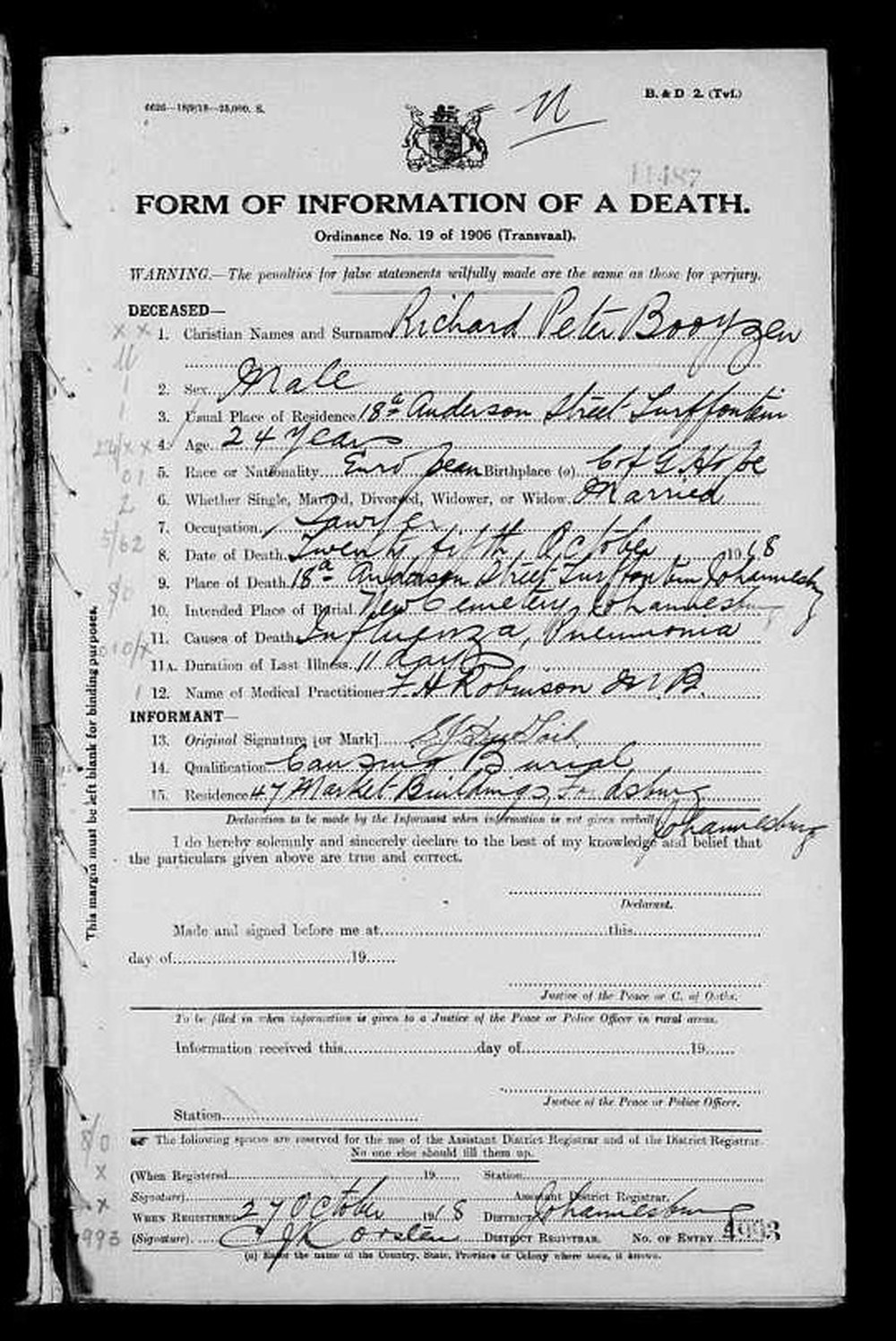
The form, as completed
| 1. Name | Richard Peter Booyzen |
| 3. Residence | 18 Anderson Street, TURFFONTEIN |
| 4. Age | 24 years |
| 5. Birthplace | C. of G. Hope · European |
| 6. Condition | MARRIED |
| 7. Occupation | Sawyer — the initial is ambiguous and could be read Lawyer; at 18 Anderson Street it will not be |
| 8. Died | 25 October 1918, at that address |
| 11. Cause | INFLUENZA & PNEUMONIA |
| 11a. Duration | eleven days |
| 10. Burial | New Cemetery, Johannesburg — he went to Brixton on the 27th |
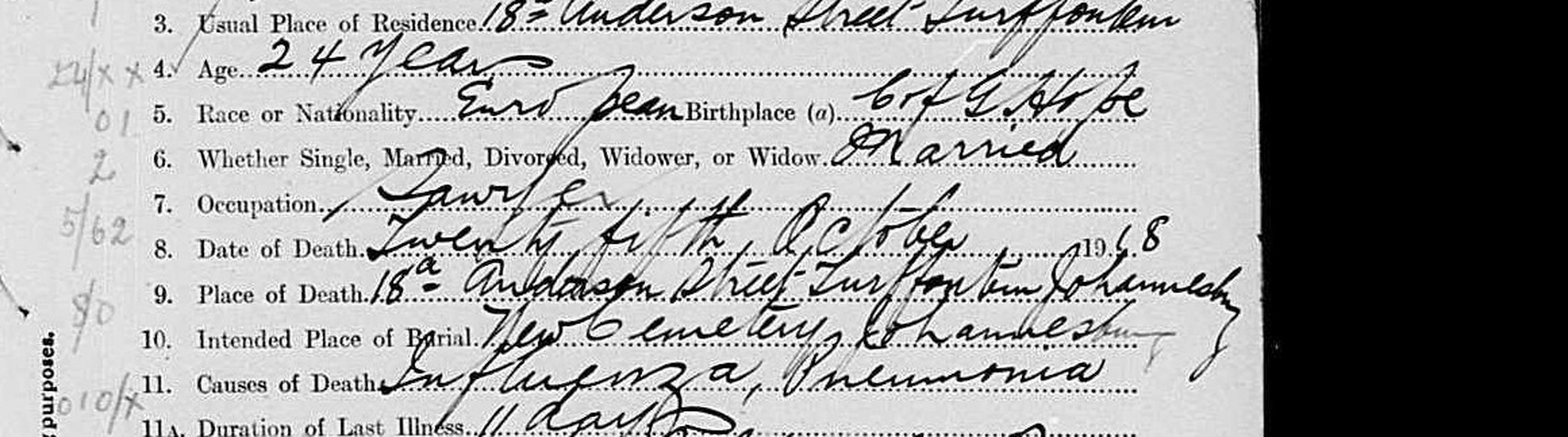
What it strengthens
Born at the Cape of Good Hope, dead at Johannesburg in 1918. That is the migration of every one of Kathleen Barry’s children — born in the north-eastern Cape, dead on the Rand. With the forename that is her own brother’s, and a birth about 1894 that falls exactly in the gap between her daughter of 1891 and her son of 1901, the inference is now a good deal firmer than it was at lunchtime. It is still not documented: this form names no parents, because a Transvaal death registration does not ask.
What it kills
This archive has an open question — why was Kathleen Barry a “Military
Pensioner” at her death in 1940? Her husband died in 1905 of a stomach ulcer, so the
pension is not his, and the page has said for months that “no son of hers is among the
First World War dead”.
A son of hers dead in October 1918 looked like the answer. Enormous numbers of South
African servicemen died in that epidemic and their dependants were pensioned.
The theory is rejected. It was a good theory — the right son, the right age, the right month — and the document says no. The open question stands, and it is now better specified: the pension belongs to a son who SERVED AND SURVIVED, which is exactly what the letter already sitting at the SANDF Documentation Centre asks about. Open question →
Three more Booyzens at Johannesburg, and why none of them is claimed
| Who | Why not |
|---|---|
| Petrus Jacobus Booyzen b. May 1882, d. May 1961, buried Johannesburg 20 May | The best of the three. A birth in May 1882 would make him Kathleen Barry’s eldest, ahead of John Barry in 1884, and Petrus Jacobus is the most-repeated name this family has. And that is the whole case — a name and a gap. There is no document. |
| Petrus Jacobus Van Blerk Booyzen b. 1872, d. 17 Mar 1949, buried West Park | Van Blerk is a mother’s surname carried as a forename, and there is no Van Blerk anywhere in this family. A different Booyzen household on the Rand. |
| Jan Gerhardus Lodewikus Booysen buried Johannesburg 17 Dec 1943 | The name is exactly right — it runs from Gerthardus Lodewikus at the top of this line down to the man who died at Vaalbank in 1885. But the 1855 child of that name would be eighty-eight in 1943, the register gives no age at all, and the name is common enough in the wider family that this archive will not guess. |
| John Zacharia Booysen d. 25 Nov 1918, buried Brixton the 26th, aged 29 | Rejected. ZACHARIA reaches nothing in this family, and his death is a civil registration, which names no parents — so nothing could ever tie him either way. He is set down because three Booysens went into Brixton in eight weeks and the shape of that is worth recording. |
South Africa, Transvaal, Civil Death, 1869–1954 · FamilySearch 1:1:7D96-H9N2, with 1:1:7DQQ-B7ZM, 1:1:WDD4-33T2 and 1:1:6J4Y-782H. Read 13 September 2026.
1915 · Estate 1291 — Margaretha Kolbe’s own notice, and a ninth Barry child
This archive looked for her estate on the films either side of 925, her husband’s, and did not find it. It is 1291, and it is indexed under Cape, KIMBERLEY, Probate Records of the Supreme Court while the probate itself was granted at Grahamstown — which is exactly how a record hides.
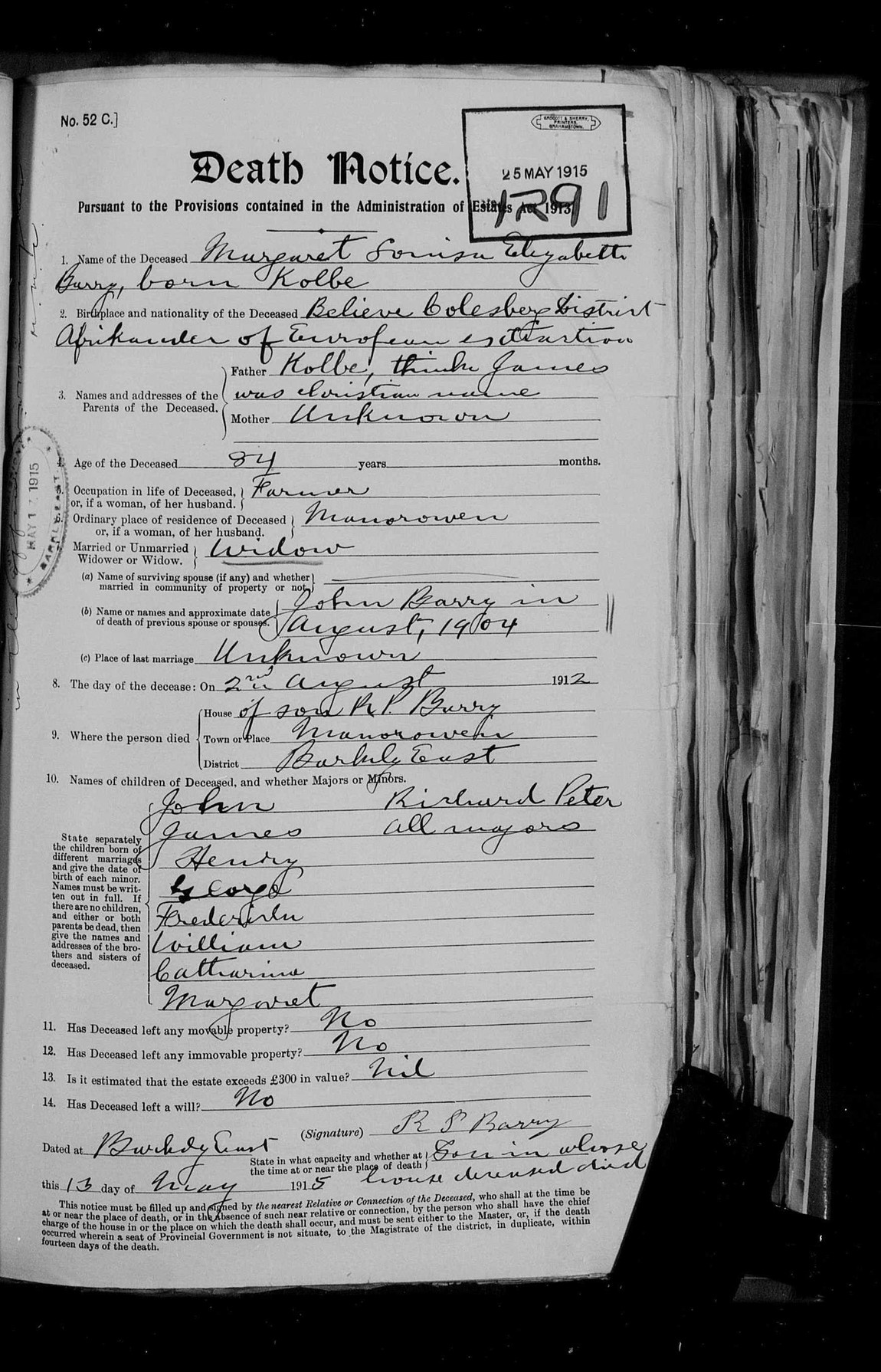
The form, as completed
| 1. Name | Margaret Louisa Elizabeth Barry, born Kolbe |
| 2. Birthplace | “Believe Colesberg District” · nationality “Afrikander of European extraction” |
| 3. Father | “Kolbe, thinks James was Christian name” |
| 3. Mother | “Unknown” |
| 4. Age | 84 years — born about 1828 |
| 5. Occupation of her husband | Farmer |
| 6. Residence | Manorowen |
| 7. Condition | Widow — of “John Barry in August 1904” |
| 7c. Place of marriage | “Unknown” |
| 8. Died | 2 August 1912 |
| 9. Where | the house of her son R. P. Barry, Manorowen, Barkly East |
| 10. Children | NINE, all majors |
| 11–14 | no movable property, no immovable, estate Nil, no will |
| Signed | R. P. Barry at Barkly East, 13 May 1915, as “Son in whose house deceased died” |
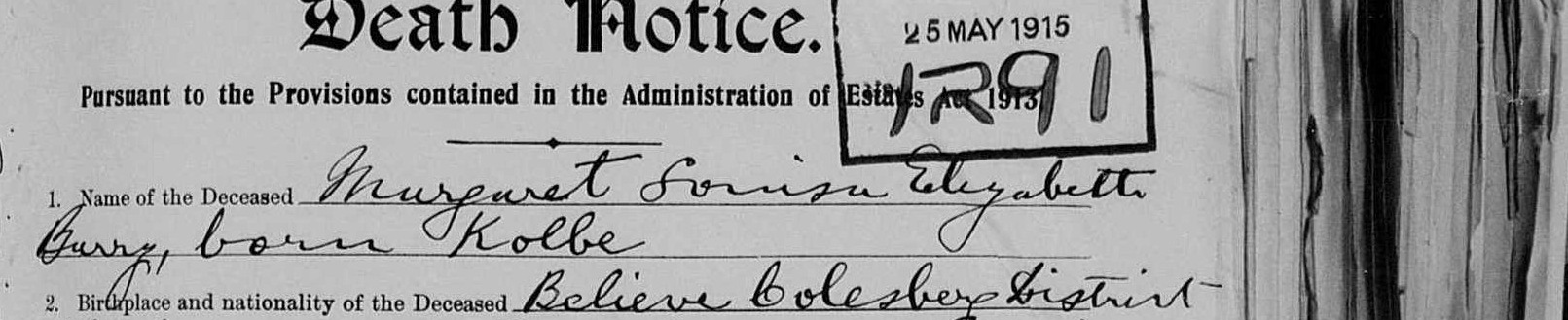
Nine children, and one of them is new
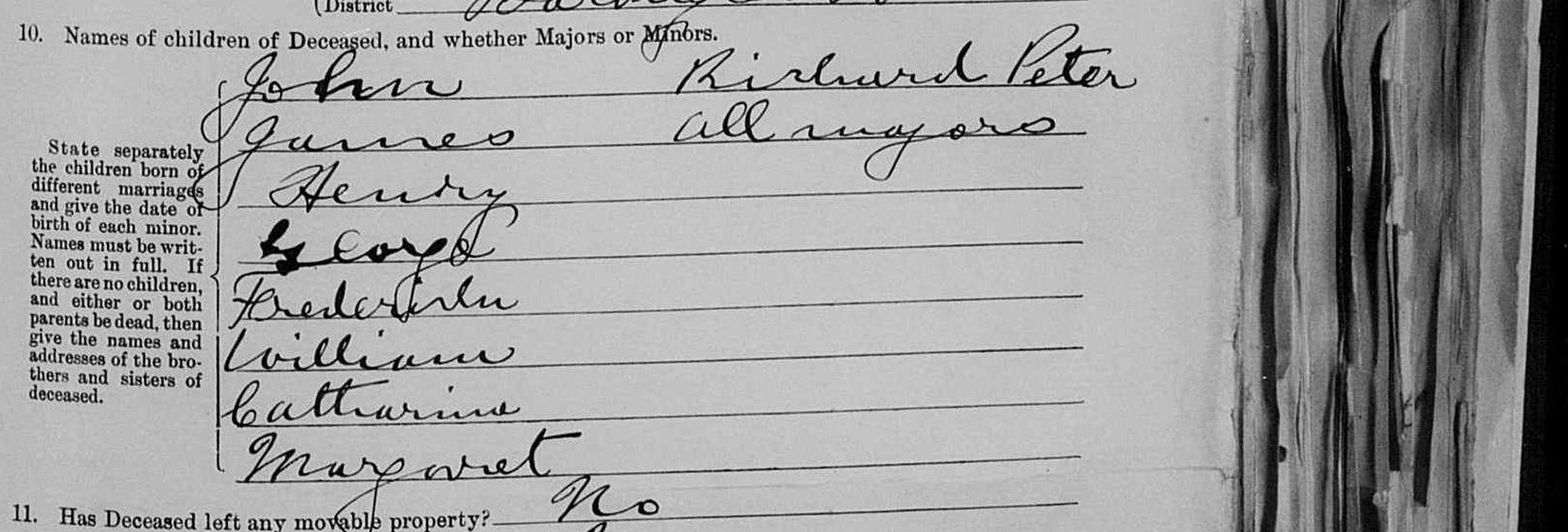
| 1915, hers | 1915, his (estate 925) | |
|---|---|---|
| John | John Augustus Barry | ✓ |
| Richard Peter | Richard Peter Barry | ✓ |
| James | James Henry Barry | ✓ |
| Henry | Henry Nicholas Barry | ✓ |
| George | George Augustus Barry | ✓ |
| Frederick | Frederick Fortunatus Barry | ✓ |
| Catharina | Kathleen Mary Boyson, born Barry | ✓ |
| Margaret | Margaret Mary Bedford, born Barry | ✓ |
| WILLIAM | — not on it — | NEW |
John Barry’s 1903 registration answers the printed question “the total number of children deceased has had” with ELEVEN. His own 1915 death notice named EIGHT, and this archive has been carrying three unnamed children since. Her notice names a ninth: WILLIAM. He is on no other document here. Two are still missing, and one of them may be Fred J. Barry or Ruben Jacobus Josuah Barry, both of whom this site already holds as open. The 1915 notice → · Open questions →
And two things the family had lost
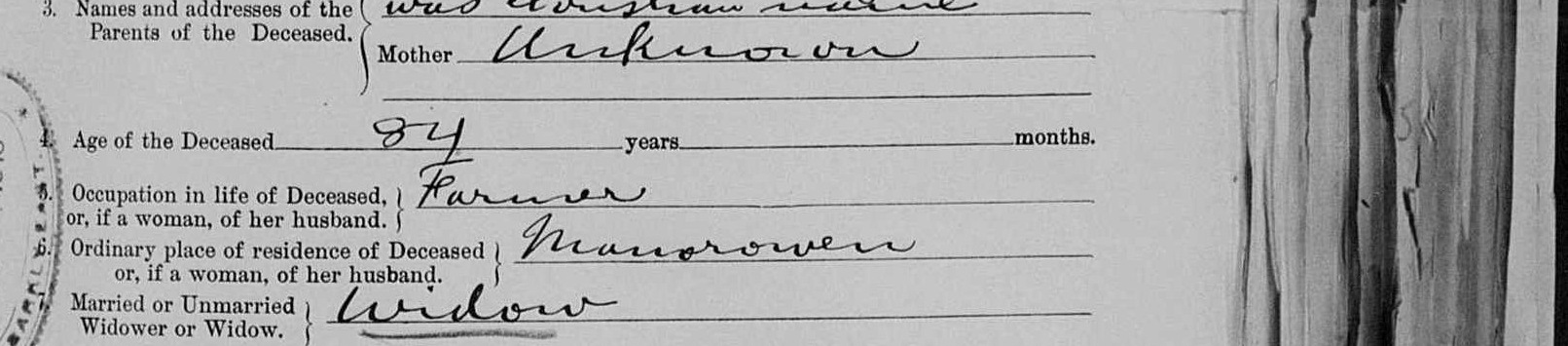
John Barry died on 25 August 1903 — his own registration says so, the one where he is called an Irishman, born in Ireland. His son, writing twelve years later, puts it in August 1904. The month is right and the year is wrong by one.
And where his parents were married, the same son writes Unknown — while on his father’s notice, three months later, he writes “Burghersdorp (probably)”. Two documents by one man in one year, and he cannot place his own parents’ wedding on either. Her father is “Kolbe, thinks James was Christian name”; her mother is “Unknown”, when the archive knows both names stand cut into a gravestone at Burgersdorp. What that is worth →

She left nothing at all. No movable property, no immovable property, estate Nil, no will. A farmer’s widow of eighty-four, dead in her son’s house at Manorowen, and the file exists only because the law required one.
South Africa, Cape, Kimberley, Probate Records of the Supreme Court, 1871–1937 · estate 1291, probate granted at Grahamstown 1915 · FamilySearch 1:1:QG2S-F1QT. Read 13 September 2026.
1847–1866 · The Barry children at the font — and William, found
Yesterday William Barry existed on one line of his mother’s death notice and nowhere else. Here is his baptism. And the page it is on does something else: it puts the two Kolbe sisters this archive had to separate side by side in one church on one afternoon.
| Child | Born | Baptised |
|---|---|---|
| John August Barry — John Augustus Barry II | 13 Mar 1847 | 12 Apr 1847 |
| George Augustus Barry | 26 Apr 1850 | 9 Jun 1850, Graaff-Reinet |
| WILLIAM FREDRIK BARRY | 23 Aug 1853 | 23 October 1853, BURGERSDORP |
| Catherina Mary Sophia Barry — “Kathleen”, the direct line | 4 Aug 1859 | 1859, Graaff-Reinet · and again 25 Dec 1859, Dordrecht |
| William Frederick Thomas Barry a second William | — | 29 Sep 1861 |
| Frederik Fortunatus Barry | 10 Nov 1863 | 10 Jul 1864, Dordrecht |
| Pieter Richard Barry probably Richard Peter | 13 Jun 1866 | 11 Oct 1866, Lady Grey |
All from the Dutch Reformed registers, under John Barry and Margaret(ha) Wilhelmina Kolbe — spelled Kolbe, Kolber, Colbe, Colby and Coetzee-adjacent nonsense across seven entries. The last two are marked inferred: the 1861 child is a second William and the archive does not know whether the first died or the clerk erred, and the 1866 entry gives the mother a surname this archive cannot read as Kolbe.
Entry 2187, and the entry above it
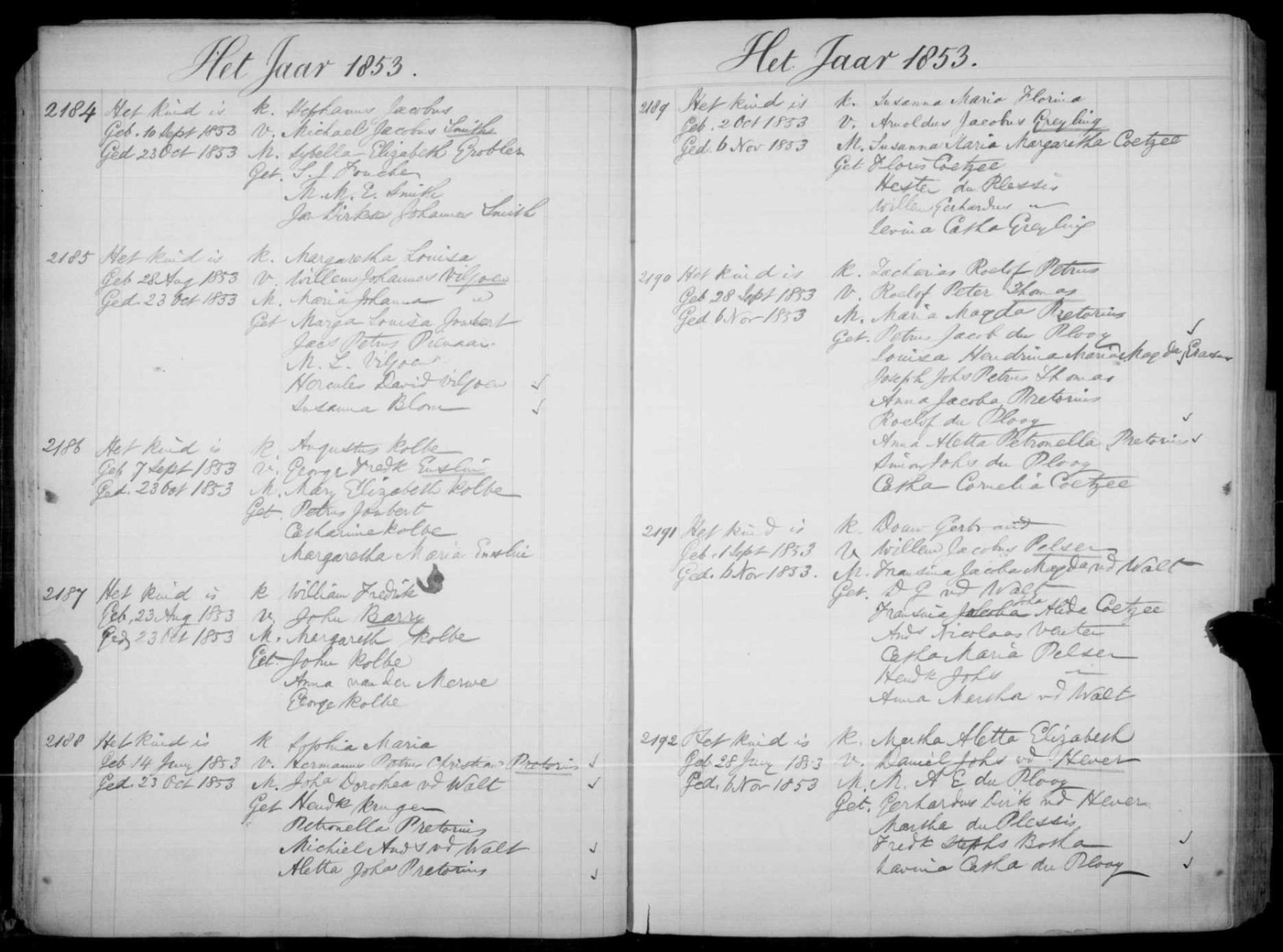
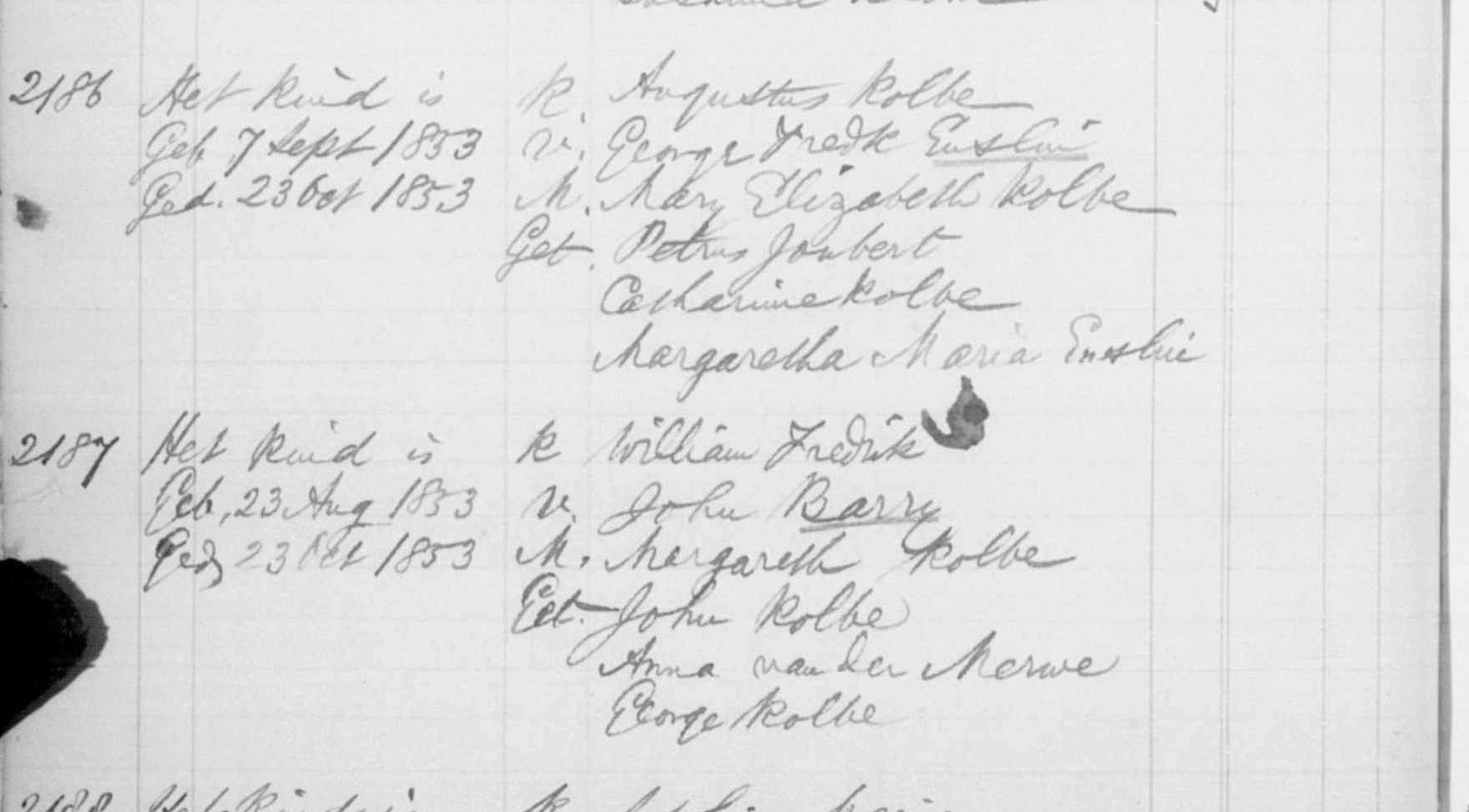
2187 — the Barry child
Het Kind is: WILLIAM FREDRIK
Geb. 23 Aug 1853 · Ged. 23 Oct 1853
V. John Barry · M. Margareth Kolbe
Get. John Kolbe · Anna van der Merwe · George Kolbe
Three godparents, and two of them are her brothers. Anna van der Merwe stands at a Barry font in 1853 — a surname this archive has been chasing on the other side of the family entirely.
2186 — two entries above
Het Kind is: AUGUSTUS KOLBE
Geb. 7 Sept 1853 · Ged. 23 Oct 1853
V. George Fredk ENSLIN · M. MARY ELIZABETH KOLBE
Get. Petrus Joubert · Catharine Kolbe · Margaretha Maria Enslin
This archive carried a contradiction marked Serious: Margaretha Kolbe appeared to marry George Frederick Enslin in 1850 while married to John Barry, and to bear Barry and Enslin children three and a half months apart in 1851. It was resolved from Margaret Downing’s 1867 death notice, which lists among her children “Mary Elizabeth (dead) who was married to George F. Enslin”. The Enslin marriage belongs to Margaretha’s sister.
Here are the two sisters, on one page, on one day, baptising a son each. Mary Elizabeth Kolbe with her Enslin, Margareth Kolbe with her Barry, two entries apart in the Burgersdorp register on 23 October 1853. The contradiction →
And it puts them at Burgersdorp. The 1915 death notice says the marriage was at “Burghersdorp (probably)” — a son guessing, sixty-five years on, at something nobody had told him. They were baptising a child in that church in 1853, and the godparents were her own brothers. The guess was right.
Three more Kolbes come out of these two entries — John Kolbe and George Kolbe, godfathers at the Barry font, and Catharine Kolbe, godmother at the Enslin one. Margaretha and Mary Elizabeth had a family around them at Burgersdorp, and this archive has been treating Margaretha as though she arrived alone.
South Africa, Dutch Reformed Church Registers (Cape Town Archives), 1660–1994 · Burgersdorp, Het Jaar 1853, entries 2186 and 2187 · FamilySearch 1:1:6FWQ-6YHH, with six sibling baptisms at 6VY5-78QK, 6VPS-NL5M, 6KNX-8WY8, 623R-9MM9, 62R5-6QHP and 653H-1PL6. Read 13 September 2026.
1852–1871 · Eight of the thirteen Mountjoy children, and the Keys question answered
This archive has known since the marriage certificate turned up that George Mountjoy and Maria Sophia Botha, married at Cradock on 20 August 1848, had thirteen children — and it could name one. The Dutch Reformed baptism registers name eight, and one of the eight settles an open question.
| Child | Born | Baptised |
|---|---|---|
| Anna Catharina Mountjoy | 5 Aug 1852 | 11 Jan 1854 |
| Maria Elizabeth Mountjoy | 12 Jun 1858 | 14 Jun 1858, Graaff-Reinet |
| Johanna Catharina Mountjoy | 28 Jan 1860 | 29 February 1860, Burgersdorp — a leap day |
| George Herkules Johannes Mountjoy | 16 Jan 1862 | 27 Apr 1862, Smithfield, Orange Free State |
| Elsje Petronella Frederika Mountjoy | 10 Jun 1864 | 17 Jul 1864, Smithfield |
| Hercules Johannes Mountjoy already held | 16 Jul 1866 | 29 Jul 1866 |
| Jacoba Regina Mountjoy | 14 Jun 1868 | 15 Aug 1868 |
| Petronella Christina Aletta Mountjoy | 10 Oct 1870 | 3 Mar 1871, Swellendam — doubted |
Seven of these sit in one country — Graaff-Reinet, Burgersdorp and Smithfield are within a hundred miles of each other on the Cape–Free State border, and the family was crossing it. Swellendam is six hundred miles west and this archive does not accept that one; the parents’ names match and the geography does not.
This one. The Keys marriage record estimates her birth at 1859; the Burgersdorp font gives 28 January 1860. She is George Mountjoy’s daughter, and the Mountjoy forenames that turn up in the Keys children are her father’s and her brother’s. The namesakes →
Their children, from the registers: Robert Byron (1878), William Henry (1882), James Jonathan (1883), George (1884), Lancelott Byron (1888), Cecil Frederik (1891), Rachel Anna Maria (1895) and Herklaas Edward Johannes (1898) — eight, baptised across Dordrecht, Barkly East and Barkly West. Byron twice, which is not a name this archive has met anywhere else.
1847–1863 · The two missing Barry children, found — and an API that lies by wrapping
Open question 13 has been on this site since it was written: the 1903 death registration says John Augustus Barry left eleven children, his own death notice names eight, his wife’s names nine, and two have never been identified. The question’s own note said the index route was closed. It was closed to a name search. It was never closed to a relationship search.
The nine baptisms, in order
| Born | Baptised | As indexed | Where |
|---|---|---|---|
| 13 Mar 1847 | 12 Apr 1847 | John August Berry | Cape Colony — known |
| 13 Jul 1848 | 13 Nov 1868 | Henry Jaonas / Hennery James | baptised at twenty — known |
| 26 Apr 1850 | 9 Jun 1850 | George Augustus Barry | Graaff-Reinet — known |
| 5 Apr 1852 | 5 Apr 1852 | Margrith Louisa Maria also Margreth Louisa Mary | BURGERSDORP — NEW. No surname of her own in the index. |
| 23 Aug 1853 | 23 Oct 1853 | William Fredrik Barry | Burgersdorp — known |
| 10 Jul 1855 | 22 Jul 1855 | Catherine Mary Sophia | Burgersdorp — found 14 September; died young |
| 4 Aug 1859 | 25 Dec 1859 | Catharina Mary Sophia Barry | Dordrecht — Kathleen, who married into the Booyzens |
| 29 Sep 1861 | 29 Sep 1861 | William Frederick Thomas Barry | GRAAFF-REINET — NEW. A SECOND William Frederick. |
| 10 Nov 1863 | 10 Jul 1864 | Frederik Fortutaums Barry | Dordrecht — Frederick Fortunatus, known |
Why neither could be found by name
Margrith Louisa Maria has no surname in the index. Two separate index passes of the same register give “Margrith Louisa Maria” and “Margreth Louisa Mary”, and the Name column stops there. It is the blank Name column again — the same failure that hid Catherine Mary Sophia of 1855 until a fortnight ago.
William Frederick Thomas is invisible for the opposite reason. He is not missing a name; he has the same one as his brother. A search for William Barry returns the 1853 child and stops, and nothing about the result says there is a second.
Both were found by asking the index for a relationship — father John Barry, mother a Kolbe — and letting it return whatever the child was called. The method →
And the count comes right
Nine baptisms in the registers, plus Hendrik Nicholaas and Richard Peter — both named on their parents’ death notices and in no register this archive can find — makes eleven, which is exactly the number the 1903 death registration gives.
Margaret Mary, named on the death notices and never placed, is almost certainly Margrith Louisa Maria: it is her mother’s name, and there is no other candidate in the sibling group. Inferred from the count and the name
And two Williams eight years apart means, by this family’s own practice, that the first William died — which is what the archive concluded about the two Catherine Mary Sophias. A baptism is not done twice. The “WILLIAM who appears on nothing else” on the wife’s death notice is one of these two, and the notice does not say which.
The citations. Margrith Louisa Maria: ark:/61903/1:1:6VYG-SS94 and 1:1:6F4L-76PK, images 3:1:3Q9M-CSVC-XPSY and 3:1:3Q9M-CSFQ-QLQN — the second of which is on film 008039088, the Burgersdorp register this archive has been sweeping by hand. William Frederick Thomas: 1:1:623R-9MM9 and 1:1:62GJ-SD8Z, images 3:1:3Q9M-CSK6-9S81-J and 3:1:3Q9M-CSVD-5VNZ. Each child is indexed twice, and neither index pass agrees with the other about the spelling.
And a trap in the tool, which is worth as much as the finding
The search API accepts q.filmNumber, and for film 008039088 it reports 22,059 records — the whole indexed film, which would have made the hand sweep unnecessary. It also accepts an offset, and pages correctly to offset 1000.
At offset 1001 it silently returns page one again. No error, no warning, no change in the reported total. The response still says "results": 22059 and still says "index": 0.
An unchecked sweep would have re-read the first thousand records twenty-two times and reported the film as holding 1,400 entries. It was caught by comparing the first name returned at offset 0 against offset 1400 — they were identical — and then bisecting to find the edge. This is the fourth undocumented boundary this archive has hit in a week, after the church films beginning in 1843, the estate inventories stopping in the 1830s, and NAAIRS defaulting to OR. It is the only one so far that answers wrongly rather than emptily.
Which is why the film sweep is not abandoned. The API will show 1,001 of 22,059 records and no more, so the remaining 214 images of the hand sweep still have to be stepped. What the API is good for is exactly what it did here: a targeted relationship query, where the answer is small enough to fit inside the first thousand.
The gravestone collection swept, and what a memoir is worth
Two of the five surnames are simply not in the Genealogical Society’s gravestone data, and this time the zero can be trusted — because three controls were run first.
| Surname | Stones | What that is worth |
|---|---|---|
| BARRY | 54 | The control. The database answers, and answers a lot. |
| KOLBE | 4 | Three of them new to this archive. |
| BOOYZEN | 3 | All three from one family cemetery. |
| MOUNTJOY | 0 | A real absence, not a broken search. |
| DASCHNER | 0 | The same. |
This is the method working as intended. A month ago this archive would have written “no Mountjoy gravestones” and moved on. The number that makes that sentence mean anything is not nought — it is fifty-four.
The three Kolbe stones
| Kolbe, GE | Concentration Camp cemetery, Volksrust, died before 1899–1902. This archive knew of a Kolbe dead in that camp; it now has the initials, and they are two of the Commandant’s three. |
| Van der Spuy, MH | Old Utrecht Cemetery, KwaZulu-Natal, d. 13 August 1946 — Margaret Harriet, born Kolbe. Her Natal estate, NAB MSCE 1639/1946, was found earlier the same afternoon. Now she has a grave as well as a file. |
| Fourie, MD | New Gelderland Cemetery, Natal, 29 September 1899 – 8 December 1979. M.D. on a Kolbe-connected stone, eighty years after Margaret Downing died at Burgersdorp. |
And the three Booyzen stones are one household. Viljoen, JCE (2 July 1807 – 11 December 1861), Viljoen, BC (8 January 1807 – 25 November 1859) and Bezuidenhout, JCE (30 October 1831 – 11 January 1904), all in the Bezuidenhout Family Cemetery at Bezuidenhout Park, Johannesburg. That is Judith Cornelia Theresia Booijsen — b3c4d5e6, baptised 16 August 1807, the woman whose three names came from her Viljoen mother — with her husband and her daughter. This archive had her stone. It did not have the other two, or know they were in the same ground. Namesakes →
Cradock in January 1822, because he counted it
This archive keeps saying it names the people documents leave out. Here is a town, complete, in one sentence — five years after James Mountjoy married in it and fifteen before the Booyzens arrived to marry there too.
At that time there were only about half a dozen inhabitants in the place. All that I can remember are Messrs. SOLOMON and S.M. DE BEER, the Rev. Mr. EVANS (D.R. Church), Mr. [P. GIE], James MOUNTJOY (a saddler, who was discharged from the 21st Light Dragoons), the two Messrs. ZIERVOGEL (one was Secretary to Government), Mr. HEILBERG, Fieldcornet B.J. VORSTER, and Gert VAN DEVENTER.
Nine names and a constable who demanded his pass in the street. Solomon is the constable — Montgomery refuses to show him the pass, walks to the Landdrost’s office four miles out at Driefontein across the Fish River, and arrives “just in time to prevent myself being brought up a prisoner”, because Solomon already had the warrant. Captain HARDING is the Landdrost, “a little cross-grained Irishman”. It is the only picture this archive has of the place its people were living in.
And what a memoir is worth — a position, since two of them cost walls
John Montgomery was recalling forty-seven years back when he wrote that, and forty-five when he placed George Augustus Kolbe at a mission school. This archive has taken two substantial claims from him. It should say what that kind of source is.
A memoir is a witness, not a record. It has no clerk, no form, no oath and no date of composition close to the event. What it has instead is circumstantial specificity — Montgomery does not say “a saddler lived there”, he says which regiment, and he slept in the man’s house and ate his breakfast.
The test this archive is using: does the memoir claim something it had no reason to invent, and does anything independent touch it?
On Koolskop, something does. A Cape Town library catalogue written from the papers themselves calls George Augustus Kolbe an LMS missionary, and this page had already deduced a mission circuit from where his children were born. Three lines of evidence, none of them aware of the others. That one is as good as an unverified claim gets.
On the 21st Dragoons, nothing does — yet. The regiment is real, it was at the Cape from 1806 to 1816, and the man married there in 1817. But he is not in any name-catalogued discharge series at Kew, and the reason may be structural or may be that Montgomery misremembered a regiment forty-seven years on. Both remain open, and the site says so rather than letting a good sentence do the work of a document.
The asymmetry is the point. One memoir claim is corroborated and one is not, and they are written up differently on this site for exactly that reason — not because one is a better story.
December 1819 · What the voyage was like, from a man on the same deck
This archive has had the Nautilus as a set of dates since the settler roll was checked: Gravesend on 3 December 1819, Table Bay on 17 March 1820, Algoa Bay on 14 April. George Augustus Kolbe was sixteen and his wife was sixteen, and the roll says twenty and nineteen. What none of it said was what the crossing was.
John Penny Mandy led another party on the same ship and wrote home to his mother in Kent. His letters survive in a descendant's copy — the originals went to the Albany Museum at Grahamstown and were destroyed in a fire in the 1920s — and a newspaper printed them in 1970.
In one letter, written in January 1820, he describes the Nautilus disaster in the Downs. After they dropped anchor in the Queen’s Channel, a day after leaving Gravesend, “it came on to blow tremendously hard, the sea running mountains high. We could not weigh anchor till Sunday afternoon, when our troubles began, the sea breaking over us in all directions, tables, chairs, boxes, plates and dishes; men, women and children all mixed together, tumbling over one another, and all dreadfully seasick, except myself and SMITH, who was on deck working the ship; I below, basin holder.”
“In the midst of this the sea broke into our cabin windows, dashing glass and frame in, the things that were below rolling and sliding, took to swimming.” … When the ship struck on the sands all was confusion and dismay — “even the sailors seemed panic struck.” After an hour and a half a heavy sea set them afloat without much damage, and five or six boats went to their help.
Then another storm, which lasted three days. “The sea was running as high as our masthead, and two of the waves broke over us; the forepart of the ship had three tons of water in, which swamped almost every person in their beds, Joseph was washed out of his cot.”
What this is, and what it is not
It is not about this family. Mandy led a different party and there is no evidence he and Kolbe ever spoke. Ships carried several parties and a hundred people apiece.
They were on the same deck in the same storm, a day out of Gravesend, and the ship went aground on the sands before it had properly started. A boy four days short of his seventeenth birthday and a girl of sixteen, both of whom had sworn on paper that they were older than they were, were somewhere in that cabin among the tables and chairs.
And it dates the voyage properly
Mandy's party reached Algoa Bay in April 1820, and he writes from there on 20 April: “I landed on Sunday night to get ready for Mary Anne and the children.” This archive has the Nautilus at Algoa Bay on 14 April. They agree.
And a child was born aboard. William Nautilus Mandy, on 1 March 1820, “in latitude 18 degrees, longitude six degrees” — a fortnight short of Table Bay, and named for the ship. He died at Lushington Valley in 1887 in his sixty-seventh year.
A note on how this was found, because it closes an item rather than opening one. The plan was to read John Montgomery's serialised memoir entire — it had already produced the Koolskop mission school and the 21st Dragoons, and it runs through The Friend across 1868, 1869 and 1870 under two titles. That turns out to be unnecessary. Both finds came out of sweeping a surname across the whole newspaper collection, and those sweeps are done: KOLBE returns 43 documents and MOUNTJOY six, across every paper in the archive. Koolskop appears exactly once in the entire collection — in the passage already read. Reading a long memoir to find what a name search has already found is work that looks like diligence. This was found instead by searching for the ship.
The Natal depot, opened — and a connection this archive nearly invented
NAB had never been searched. It had only ever been asked for six references somebody else had found. Opened properly it holds thirty-nine Kolbes, nine Mountjoys, four Booyzens and no Daschners at all — and one document that looked for ten minutes like the link this archive has been hunting for a fortnight.
The one that was not what it looked like
NAB · CSO 1860 · 1908/4469
CK BARRY, WAKKERSTROOM. MR. GS KOLBE ASKS TO BE SUPPLIED WITH A COPY OF THE ROAD BOARD LAW.
A Barry and a Kolbe in one sentence, at Wakkerstroom, in 1908. Wakkerstroom is the district whose Kolbes this archive has spent weeks trying to attach to the 1820 Settler. This archive holds three Barrys carrying Kolbe as a forename — Henry James Kolbe Barry, Richard Pieter Kolbe Barry. C.K. Barry read, for about ten minutes, like a fourth.
He is CYRIL KERSHAW BARRY, and he is an attorney. Four further documents settle it: he asks about the appointment of a Commissioner of Oaths at Wakkerstroom; he enquires whether a certificate of domicile has been issued to Mahomed Mamoojee Motala of Ladysmith; he forwards quitrent on behalf of Mr Moll; he writes about the division of ground in Natal. That is a country solicitor’s week, and G.S. Kolbe is a client. The K is Kershaw. Nearly published as a family link
It is set down at length because the mistake was a good one to almost make: two surnames from this archive, in the right district, in one line of a catalogue — and the thing joining them is a professional relationship that would have been invisible if the other four documents had not been read.
What Natal actually gave
| Reference | Entry, and what it does |
|---|---|
| NAB MSCE 8509/1923 | KOLBE, ELIZABETH JOHANNA, born DU TOIT, surviving spouse FREDERICK FORTUNATUS. This archive derived that marriage from Dutch Reformed baptism registers. Here it is in an estate index, from the other end. |
| NAB MSCE 15161/1929 | KOLBE, FREDERICK FORTUNATUS, cross-referenced to hers. Both their estates are in Natal. |
| NAB MSCE 21335/1934 | KOLBE, JOHANNA MARIA, born POTGIETER, spouse KOLBE, HENDRIK JOHANNES HOFMEYR — who is one of the two Wakkerstroom men on the unsent Pietermaritzburg letter. He now has a wife, and she has an estate of her own. |
| NAB MSCE 581/1973 | SHOOTER, MATHILDA ELIZABETH, born MOUNTJOY, BORN IN BARKLY EAST. A second Barkly East Mountjoy who died in Natal, and new. |
| NAB MSCE 4458/1973 | BOTHMA, WRAY, born MOUNTJOY, born in KOKSTAD — the bride of the 1957 marriage found in the newspaper transcriptions, now with a birthplace and a death. |
| NAB MSCE 4064/1974 | BOOYZEN, NICOLAAS THEODORUS, BORN IN WAKKERSTROOM. A Booyzen born in the Kolbe district, which is not a combination this archive has met before. |
And two court cases from before the Republic
NAB · RSC 1/5/3 · 46/1846
ILLIQUID CASE. PETRUS GERHARDUS BOOYZEN VERSUS DAVID SCHALK VAN DER MERWE.
NAB · RSC 1/5/7 · 95/1848
ILLIQUID CASE. ANDRIES EVERT GOUWS… VERSUS PETRUS GERHARDUS BOOYZEN.
1846 is the oldest Booyzen document this archive has found outside the Cape. And the defendant's name is the one this site spent yesterday proving is a van der Merwe name that entered the Booyzen line by marriage — here the two surnames are on opposite sides of a lawsuit two years before this family's own David Schalk turned forty. No connection is claimed. Petrus Gerhardus is not a name in this archive, and a Booyzen in Natal in 1846 is more likely one of the trekker families than one of ours. Recorded because it is early and because the pairing is worth somebody's attention, not because it is a lead.
And the Kolbes of Wakkerstroom kept stock. Six veterinary files, 1905–1912: F.F. Kolbe refusing a cheque for sixteen shillings for the rent of a sheep kraal; a claim for £25 for a cow lost to poisoning; G.S. Kolbe asking permission to move two bulls; scab in J. Kolbe's sheep; and permission to move one bull from Wakkerstroom to Saxony, Utrecht. It is the most ordinary material in this archive and it is the first time these people appear doing their actual work.
Three smaller returns from the same afternoon
A farm called Mountjoy
TAB SS 2932, R8960/91: the Registrar of Deeds sends title deeds for the farms “MOUNTJOY”, Smaldeel, Bloemhof, Krausberg and Gossard, 1891. And TAB PM 29, 66/6/1907: “LANDS — MOUNTJOY AND PHILLAMORE’S OCCUPATION — RUSTENBURG DISTRICT”. Rustenburg is this archive's own district. Also W. Mountjoy’s application to capture ostrich chicks, 1906.
Daschner, worked entire
Twelve in the Transvaal and none in Natal. William Herman Daschner, d. 1963, now has a wife: Mildred. A Heinrich Daschner died in 1969 and the index marks him CHILD. And a HENRY JAMES DASCHNER appears twice — which is the Barry and Booyzen forename string, arriving on a fourth surname by way of Catherine Mary Sophia.
A Kolbe on a school paper
TAB OD OR3052/99: declarations from the school at Martinus Wesselstroom — the old name for Wakkerstroom — “ondertekend door de heeren GA KOLBE en Francois L…” A George Augustus Kolbe signing for a school commission in 1899, in the district this archive cannot yet attach to the Settler.
And a sweep that was abandoned, deliberately. The plan was to put this family's farms through the education series as well as its surnames. Brakfontein returns 77 documents, Koedoesfontein 188, Goedehoop 41 — they are among the commonest farm names in the country and the results are other people's schools in other districts. One is worth keeping: OD OR150/95, “CAB MEYER, KOEDOESFONTEIN, WYK ZWARTRUGGENS, RUSTENBURG”, is unmistakably this archive's Koedoesfontein — the farm where Hendrik Stefanus Booijsen died in 1908, in the ward of Zwartruggens. It had a school in 1895 and no Booyzen is anywhere on its papers. A farm-name sweep without a surname is not a search, and the rest of it is recorded as void.
The Free State depot, swept at last — and the Settler was a missionary
VAB had been opened twice in this project's life, both times for a single reference. Swept properly it holds 146 Kolbe documents and thirteen McCabes, and among them is the catalogue entry that turns this morning's inference into a fact.
First, the thing nobody was looking for
SA Library, Cape Town · Manuscript · MSB751
GA KOLBE COLLECTION. Donated by Dr Jean Griffiths, Somerset West, 1985. Photocopy, 4 pages.
“George Augustus Kolbe, pharmacist, 1820 settler, missionary, married Margaret
Downing. + Letter, 1830 Aug. 23, from Johan Kolbe, London, to his son, George Augustus Kolbe on
his ordination.”
And on the second entry: “George Augustus Kolbe, 1802–44. LMS missionary. +
Letter from his father, JG Kolbe, London.”
It corroborates a memory this archive published as an inference
This morning John Montgomery’s reminiscence put the Settler at a Bushman mission school at Koolskop about 1824, and this archive published it hedged: a man recalling forty-five years back, naming somebody only as a Commandant’s father.
A library catalogue, written from the papers themselves, calls him an LMS missionary. Two sources that have nothing to do with each other — an old man’s memoir in a Bloemfontein newspaper and a manuscript donated to a Cape Town library in 1985 — and they agree. The inference stands up.
It also settles the occupation. The 1820 settler roll entered him as a CHEMIST; the catalogue says pharmacist; the 1844 obituary describes a medical practice. They are one man and one trade, and the missionary work is the part nobody had.
And it is the London end, in four photocopied pages
A letter from Johan Kolbe in London to his son at the Cape, dated 23 August 1830, written on his ordination. This archive has spent a fortnight failing to connect the tailor of Conduit Street to the settler of Colesberg by way of directories, census returns and a newspaper obituary.
The two men wrote to each other, and the letter survives. A letter from London in 1830 is very likely to carry an address at the head of it — which is the exact question the Brunswick Square muddle turns on, and which Google Books, HathiTrust and archive.org between them could not answer.
It is a photocopy of something. Where the original is, and whether more of it survives with Dr Griffiths’s descendants, the catalogue does not say.
Francis McCabe’s own estate, and a first wife
| Reference | Year | Entry |
|---|---|---|
| VAB MHG C129 | 1872 | MCCABE, FRANCIS. Eggenotes 1) MARIA PETRONELLA ELISABETHA ANTOINETTA RAATH en 2) ANNA (gebore VAN DER MERWE). |
| VAB 1/3/1/12 BC11 | 1872 | MCCABE, FRANCIS. INSOLVENTE BOEDEL. Remarks: BEVAT GEEN STERFKENNIS NIE — contains no death notice. |
| VAB MHG M777 | 1896 | MCCABE, ANNA JACOBA. Nooiensvan VAN DER MERWE. Eggenote JOHN GHERSON ELEASAR KOLBE EN FRANCIS MCCABE. |
| VAB MHG C30 | 1860 | MCCABE, JOHN. Eggenote Magdalena Maria Antoinette (gebore LIESCHING) — the brother the obituary says “died here in 1860”. |
| VAB MHG C63 | 1865 | MCCABE, JOSEPH — the trader and traveller who died in the interior. |
Three things. His widow’s own estate index entry names both her husbands, so the remarriage is documented in the archives and not only in a newspaper. He died insolvent — the Landdrost of Bloemfontein, buried with the State President walking behind him, left an insolvent estate. And the insolvency file says outright that it holds no death notice, which is the depot telling a researcher not to travel for it.
The Kolbe–McCabe marriage that was “perhaps a coincidence”
This archive recorded, and flagged as unresolved, that a Rosa Magdalena Kolbe was baptised at Bloemfontein in 1890 to Frederik Fortuna Kolbe and Maria Petronella Elizabeth Antoinetta McCabe — “a second Kolbe–McCabe marriage in the same small Free State world, and this archive does not yet know whether that is a coincidence.”
Francis McCabe’s first wife was Maria Petronella Elisabetha Antoinetta Raath. A woman carrying that entire four-name string, with McCabe as her surname, marrying a Kolbe in the same town, is his daughter by that first marriage, named for her mother. So the two families joined twice: he married the Commandant’s widow, and his daughter married a Kolbe. Inferred on the name, and the name is four names long His estate file would confirm it in a line.
Downing is a Kolbe forename, for four generations and three provinces
| Reference | Who |
|---|---|
| TAB MHG 40293 | KOLBE, FREDERICK FORTUNATUS DOWNING, d. 1918 — his son’s name and his wife’s surname in one man. Surviving spouse Hester Gertina Susanna born Joubert. |
| NAB MSCE 1229/1960 | That widow, remarried: MEIRING, Hester Gertina Susanna, formerly KOLBE, born Joubert, born in VOLKSRUST — which ties the Downing name to the Wakkerstroom and Volksrust Kolbes this archive found on gravestones. |
| VAB MHG 23877 | FICK, Lambertus Hendrik, spouse MARGARET DOWNING (born KOLBE), 1932. |
| VAB MHG 801/49 | The same woman’s own estate: KRUGER, MARGARET DOWNING, nooiensvan KOLBE, voorheen FICK — twice widowed, d. 1949. |
| VAB MHG 33459 | DU PLESSIS, MARGARET DOWNING, born KOLBE, 1941 — a second woman of the same three names. |
| TAB MHG 5450/68 | ROUSSEAU, surviving spouse MARIA MARGARETHA DOWNING ROUSSEAU, 1968. |
| VAB, civil | PIETER DOWING KOLBE LUBBE, twice in 1959 — by then the surname is Lubbe and Kolbe has become a forename beside Downing. |
Margaret Downing signed her marriage allegation with a mark in 1819, aged fifteen, swearing she was twenty-one. A hundred and thirty years later women in three provinces were being christened with the whole of her name. Namesakes →
And six of them in one court application
VAB · HG 4/2/1/1/456 · 702/1931
APPLICATION: LEONORA STEENKAMP, BORN KOLBE · MARGARET DOWNING FICK, BORN
KOLBE · GEORGINA AUGUSTA DE WET, BORN KOLBE · JACOBUS WYNAND LOUW
KOLBE · GEORGE AUGUSTUS KOLBE · CATHARINA ELIZABETH MALAN, BORN
KOLBE.
Six people of one surname applying to a court together is a sibling group. Four married daughters, two sons, and among the six forenames are Margaret Downing, George Augustus and Georgina Augusta. It is a generation too late to be the Commandant’s twelve — these are more likely his grandchildren — but it is the first Free State Kolbe sibling group this archive has been able to name at all, and the file will say what they were applying about, which is usually a parent’s estate. On the errands list →
1780–1810 · Anna Catharina Slier gets parents, and this archive had two men under one name
Volume 3 of the Cape genealogies was opened to look up the six Slier entries the index reported. One of them is a whole family, and it answers a woman who has been on this site as a birth year and five spellings. It also shows that what this archive has been calling her first husband is two people.
876.—SLIER.
Willem Slier, van Hamburg, gehuwd 19 November 1780 met Anna Catharina Fortman.
(b) 1 Anna Catharina, gedoopt 14 October 1787, gehuwd met Hermanus Pieterse
2 Wilhelmina Christina, gedoopt 27 December 1789, gehuwd 5 Januari 1811 met Jan Abraham van Wijk, van Amsterdam
3 Geertruida Johanna, gedoopt 2 Juli 1791
4 Wilhelmus Josephus, gedoopt 5 Maart 1797
This archive has carried her as “Anna Catharina Sleer — Slier · Schleher · Sher · Hier, five renderings, five sources”, born 1787, died 1885 aged ninety-eight, first the widow of a Pietersen and then the wife of James Montjoy. Every one of those facts holds and three more arrive. She was baptised on 14 October 1787. Her father was Willem Slier of Hamburg and her mother Anna Catharina Fortman. And she had three siblings, one of whom married an Amsterdammer.
The five spellings stop being a mystery. A Hamburg name — Schlier, Schleer — written down by Cape clerks who had never seen it, which is exactly how Slier, Schleher, Sher and Hier all come out of one family in one generation. This archive has a whole page arguing that a spelling is whatever the clerk had, and here is the argument again, on a different surname, from a different country. The Name →
And then the Pietersens, two pages later
Hermanus Pietersen, namen van ouders
onbekend, gehuwd 5 April 1807 met Anna Catharina Slier.
(b) 1 Willem Hermanus, gedoopt 12 Maart 1809
2 Johan Christiaan, gedoopt 28 April 1810
This archive has been running a father and a son together. The entry here reads “Willem Hermanus Pieterzen — Anna Catharina Slier’s first husband”, built out of two documents that spell him differently: the 1817 marriage register, which calls him Harmanus Pieterze, and the 1840 death notice, which calls him William Pietersen. Two spellings looked like one man with a long name. They are two men. The husband is Hermanus, married on 5 April 1807. Willem Hermanus is his son, baptised 12 March 1809 — and this archive already half knew it, because its own note says the 1851 godfather who carries both forms in full was his son.
A person nobody had
Johan Christiaan Pietersen, baptised 28 April 1810 — a second son, and a second half-brother to the Montjoy children. He is on nothing else this archive holds.
And the marriage is dated. She married Hermanus Pietersen on 5 April 1807, at nineteen; was a widow by 9 March 1817, when she married James Montjoy; was a widow again by September 1827; and lived until 1885. Fifty-eight years a widow.
Where “Willem Hermanus” comes from, at last
This site has said for weeks that the name Willem Hermanus — carried by two Booyzens in the direct line — entered through a step-relation with no blood tie. That was right, and it can now be traced one generation further back.
The boy baptised in 1809 is Willem, for his mother’s father Willem Slier of Hamburg, and Hermanus, for his own father. The whole name is accounted for, and half of it is German. Namesakes →
One more, and it is a negative worth the space. The Dormehls are in volume 2 at entry 393 — Siebert Dormehl, van Marburg, married 29 January 1792 to Johanna Israel, widow of Johan Godlieb Carstedt, and twice more after that. His sixth child is Charlotta Elisabeth, baptised 18 June 1802. This archive holds a Charlotta Elizabetha Dormehl who married Hendrik Stefanus Booijzen at Zeerust in 1892. A woman baptised in 1802 cannot be marrying in 1892, so these are two women ninety years apart, and the only thing the book gives is that the name Charlotta Elisabeth was already in the founding Dormehl household. Not a link, and recorded so that it does not become one later.
January 1822 · A man who lodged in James Mountjoy’s house says where he came from
Question 12 on this site has been marked Blocking since it was written: who were James Montjoy’s parents? His own death notice answers not known. His marriage register leaves the column ruled through and empty. And the question’s own note concluded that “the way in is a Cape arrival record, not an English birth record”. It is, and one has just been found in a newspaper.
The Friend of the Free State and
Bloemfontein Gazette · Thursday, 25 November 1869
“How I arrived in Cradock in January 1822, and narrowly escaped incarceration…”
By Mr. John MONTGOMERY, Founder of Burghersdorp, Cape Colony
I arrived in Cradock, tired and jaded, on a knocked-up horse, on a very cold, stormy afternoon in January 1822. At that time there were only about half a dozen inhabitants in the place. All that I can remember are Messrs. SOLOMON and S.M. DE BEER, the Rev. Mr. EVANS (D.R. Church), Mr. [P. GIE], James MOUNTJOY (a saddler, who was discharged from the 21st Light Dragoons), the two Messrs. ZIERVOGEL (one was Secretary to Government), Mr. HEILBERG, Fieldcornet B.J. VORSTER, and Gert VAN DEVENTER. After some trouble I obtained lodgings for the night from Mr. MOUNTJOY.
He goes on to be challenged for his pass in the street outside the house by Solomon the constable, to be asked to breakfast by Mountjoy, to be told by him that the Landdrost’s office was four miles out at Driefontein across the Fish River, and to walk there and arrive “just in time to prevent myself being brought up a prisoner”.
Is it our man
This archive holds James Montjoy, saddler, born in “Europe” about 1782, who married Anna Catharina Slier at Graaff-Reinet on 9 March 1817 and died at Cradock in September 1827. Montgomery names a James Mountjoy, a saddler, at Cradock in January 1822 — inside that window, in that town, in a place with six inhabitants.
There is no room in a village of six for two saddlers of one name. It is him.
And what it gives
A regiment. The 21st Light Dragoons were the cavalry of the Cape garrison — they came out with the 1806 expedition and were not disbanded until the end of the 1810s. A man discharged from them at the Cape is a man who arrived in uniform, which is why no Cape document can say where he was from: he did not come as a settler and no ship’s list records him as a passenger.
It also dates him. Discharge would put him a civilian in the colony by about 1817 — the year he married.
The document that answers the question is now named. British Army discharge papers for the period are WO 97 at The National Archives, Kew — Royal Hospital Chelsea soldiers’ documents, arranged by regiment before 1855 — and they give the man’s parish and county of birth, his age on enlistment, his trade and his service. The muster books and pay lists are WO 12. Neither is digitised for this regiment. Question 12 stops being unanswerable and becomes an errand at Kew, which is a different kind of problem and a much better one. Errands →
The same man, twice in one week. John Montgomery’s serialised reminiscences in The Friend have now broken two walls on this site that had nothing to do with each other. His “Forty-five years ago” piece put George Augustus Kolbe at a Bushman mission school at Koolskop, on the ground where Colesberg was later laid out. This one puts James Mountjoy in the 21st Light Dragoons. Neither was found by searching for a Kolbe or a Mountjoy. They were found by reading a surname sweep to the bottom instead of skimming it, and both were sitting in the memoir of one old man in Burgersdorp who happened to write down who he met. The Koolskop passage →
Two others from the same sweep, neither of them this family
1859 · An intestate estate at Middelveld
The Friend: “In den intestaten boedel van wyle Jan Lodewyk BOOIJSEN, van het Middelveld, District Bloemfontein” — who married about 1819 Christina Magdalena de Buijs, widow of Cornelius Faber of the Cape Colony, and whose estate had become mixed with Faber’s. A Jan Lowies Booijsen also has a Cape inventory of 1831, at Onder Roggeveld. Not connected here, and recorded because the forename pair Jan Lodewyk / Jan Lowies keeps appearing beside this family without joining it.
1862 · A trek-farmer near the Orange River
The Eastern Province Herald reports a Booyzen, a trek-farmer digging for water at Deep Fountain between the Hartebeest River and Hope Town, who recognised and seized a party of Bushmen accused of shooting a farmer — “six men, seven women and seven children”. The dispute behind it was water: ground the Bushmen had used “from time immemorial” and which the Government had let to the dead man for £70 a year. Nothing connects this Booyzen to this family. It is set down because the paper recorded the numbers and this archive is not going to be the place that drops them.
Three questions put to the same search engine, and what each one cost
The Baptism Finder, the Land & Deeds finder and the marriage transcriptions, asked in that order. One returned a hard negative that closes a route, one returned four exact dates for nothing, and one turned out not to be an index at all.
1. The 1788 baptism is not on this route, and now this archive knows why
The decisive errand on this site is the Dutch Reformed baptism entry of 21 September 1788, which would name Petrus Jacobus Booijsen's father in a contemporary hand and end the oldest question here. The Baptism Finder lists, town by town, which registers the FamilySearch project holds. The three candidate congregations were asked:
| Congregation | Registers | Earliest held |
|---|---|---|
| Paarl (Drakenstein) — where b3c4 Jan was a burgher | 54 | 1843–1844 |
| Graaff-Reinet | 48 | 1843–1844 |
| Stellenbosch | 55 | 1843–1844 |
Every register in the collection begins in 1843, in every town, sorted earliest first. This is the post-1842 Nederduitse Gereformeerde Kerk archive series, and it does not reach the eighteenth century at all. The 1788 baptism cannot be got from this collection, and neither can anything else this archive wants from before 1843 — which is a fact about the filming project and not about the registers, because the originals exist. It also explains, retrospectively, why weeks of FamilySearch work on this family has produced nothing older than the 1840s. The errand stands, and it is a Cape Town errand, not a screen one.
2. Four Mountjoy children, with the day of birth, for nothing
The Baptism Database — a different thing from the Finder — holds six Mountjoys, four of them nineteenth-century, and the free layer of each record gives an exact date of birth:
| Name | Born | Baptised |
|---|---|---|
| Maria Elizabeth Mountjoy | 12 June 1858 | — |
| Johanna Catharina Mountjoy | 28 January 1860 | — |
| Georg Herkules Johannes Mountjoy | 16 January 1862 | 27 April 1862 |
| Elsje Petronella Frederika Mountjoy | 10 June 1864 | 17 July 1864 |
Four children at roughly two-year intervals is a sibling group, and the names are the interesting part: Georg Herkules Johannes and Elsje Petronella Frederika are thoroughly Cape Dutch name-strings sitting on an English surname, baptised in the Dutch Reformed Church. This archive already holds a Hercules Johannes Mountjoy, born 16 July 1866 — the same forenames and the same day of the month, four years later.
And one of them may be the woman who died at Indwe
This archive holds “Johanna Catharina Mountjoy of Indwe” with no birth date at all — she joined the Dutch Reformed congregation at Indwe on 23 July 1907, arriving from Barkly Oost six weeks after Willem Hermanus Booijzen was confirmed in the same church, and the register's last column records her dead there in June 1911. A Johanna Catharina Mountjoy born 28 January 1860 would be fifty-one in June 1911.
It is a candidate and it is not being entered. This family already contains one Johanna Catharina Mountjoy, born 1819 and dead in 1863, so the name repeats within it. What would decide it is the congregation the 1860 baptism was registered in — if it is Barkly East or anywhere in that district, the two women are almost certainly one. And the congregation is the field the site charges for.
3. Where exactly the paywall falls
Worth setting down precisely, because it decides whether a subscription is worth buying for this project. On a baptism record the free layer gives:
Free
Names
Surname
Date of birth
Baptism date
“Sign in to view”
Baptism place
Source
Image
Entry
Father's names and surname
Mother's names and surname
Parents
The free layer gives dates; the paid layer gives parentage and the citation. For a project that already has most of its dates and is short of parents, that is the wrong half — which is exactly why it is worth knowing before paying rather than after. Nothing has been bought and no account has been made.
4. Land & Deeds turned out not to be an index
It was opened to look for Vaalbank and Kwaggafontein. It does not take a farm name or a surname: it takes a year and an area, and the areas are Natal and the Transvaal only — no Cape, no Free State, so Leeuwberg and Kaalspruit are out of reach by this road anyway.
What it returns for 1898, Transvaal is fifty-seven registers — Farm Records, volumes RAK 89, RAK 243, RAK 274, RAK 275, RAK 279, RAK 281, RAK 387 and more — each with a link to view the film online. It is a film finder, not a name index. To find Vaalbank in it somebody has to open a volume and read. That is a real errand and it is now a specified one, which it was not this morning.
And the marriages, since they were free
MOUNTJOY: twenty-two, 1895 to 1969. Two are worth naming. 1937 — WILLEM HERMANUS MOUNTJOY × ELSIE SUSANNA DU PLESSIS: Willem Hermanus is this archive's own name-string, carried by two Booyzens in the direct line, here on a Mountjoy. And 1919 — FRANK MOUNTJOY-BENTLEY × KATHLEEN RITA MILEY FITZPATRICK — a second hyphenated compound in this archive's own surnames, after Kolbe-Booysen.
DASCHNER: three. 1900 — CARL AXEL MARTENSON × MINNIE DASCHNER; 1935 — JOSEPH CHARLES DASCHNER × ELIZABETH HENDRINA MURRAY; and 1935 — GERT ANDRIES VAN JAARSVELD × MARGARET WILHELMINA ELIZABETH JEANETTE DASCHNER. The whole surname holds forty-five records in the entire aggregate, which is the smallest of this archive's five families by a long way.
None of the above is entered as fact. Every line is an index entry from a commercial aggregator, and the archive's rule has not changed for being given a better search box: a transcription is a lead, and the register is the record.
1781 · The people this family owned, and the fact that this archive had never looked
The MOOC8 finder searches the inventories taken of Cape estates at death. Thirteen of them name a Booijsen. The oldest belongs to Gerrit Booijsen — the man at the top of this archive's Cape line — and like every inventory of its kind it lists the enslaved people of the household by name, because under Cape law they were property and property is what an inventory is for.
This project has been running for weeks. It reaches back to a marriage of 1733. It has a page about who this family named their children after and a page about what its documents fail to record. Until this afternoon the word slavery appeared nowhere on it, and that was not a judgement about the family — it was an artefact of which records had been read. Estate inventories had never been opened.
MOOC 8/18.11 · 13 December 1781
Gerrit Booijsen — St Martijn, Eselscloof, Drakenstein
The eleven people named in it
The Cape formula gives a name and where the person was taken from. It is set out here in full, because a list of eleven names is the only thing that survives of eleven people and shortening it would be the second theft.
| Name | As written |
|---|---|
| Silvia | Silvia van de Caab |
| Lena | Lena van de Caab |
| Sara | Sara van de Caab |
| Janna | Janna van de Caab |
| Dorinda | Dorinda van de Caab |
| Fortuijn | Fortuijn van de Caab |
| Meij | Meij van de Caab |
| Februarij | Februarij van de Caab |
| Dijk | Dijk van Madagascar |
| Farla | Farla van Madagascar |
| Achilles | Achilles van Mallabaar |
Eight born at the Cape, two taken from Madagascar, one from the Malabar coast. The names are the ones given to them, not the ones they were born with: Fortuijn is Fortune, Februarij and Meij are the months they were bought or landed in, Achilles is the classical joke a slave-owner made. That is the whole vocabulary of the practice, in one column.
Is this the right Gerrit
De Villiers has b3 Gerrit Booijsen, married Johanna du Rand in 1733, father of c4 Jan, who was a burgher at Drakenstein — and this inventory is at Drakenstein. A man who married in 1733 and died in 1781 is seventy-odd, which is ordinary. The other Gerrit in the printed genealogy, b3c4d1, was not baptised until 1771 and cannot have an inventory in 1781.
So it is almost certainly him, and it is published as almost certainly. What would settle it is the inventory itself, which names the heirs — and if the heirs include a Jan, this archive's direct line runs straight through this document. It has gone on the errands page for Cape Town. The identification is the uncertain part. The eleven names are not.
The other twelve
| Reference | Date | Estate |
|---|---|---|
| MOOC 8/18.10 | 26 Jun 1781 | Gijsbert Verweij, Tijger-bergen — and de Villiers records a Booijsen daughter, Hermina, baptised 1789, married to a Gijsbert Verweij. Names Alexander van de Caab, April van Macasser, Slammat van Mandaar, Dam van Balij, Candasa van Mallabaar. |
| MOOC 8/49.6 | 15 Mar 1781 | Jacobus Petrus Kriel |
| MOOC 8/20.6 | 9 Mar 1790 | Tafelvalleij, Block 12 — an inventory naming more than twenty people from Ceylon, Bugis, Bengal, Malabar, Timor and the Cape |
| MOOC 8/51.8b | 1 Nov 1792 | Hendrik du Plessies, Slangerivier |
| MOOC 8/51.8a | 25 Oct 1793 | Hendrik du Plessies |
| MOOC 8/53.32a | 17 Jan 1800 | Alletta Catarina Karsten |
| MOOC 8/53.32b | 8 Aug 1799 | — no name carried in the index |
| MOOC 8/55.38a / b | 18 May 1804 | — no name carried in the index |
| MOOC 8/56.16b | 30 Mar 1805 | Zacharias Booijsen, Graaff Reinet |
| MOOC 8/56.16a | 12 Apr 1806 | Zacharias Booijsen, Graaffe Reinet |
| MOOC 8/42.46 | 18 Feb 1820 | Aletta Booyzen, Graaff Reinet |
| MOOC 8/46.59 | 5 Oct 1831 | Jan Lowies Booijsen, Vondelings Fontein, Onder Roggeveld, Clanwilliam — naming Castoor, Jan, Piet, Eva, Malatie, Eva, Marie, Catryn, Clara, Roset |
| MOOC 8/48.32 | 6 Dec 1832 | Piet Booijsens |
A caution about the last one. The index line for MOOC 8/46.59 runs personal names and farm names together in one string, so Knue and Onder Roggeveld sit in the same list as Eva and Castoor. The ten names above are the ones that are unambiguously people. The document has to be read before anyone is counted. 1831 is three years before emancipation at the Cape.
Two things this archive owes
It did not find these people. It found them by accident.
The MOOC8 finder was opened this afternoon to look for Mountjoy inventories, because the Mountjoy wills are on the Cape Town errands list. Mountjoy returns zero. Booijsen returns thirteen. Nobody here went looking for the eleven names; they were on the way to something else, and that is worth admitting rather than dressing up.
And the zeros are not yet negatives
MOUNTJOY 0 · MONTJOY 0 · SLIER 0 · KOLBE 0. Every one of those families arrived at the Cape in the nineteenth century, and MOOC8 as indexed here runs from the 1780s to the 1830s. A zero from an index that stops before your people arrive is not a finding. This archive published exactly that mistake this morning about LUUS and is not going to publish it again four hours later. Recorded as untested.
Where the full text is, and why it is not here. The MOOC8 inventories were transcribed in full by the TANAP project, and its database is off the air — databases.tanap.net does not resolve, and the Internet Archive was itself down when this was written. So what is above is read off index entries, not off the documents. The documents are at the Western Cape Archives, 72 Roeland Street, and are already on the errands page. Eleven people are named here on the strength of a catalogue line, and the line is not the record. What is wanted from Roeland Street is the inventory of MOOC 8/18.11 entire: the heirs, and every name and valuation on the list.
A search engine this project had never opened, and a negative it took back in ten minutes
The user asked whether gendatabase.com had been tried. It had not. The word appears nowhere in this repository. It aggregates ten South African datasets in one query, four of which this archive has never touched at all — and inside the first half hour it produced a marriage this archive had published as not existing.
The withdrawal first
On 14 September this archive published, about the twelve household names on the Silverton pillar:
“LUUS with BOOYZEN returns NOTHING.” … Five of the twelve Silverton children remain unplaced and this archive would rather say so than fill them in.
The Marriage Transcription Database on gendatabase:
1928 · CORNELIUS ABRAHAM LUUS × SUSANNA FREDERIK ALETTHA BOOYZEN
The negative was true of NAAIRS, which is the only index this archive had asked. It was published as though it were true of the record. A marriage register is not an estate index, and a sentence that says “returns nothing” has to name what was asked. Withdrawn. Whether this Susanna is the “Ousie” of the pillar is a separate question and is not being assumed — but she is a Booyzen who married a Luus, which is the thing this archive said did not exist. Corrections →
What the site actually is
One search box over ten datasets, with facet counts returned before you pay for anything. For BOOYZEN it gives 569 records:
| Database | BOOYZEN | What this archive had been using instead |
|---|---|---|
| Verified Death Database | 190 | Nothing. Post-war deaths, verified. |
| National Archives | 152 | NAAIRS itself — already swept, and this is a far better search over it. |
| Estate File Database | 122 | The estate indexes, reached the hard way. |
| Marriage Transcription Database | 54 | Nothing at all. This is the gap. Fifty-four marriages with both spouses' full names and a year. |
| Baptism Database | 22 | Nothing at all. 1812–1835. |
| FamilySearch | 22 | Tree data. Not evidence, and treated as such below. |
| Concentration Camps | 3 | Reached once, through NAAIRS, by accident. |
| 1925–1931 Voter Database | 2 | Nothing at all. |
| Civil Death / Unconfirmed Death | 2 | — |
It also carries specialist finders this archive has not yet used: Cape Estates, Transvaal Estates, MOOC8 Inventories, Land & Deeds, Old Voter Rolls, Boer War Soldiers, Legal Gazettes, and a Baptism Finder that lists which Dutch Reformed registers survive for each of 181 towns.
Four things it confirmed in the first pass
1921 · David Kolbe Booyzen × Maria Jacoba Smit
This morning this archive published the Kolbe-Booysen household of Port Elizabeth off two Eastern Province Herald notices, and noted that the 1921 marriage behind it came from a family tree with no document. It is in the marriage transcriptions. Same names, same year.
1933 · Michael Johannes Vermeulen × Beatrix Magdalena Catharina Booyzen
That is Betie of the Silverton pillar, found last week only through a 1951 estate index that named her as a surviving spouse. Here is the year she married him, from the other end of the marriage, and she is his second wife.
1850 · Hendrik Stephanus Booijzen × Anna Johanna Olivier
The marriage that puts this family north of the Vaal in 1850, already on this site — now in an independent transcription. It gives her as Anna Johanna where this archive has Anna Catharina Johanna. A variant, recorded, not resolved.
Three Booyzens in the camps, and two on a voters' roll
Gert Jacobus, Gertruida Magdalena and Jan Gerhardus Lodewicus Booyzen in the University of Cape Town's Born in the Camps database — this archive had reached one of them, once, through NAAIRS. And on the 1925–31 voters' roll: Jacobus Nicolas Booyzen and John Barry Booyzen, both of whom are on the list of six estate files now with a researcher in Pretoria. A voters' roll gives an address.
And what it is not
A search for KOLBE returns 2,308 records, and of those, thirty-one are people born between 1843 and 1869 — which is exactly the window of the Commandant's twelve children, between his marriage on 3 April 1843 and his death on 3 April 1868. It looks for a moment like the answer to the oldest question on the Kolbe side of this family.
Every one of the thirty-one comes from the FamilySearch slice, which is tree data. Not a register, not an estate, not a death notice — other people's trees, indexed. This archive does not take a child from a tree, and thirty-one plausible ones do not become evidence by being plausible together. They are worth exactly what they cost, which is a list of names to test against documents, and they are not being entered.
Two of them are worth naming anyway, because they are testable. GERSOM ELIEZÄR KOLBE, born 1868, died 1902 carries the Commandant's own forenames and was born in the year he died — and the obituary says the youngest child was an infant. And the National Archives rows, which are documents, show the name running on: a John Gerson Eliezer Kolbe sued by E. Wille and Sons, by John William Pearce and by the Nelspruit Roller Mills, divorced by Hester Johanna Catherina born Hammon, and tried with one Adam Barnard in a criminal case. Four generations of the same three names, and this archive has documents for the first and the last of them and none in between.
Terms. It is a commercial service: the result lists are free, the documents behind them are not. Nothing here was bought, no account was made, and everything quoted above came off the public result pages. What it is worth to this project is not the documents — it is that four of its ten datasets are sources this archive did not know it had not searched.
Question 0, answered by two people who own the book this archive does not
The oldest open question on this site is one line of one form. The 1876 Rustenburg Sterfkennis of Petrus Jacobus Booijsen names his father Gerthardus Lödewikus Booijsen, and the printed Cape genealogy of 1893 names him Jan. One of them is wrong, and this archive could not say which without a book it has never seen.
The escape route was always the same: de Villiers’s 1893 original was revised by Pama in 1981, and a revision can move a man. If the 1981 edition had quietly relocated Petrus Jacobus, the death notice would stand and the 1893 entry would be a superseded reading. That was the question put to the WikiTree forum, and it came back in nine words.
Riël Smit · 14 September 2026
“Yes, de Villiers & Pama (1981) still place Petrus Jacobus (b3c4d7) b. 21 Sept 1788
under JAN b3c4.”
And in the same thread, from Pieter van Zyl, who had gone and looked at the notice:
I have seen Death Notices or “Sterfkennis” where mistakes were often made with especially the parents. (I also had a look at the specific one that you mentioned.) The informant that gives the information to the person who writes the Notice is usually a child or even a grandchild. His real dad, Jan, was already dead for more than 40 years when Petrus Jacobus died. Quite possibly, the informant “thought” the dad’s name was G L. Normally the parents are not so important for the executor of the probate, especially if they were deceased. I searched for a marriage between a Gerhardus Lodewicus and Magdalena de Beer but could not find one. If I remember there was a child of Petrus called Gerhardus Lodewicus on his Sterfkennis.
Riël Smit, concurring, added his own case: “I have seen a mother on a death notice to be actually the wife — the son filling out the form confused his mother with his dad’s mother.”
He remembered right, and the proof is nine lines lower on the same sheet
Line 3 of Notice 678 gives the parents as Gerthardus Lödewikus Booijsen and Magdalena de Beer. Line 12 of the same sheet lists eight children, all of age, and the fifth of them is:
JAN GERTHARDUS LODEWIKUS BOOIJSEN
The name written in the parents’ box is the back half of a son’s name, on the same page, in one clerk’s hand. And the half that was dropped is Jan — which is the name the printed genealogy gives for the father, in both its editions. A grandson named for his grandfather is the ordinary thing in this family; this archive has spent a whole page demonstrating it. The old man’s father and the old man’s fifth son had the same first name, and an informant reaching for one of them arrived carrying too much of the other.
Who was doing the remembering. The form is countersigned by H. S. Booijsen — Hendrik Stefanus, the seventh child, whose own name is four lines above his signature. He was born about 1828. His grandfather Jan had married in 1770, remarried in 1793, and was dead before he was ten. He was writing the name of a man he had almost certainly never met, about a father who was eighty-eight.
What this archive now holds, and what it still will not do
Four things now point one way
1. de Villiers 1893 puts Petrus Jacobus (bapt. 21 Sept 1788) under Jan, b3c4.
2. de Villiers & Pama 1981 still does — the revision did not move him.
3. No marriage of a Gerhardus Lodewicus to a Magdalena de Beer can be found, and a
Cape genealogist went looking.
4. The disputed name is on the same document, nine lines lower, as a son.
And the mother on line 3 — Magdalena de Beer — agrees with the book exactly. The informant got the woman right and the man wrong, which is what an informant reaching for a half-remembered pair of names would do.
And the spine is not being moved on this
The pedigree still shows Gerthardus Lodewikus Booysen at the top, marked open, and it stays there today. Everything above is secondary. De Villiers is a printed genealogy of 1893; Pama’s revision agreeing with it is one book agreeing with its own earlier edition, not two sources agreeing. Against it stands a primary document, a death notice signed by a son, and this archive does not let a book overrule a page just because the book is tidier.
De Villiers is not a source. He is an index to one. His entry for Petrus Jacobus was compiled from the Dutch Reformed baptism register, from the entry of 21 September 1788. That register entry names the father in a contemporary hand, written within days of the birth, by somebody with no reason to be confused about it. That single line ends this question outright, and it has gone to the top of the errands page.
This is the second time the forum has done in a day what this archive could not do in a fortnight, and both times what it supplied was not a document but access to a shelf. The 1981 edition exists in a number of South African houses and in none of this project’s. Sources →
1893 · Volumes two and three of the Cape genealogies — where the name David Schalk comes from
On 14 September Riël Smit posted links to all three parts of de Villiers’ Geslacht-register der oude Kaapsche familien in the WikiTree forum. This archive downloaded Part 1, read page 78, and never went back for the other two. They were sitting there the whole time, and they answer a question the Namesakes page has been asking since it was written.
First, a negative, and it is the useful kind
Volume 2 has a KOLBE entry, number A483, and it is not this family:
A483.—KOLBE.
Carel Frederik Kolbe, van Anhalt Dessau, burger te Kaapstad, gehuwd 6 Juni 1762 met Maria
Magdalena de Wens.
1 Johannes Marthinus, ged. 6 Februari 1763 · 2 Jacobus, ged. 13 Januari 1765, gehuwd
6 Juni 1799 met Johanna Magdalena Paulsen · 3 Johanna Elisabeth, ged. 13 Maart 1767
· 4 Maria Magdalena, ged. 21 Mei 1769 · 5 Marthinus, ged. 12 Augustus 1770 ·
6 Carel Frederik, ged. 11 Augustus 1771 · 7 Salomon, ged. 8 Januari 1773.
A German Kolbe family was at the Cape fifty-eight years before the 1820 Settler landed, from Anhalt-Dessau, burghers in Cape Town, and Volume 3 confirms the marriage from the other side under Paulsen. They are nothing to do with George Augustus Kolbe, whose father was a tailor in London and who came out on the settler ships. This archive spends a great deal of its time warning itself that a rare-looking surname is a trap; here is the trap, printed, in the standard reference, and it is being set down so that nobody — including this archive — walks into it later.
Anna Maria van der Merwe, who was a name and is now a family
She has been in this archive as the mother on a baptism of 4 January 1807 and almost nothing else. Volume 2 carries the van der Merwe genealogy, and she is in it:
(e) 3 Willem, gedoopt 30 September 1764, burger te Stellenbosch, gehuwd 7 November 1784 met
Hester Maria van der Merwe
(f) 1 Johanna Catharina, gedoopt 8 Maart 1787
2 Anna Maria, gedoopt 5 October 1788, gehuwd met Petrus Jacobus Booijsen
3 David Schalk, gedoopt 10 October 1790, gehuwd met Maria Magdalena van der Merwe
4 Hendrina Magdalena, gedoopt 10 Juli 1792
5 Hester Maria, gedoopt 3 November 1793, gehuwd met Michiel van Niekerk
6 Hendrik Petrus Jacobus, gedoopt 21 Februari 1796
Two babies, fourteen days apart
Volume 1, page 78, has Petrus Jacobus Booijsen baptised 21 September 1788. Volume 2 has Anna Maria van der Merwe baptised 5 October 1788. A fortnight between them, in the same colony, and they married each other. This archive has never had a date for her of any kind.
The two volumes also confirm the marriage from both directions — Volume 1 from his side, Volume 2 from hers. That is one author being consistent with himself, not two sources agreeing, and it is worth exactly that much.
And the parents do not agree with the tree
This archive has carried, flagged as coming from WikiTree and not from a document, that Anna Maria was a daughter of David Schalk van der Merwe and Anna Elizabeth Louw, born 1785. De Villiers makes her a daughter of Willem van der Merwe and Hester Maria van der Merwe, baptised 1788. Both cannot be right. Neither is being adopted over the other here.
But look at what survives the disagreement. On the tree’s version, David Schalk is her father. On de Villiers’s, David Schalk is her brother. Two incompatible parentages, and in both of them the name sits one step from her. A conclusion that holds under either reading of the evidence is the only kind this archive gets to keep.
The name counted
The claim is testable, so it was tested. The three volumes were downloaded as text and the string David Schalk counted in each, allowing for the scanner’s misreadings.
| Volume | “David Schalk” | Where |
|---|---|---|
| Part 1 (A–J, and it holds the whole BOOIJSEN genealogy) | 1 | And it is our man. “David Schalk, gedoopt 4 Januari 1807” — the son of Petrus Jacobus and Anna Maria. The only one in the volume. |
| Part 2 | 15 | Thirteen of the fifteen are inside the van der Merwe section, generation on generation of them — 1738, 1739, 1761, 1787, 1790, 1791, 1797, 1800, 1804… |
| Part 3 | 3 | Scattered, none connected here. |
David Schalk is a van der Merwe name. In the entire first volume of the Cape genealogies — which contains every Booijsen de Villiers recorded — it occurs once, and it is the child born the year after a van der Merwe married into the line. This archive holds three David Schalks and has built a page around the way names descend in this family. It can now say where this one came in, and on what evidence. Namesakes →
And David Schalk Booijzen married his first cousin
This one was not looked for. Volume 3 holds the Viljoens, under their older spelling:
1,008.—VILLION, thans VILJOEN.
(e) 12 Hercules Albertus, gedoopt 30 Maart 1777, burger te Graaff-Reinet, gehuwd 26
Februari 1797 met Magdalena Booijsen
(f) 1 Jan Wilhelmus, ged. 1799 · 2 Magdalena, ged. 1801 · 3 Henning
Jacobus, ged. 1803 · 4 Anna Cornelia, ged. 1805 · 5 Hercules Albertus, ged. 1807
· 6 Pieter Nicolaas, ged. 1808 · 7 Adriana Christina, gedoopt 19 Augustus 1810
(e) 14 Judith Cornelia Theresia, gedoopt 22 October 1782, gehuwd met Jan Jonathan Booijsen
Volume 1 gives the Booijsen side of both marriages, and they are three children of one household — Jan Booijsen and Magdalena de Beer:
| Code | Child | Married |
|---|---|---|
| d5 | Jan Jonathan, ged. 11 Juli 1779, burgher at Graaff-Reinet | 28 May 1797 — Judith Cornelia Theresia Viljoen |
| d6 | Magdalena, ged. 29 September 1782 | 26 February 1797 — Hercules Albertus Viljoen |
| d7 | Petrus Jacobus, ged. 21 September 1788 | Anna Maria van der Merwe |
A brother and a sister married a sister and a brother, three months apart in 1797. Magdalena Booijsen married Hercules Albertus Viljoen in February; her brother Jan Jonathan married Hercules Albertus’s sister Judith Cornelia Theresia in May. Two households became one twice over in a single year.
Thirty-one years later, David Schalk Booijzen — son of the third of those children — married Adriana Christina Viljoen at Cradock on 3 November 1828. Magdalena Booijsen’s seventh child is Adriana Christina, baptised 19 August 1810, which makes her eighteen in 1828 and makes him her first cousin: his father and her mother were brother and sister.
What is proved and what is not. De Villiers records Adriana Christina Viljoen’s baptism and gives her no husband. The marriage date of 3 November 1828 at Cradock is itself something this archive holds from WikiTree and has never seen a document for. So the cousin marriage rests on a right name, a right age, a right district and a family already doubly tied — and on a date that is not yet a document. It is published as an inference and the weak join is named. The Cradock marriage register would close it.
One more, for the same page. Jan Jonathan Booijsen and Judith Cornelia Theresia Viljoen’s sixth child is Judith Cornelia Theresia, baptised 16 August 1807 — which is b3c4d5e6, the code this archive resolved last week to settle a Johannesburg gravestone. She has her mother’s three names entire, and her mother was a Viljoen. The same mechanism, in the same generation, in the house next door.
1866–1872 · The widow remarried, and the farm was two hours from Bloemfontein
The Commandant’s estate file at Bloemfontein is indexed under the name McCabe, and this archive has been saying for days that it did not know who McCabe was. He is in the newspapers, with a birth date, an office and a funeral. The same run of papers also settles where the farm was, names the first of the twelve children, and gives the Settler an occupation nobody had.
The Friend of the Free State, 29 February 1872
DIED near Modder-river district, Bloemfontein, Orange Free State, suddenly, of heart disease, on Friday evening, 23rd February, Francis McCABE, Esq., Landdrost of Bloemfontein, aged 54 years, Deeply regretted by a sorrowing widow and large family of children and stepchildren, besides many attached friends and acquaintances, as well as by the public of this town and district whom he long and faithfully served.
And the obituary beneath it does the rest of the work:
The late Francis McCABE was the son of Dr. McCABE, a Staff-Assistant Surgeon, attached to the British Army on the Cape Frontier, and was born at one of the Military Posts, in what is now known as British Kaffraria, on the 29th September 1817. He married his second wife about ten months since — the widow of the late Commandant J.G.E. KOLBE, of Kafirberg, near this town. He leaves a widow, four sons and two daughters, besides a large family of step-children, to mourn their loss.
What that gives Anna Jacoba van der Merwe
Married 3 April 1843. Widowed 3 April 1868, on the anniversary, with twelve children. Married Francis McCabe about April 1871. Widowed again 23 February 1872. Fifteen months. She then lived another twenty-four years and died in 1896, which is why the Free State estate index holds her as MCCABE, ANNA JACOBA, nooiensvan VAN DER MERWE and why she was so hard to find.
The newspaper also counts for us. McCabe left four sons and two daughters of his own, and the step-children are “a large family” — the twelve. For about eleven months there were eighteen children attached to one household.
And how he died
He had spent 23 February — the anniversary of the State’s independence — superintending the burghers’ annual target shooting for the government prize. At 5:15 in the afternoon he set off for the Diamond Fields by spring-cart with four horses, Adjutant van Rensburg of the Free State Artillery and a servant, meaning to sleep at his own farm “Uitvlugt” on Modder River. At about half past seven, in deceptive moonlight, one hour’s ride short of the farm of Mr G.F. ENSLIN, the cart went into a sluit washed out by the recent rains. He was dead that evening of heart disease.
G.F. Enslin is already in this archive — he is the husband who placed the notice of 23 October 1863 saying that Maria Elizabeth Kolbe had died intestate. He is used here as a landmark on a road at night, which is how a district knows a man.
He was buried in the public cemetery at Bloemfontein on the Sunday afternoon at six o’clock, the coffin carried from house to hearse and hearse to grave by the Commandant of the district, the resident members of the Volksraad, and the principal Government officers, in the presence of the State President and upwards of two hundred who walked in the procession. His brother Joseph McCabe, the well-known trader and traveller, had died in December 1865 in the interior; his brother John died at Bloemfontein in 1860; their mother Rose, relict of Patrick McCabe, resident-surgeon, died on 1 August 1858 aged 72 years 3 months and 8 days. One sister only survived. Four McCabe deaths and a surviving sister, all in the Bloemfontein papers, and none of it was looked for.
The first of the twelve children to be named
The Free State criminal court, reported in The Friend in the second half of 1869. Jochemus Jacobus Ackerman pleaded guilty to horse stealing at the farm Springfield, ward Upper Modder-river, district Bloemfontein, in the beginning of October 1868, and got three years’ hard labour. He had driven off three animals:
firstly: 1 black mare, with dark brown foal, the property of Anna Jacoba van der MERWE, widow of late J.G.E. KOLBE: secondly 1 blue schimmel mare, with foal, the property of John KOLBE, jun.: and thirdly, a chestnut riding horse, the property of Jephts, a man of color, now residing at Leeuwberg.
Three things at once. The widow is on Springfield, ward Upper Modder River six months after her husband’s death, which gives the field-cornetcy. John Kolbe, junior is holding stock in his own right beside her — a son, carrying the father’s name, and the first of the twelve this archive can put a hand on. And Jephts, a man of colour living at Leeuwberg, owned a chestnut riding horse and the court wrote his name down beside theirs. He is recorded here because he was recorded there. A great many people who lived on these farms are in no document at all; he is in one, and this archive is not going to be the second place that leaves him out.
Where the farm was — and a pin that has to come out
An auction advertisement in The Friend of 13 January 1870, placed by W.W. Collins, general agent, dated Bloemfontein 30 November 1869, selling the landed property of the insolvent estate of Thos. Heatly of Worcester:
1. The farm, Wildebeestkooi, adjoining the farm Leeuberg, the property of the late J.G.E. KOLBE, about two hours ride from the town of Bloemfontein; this farm is well adapted for the breeding and depasturing of all kinds of live stock, being healthy and well situated.
Two days ago this archive pinned Leeuwberg at Fauresmith, on a 1903 land file recording a “LEEUWBERG NO 465, DIST. FAURISMITH”, and published the pin with its own objection attached: Fauresmith is a hundred and thirty kilometres from where Kaalspruit was pinned, and the obituary says he died at the one and lies at the other. The objection has now been answered, and it answered against the pin. Leeuberg adjoins Wildebeestkooi and is about two hours’ ride from Bloemfontein — fifteen or twenty kilometres, not a hundred and thirty. The Fauresmith farm is a different farm of the same name. Withdrawn, and the pin moved. Corrections →
Everything else now agrees. The McCabe obituary calls him “of Kafirberg, near this town”. His own 1864 advertisement signs “J.G.E. KOLBE, Kafferberg, Kaalspruit”. His widow is at Springfield in the ward of the Upper Modder River. Kafferberg, Kaalspruit, Leeuberg, Wildebeestkooi and Springfield are one neighbourhood, an easy ride north-west of Bloemfontein — and the soil-conservation district registered as KAALSPRUIT – KAFFERRIVIER (BLOEMFONTEIN), which was a guess when this archive used it, now has three documents standing behind it.
The Settler kept a school for Bushmen where Colesberg now is
The Friend of the Free State, first half of 1869, printed a reminiscence headed “FORTY-FIVE YEARS AGO”, by John MONTGOMERY, Founder of Burghersdorp. He is describing a journey from Cradock made about 1824.
After visiting my friends I continued my journey towards the Orange River, by Koolskop, where the father of the late lamented Commandant KOLBE conducted a Bushmen mission school, and which is now Colesberg. From there I crossed the Orange River, which was almost dry — the water being in pools only here and there. I then trekked on to Philippolis, where old Dam KOK was in command of the Bastards or Griquas.
This archive had George Augustus Kolbe as a medical practitioner, from the 1844 obituary, and as a man who died on a farm in the Colesberg district. Here he is twenty years earlier, at a place called Koolskop, running a mission school for Bushmen on the ground where the town of Colesberg was laid out in 1830. It explains what the family was doing in that corner of the colony at all — they were there before the town was.
What it is worth. Montgomery is writing forty-five years after the fact and identifies the man not by name but as the father of a Commandant who had died the year before he wrote. That is a recollection, not a register. It is also a specific one, from a man who founded a town in the same district and had no reason to invent a school. Recorded as an inference with the source printed beside it, not as fact.
Three smaller things out of the same run
Foreman of the jury, 1866
A forgery trial at Bloemfontein, before Mr van Soelen — the same official who spoke at Kolbe’s graveside two years later. “The jury, through their foreman, Mr. J.G.B. KOLBE, of Kafferberg, brought in a verdict of Not Guilty.” A fourth public office, and the initials printed J.G.B. for J.G.E., in the town paper, in his own lifetime.
A grandson, killed by lightning, 1884
“The eldest son of Mr. John KOLBE, ‘little Jannie’, a promising youth ten years old, was struck dead by the electric fluid on his father’s farm five hours to the northward of Bloemfontein.” The Natal Witness index carries the same death and names the father George. Two papers, two fathers. If the John of 1884 is the John Kolbe junior of 1868, this is the Commandant’s grandson.
Kolbe-Booysen, in print
The Name page carries Kolbe-Booysen as a compound the family tree records for the wife of David Kolbe Booyzen, married 1921 — and calls it a tree oddity. The Eastern Province Herald prints it twice. It is a household in Port Elizabeth.
16 October 1944 · ENGAGEMENTS
SAWTELLE – KOLBY-BOOYSEN. — The engagement has been announced between
Levina (Finnie), only daughter of Mr and Mrs D. KOLBE-BOOYSEN, of Port Elizabeth, to
Raymond Patrick, only son of Mrs D. SAWTELLE, of Cambridge, England.
19 April 1945 · TO BE MARRIED
KOLBE-BOOYSEN – KRUGER. To be married at St Cuthbert’s Church, Bingley Street,
Port Elizabeth, to-day (Thursday), April 19th, at 3.30 p.m., Hilda (S.A.C.S.), only daughter of
Lieut. and Mrs F. KRUGER, of Heidelburg, Transvaal, to William (S.A.A.F.), son of Mr and
Mrs D. KOLBE-BOOYSEN, of Port Elizabeth.
D. is David. David Kolbe Booyzen married Maria Jacoba Smit in 1921 and the tree recorded her surname as Kolbe-Booysen; the compound had no document behind it. Now it has two, six months apart, and with them a town and two children: Levina, called Finnie, the only daughter, marrying an Englishman from Cambridge in the last winter of the war, and William, of the South African Air Force. Their father hyphenated the two surnames of this entire archive and used it as his name.
And the engagement notice spells the headline KOLBY and the body KOLBE, four words apart, in one paragraph, in 1944. The Name →
1897–1900 · A farm school in Marico, and the man who countersigned it
The seven Marico compensation claims were read today and gave up nothing but their own initials. The same search returned three files nobody had asked for, and those three turned out to be part of a bundle of forty-eight: the entire correspondence of a school on a farm, from the letter asking for a teacher to the last cheque before the war.
Start with the negative, because it was the errand. Seven Booyzen men claimed compensation as burghers in the district of Marico in 1903 and 1904. All seven detail records were pulled. Every one of them reads, in full:
| Reference | Description, entire | Year |
|---|---|---|
| TAB CJC 906/76 | CLAIMS FOR COMPENSATION BURGHERS. MARICO. JPJ BOOYZEN. | 1903 |
| TAB CJC 906/77 | CLAIMS FOR COMPENSATION BURGHERS. MARICO. PJ BOOYZEN. | 1903 |
| TAB CJC 907/104 | CLAIMS FOR COMPENSATION BURGHERS. MARICO. GL BOOYZEN. | 1904 |
| TAB CJC 907/109 | CLAIMS FOR COMPENSATION BURGHERS. MARICO. JPJ BOOYZEN. | 1904 |
| TAB CJC 907/123 | CLAIMS FOR COMPENSATION BURGHERS. MARICO. L BOOYZEN. | 1904 |
| TAB CJC 907/125 | CLAIMS FOR COMPENSATION BURGHERS. MARICO. JC BOOYZEN. | 1904 |
| TAB CJC 907/126 | CLAIMS FOR COMPENSATION BURGHERS. MARICO. HE BOOYZEN. | 1904 |
No remarks field, no farm, no forename, no amount. The index line is the whole record. Nothing more about these seven men can be got at a screen, from anywhere, and this archive should stop trying. Seven files in one building in Pretoria would answer it in an afternoon. That has gone on the errands page as what it is: a door, not a search.
What came back instead
The query was BOOYZEN AND MARICO in the Transvaal depot. Ten documents. Seven were the claims. The other three were from source OD, the education files of the South African Republic, and all three were about a school.
TAB · OD · OR262/98 · 1898
H DE VRIES, JGL BOOYZEN, KWAGGAFONTEIN, DISTRIK MARICO, PK KAFFERSKRAAL.
ZENDEN AANZOEK OM SUBSIDIE. — remarks: BIJ OR13059/97
That remark is a thread, and pulling it brought up the whole bundle. OR 13059/97 is the parent file, and searching the farm name returned forty-eight documents running from 4 October 1897 to April 1900. Read in order they are a single continuous story, told in the form of receipts.
| Date | Reference | What it says |
|---|---|---|
| 4 Oct 1897 | OR13059/97 | G.E. ter Haar of Kafferskraal asks for a teacher for the school at Kwaggafontein. |
| 13 Nov 1897 | OR15382/97 | G.C. Snyman has had no answer and asks for one as soon as possible. |
| 26 Nov 1897 | OR16045/97 | The school commission has found a teacher, in the person of N. de Vries. |
| 6 Dec 1897 | OR16200/97 | Telegram: “wagon leaves Thursday to fetch teacher De Vries — is everything in order?” |
| Jan 1898 | OR262/98 | De Vries and JGL Booyzen send the application for a subsidy. |
| 12 Feb 1898 | OR2773/98 | De Vries and JGL Booysen — a book order. |
| 23 Feb 1898 | OR2943/98 | Inspector of schools T.C. Stoffberg has forwarded the subsidy application. |
| 9 Apr 1898 | OR5071/98 | Holidays. |
| 1898 | OR5429/98 | Stoffberg’s inspection report. |
| 9 May 1898 | OR6919/98 | De Vries and JGL Booysen explain the writing-off of an adverse balance of £61-6-0 at the start of the first quarter. |
| 30 May 1898 | OR8109/98 | The commission’s statement on the size, value and fitting-out of the teacher’s dwelling, with the field-cornet’s valuation. |
| 1 Jul 1898 | OR9812/98 | De Vries and JGL Booyzen send the second-quarter returns, with notice that a certain pupil has left the school. |
| 27 Aug 1898 | OR13051/98 | J.H. Snyman corrects the department: the teacher has lived in the house since 1 January, not since 4 July. |
| 15 Sep 1898 | OR13692/98 | De Vries asks why the second quarter’s subsidy has still not been paid. |
| 20 Oct 1898 | OR16104/98 | De Vries and JGL Booijzen send the third-quarter returns, and another pupil has left. |
| 22 Oct 1898 | OR16356/98 | An account for a subsidy on school furniture, with two receipts and Stoffberg’s certificate that the furniture was found suitable. |
| 15 Dec 1898 | OR19636/98 | De Vries and JGL Booysen send the fourth-quarter returns with a covering letter. |
| May 1899 | OR7499/99 | JGL Booysen, replying to OR5590/99, states that in his opinion £8-0-0 too little subsidy was paid, and gives his reasons. |
| Apr 1900 | OR3259/1900 | De Vries sends his own monthly certificate and asks that the money be sent to the landdrost. The file stops here. |
What JGL Booyzen was
He is on eight of the forty-eight, and always in the same position: first or second name at the head of the letter, beside the teacher, on the documents that involve money and returns — the subsidy application, the book orders, the four quarterly statements, the explanation of the deficit, and the argument about the eight pounds. He is on none of the documents about holidays, forms, or railway certificates, which the teacher sent alone.
That is the shape of a school commission officer — on the evidence of the paper, its treasurer. The parallel file at Vaalbank below names a penningmeester explicitly and puts him in exactly this slot.
He is not the teacher. The teacher is H. de Vries, fetched by wagon from somewhere else in December 1897, and the department writes to him about his own salary certificates every month. Booyzen is the local man who signs for the school.
And which JGL Booyzen — not answered
This archive holds two men of those initials. Jan Gerthardus Lodewikus Booijsen, fifth of the eight children on the 1876 Sterfkennis, born district Graaff-Reinet about 1818, died on the farm Vaalbank in the district of Lichtenburg on 25 May 1885 — so he is thirteen years dead and cannot be this man. His nephew and namesake Jan Gerhardus Lodewicus Booysen, born 4 December 1855, seventh on the 1863 list, is a man of whom this archive has said for months that nothing is known of what became of him. In 1898 he would be forty-two.
That is a candidate and not an identification. Marico adjoins Lichtenburg, this family is documented in Marico from the 1892 Zeerust marriage, and Jan Gerhardus Lodewicus is the name at the top of this line. It is also one of the commonest name-strings in the whole surname. The index line gives initials, a farm and a post office, and no more. Recorded open.
Three spellings of one man, in ten months, by one department
This is worth setting down on its own, because this archive has an entire page arguing about the letter in the middle of the name. Within a single register series, in a single government office, about a single man at a single farm school, the clerks wrote:
BOOYZEN — January 1898 · OR262/98, the subsidy application
BOOYSEN — 12 February 1898 · OR2773/98, a book order
BOOYSEN — 9 May 1898 · OR6919/98, the deficit
BOOYZEN — 1 July 1898 · OR9812/98, second quarter
BOOIJZEN — 20 October 1898 · OR16104/98, third quarter
BOOYSEN — 15 December 1898 · OR19636/98, fourth quarter
Three spellings, one man, one office, ten months. Nothing in this archive has ever shown the point so cleanly. The z is not a branch and the ij is not a generation. It is whichever clerk had the pen. The Name →
And a second school, on this family’s own farm
Searching the same series for the surname against ONDERWYZER returned sixteen documents, most of them other Booysens running other farm schools across the republic — Wonderboom, Hartsenbergfontein, Kareeboomputten, Zeekoefontein. One of them is not somewhere else.
TAB · OD · OR19199/98 · December 1898
DS. BOOYSEN (ONDERWYZER JP LOUW) VAALBANK, DISTRICT LICHTENBURG, POSTMERK RIETKUIL.
ZENDT IN ONGEZEGELD VOLMACHT AAN DEN BOEKHOUDER EN £0-1-6 IN POSTZEGELS.
TAB · OD · OR19484/98 · December 1898
JP LOUW, DS BOOIJSEN, VAALBANK, DISTRIK LICHTENBURG, PK RIETKUIL.
ZENDEN STATEN VIERDE KWARTAAL 1898 MET VERKLARINGEN 0.19, 0.24 EN 0.25.
TAB · OD · OR2037/99 · 6 February 1899
DS. BOOIJSEN, LOUW (ONDERWIJZER), VAALBANK, DISTRIK LICHTENBURG, PK RIETKUIL.
VRAAGT INLICHTINGEN OVER HET VERSCHAFFEN VAN LEERMIDDELEN AAN WEEZEN, NAAR AANLEIDING VAN
EEN GEVAL TEN HUNNEN.
Vaalbank in the district of Lichtenburg is this archive’s own ground. Jan Gerthardus Lodewikus Booijsen died on that farm on 25 May 1885, and his daughter Magdalena Susanna Maria died on the same farm on 1 May 1920. In between, in December 1898, a Booysen on Vaalbank is sending an unstamped power of attorney and eighteen pence in postage stamps to the government bookkeeper, co-signing the school’s quarterly returns with the teacher J.P. Louw, and — in February 1899 — writing to ask how school materials can be provided to orphans, arising from a case among them.
And the initials will not be read from here. DS. may be a man with the forenames David Schalk, which is this family’s most heavily used name-string and would put a named relative on the farm. It may equally be Ds., the Dutch abbreviation for dominee — and six weeks earlier, at this very school, OR15594/98 names “JP LOUW DS VAN ROOJEN” in exactly the same slot, where Ds. van Rooijen is far more likely a minister than a man with those initials. One abbreviation, two readings, and this archive cannot choose between them from an index line. The file itself would settle it in a sentence. It has gone on the errands page.
A correction while doing this. The atlas has carried, since it was built, an event under Marico reading “1898 — JGL Booyzen of Kwaggafontein, district Marico, in the field-cornet’s papers”. The papers are the education department’s, not the field-cornet’s. A field-cornet does appear in this bundle, once, valuing the teacher’s house — and that is a different document, sent by a different man. Corrected in place. Corrections →
1907–1953 · Piet Retief and Wakkerstroom — a date for the twin, and a third stone that names children by nickname
Two Kolbe stones at Piet Retief and one at Wakkerstroom, all located yesterday in an index line and read today. One of them may put a day on a birth this archive has only ever had as a year.
Piet Retief — G.A. and A.M. Kolbe
… GEDACHTENIS
AAN … VADER EN MOEDER
G.A. KOLBE
GEB. 23 FEB. 1836
OVERL. 7 JAN. 1913
A.M. KOLBE
GEB. 4 MEI 1843
OVERL. 21 SEP. 1907
VAN HUN KINDERS
The Settler's ninth and tenth children were twins born at Burgersdorp in 1836 — Charlotte Felicia and George Augustus — and this archive has never had a day for either. A G.A. Kolbe born 23 February 1836 is the right man in the right year, and would date his twin sister too. It is initials and a year, not a name and a parent. It would also give the other George Augustus Kolbe — born Burgersdorp 2 October 1861, buried at Wakkerstroom — a father aged twenty-five, which is the shape the eastern Transvaal Kolbes have been missing.
Piet Retief — P.J. Kolbe
P.J. KOLBE
GEB. 1_ AUG. 1865
OORL. 28 NOV. 1919
RUS SAG.
The day of birth will not resolve at any magnification and is not guessed. Thirty years younger than the stone beside it; if G.A. is the twin, this is very likely his son, and nothing on the stone says so.
Wakkerstroom — and the third stone in this archive to name children by nickname
IN LIEFDEVOLLE HERINNERING
AAN ONS MAMMIE
MARIA JOHANNA VAN DER MERWE
(GEB. KOLBE)
26 OKT. 1886 – 1 OKT. 1953
Wat hy doen is wel gedaan.
MARTZI · P.S. · JUDIE · PIETMAN · CHARL EN SUZAN
Her birth is now a date, where this archive had only the year off an estate file. And six children are named — by what they were called, not by what they were registered as. She is George Augustus Kolbe's daughter, so these six are great-grandchildren of the 1820 Settler, and they are new.
That is three stones now. The Booyzens at Silverton list twelve children on a centre pillar; the Kolbes at Wakkerstroom use the same double-stone-and-pillar form; and this one sets six household names under a mother's dates. Two families, four hundred miles apart, burying their dead in the same grammar. This archive keeps finding children on gravestones that are on no register it can reach — and the reason is simple enough: a register records a birth, and a stone records who was left.
8 October 1831 – 3 September 1832 · “Extracts from the Journal of Mr. George Augustus Kolbe”
Until 11 October 2026 the sum of this man’s own words in this archive was one sentence, quoted at second hand. The London Missionary Society printed his journal in its own monthly — The Evangelical Magazine and Missionary Chronicle, 1833, pp. 410–412 — and the volume is out of copyright and free. All three pages have now been read from the page images and are transcribed from them. This page carried a caveat for six hours saying pp. 411–412 had been read only from the Internet Archive’s OCR; the images were then fetched and the caveat earned its keep, because the OCR text had silently dropped four words and this transcription had stopped before the document did. Both are repaired below, and what the repair changed is stated rather than quietly absorbed. The page, and what else tests these years →
…Our church at present consists of
thirty members, who are all (as far as can be ascertained) walking worthy of the gospel of
Christ. There are also twenty-five candidates for baptism and church-fellowship. From 80
to 133 children daily attend the school.
You have been informed, from previous reports, that some Griquas from this place, with others, had
attacked the Zoola King, Mosselekaats. I feel happy in being able to state that none of
our church members had any concern in this wicked transaction, and they all express their
abhorrence of such deeds. Our new chapel is completed. It can hold and seat about 500
persons.
We have commenced a Temperance Society, and it promises much success…
I remain, Rev. and Dear Sir,
Your obedient servant,
And fellow labourer in the gospel,
(Signed) G. A. KOLBE.
NOVEMBER 6th, Sunday.—260 persons attended the different services of
religion to-day. Three candidates were admitted as church members. In the evening the Lord’s
Supper was administered to fifteen persons. We trust the Lord was with us. After the sacrament, two
persons came to me, desiring to speak about their spiritual state before God. [Mr. Kolbe afterwards
speaks of his weariness of body in the spiritually delightful duties of the day, and closes by
remarking, in reference to the people among whom it is his privilege to labour, “It is now
ten o’clock, yet we still hear prayers and hymns of praise ascending to God and our Saviour
Jesus Christ. May the Lord bless his own work!”]
November 7th, Monday.—100 persons attended the missionary prayer-meeting.
November 9th, Wednesday.—The chief sent a letter to the Veld Cornet Joubert,
complaining of the intrusions of the farmers, especially of the colonists, who had insulted and
beaten his people.
November 20th, Sunday.—178 persons attended the services. Proclaimed a solemn fast to
the Lord for the acknowledgment of sin, and deprecating his wrath…
November 24th, Thursday.—Visited the people in their houses. From this day’s
experience we are constrained to praise God, who is doing great things for us… Of many who we
supposed never had a serious thought about their souls, we were constrained to say, Behold, they
pray!
January 14th, 1832, Saturday.—In the evening twenty-nine waggons arrived, all loaded
with people who came to attend the services of religion. Mr. Jenkins, of Bootschaap, being here,
addressed a crowded congregation.
January 18th, Wednesday.—Vaccinated twenty-six persons. The school increased to
ninety children. Service in the evening—102 attended.
January 22nd, Sunday.—The number of candidates exceeding thirty, it was thought
necessary to divide them into two classes…
January 29th, Sunday.—This day being appointed as a day of thanksgiving to Almighty
God, for having mercifully delivered us from that dreadful disease, the small-pox, Mr.
Jenkins preached to 400 persons…
February 5th, Sunday.—Two elders and two deacons were chosen by the unanimous votes of
the members. Our church discipline is as follows:—If a member conduct himself
unbecomingly he is reprimanded; if this proceeding have no effect, two other members endeavour to
convince him of his error. If their endeavours fail, the subject is brought before the missionary,
elders, and deacons, and their conclusion is laid before the whole church. The votes of the members
decide the questions brought forward.
February 15th, Wednesday.—Some Bushmen having stolen two heifers belonging to our
people, two parties went out last night in quest of the thieves. This morning many Bushmen were
brought to the station. The delinquents were discovered and whipped, and the other Bushmen were sent
away with presents of meat, &c. This is another proof that Bushmen may be brought to
punishment for their depredatory acts, and that in many cases (as in this) there is no need of
discharging a gun, much less of shooting them.
April 1st, Sunday.—…Our new church being so far ready, we were able to hold
service in it to-day. This building has been erected entirely by the inhabitants of the district
of Philippolis. The Society assisted with 200 rix-dollars (£15), and some nails, hinges,
screws, &c. It will contain 500 persons. The walls are of stone, two feet and a half thick,
and twelve feet high. To-day the church was filled, and the aisles crowded, and 100 were
obliged to remain in the street…
April 2nd, Monday.—335 children in the school.
April 9th, Monday.—Rode to Dice Fountain (five miles distance from this place). All the
scholars requested to go with me. I took as many as the waggon could contain. Such affection is very
pleasing. On my return they (the children in the waggon) sung many hymns, which quite excited
my feelings. At five o’clock met the members of the church.
April 15th, Sunday.—In the evening a Griqua came, desiring to speak to me. He stated
that for some time past he had had great prejudices against me and my preaching; that he was sorry
for it, and begged my forgiveness… I advised him to refrain from Commandoes, and to seek
Christ as his Saviour.
May 8th, Tuesday.—After dinner, rode to a horde of Corannas, who were afflicted with the
small-pox…
May 23rd, Wednesday.—Having preached various sermons against drunkenness, calling upon
the Chief and his council… to do all in their power to prevent the bad practice which the
colonists have of bringing brandy into this country. I rejoice to hear that the chief has
prohibited the sale of spirits at the station.
May 26th, Saturday.—A Griqua, who came from Graham’s Town with a load of goods to
this station, stopped at Okkert Schalkwyk’s (a colonist residing near this station), where he
had so much brandy given him to drink by the Boor, that he was found dead in his bed the next
morning.
June 2nd, Saturday.—To-day we were informed that a person had shot a Griqua in a fit of
drunkenness…
July 21st, Saturday.—The Veld-Cornet Joubert (the nearest Veld-Cornet to this
boundary), and two other farmers, arrived here this afternoon, for the purpose of obtaining
medical advice, and also to attend the religious services of the station.
August 5th, Sunday.—Our chapel was filled—yea, literally crammed. 500 persons
attended the various services of religion, among whom were a Dutch colonist, three English traders,
Captain Waterboer and his council from Griqua Town, and a few persons from Bootschaap…
August 12th, Sunday.—400 persons attended the services of religion, among whom were
eighty Bechuanas.
September 1st, Saturday.—Service as usual. 300 attended. After service, met the members
for prayer and self-examination, preparatory to the sacrament.
September 2nd, Sunday.—500 persons attended the different services of religion.
September 3rd, Monday.—A meeting was called for the purpose of commencing a
Temperance Society. Several persons addressed the meeting, and eighty-three signed as
members. Joseph de Bruin (a member of the church) proposed that the use of spirits should
be entirely discontinued, even for medicinal purposes; for he observed, that under the name of
using spirits as medicine, drunkenness would be secretly indulged in. This proposition was
unanimously agreed to, with an amendment.
A memorial was also presented to the Chief and council, signed by all the members, requesting
him to issue an order that all spirits brought from the colony, for the purpose of trafficking in
this district, should be considered as contraband and forfeited goods.
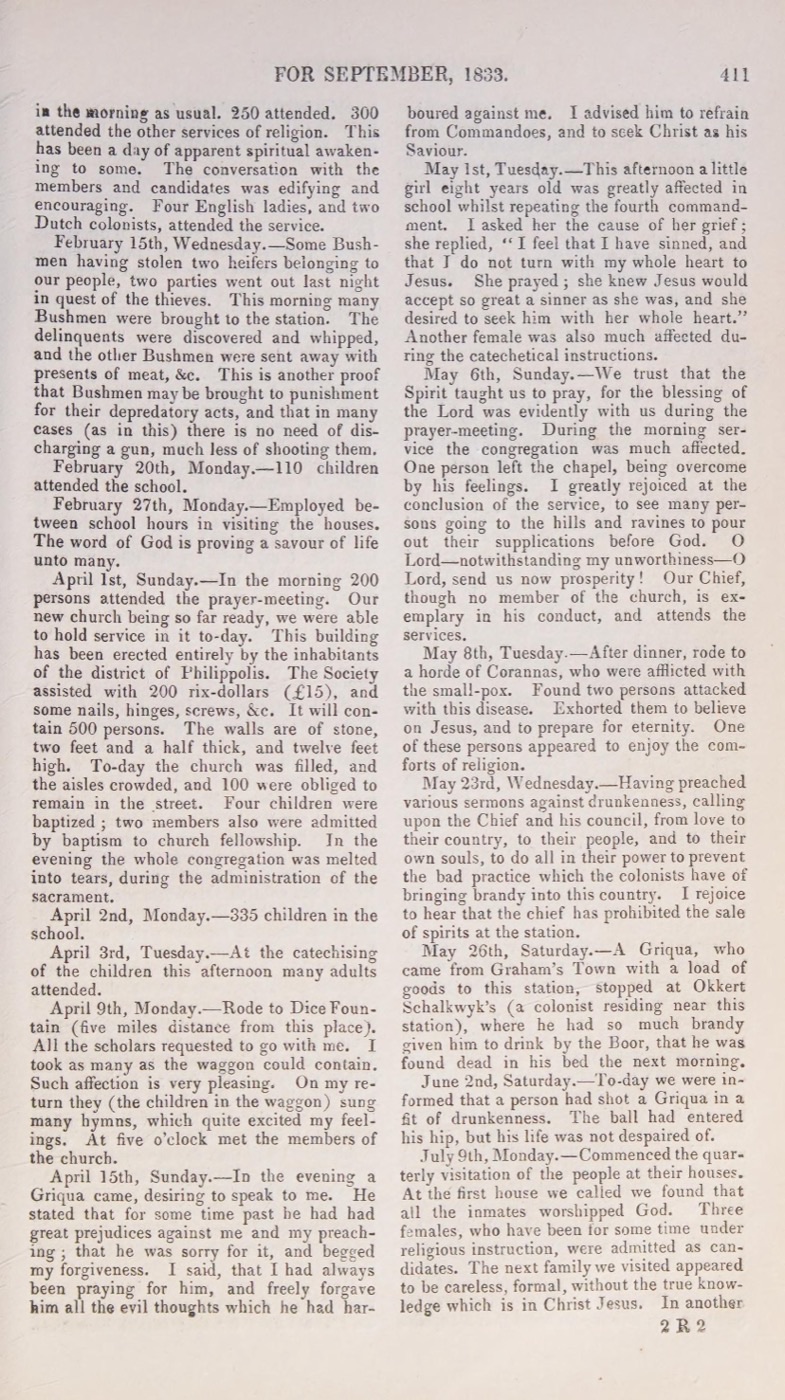
What reading the type actually changed. Two things, and one non-thing. The OCR had dropped “(the children in the waggon)” from the 9 April entry — four words, and they are the ones that make the sentence a picture. The transcription had also ended at 2 September, three sentences before the journal does, losing the Temperance Society entirely. And one suspected error turned out not to be one: a first pass at the page image read “four English traders” against the published “three”; magnified, the type says three, and nothing was changed.
Why the July entry matters more than it looks. His 1844 obituary said he had been “for many years engaged in rendering them medical advice and assistance whenever called upon”, and this archive had only the obituary’s word for it. Here is a Veld-Cornet and two farmers riding in for exactly that, sixteen years earlier, in his own hand.
15 April 1868 · “Death of Commandant Kolbe” — the Settler’s eldest son, at length
Two lines in this archive: John Gerson Eliezar “Jan”, 1822, Uitenhage. The Grahamstown Journal gives him a marriage, a farm, four public offices, twelve children, a cause of death, a deathbed speech about the Basuto boundary — and a description of his parents written by somebody who knew them.
The man
Born 7 July 1822
Married 3 April 1843, Anna Jacoba van der Merwe
Died 3 April 1868, the farm Leeuwberg — his wedding anniversary
Settled on Kaalspruit, where he lies
Typhus, or typhoid fever, caught on commando
“He had not completed his 46th year”
“He returned from commando some four weeks ago, suffering illness… thus adding another to the long list of victims of our miserable war.” The paper then says the war could have been avoided by good management after April 1866 — an obituary that stops to argue with its own government.
What he held
Commandant of the district
Justice of the Peace
Director of the Bloemfontein Bank
Deacon of the Dutch Reformed Church
and he spoke in the Volksraad, May 1867
He had refused public life for about twelve years after the abandonment — he was among those who protested the British withdrawal and applied to Sir George Clerk for compensation for his land so that he might leave with the troops. Failing that, “he, like many more, had to cast his lot with the Free State”. He took no office until the end of 1865.
The household
A widow and twelve children. Of four daughters, only one was married; the youngest was an infant. Two of the sons had been serving with their father in the field and “have proved themselves to be amongst the bravest of our burghers”. Not one of the twelve is named, and none of them is in this archive.
The deathbed, which is the part worth keeping
“On his death-bed, and while he still retained his full senses, he declared to the Doctor, to Mr. SALZMANN, and to others that were at his bed-side, that this State had taken too much land from the Basutos, and that he had felt so all along, and had declared it as his opinion in the Volksraad, in May 1867, at the time of the making of the ‘corn peace’; and now, on the bed from which he never expected to rise again, he wished by message to warn the Raad, and to beg of them to rescind their resolution, annul their protest, and to treat with the Governor for an equitable settlement of the boundary line.”
He was interred the Monday following; Mr. P. Grobler, Elder of the Church, conducted the service in the minister's absence, and the President of the Free State delivered an address.
And it describes his parents
“His parents came out with the settlers of 1820; his father was of German extraction, if not birth, but resided and married in London. His mother — a thorough-going and fine old English lady — it will be remembered died in Burghersdorp about three months since.”
That is George Augustus Kolbe and Margaret Downing, described in 1868 by somebody who knew them, in a newspaper that had no genealogical interest whatever. German extraction, if not birth is exactly right for a man born in Westminster to a Württemberg father — and this archive worked that out from a Soho baptism, a London Gazette notice and a census, none of which this writer had. It also confirms from a fourth direction that the father became a missionary to the Griquas at Philippolis, and that most of the family grew up there — which is what the children's baptism places already said.
One date does not fit, and it is left not fitting. This archive has Margaret Downing dying in 1867, on the strength of her death notice. This obituary, printed 15 April 1868, says she died at Burgersdorp about three months since — which is January 1868. A death notice is a form with a date on it and a newspaper’s “about three months” is a journalist rounding, so the notice should win; but this archive has already been caught once by an estate filed thirteen years after the death it records, and will not simply wave this away. Her place of death is new either way: Burgersdorp.
And one small thing, from the same search. Grahamstown Journal, 9 February 1872, quoting the Colesberg Advertiser under the heading “Terrible Warning”: an action before the Resident Magistrate between Mr. Geo. KOLBE, plaintiff, and Mr. T. NELSON, watchmaker, defendant — Kolbe “sought to recover a watch which had been entrusted to defendant for repair, but which, despite repeated promises, the latter neglected to repair or to deliver”. A Kolbe of Colesberg, in court, over a watch.
1874–1909 · The Werdmullers — a nameless baptism, four newspaper notices, and a Victoria Cross
The Settler's fourth daughter married a Werdmuller and vanished from this archive. Ten newspaper hits, found in the same collection as her father's obituary, put four generations back on the page — with one link in the middle that is not proved and is marked as such.
| Date | What was printed |
|---|---|
| 10 Apr 1857 Burgersdorp doopregister | A child born 14 February 1857, baptised at Burgersdorp, mother Augusta Louisa Kolbe, father Coenraad Johannes Otto Werdmuller. The Name column of the index is empty, which is why this archive had never seen it. The sweep → |
| 7 Jul 1874 Eastern Province Herald | “MARRIED at Burghersdorp by Special Licence, on Tuesday the 7th July 1874, by the Rev. William Cromar, Coenraad Johannes Otto Werdmuller D’ELGG to Miss Elizabeth Johanna Catharine VORSTER, both of Burghersdorp.” The von Elgg this archive has only ever had as a bracket after a name, printed as D’Elgg. |
| 13 Feb 1884 Queenstown Free Press | “MARRIED — at Wesley Church, Queenstown … Charles Andrew WERDMULLER, of Steynsburg. Second son of the late C.J.O. WERDMULLER, of Burghersdorp, to Charlotte Anne CALLAGHAN, eldest daughter of Hugh Callaghan, Esq., of Ashby Manor, Queenstown.” C.J.O. is dead by February 1884. |
| 17 Feb 1891 Queenstown Free Press | “DIED — At Hoopstad, Orange Free State … at the age of 32 years, after a long illness, Charlotte Anne WERDMULLER … leaving a husband and two little girls to mourn their loss.” An obituary paragraph adds that she had reached Hoopstad only months earlier, in indifferent health, with an organic disorder of the heart. |
| 31 Jul 1909 South Africa, a weekly journal | “MARTINEAU — WERDMULLER — On July 31, at East London, Horace Robert Martineau, V.C., of Durban, to Amy Werdmuller, second daughter of Charles Werdmuller, J.P. of Hoopstad, O.R.C.” |
Read in order they make a family. Charles Andrew, of Steynsburg in 1884, is Charles Werdmuller, J.P. of Hoopstad by 1909 — the same town his wife died in. The two little girls left in 1891 are the reason the 1909 notice can call Amy a second daughter. And a child of Charles Andrew's father was baptised at Burgersdorp in April 1857 to a mother named Augusta Louisa Kolbe.
The link that is not proved, and this archive will not pretend otherwise. Nothing read here names Charles Andrew's mother. His father remarried — or a man of exactly the same name married — at Burgersdorp in 1874, to Elizabeth Johanna Catharine Vorster. If Charles Andrew is the child born 14 February 1857 he was twenty-seven when he married and Augusta Louisa Kolbe is his mother; if he belongs to the later marriage he is no relation to this family at all, and the 1874 date makes that impossible for a man marrying in 1884 as a second son. The dates favour Kolbe strongly and the documents do not say it. Set down as a chain with a gap in it.
If the chain holds, Amy Werdmuller is a great-granddaughter of the 1820 Settler, and in 1909 she married a holder of the Victoria Cross. This archive records the two letters exactly as the journal printed them and has not gone looking for which action he won it for; that is somebody else's page, and the temptation to borrow it is exactly the temptation this archive is built to resist.
1853–1859 · The Burgersdorp register swept image by image — and why no search could have found this
The two missing Barry children have been the standing errand of this project. The index could not produce them. Two hundred and sixty-seven register images later, one of the two is found — and the reason she was invisible turns out to be worth more than she is.
The entry
Image group 008039088, image 427
Name: Catherine Mary Sophia · Born 10 Jul 1855
Parents: John Barry · Margaret Louisa Kolbe
Baptism 22 Jul 1855, Burgersdorp
Her sister has the same name. On 25 December 1859, at Dordrecht, the same parents baptised another Catharina Mary Sophia, born 4 August 1859 — the woman who married into the Booyzens and whose name reached Australia. Two daughters, one name, birthdays four years apart in two different towns. A baptism is not done twice, so the ordinary reading is the ordinary Cape practice: the first child died and the name was given again. This archive has no burial for her and dates the death only as before August 1859.
It also says something about the name. This archive has already shown that Catherine Maria Sophia is a Kolbe name, off the godmother at the 1848 Graaff-Reinet font, Catharine Sophia Maria Kolber. It was thought important enough to use, lose, and use again. Namesakes →
Why no search would ever have found her — and this is the finding that outlasts her. The FamilySearch film viewer carries an index panel under each image, listing every entry on that page: name, birth date, both parents, event, place. On image 427 the row reads | 10 Jul 1855 | John Barry | Margaret Louisa Kolbe | Baptism | — the Name column is empty. The child is indexed with no name at all. Her forenames are written plainly on the register page and simply were not keyed. No search by surname, forename or spelling variant can return a record that has neither, which is why nine separate attempts here — Barry, Berry, Barrie, Bary, Barrey, Barri, Bari, and the mother under Kolbe, Kolber and Colbe — all came back with the same seven children. The parents are indexed. The child is not. Searching by the parent is the only thing that reaches her, and a parent search only works if you already know to run it on a page you cannot see.
The same sweep caught a second nameless row, on image 513: a child born 14 February 1857, baptised 10 April 1857 at Burgersdorp, to Augusta Louisa Kolbe and Coenraad Johannes Otto Werdmuller. She is the Settler's fourth daughter, born at Graaff-Reinet in 1829, and this is the first of her children this archive has ever seen. Two nameless entries in 267 images, and both of them belong to this family.
| What was swept | Result |
|---|---|
| Images 338–604 | 1853 through to 1859, when the family had moved to Dordrecht. About 2,400 indexed entries read. |
| 1854 | Clean. No Barry. |
| 1855 | Catherine Mary Sophia, 10 July. |
| 1856 | Clean. |
| 1857 | No Barry — but the Werdmuller child, on image 513. |
| 1858 | Clean. |
| The eleventh child | STILL MISSING. Not at Burgersdorp between 1853 and 1859. The ground left to sweep is 1851–1852, the Dordrecht register after 1863, and the possibility that the child was born and died between two of the known baptisms and was never entered at all. |
| Blank pages | About thirty images in the range returned no index rows. Some are genuinely blank; this archive cannot say all of them are, and says so. |
19 December 1844 · The Grahamstown Journal buries the Settler — and names a London square and eight sons
Printed eighteen days after he died, four hundred miles from the farm, and never read here until today. It is the fullest contemporary account of George Augustus Kolbe that exists, and almost every line of it says something this archive did not have.
DIED at his Farm, Wirtemberg, near the Orange River, December 1st, the Rev. George Augustus KOLBE, aged 44 years, a man possessed of a most amiable temper, and of more than ordinary abilities. He was the last remaining of eight sons of John Godloff KOLBE Esq. of Brunswick-square, London, has left a Widow and ten Children to lament their loss, and to whom he has been a most affectionate Husband and Father. The Inhabitants of the District of Colesberg, and the surrounding Districts, will sustain a heavy loss, he having been for many years engaged in rendering them medical advice and assistance whenever called upon. His very long affliction for nearly a year has been borne with exemplary patience and resignation. His disease was an affection on the lungs, which brought on extreme weakness and debility. He died in peace, in sure and certain hope of a glorious immortality, through the merits of his Redeemer, Jesus Christ.
Grahamstown Journal, Thursday 19 December 1844, transcribed in the eGGSA newspaper extracts.
Eight sons
This archive knew John Gottlob Kolbe of Conduit Street through a census, a Gazette notice, a burial and a death index, and knew of one son — the one who sailed. The obituary says George Augustus was the last remaining of eight.
Seven brothers, all dead before December 1844, and not one of them is in this archive. The three women in the 1841 Conduit Street household — Marianne, Charlotte and Amelia — are sisters or daughters; the sons are simply absent, because dead men do not appear in a census.
Brunswick Square, not Conduit Street
The 1841 census has John Gottlob Kolbe at Conduit Street, Mayfair, and he died at number 34 in 1845. The obituary — written from the son's side, and printed while the father was still alive — places him at Brunswick-square, in Bloomsbury, a mile and a half away.
Both can be true: the family may have been at Brunswick Square when George Augustus sailed in 1819 and at Conduit Street twenty years later. This archive has already had to move this man once, off the family tree's Lamb's Conduit Street and onto Conduit Street proper, and it is not going to move him again on one line of print. Recorded as a second address and not as a correction. Corrections →
A doctor, in everything but the word
His death notice calls him an Agriculturist. The trades this archive had were Reverend Missionary, Chemist, Tailor. The obituary says he had for many years rendered medical advice and assistance to the inhabitants of the District of Colesberg and the surrounding districts, whenever called upon.
That is the difference between a trade listed on a form and what a man actually did for thirty years. It also explains the chemist: on that frontier, in the 1830s, the chemist was the doctor.
What he died of, and what does not fit
Ill for nearly a year, of an affection on the lungs — consumption, in the language of the time.
Two things in the notice are wrong and are printed here anyway. Aged 44: he was born 7 December 1802 and died 1 December 1844, five days short of forty-two. And ten children: this archive counts twelve born, one of whom died an infant, which leaves eleven. A death notice in a newspaper is written by the grieving and set by a compositor four hundred miles away. It is the best kind of source and it is not a register.
1937–1963 · BARRY, MOUNTJOY and DASCHNER on NAAIRS — the first time they have been asked
The national archives index has been used here for Booyzens and for Kolbes. The other three surnames in this family had never been put to it. Two of the three are small enough to read entire; the third is not, and that is a finding of its own.
| Surname | Documents | What that means |
|---|---|---|
| DASCHNER | 12 | The entire surname, in every South African repository. Two of the twelve are this archive's own. |
| MOUNTJOY | 136 | Readable in a sitting. Thirty-four are estates or death notices. |
| BARRY | 5,022 | Not workable as a surname search. Barry is also a forename, a company name and a place. It has to be paired with a second keyword. |
| BARRY AND BURGERSDORP | 1 | A municipality file. Nothing. |
| BARRY AND INDWE | 0 | Nothing at all. |
| BARRY AND BARKLY | 2 | And both of them matter. |
A farm owner and a bywoner, both called R.P.K. Barry
SAB · VWR · volume 2 · B645/8/38 · 1937
AANSOEK DEUR PLAASEIENAAR
BARKLY-OOS.
RPK BARRY.
BYWONER
RPK BARRY (SEUN).
An application by a farm owner at Barkly East. The owner is R.P.K. Barry. The bywoner on the place is R.P.K. Barry, his son. Two men of those initials on one farm, one holding the land and one working it as a tenant, and a state file between them. Bywoner is not a labourer and not an owner: it is the word South Africa used in the 1930s for a white tenant on another man's ground, and VWR is the Department of Social Welfare. This archive has one Richard Pieter Kolbe Barry, born 1899, and cannot say which of the two he is. The file is not read.
Henry James Kolbe Barry
NAB · MSCE · 2183/1958
BARRY, HENRY JAMES KOLBE.
BORN IN BARKLY EAST, CAPE PROVINCE.
UNMARRIED. DECEASED ESTATE.
1958–1959
The whole argument of this archive, in one man's name. Henry James is the Barry forename followed here since the Graaff-Reinet font of 1848. Kolbe is the surname this project has spent itself proving is the source of half the family's given names. Here they are together, in a man born in this archive's own town and dying unmarried in Natal in 1958 — so the names stop with him. The third Barry found carrying Kolbe as a forename. Namesakes →
And two men got their dates from two sources on the same afternoon. William Herman Daschner, who was a name on his father's 1942 notice and nothing else, is MHG 2703/63 in the estate index and “DASCHNER Willie 1915–1963” on a West Park stone. The index gives the registered name and the year; the stone gives the household name and the same year. Fritz Johannes Mountjoy, baptised at Barkly East in 1894, lies in Barkly East main cemetery, 1893–1973. Neither was found by looking for him. Both fell out of sweeping a surname.
A method note, because it cost an hour. NAAIRS treats two keywords as OR unless the operator between them is sent explicitly. BARRY with BURGERSDORP returned 6,245 documents — more than BARRY alone — and looked for a moment like a rich seam. With AND sent, it returns one. A search that returns more than its own first term is not a search.
1901–1954 · The Wakkerstroom stones — two men of one name, and a child returned to the right cemetery
The eGGSA Mpumalanga collection holds thirteen Kolbe stones, and ten of them are in one small cemetery in the eastern Transvaal. Read in a morning, they settle a question this archive had opened and closed twice the same day, and take back a word it should not have used.
George Augustus Kolbe, 1863–1954
VADER
GEORGE AUGUSTUS
GEB. 29 JULIE 1863
OORL. 28 SEPT. 1954
Hy het die goeie stryd gestry / Hy het die wedloop voleindig / Hy het die geloof behou. II Timotheus 4:7
In tere herinnering van sy dankbare kinders, kleinkinders en nageslag
29 July 1863 is the Colesberg font date to the day. The baptism of 11 October 1863 gives him born 29 July, son of Frederik Fortunatus Kolbe and Elizabeth Johanna du Toit. Ninety-one years later a stone four hundred miles north cuts the same date. That is the whole northward argument confirmed by a source that has nothing to do with the register. His half of a double stone; his wife has the other, and a pillar between them reads VREDE · KOLBE — the same form as the Booyzen stone at Silverton. The pillar at Silverton →
Martha Sophia, born Klopper, 1867–1950
MOEDER
MARTHA SOPHIA
(GEB. KLOPPER)
GEB. 27 MEI 1867
OORL. 14 OKT. 1950
Ons dank God elke maal as ons aan haar dink
The birth is new; the death matches the civil register to the day. She was seventeen when she married him. Her daughter Maria Johanna, born at Wakkerstroom in 1886 and dead there in 1953, lies in the same ground under a van der Merwe stone.
George Augustus Kolbe, 1861–1934 — the other one
IN LIEFVOLLE HERINNERING AAN ONS OUERS
GEORGE AUGUSTUS KOLBE
GEB. 2 OKTOBER 1861
OORL. 8 NOVEMBER 1934
EN
SUSANNA MARGARETHA KOLBE
GEB. 26 OKTOBER 1861
OORL. 28 JULIE 1940
HULLE RUS
Two men of one name in one cemetery, born two years apart and buried twenty apart. He was born at Burgersdorp — where the 1820 Settler is buried, and where the Settler's twin son George Augustus was born in 1836. That descent is not documented here and is not claimed. He died at Standerton and was brought back to Wakkerstroom.
Martha Angeline Kolbe, sixty days old
TER GEDACHTENIS VAN
ONS GELIEFDE KLEINE
MARTHA ANGELINE KOLBE
GEBOREN 9 OCT. 1901
OVERLEDEN 8 DEC. 1901
HEBR. 6
— and cut across the base: NEWCASTLE
This morning this archive put her at Volksrust, and said Volksrust held a camp. Both halves are wrong and both are withdrawn. The stone is in Wakkerstroom. The index said “Volksrust, Eastvaal District Council”, which is a modern district municipality, and Wakkerstroom lies inside it — an administrative area read as a place of burial. And with the town goes the camp: a family stone in a town churchyard, in Dutch, cut by a monumental mason twenty-five miles away in Natal, is not a camp burial. The correction →
And the prisoner of war is decided, in the other direction. At breakfast this archive gave the 1902 POW record — WO 108/368, age 40, residence Wakkerstroom — to the man born in 1863, on the strength of the residence. By lunch it had withdrawn that, because he was thirty-nine. The stones close it: the other George Augustus Kolbe of Wakkerstroom was born 2 October 1861, and was therefore exactly forty from October 1901 to October 1902. The prisoner is the elder man. Published, withdrawn and reversed inside one day, and all three are on the corrections page, because a reader is owed the whole of that and not just the answer.
1930–1951 · Four Booyzen stones in one Cape cemetery, read
Middelburg main cemetery, in the eastern Cape, holds four stones spelt with a z. Three of them are one household. The fourth is a warning.
Gert Jacobus Booyzen
IN DANKBARE HULDE
AAN
ONS GELIEFDE VADER EN OUPA
GERT JACOBUS BOOYZEN
GEB. 19 JAN. 1870
OORL. 2_ AUG. 1951
SY GENADE WAS VIR MY GENOEG
19 January 1870 is exactly what this archive already had, and this is the first source for it that is not the death notice it came from. The death was a bare year; it is now a month. The day is a 2 and then a digit this archive cannot read, and it is not going to guess one. Vader en oupa — he was a grandfather, which nothing here had said. And the last line is in the first person: his grace was enough for me, cut twenty-one years after his wife died.
Isabella Fredericka, born Coetsee
TER GEDAGTENIS
AAN
ISABELLA FREDERICKA BOOYZEN
(GEB. COETSEE)
GEB. 15 APRIL 1874
OORL. 31 MAART 1930
HEMELSE RUS
Her birth is now a date. This archive had “c. May 1874”, worked back from an age on a notice; the stone gives 15 April 1874. The death matches to the day, and is the third independent source saying 1930 against the 1943 this archive once published — 1943 being only the year her husband finally filed. The correction →
Pieter J. Booyzen — and one word that carries the whole stone
HIER RUS
MY GELIEFDE SEUN
PIETER J. BOOYZEN
GEB. 29 DES. 1904
OORL. 7 JUNIE 1937
NA DIE KRUIS DIE KROON
Both dates confirm this archive exactly; he was thirty-two. The reading is in the second line. My geliefde seun, not ons — one surviving parent, not two. His mother had been dead seven years. So the stone was cut by his father, who lay down beside them both fourteen years after that. The grammar of the inscriptions gives the order the household went in.
Catharina Johanna Helena, born Beyleveldt — the warning
HIER RUS
CATHARINA JOHANNA HELENA BOOYZEN
(GEB. BEYLEVELDT)
GEB. 7 JANUARIE 1855
OORL. 16 MAART 1937
A fourth Booyzen stone in the same ground, and no connection to the other three that this archive can find. The Cape civil register carries her under a chain of surnames that is its own biography — BOOYZEN BYLEVELD LANGENBOG BOOYZEN — and dates her birth 1857 where the stone says 1855. Her probate names her husband Johannes Hendrik. She died twelve weeks before Pieter J. went into the same cemetery. Same surname, same town, same year: exactly the shape that gets two families welded into one, which is why she is written down here and not quietly left out.
What four stones in one cemetery are worth. Between them they moved a birth from a guessed month to a date, a death from a year to a month, and confirmed two dates this archive already had from sources that had nothing to do with the ones it got them from. None of that is a new person. It is the difference between a record and a corroborated record, and it took one search and five photographs.
1940 · The pillar at Silverton — twelve household names, matched to eleven legal ones
The centre pillar of the double stone at Silverton lists the children of Stefanus Francois Booyzen and Beatrix Magdalena Catharina Boshoff by the names they were called at home. His 1940 estate lists eleven children by the names they were registered under. The two lists have never been set side by side, and doing it identifies a twelfth child.
| On the stone | On the 1940 estate | How the match is made |
|---|---|---|
| OUBOET | David Schalk Booyzen | Not a name: ouboet is Afrikaans for eldest brother. Matched by position — he heads the estate list. |
| OUSIE | Susanna Fredrika Aletta Booyzen | Not a name either: ousie, eldest sister. Matched by position — and she is the only daughter left over once the other three are matched by name. |
| BESSIE | Elizabeth Magrieta Booyzen | Bessie ← Elizabeth |
| BETIE | Beatrix Magdalena Catharina Booyzen | Betie ← Beatrix — her mother's name entire |
| HENNA | Johanna Catharina Booyzen | Henna ← Johanna. The weakest of the nine: Henna can also stand for Hendrina, and there is no Hendrina on the estate. |
| EVERT | Ewert Philippus Booyzen | The same name, spelt as the family said it |
| ✝ BABA | Nobody | A TWELFTH CHILD. Cut with a birth star and a cross and no name at all — baba is simply baby. Not on the 1940 estate because the child was already dead when it was written. |
| FANIE | Stephanus Francois Booyzen the younger | Fanie ← Stefanus. Standard, and unambiguous. |
| WILLIE | Willem Hendrik Booyzen | Willie ← Willem |
| PIETIE | Petrus Jacobus Booyzen | Pietie ← Petrus |
| JOHAN | Johan Abraham Frederik Booyzen | The same name |
| HENNIE | Hendrik Rudolph Philippus Booyzen | Hennie ← Hendrik |
Eleven names on the estate, twelve on the stone, and every one of the eleven is claimed exactly once. That is what makes the twelfth real. Nine of the matches are ordinary Afrikaans diminutives; two — ouboet and ousie — are not names but places in the family, and they fall to the two children the diminutives leave over. Nothing is left unassigned except ✝ BABA.
This archive has met this shape before. Joseph Heinrich Daschner's 1942 death notice named eleven children; the Brixton burial register turned up a twelfth, George Downing Daschner, three months and five days old, buried in 1925 and therefore not on a notice written seventeen years later. The register → A death notice lists the living. A gravestone, cut by the family, lists the children. That is the difference between the two documents, and it is worth more than either of them alone.
What is not claimed. No birth date, no sex, no order of birth beyond the stone's own order, and no name — the child is entered here as Baba Booyzen because that is the only word cut for it. The matches above are readings of nicknames, not documents, and the household page marks every one of them as inferred rather than stated. The mother's own name is on the stone as Betie's: the family reused it inside one generation.
What was searched today and not found
Four questions worked properly and answered no, or not yet. They are set down at the same length as the finds, because a family history that publishes only its successes is asking to be believed on trust.
Elizabetha van der Merwe’s marriage
The second wife of Petrus Jacobus Booysen (1788–1876), named on her son’s 1908 death notice. If the marriage could be dated it would split the eight children of the 1876 Sterfkennis between two mothers instead of leaving all eight under a printed warning. Searched: Booysen × van der Merwe marriages across all South African collections; Elizabeth van der Merwe with a Booysen spouse; the Cape registers 1820–1835. Nothing. Every Booysen–van der Merwe marriage the indexes carry is twentieth century. The eight stay under the warning.
The four remaining 1876 children
David Schalk, Magdalena Johanna, Anna Eliezabet, Eliezabet Cornelia and Anna Maria Booijsen — five of the eight on the 1876 Sterfkennis with no document of their own. Still none. The Transvaal probate index carries nobody of those names who can be tied to this family, and the Cape index carries too many. The three that were settled today — Petrus Jacobus, Jan Gerthardus Lodewikus and Hendrik Stefanus — were all settled by somebody else’s death notice, not their own.
Ockert Johannes Stephanus Booysen’s estate
He died at Klerksdorp on 16 January 1921 and has no estate file of his own in the indexed Transvaal probate records. Six index hits under four spellings, every one of them him as somebody else’s relative. His death is a civil registration, which names no parents, and the films are not ordered by estate number so there is nothing to browse along. What was found instead →
The three untraced daughters
Anna Johanna Maria, Elesabettha Maria Cornelya and Magdalena Johanna Booijsen, all of age on their mother’s 1891 notice and on nothing else. Two of the three are probably dead before 1908, because their father’s notice names four children where their mother’s named seven. And this archive cannot show that the Anna Catharina Grobelaar of 1908 is the Anna Johanna Maria of 1891: the forenames do not agree, and guessing that they do is the exact mistake this site spent today undoing.
Two questions worked hard and not closed
Both of these were predicted to fail before they were started. One did. The other moved further than expected, and neither is resolved — which is set out here at the same length as the finds, because that is the only way the finds are worth anything.
1 · Whose son was Stephanus Francois Booyzen?
He sits on this site as a son of Petrus Jacobus Booysen and his second wife Johanna Margaritha Pretorius, placed there on his birth date alone because his own 1940 Sterfkennis names neither parent — his widow wrote oorlede for both. Then the 1900 death notice of Elizabetha Margaretha Marais named a Stephanus François Booijzen as a son of DAVID SCHALK BOOIJZEN, and the dispute opened.
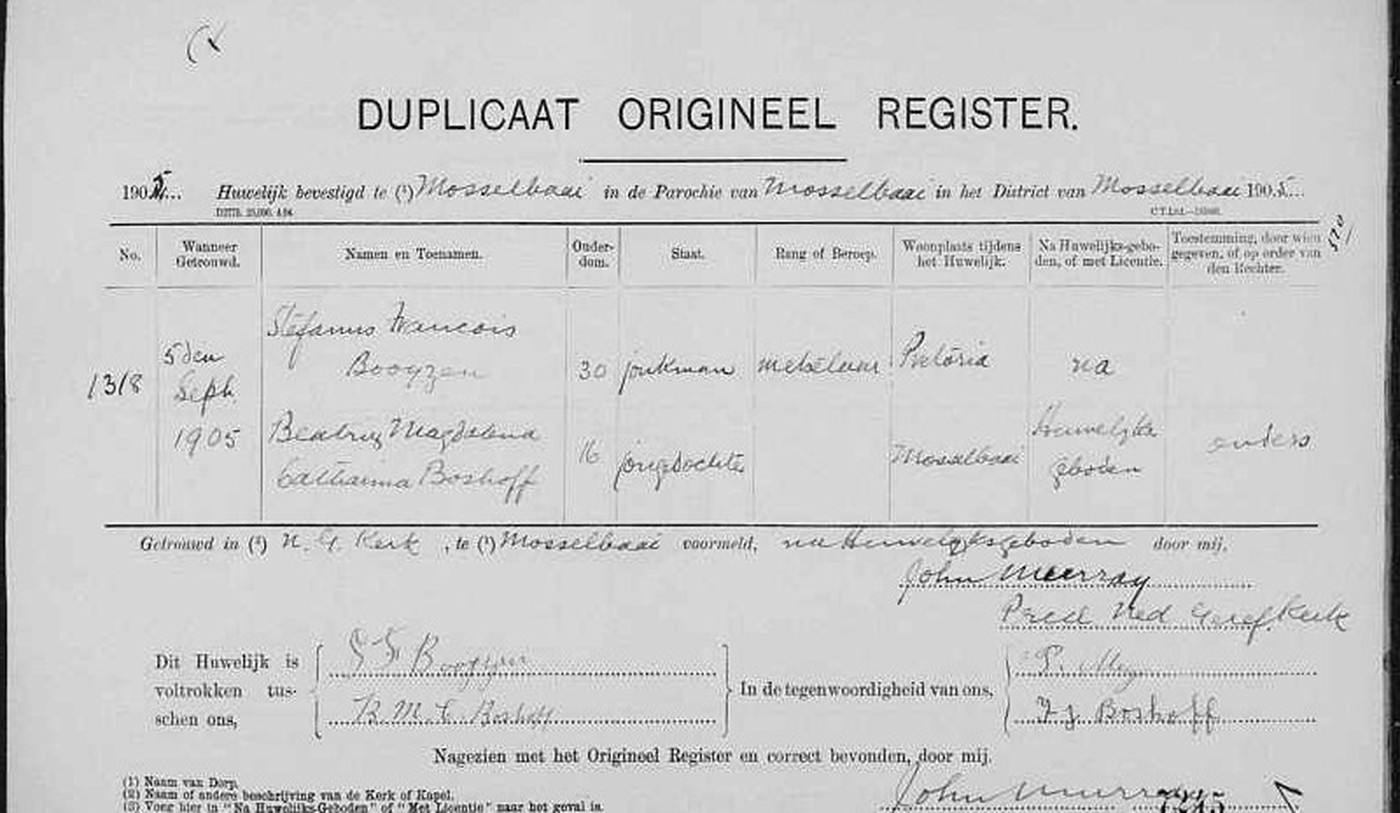
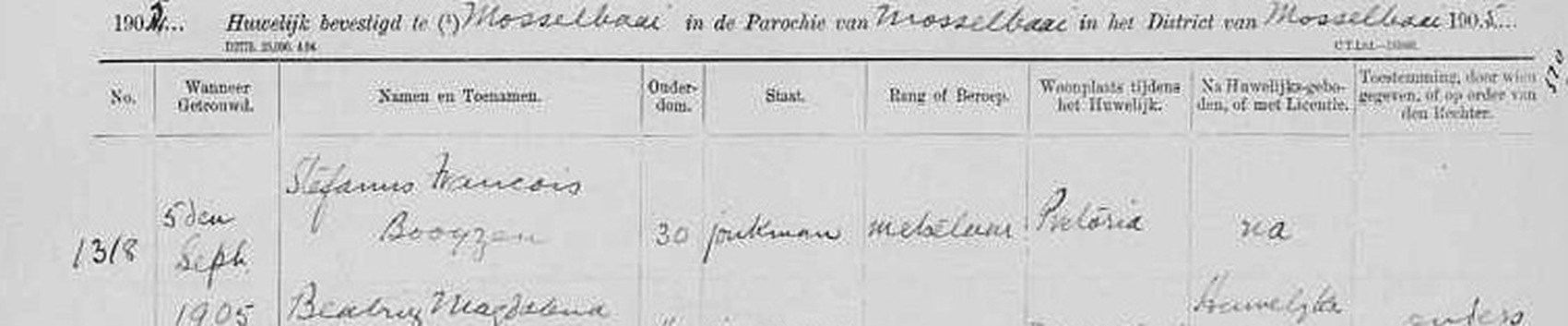
What the register gives
Stefanus Francois Booyzen, 30, JONKMAN — a bachelor — METSELAAR, a mason, woonplaats tijdens het huwelijk: PRETORIA. He married Beatrix Magdalena Catharina Boshoff, 16, jongdochter of Mosselbaai, with her ouders consenting, in the N.G. Kerk by John Murray.
What it does not give
No parents. No birthplace. This register has a column for woonplaats tijdens het huwelijk and none for waar geboren — unlike the Zeerust register of 1892, which gave this archive Hendrik Stefanus’s Graaff-Reinet. The question is not settled and this document cannot settle it.
Two Booyzens in Pretoria in one autumn, one of them exactly the bachelor son the 1900 notice describes. Against that: the existing placement rests on a birth year and nothing else, and both men are masons, which discriminates nothing — Willem Hermanus was a mason at Indwe too, and he is either this man’s half-brother or his uncle depending on which reading wins.
Still marked Serious. It moves, it does not close, and this archive is not going to decide a father on a city. Disputed →
2 · The Oliviers of Cradock
Anna Catharina Johanna Olivier’s parents came into this archive yesterday as two names on a baptism. The problem stated then was that at least four men of nearly that name were baptising children in that church in the 1820s, and separating them is the only way her line goes higher. They are not separated. But this couple now has a footprint of its own.
| Date | Event | Where |
|---|---|---|
| 8 Dec 1816 | They marry | GRAAFF-REINET — index only, no image |
| 25 Jul 1820 | Gert Cornelis Olivier born | baptised 2 Oct 1820, Cradock |
| 15 May 1823 | Aletta Catharina Olivier born | baptised 20 Oct 1823, Cradock |
| 10 Sep 1824 | Anna Johanna Olivier born | baptised 4 Oct 1824, Cradock |
| Feb 1826 | Ockert Johannes Stephanus the younger born | baptised 3 Apr 1826 |
What is still not done: four children is not a family, an index entry with no image is not a marriage register, and this archive still cannot tell this Ockert Johannes Stephanus Olivier from the Ockert Johannis Fredrik Lodewyk, the Okker Petrus Jacobus and the Ockert Johannes Frederik who were all baptising at Cradock in the same decade. Her line still stops with her parents.
Marriage: South Africa, Civil Marriage Records, 1801–1974 · Mosselbaai certificate 1318, FamilySearch 1:1:6ZH5-CQZW. Oliviers: Dutch Reformed Church Registers (Cape Town Archives) · 1:1:62V5-DRCK (marriage, image unavailable), 1:1:6LXQ-ZMNM, 1:1:6KRL-Q4H7, 1:1:6KRN-K37Y, 1:1:6LX3-J5WM. Read 13 September 2026.
1915 · The death notice, read entire at last
Estate 925, Grahamstown, stamped 18 April 1915. This archive has shown the top of this page for weeks and quoted four lines from it. The children's list is further down, and it contradicts this site in two places.
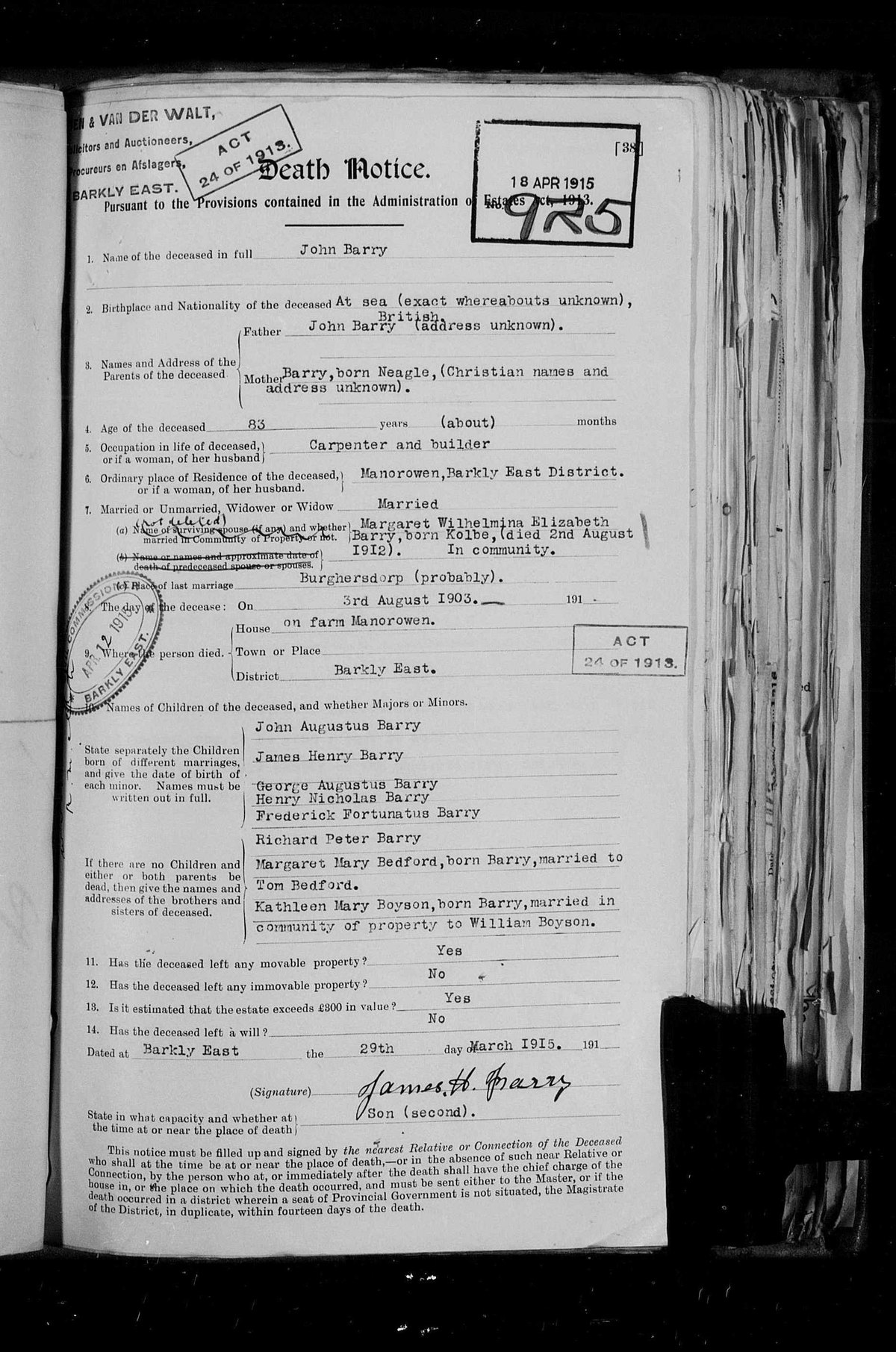
The form, as completed
| 1. Name | John Barry |
| 2. Birthplace | At sea (exact whereabouts unknown), British |
| 3. Parents | John Barry (address unknown) Barry, born Neagle (Christian names and address unknown) |
| 4. Age | 83 (about) |
| 5. Occupation | Carpenter and builder |
| 6. Residence | Manorowen, Barkly East District |
| 7a. Wife | Margaret Wilhelmina Elizabeth Barry, born Kolbe — died 2nd August 1912, in community |
| 7c. Married at | Burghersdorp (probably) |
| 8. Died | 3rd August 1903, on farm Manorowen |
| 11–14 | movables yes · immovables no · over £300 yes · will no |

Eight children, where the registration said eleven
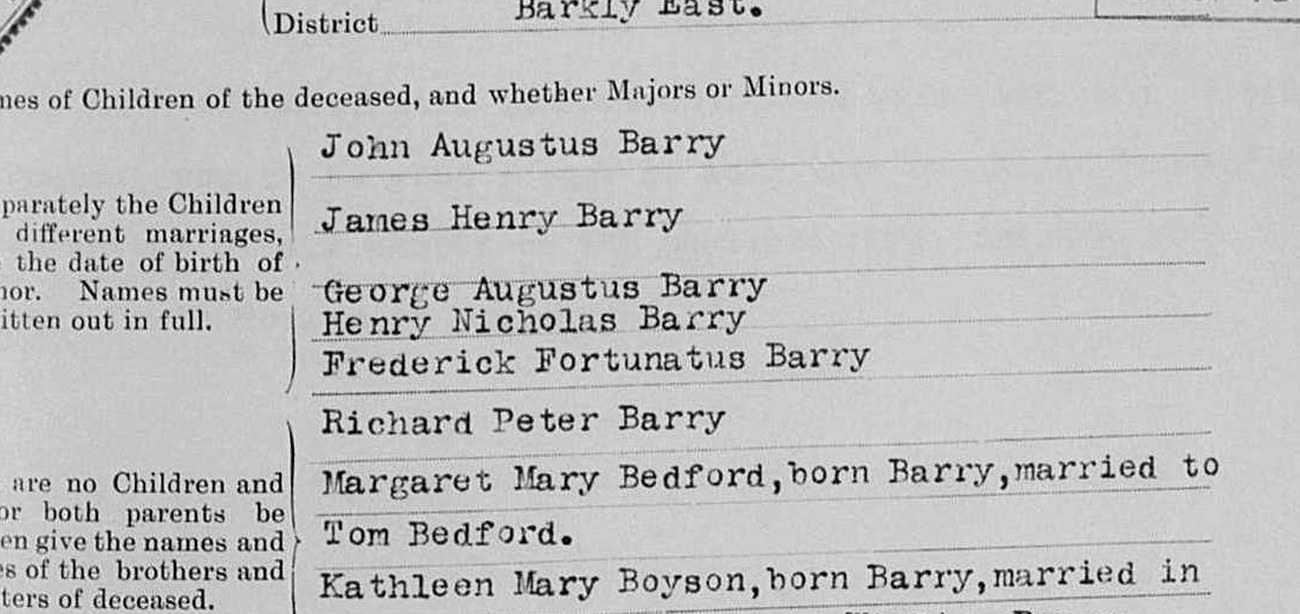
| As typed | What this archive has |
|---|---|
| John Augustus Barry | A son of the same name as his father's — and the reason this site has been calling the father "John Augustus Barry I". Both his own documents call him simply John Barry. |
| James Henry Barry | The second son. He signed this form, and died at Barkly East on 23 June 1939. |
| George Augustus Barry | New. |
| Henry Nicholas Barry | Hendrik Nicholaas — who married Anna Johanna Maria Schoeman and signed his own daughter's death registration in 1912. |
| Frederick Fortunatus Barry | Carries the Kolbe name. |
| Richard Peter Barry | Present at his father's death in 1903, and the name on the Cape Rebel roll. |
| Margaret Mary Bedford, born Barry, married to Tom Bedford | Margaretha Louisa Maria, m. Thomas Bedford 1875. |
| Kathleen Mary Boyson, born Barry, married in community of property to William Boyson | The only Booyzen marriage on the list, and it is spelled Boyson by an English clerk. |
Dorothea Regina Barry and Ruben Jacobus Josuah Barry are not on it. This archive has carried both as children of John Barry, "named on the 1915 death notice". They are not named on it. What the registers do hold is a Dorothea Regina baptised at Slang River in 1892 and a Ruben Jacobus Hosea baptised at Dordrecht in 1888 — both children of Henry Nicholas Barry and Anna Johanna Maria Schoeman, so grandchildren, not children. What was taken back →
And eight is not eleven. The 1903 registration, made by Richard Barry twelve years earlier, answers the printed question "the total number of children deceased has had" with eleven. This list has eight. Three children died between 1903 and 1915, or before, and this archive cannot yet name one of them. Open questions →
One more thing worth noticing. The form asks where the marriage took place and the answer is "Burghersdorp (probably)". A son of the house, writing twelve years after his father's death and three after his mother's, does not know where his parents were married and says so in brackets. It sits beside line 3, where he gives his grandmother's surname as Neagle and admits he has neither her Christian names nor an address.
This is the same failure this archive has been tracking since 1840, in a family that wrote in English and filed with a solicitor. Six death notices here fail to name a parent properly; two of them are John Barry's and his wife's.
1900–1901 · Six Kolbes and three David Schalk Booysens, each with a farm against his name
The War Office kept a list of Boer prisoners of war, numbers 1 to 32,561 — WO 108/368 at The National Archives. It gives a name, an age, a nationality and, for most of them, the farm and district the man was taken from. That last column is what makes it a genealogical source rather than a casualty list.
| Name as indexed | Age | b. | Farm and district | Held at | Folio |
|---|---|---|---|---|---|
| George Augustus Kolbe — of Burgersdorp, b. 2 Oct 1861 | 40 | — | Wakkerstroom, Wakkerstroom — Transvaaler | Natal | 709 |
| George Augustus Kolbe | 32 | 1869 | Sterkfontein, Bethulie — Free Stater | Natal | 581 |
| Andries Frederick Kolbe | 45 | 1856 | LEEUWBERG, Bloemfontein | Cape Town & Natal | 431 |
| Williem Johannes Kolbe | 54 | 1847 | Panfontein, Bloemfontein — Free Stater | Natal | 603 |
| Ian Henry Kolbe | 51 | 1849 | Linberg, Bloemfontein | Cape Town | 294 |
| Pietrus Emelius Strucker Kolbe | 24 | 1876 | Bossiespan, Fauresmith | Cape Town | 381 |
Leeuwberg, again
This archive wrote Leeuwberg into the record a week ago, from an entirely different document — John Kolbe junior and the Jephts of Leeuwberg. Here it is again, in a War Office list, as the farm a Kolbe was taken from in 1901.
Not proof of a link. But the same farm carrying the same surname forty years apart is not nothing.
The Settler’s own forenames, twice
Two men called George Augustus Kolbe were taken prisoner in the same war — one at Wakkerstroom, one at Bethulie.
The Wakkerstroom one was already identified on this site, from the gravestones, before this search was run: George Augustus Kolbe of Burgersdorp, born 2 October 1861, who was forty from October 1901 to October 1902 where the other Wakkerstroom man of that name, born 29 July 1863, was thirty-nine all year. The folio number is the only thing this sweep added to him. The stones →
The Bethulie man is new and unattached. No descent is claimed for him.
Five of six in one corner of the Free State
Leeuwberg, Panfontein and Linberg near Bloemfontein, Bossiespan in Fauresmith, Sterkfontein in Bethulie. That is the country the Settler preached in — across the Orange River from Colesberg, where he farmed Wirtemberg.
And where the Commandant’s farm turned out to be, two hours from Bloemfontein, when the Fauresmith pin was withdrawn earlier this month.
And three David Schalk Booysens
| Age | b. | Farm and district | Folio |
|---|---|---|---|
| 53 | c.1848 | Pretoria, Boksburg | 442 |
| 41 | c.1860 | VAALBANK, Lichtenburg | 491 |
| 33 | c.1868 | Kapsteinkop, CRADOCK — British Subject | 575 |
Two of those three places are this family’s own ground, and one is the Vaalbank whose farm school this archive documented a week ago. It is a lead and not a finding. This archive has already shown that David Schalk is a van der Merwe name before it is a Booysen one, and there are fifty-four Booysens and twenty Booyens in the same list. A Petrus Jacobus Booysen, aged 27, of Pretoria and Pietersberg, is among them — the right name, the wrong generation, and recorded here so that he is not later mistaken for the Petrus Jacobus this archive holds.
One thing about the index that will cost somebody a day. It renders Jan as “Ian”, systematically — Ian Henry Kolbe, Ian Gert Booysen, Ian Lodewyk Booysen, Ian Jonathan Booysen, Ian Adriaan Booyens. A search for Jan in this set returns nothing. It also writes Willem as Williem and Petrus as Pietrus. Searched on the surname and read down; that is the only way it works.
1841 and 1851 · The Yorkshire John Barry is real, and he is a shipowner at Whitby
Open question 6 has stood since it was written: one profile welds a Yorkshire farmer of Bilsdale, christened 1796 and buried at St Hilda’s on 3 January 1853, to a John Barry who died at de Bruins Poort in the Cape on 8 January 1853, five days later. The burial registers have already been searched and hold no Barry at Bilsdale at all. The censuses do better than a negative: they produce the man.
1841 · HO107/1265, book 11, folio 38, page 4
JOHN BARRY, head, aged 45, born Yorkshire. Address SHIP YARD, RUSWARP, WHITBY. Schedule 1116. In the house with him: Jno, Mary, Ann and Catharine Barry.
1851 · HO107/2374, folio 563, page 12, line 6
JOHN BARRY, head, married, aged 55, born WHITBY. Occupation SHIP OWNER. Address SHIP YARDS, RUSWARP, WHITBY. Schedule 46. With Mary (b. 1809), Catherine (b. 1832) and Elizabeth (b. 1836).
He is not a farmer, he is not of Bilsdale, and he is alive in 1851. Ruswarp is a township on the Esk a mile above Whitby harbour, thirty miles from Bilsdale across the moor. The occupation is Ship Owner and the street is Ship Yards.
And there is nobody else he could be
| Census | Barrys in the North Riding | Where they were |
|---|---|---|
| 1841 | 50 | Whitby 22, Scarborough 13, Brompton 10, Allerston 2, Lythe 2, Fylingdales 1 — registration districts Whitby 25, Scarborough 23, Pickering 2 |
| 1851 | 52 | Ruswarp 8, Whitby 7, Sneaton 7, Brompton 10, Easingwold 4, Fylingdales 3, Hinderwell 2, Great Smeaton 2, Lythe 1, Eston 1, Filey 1 — districts Whitby 26, Scarborough 17, Easingwold 4, Guisborough 3, Northallerton 2 |
Not one of the hundred and two is in the Helmsley registration district, which is the district Bilsdale sits in. And across both censuses there is exactly one John Barry born in 1796 in the whole North Riding: the shipowner at Ruswarp, in 1841 at Ship Yard and in 1851 at Ship Yards, the same house ten years apart.
What question 6 becomes
The English half of that profile has been taken apart and rebuilt. There is a real John Barry born in the North Riding in 1796. He is a Whitby shipowner, not a Bilsdale farmer of Holly Bower; there is no Barry in 5,934 indexed Bilsdale burials; and he was still keeping house at Ruswarp in the spring of 1851. Whether he is the man the tree meant or a man the tree found and dressed in somebody else’s clothes, he cannot also have been buried at St Hilda’s.
What is still open, and it is a smaller question than it was: whether the Whitby shipowner has any connection at all to the John Barry who died at de Bruins Poort. Nothing here says he does. The five-day coincidence that built the profile is now a coincidence with nothing on the English side of it.
1824–1845 · Five notices in the London Gazette, and a house coming apart in one year
This archive already had one of these — the 1836 dissolution — and had treated it as a lucky find. There are five. Together they give a tailoring business from Church Street to Conduit Street across twenty-one years, and they date the move that the rate books could only bracket.
| Date | Issue · page | What it says |
|---|---|---|
| 12 May 1824 | 18027 · 796 | “the Partnership heretofore subsisting between the undersigned, John Gotlob KOLBE and John Henry KOLBE, of Church-Street, Soho, in the County of Middlesex, TAILORS, was this day dissolved…” |
| 9 Oct 1824 | 18069 · 1668 | INSOLVENT DEBTORS. Petitions to be heard at Portugal-Street, Lincoln’s-Inn Fields, on Friday 5 November 1824. “John Henry KOLBE (sued as Henry Kolbe), formerly of No. 22, Norfolk-Street, Middlesex-Hospital, and late of No. 4, Mansfield-Place…” |
| 16 Nov 1824 | 18080 · 1900 | The same man in the insolvency lists a second time, the name printed “Kolbe, John Henry”. |
| 30 Sep 1836 | 19424 · 1702 | “John Gbttlob KOLBE and David Fletcher, of Conduit-Street, Bond-Street, in the County of Middlesex, Tailors…” (already held here) |
| 21 Mar 1845 | 20455 · 930 | “the Copartnership heretofore subsisting between the undersigned, John Gotlieb KOLBE and Richard Davies, of Conduit-street, Bond-street, Tailors, has been dissolved by mutual consent.” Eight months before he died. |
1824, which was the worst year they had
12 May — father and son dissolve the partnership at Church Street.
15 August — Mrs Mary Kolbe, the second wife, dies aged 36, and is buried in
the German Lutheran register.
9 October and 16 November — John Henry is in the insolvent debtors’
lists, out of Soho and living at Mansfield Place.
He was twenty-four. He died eight years later, aged thirty-two. Five years before all this he was eighteen and losing a six-pound coat outside a Westminster public house. The trial →
And the move that the rate books could only bracket
The Westminster rate books have him in Church Street South to 1831. The Gazette has him in Conduit Street by September 1836. Between those two dates the family left Soho for Mayfair, and he was working with a partner at each end — David Fletcher to 1836, Richard Davies to March 1845.
Which makes the obituary’s “Esq. of Brunswick-square” harder still. He was signing himself a tailor in the Gazette eight months before he died.
All five are free. The London Gazette’s own archive at thegazette.co.uk is searchable back to 1665 and returns the OCR text in an Atom feed — /all-notices/notice/data.feed?text=… with a publication-date range. This archive found the 1836 notice months ago and never ran the same search again with the dates widened. The other four had been sitting there the whole time.
9 January 1819 · A brother of the Settler says where his father lives
This archive spent a fortnight arguing about a London address from obituaries, wills and tax books. The son of the house answered it out loud, in a courtroom, in January 1819, and somebody wrote it down.
The Proceedings of the Old Bailey ·
Session of 13 January 1819 · trial t18190113-149
309. RICHARD KERR was indicted for stealing, on the 9th of January, one coat, value
6l., the property of John Henry Kolbe.
JOHN HENRY KOLBE. My father is a tailor, and lives in Church-street, Soho. On the 9th of January, about eleven o’clock at night, I stopped at the Star and Crown public-house, Westminster, and left my coat over my horse’s head — I had a chaise standing at the door; I saw the prisoner go out, and suspected him — I went out, and missed my coat.
Henry Betts, a constable, had taken Kerr in charge for another offence; two other witnesses did not appear. NOT GUILTY. Second Middlesex Jury, before Mr Recorder.
Who is speaking
John Henry Kolbe, baptised at Westminster on 29 July 1800 — one of the eight sons, and eighteen years old on the night he lost his coat. He died on 13 April 1832, aged thirty-two, and was buried in the German Lutheran register.
His younger brother George Augustus sailed for Algoa Bay the following year. This is the closest thing this archive has to a voice from the house he left.
What he settles
The rate books put his father at Church Street South, St Anne’s Soho in 1811, 1819, 1828 and 1831. The son says the same street, in 1819, under oath, to a court that had no interest in where he lived.
Two sources with nothing whatever to do with each other — a parish tax list and a criminal indictment — agreeing on an address the family tree had wrong twice.
And what it shows of them
A coat worth six pounds — several months’ wages for a labourer, and exactly what a master tailor’s son would be wearing. A chaise and a horse at eleven at night outside a Westminster public house. “My father is a tailor”, said plainly, twenty-five years before an obituary preferred Esq.
How it was found, which is the part worth repeating. Not by searching the Old Bailey. It came out of a surname sweep of FindMyPast for Kolbe in London, in a list of 154 rows that was mostly rate books, where two entries said Old Bailey Court Records and were nearly scrolled past. The trial text itself is free, at oldbaileyonline.org, and always was. The rate books →
1792–1819 · Five of the eight sons, named at last
The obituary of George Augustus Kolbe, December 1844, calls him “the last remaining of eight sons of John Godloff Kolbe Esq. of Brunswick-square”. Seven brothers died before him and this archive had never found a single one. The route was always obvious — the London parish registers — and was never open.
The control first. George Augustus himself: baptised at Westminster on 2 February 1803, father John Gottlow Kolbe, mother Mary. This archive already had that date from another route entirely. The register agrees, so the register can be trusted for the rest of them.
| Baptised | Name | Father written as | Batch | |
|---|---|---|---|---|
| 9 Jan 1792 | Juliet Rosinia | F | John | C72301-3 |
| 11 Jun 1794 | Mary Ann | F | John | C32052-8 |
| 29 Dec 1795 | Elizabeth | F | John | C15051-2 |
| 17 Jan 1798 | Charles | M | John | C15051-2 |
| 29 Jul 1800 | John Henry | M | John | I02559-1 |
| 2 Feb 1803 | George Augustus | M | John Gottlow | — |
| 12 Mar 1805 | Frederick Charles | M | John Gottleb | C15051-2 |
| 3 Feb 1807 | Charles Samuel | M | John Gottleb | C15051-2 |
| 18 Aug 1813 | Frederica Carolina | F | John Gottleb | C06236-1 |
| 4 Jul 1819 | Jane Day | F | John Gottlob | C06236-1 |
All ten at Westminster. The mother is Mary in every single entry — which turned out to be two women, not one. The burials say why →
What this gives
Five of the eight sons, named: Charles 1798, John Henry 1800, George Augustus 1803, Frederick Charles 1805, Charles Samuel 1807. Three brothers are still missing, and the gaps in the run — 1808 to 1812 and 1814 to 1818 — are where they must sit.
And a detail that reads as tragedy once the burials are put beside it: there is a Charles in 1798 and a Charles Samuel in 1807. Families reused a name when the first child carrying it had died.
One that was thrown out
Frederick Kolbe, baptised at Westminster on 16 December 1816. Right surname, right parish, right decade, and the run has a gap exactly there. He is not a brother: his father is George, his mother Elizabeth, and his register batch is C72301-7 rather than the family’s.
He was one click from being made a son. The thing that stopped it was reading the parents’ names on the transcript instead of the name, place and year in the result list. The same check threw out Henry Kolbe, baptised at Southwark on 2 February 1800 — father Henry, mother Susannah.
Then the same search in Westminster’s own registers, which the FamilySearch index is only a summary of
The table above comes from England Births & Baptisms, which is FamilySearch’s index and gives the place as “Westminster” and nothing finer. Westminster Archives’ own baptism register set names the parish — and holds a child the other index does not.
| Baptised | Name | Parish |
|---|---|---|
| 9 Jan 1792 | Juliet Rosinia | St James, Piccadilly |
| 11 Jun 1794 | Mary Ann | St James, Piccadilly |
| 29 Dec 1795 | Elizabeth | St Anne, Soho |
| 17 Jan 1798 | Charles | St Anne, Soho |
| 29 Jul 1800 | John Henry | St James |
| 2 Feb 1803 | George Augustus | St Anne, Soho |
| 12 Mar 1805 | Frederick Charles | St Anne, Soho |
| 3 Feb 1807 | Charles Samuel | St Anne, Soho |
| 4 Jul 1810 | LOUISA MARIA — born 13 May 1810 | St Anne, Soho |
| 18 Aug 1813 | Frederica Carolina | — |
| 4 Jul 1819 | Jane Day | St Anne, Soho |
An eleventh child, and the only one with a birth date as well as a baptism date. Louisa Maria, born 13 May 1810, baptised 4 July, father John Gottlob, mother Mary. She sits in the 1808–1812 gap, and she is not in the FamilySearch index at all.
And three of them married
Elizabeth Kolbe married JOHN MILNE in 1817 at St Clement Danes, both of that parish. She was twenty-one.
John Henry Kolbe married MATILDA FORD on 26 April 1819 at St Margaret, Westminster, both of that parish. He was eighteen, and three months earlier he had been in the Old Bailey losing a six-pound coat. The trial →
Jane Day Kolbe married in 1853 in the City of London — GRO index, 1853 Q3, vol AM, 1170, p.33. The youngest of the eleven, and she lived to thirty-four at least.
A grandchild, probably
MARY ANN MARIA FORD KOLBE married at Whitechapel in the first quarter of 1847 — GRO index vol AZ, 840, p.16.
“Ford” is Matilda’s maiden name, carried as a forename in the way families did carry them, and there is no other Ford anywhere near this family. She is very probably John Henry and Matilda’s daughter, born after the 1819 marriage and married fifteen years after her father died.
That is an inference from a forename and it is written down as one. The certificate would settle it, and it has not been ordered.
1807–1832 · Seven Kolbe burials in a German Lutheran register, and two wives called Mary
The 1844 obituary of George Augustus Kolbe calls him “the last remaining of eight sons of John Godloff Kolbe Esq.” Seven brothers died before December 1844 and this archive had never found one of them. It had guessed where to look — the German Lutheran church of the Savoy, TNA series RG 4 — and had never been able to get at the registers. They are on FindMyPast, and they hold seven Kolbes.
| Died | Buried | Name as written | Age | Image |
|---|---|---|---|---|
| 6 Dec 1807 | 11 Dec 1807 | Chs Saml Kolbe | 1y 10d | RG 4/4631 f.47 RG 4/4630 f.44 |
| 8 Mar 1809 | 14 Mar 1809 | Frederick Kolbe | 4y 6w | RG 4/4631 f.49 |
| 1 Jul 1814 | 3 Jul 1814 | Fredericka Caroline Kolbe | 11 months | RG 4/4631 f.61 |
| 2 Aug 1814 | 5 Aug 1814 | Mary Kolbe | 46 | RG 4/4631 f.62 |
| 15 Aug 1824 | — | Mrs Mary Kolbe | 36 | RG 4/4631 f.81 |
| 13 Apr 1832 | 22 Apr 1832 | John Henry Kolbe | 32 | RG 4/4631 f.100 |
Six rows, seven records: the 1807 child is entered twice, once in RG 4/4631 and once in RG 4/4630, with the same death date and the same age to the day. That is a register and its duplicate, not two children. RG 4/4630 was not on this archive’s list of Savoy volumes.
Matched against the baptisms, which were found the same afternoon
Three brothers, dead and dated
Charles Samuel, baptised 3 February 1807 — dead at one year and ten days. Frederick Charles, baptised 12 March 1805 — dead at four years and six weeks. John Henry, baptised 29 July 1800 — dead at thirty-two, on 13 April 1832, twelve years before the obituary that counted him.
And a sister with them: Frederica Carolina, baptised 18 August 1813, buried at eleven months.
Two wives, and both of them Mary
The archive had one Mary and could not make her fit. There are two. The first died 2 August 1814 aged 46 — born about 1768, and buried a month after her eleven-month-old daughter. The second died 15 August 1824 aged 36 — born about 1788, and she is the Mary named as mother at the 1819 baptism of Jane Day Kolbe.
Which is why a single Mary would not work: she would have been bearing children from 1792 to 1819, and the woman who died in 1814 could not have been the mother in 1819.
What is still missing. Three of the eight sons remain unnamed. The German Lutheran baptism registers — RG 4/4627 and RG 4/4629 — are not on FindMyPast under any dataset name this archive could find, only the burials. The gaps in the Westminster baptism run, 1808–1812 and 1814–1818, are where the other three sit.
1800–1845 · Not Brunswick Square: a tailor rated in Soho for thirty-one years
An 1844 obituary puts the family at Brunswick-square. His own 1842 will and 1845 death put him in Conduit Street, off Bond Street. Those are different parts of London and this archive could not choose between them. It has been waiting for a trade directory. What decided it was a rate book — the list of who paid the parish rates, house by house, year after year.
One hundred and twenty-one entries under twenty-four spellings of one forename. Westminster Rate Books 1634–1900 index him as Gothel, Gotleb, Gotleib, Gotlieb, Gotliel, Gotlob, Gotlobe, Goltief, Gottieb, Gottiel, Gottlieb, Gottlob, Gutlieb, Kottieb, Gilliet and — once — Jos Gottiel. A name search for “Gottlieb” finds one entry in twenty-four. The run is only visible because the surname was searched and the forenames read.
| Year | Written as | Address | Parish |
|---|---|---|---|
| 1800 | John Kolbe | Broad Street North, folio 41 | St James, Piccadilly |
| 1811 | John G Kolbe | Church Street South | St Anne, Soho |
| 1819 | John Gottlob Kolbe | Church Street South | St Anne, Soho |
| 1828 | John Gotlieb Kolbe | Church Street South | St Anne, Soho |
| 1829 | John Gottlieb Kolbe (land tax) | Church Street | Westminster, St Anne, Soho |
| 1831 | John Gottieb Kolbe | Church St South | St Anne, Soho |
The 1800 entry settles an older question too
This archive holds a line from a printed list of 234 master tailors who met over the Combination Act in December 1799: “Kolbe, John, 18 Broad-street, Soho”. It had no way to test it. The rate book for 1800 puts a John Kolbe in Broad Street North. Two sources, neither aware of the other, one street.
And what it does to Brunswick Square
Brunswick Square is in Bloomsbury. It is not in Westminster and would not appear in any of these books, so they cannot disprove it. What they can do is close the gap: he is rated in Soho from 1800 to 1831, he is in the 1841 census at St George Hanover Square with Amelia A, Charlotte and Marianne Kolbe, and he dies in St George Hanover Square in 1845. There is no window left for a Bloomsbury house. Conduit Street is in St George Hanover Square. The obituary is the odd one out.
What a rate book is, and why it beat the directory. A trade directory lists the men who paid to be listed. A rate book lists everyone the parish could get money out of, every year, by street. This archive spent a fortnight trying to get at a London directory of the 1820s past Google Books’ quota and HathiTrust’s bot check. The answer was in a tax record, which nobody thinks of as a genealogical source because it has no names of relatives in it. It has something better: an address, repeated thirty-one times.
September 2026 · Four things FindMyPast does not have, and the controls that prove it
A month’s full subscription was opened on 16 September. Four of the questions put to it came back empty. A nil return is worthless until a control shows the search works, so each one below is published with the count that makes it mean something. The method →
First, the trap — and it is the kind that answers wrongly rather than emptily
FindMyPast indexes the 21st Light Dragoons under four different regiment strings, and they hold different War Office series.
| Indexed as | records | series | years |
|---|---|---|---|
| 21st Dragoons | 342 | WO 22, WO 23, WO 121 | 1801–1886 |
| 21st Regt Of Light Dragoons | 128 | WO 97 only | 1793–1813 |
| 21st Light Dragoons | 66 | WO 22, WO 23, WO 76 | 1801–1877 |
| 21st Hussars | 574 | WO 22, 23, 76, 97, 121, 131 | 1801–1919 |
Searching the obvious string alone would have produced a negative against an index holding no WO 97 at all — and WO 97, the Chelsea discharge papers, is the series that would give James Mountjoy his parish and county of birth.
1 · James Mountjoy is not there
All four strings swept in full: 1,110 records. No Mountjoy, Montjoy, Monjoy, Mountjoye or Montjoie in any of them.
The controls. WO 23/136, the 1806–07 volume, holds 18 men of the regiment, Mark Allen to Jno Warnsnop. WO 23/147, 1817–26, holds 12. The WO 97 run holds 128, 1793 to 1813. The alphabetical run through the Ms goes Martin, McClay, McCracken, McCue, McGregor, McNary, Merrick, Morgan, Morris, Morrison — and in the other sweep, Moses straight to Napier.
Eighteen pre-1860 Mountjoys do exist in the set and every one is 36th, 44th or 60th Foot.
And the WO 97 half of it is as strong as a negative can be made. That string resolves to “WO 97 — Chelsea Pensioners British Army Service Records 1760–1913”, which is the exact series this archive named as the answer to question 12. Its 128 men of the regiment are indexed with birth parish, birth town, birth county, birth country, age at attestation and date of attestation. They attested between 1793 and 1813, and the distribution peaks precisely where James Mountjoy’s would fall — 35 in 1800, 25 in 1799, 10 in 1801, 9 in 1805. They were born in England (95), Ireland (26), Scotland (2), Wales (2), and one each in Switzerland, Germany and unspecified Great Britain.
So the sentence this archive has been waiting to write is available for a hundred and twenty-eight other men and not for him. WO 97 before 1855 holds only soldiers discharged to a pension. A man who left the ranks at the Cape without one, and stayed to make saddles, is exactly the man it would not hold.
2 · Margaret Downing has no London baptism
Her Burgersdorp gravestone says born London, 23 February 1803.
The controls. London baptisms 1801–1807 under the surname Downing: 28 — Louisa three times, Eliza three times, Susanna Delafield, Frances, Robert, Eliza Eleanor, Jacobus, Joannes, George Philip Thomas, Dennis, Hugh Robt., Joseph, Louisa Towgood twice, Thomas, William, Samuel and the rest. No Margaret in 1803. Westminster’s own registers 1798–1810: 14 Downing baptisms, and again no Margaret. The set holds 239 Downings in Westminster overall.
A Margaret Downing does turn up in the Roman Catholic banns of St Patrick’s, Soho Square, two streets from the Kolbes’ own door — but the date is 22 September 1861 and the groom is Henry Shea. Not her, and written down so that she does not become her later.
3 · The Yorkshire half of question 6 does not exist
One profile welds a farmer of Bilsdale, christened 1796 and buried at St Hilda’s on 3 January 1853, to a John Barry who died at de Bruins Poort in the Cape on 8 January 1853 — five days later.
The controls. FindMyPast’s Yorkshire Burials includes Bilsdale, St Hilda, from the Ryedale Family History Society transcripts, with burials at 1849, 1851, 1857, 1859 and on through the 1860s — January 1853 sits inside an indexed run.
| Burials recorded at Bilsdale | 5,934 |
| Barrys among them | 0 |
| Barry baptisms at Bilsdale | 0 |
| Barry burials elsewhere in Yorkshire | 771 |
| Barry burials anywhere in Yorkshire in 1853 | 1 — Sheffield, no forename |
| John Barry burials in Yorkshire, all years | 66 — 1837, then 1856 |
A man buried at St Hilda’s on 3 January 1853 is not in an index of 5,934 Bilsdale burials, while 771 Barrys are buried elsewhere in the same county. The surname is not invisible to the index. That profile has nothing under its English half.
4 · No Cork baptism for a Barry born to a Neagle
John Augustus Barry’s 1903 death registration, made by a son who was in the room, answers Irishman born in Ireland and gives his mother only as “born Neagle”. The family says County Cork. He was 84 years 2 months, so born about November 1818.
The controls. Irish Roman Catholic baptisms in Cork for 1818 alone: 12,273. John Barry baptisms in Cork, 1816 to 1820: 71. John Barry baptisms in all Ireland with a mother surnamed Nagle: four — 1811, 1845, 1860, 1876. None between 1816 and 1820. Under Neagle or Nagel: none at all.
The honest limit of this one: it tests the Roman Catholic registers. He may not have been Catholic, and the Church of Ireland registers for Cork largely burnt in the Four Courts in 1922.
And a citation of this archive’s own that does not resolve. This site has been carrying R_177176049779 for Petrus Jacobus Booysen’s 1812 birth — a FindMyPast transcript reference recorded once, from a search run without a subscription, and never seen. Opened twice on a live full subscription, it returns a 500 error from FindMyPast’s own transcript page. It does not open. A reference cited and unread is exactly what this archive corrects other people for. Corrections →
What is still in there
This was one pass over two profiles. The tree holds far more.
| Profile | Photos | |
|---|---|---|
| George Augustus Kolbe (1802–1844) | 23 | plus 4 biographies — the 1820 Settler; by far the richest record in the ancestry |
| Johan Gottlieb Kolbe (1765–1845) | 10 | the Bond Street tailor |
| Anna Johanna Maria Pretorius (1906–1944) | 9 | |
| Margarietha Wilhelmina Elizabeth Barry (1880–1961) | 9 | |
| Catherine Maria Sophia "Kathleen" Barry (1859–1940) | 8 | |
| John Augustus Barry I (1819–1903) | 6 | plus 2 biographies |
| Margaretha Kolbe (1826–1912) | 6 | |
| Petrus Jacobus Booysen (1788–1876) | 4 | |
| Johanna Catharina Mountjoy (1819–1863) | 3 | |
| Catherine Mary Sophia Booyzen (1929–2013) | 2 |
Five further images already downloaded from Willem Hermanus's and George's profiles are not yet read (the 1851 baptism has since been read, above, from the archive scan): the 1891 birth of Catherine Mary Sophia, a Johanna Catharina birth entry, the Anna–George marriage certificate, and two further pages of death information.
Every document this archive has read at the page, which is what this page is. The register entry for each gives where it is held and what it cost to get.
The full bibliography, with what each source gave and where it is weak →